Goodbye Hobbs

Goodbye Hobbs
Emma Bettridge and Josephine Birch
Graffeg

Based on real life events of love, loss and grieving, the author offers a dog’s eye view of losing a very dear friend. It’s with great reluctance, that Merlin eventually follows his owner out of the house for a walk to the shops. It’s hard for him to do so without Hobbs, his gentle black Labrador best friend.

As they walk, Merlin catches the scent of something on the wind and following his nose he detects a message asking ‘ … How are you today?’ but the message is incomplete. Merlin sniffs again and again as they continue walking and he finally stops beneath a weeping willow tree beside the river. ‘I just wanted to tell you that I am OK. It was time for me to go away. I love you. If you need me …’ Again the message stops mid-sentence.

On the two go, Merlin sniffing and gathering pace as he and his human head through the woods, back towards the village, bound for home.

Still sniffing and alert to any message, Merlin finally receives the words he needs so much. Words that will help him cope with those feelings of near despair as little by little he accepts that although his belloved Hobbs is no longer present in a physical form, he remains in the form of memories of the wonderful times the two have shared over the years together.

Josephine Birch’s painterly illustrations of the walk capture the complex emotions of Merlin. Her initial sombre colour palette changes to one of warm autumnal shades, and her subdued brush strokes become more exuberant as his mood lifts with each new discovery of his friend’s scented messages.

A helpful book for any parents or educators wanting something to help explain the feelings surrounding the loss of a loved one.

A New Day / Robin and the White Rabbit

Here are two recently published books from Jessica Kingsley Publishers that will be of particular interest to those working with children or young adults who have additional needs:

A New Day
Fiona McDonald
Jessica Kingsley Publishers
Talking about losing a loved one can be difficult: this little book offers a good starting point for opening up a discussion for young children and those with PMLD.
Following the death of Grey Mouse, Brown Mouse feels so sad she stays in bed. The other mice try to help, bringing tea and cake, a story …

and a comforting blanket but Brown Mouse says no to them all: she just wants to sleep – all day. Come evening though, she wakes up and joins the other mice in the kitchen.
There they all share their memories of their beloved Grey Mouse and thereafter, things begin to look just a little brighter.
Simply told and illustrated with line drawings, this could be a useful resource for adults looking for something to use with those needing help in coming to terms with the loss of a loved one.

Robin and the White Rabbit
Emma Lindström and Åse Brunnström
Jessica Kingsley Publishers
Children with autism have powerful feelings but often can’t find a way to express how they feel. Now here’s a book that offers those who work with ASD youngsters a means of helping them.
Many of those who work with ASD children will be familiar with the use of pictorial symbols to facilitate communication but this picture book deals specifically with helping youngsters understand and express their feelings.
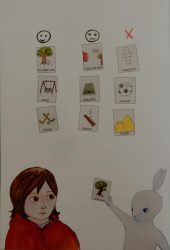
The story centres on young Robin, who acts as narrator, and a white rabbit. It’s playtime and Robin sits alone in the playground under a tree. Her head is buzzing with feelings but she has no way to express them. Her sadness is palpable.

Enter a white rabbit who sees the child, disappears and returns with a blue bag full of picture cards.
Using these, the animal offers the girl or boy (it matters not) a way to access her feelings: a means of self-discovery through visual communication via the pictures on the cards:

a way that ultimately allows the narrator to begin to feel part of the group.
Emma Lindström and Åse Brunnström offer a very useful and empowering tool that can be used in school or at home; there’s no judgement involved; and the final explanatory pages speak directly to the listener (via Robin) and the reader aloud (via the book’s creators, Emma and Åse).