Mouse House

Mouse House
John Burningham
Jonathan Cape

John Burningham returns to the theme of mice for the first time since his 1964 classic, Troubloff: the mouse who wanted to play the balalaika.
The mouse, or rather family of mice in this story has no musical inclinations; rather they desire only to live peaceably alongside the human family whose house they share.
The mice are fully aware of the humans, keeping well out of their way and only emerging at night once the humans have retired to bed.
The humans in contrast, are completely ignorant of their co-residents.
One evening though, on his way to bed, the boy spies a small furry creature …
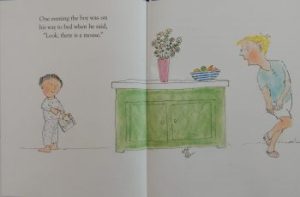
Before you can say, “Look, there is a mouse,” his father has called the rodent exterminator.
The children are firmly on the side of the mice insisting they’re harmless. They have just until morning to alert them; so they write a note warning them of the imminent danger.
Exit one mouse family …
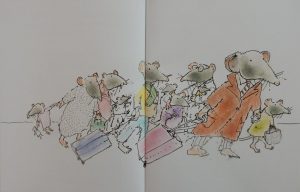
The following morning the mouse catcher comes: job done, so he says.
The children know otherwise and watch the mice at play from their bedroom window, even making things for them to play on.

But, with the coming of winter, their playthings and the mice are nowhere to be seen. Where can they have gone, without even leaving a note, the children want to know.
I wonder …
In this exploration of the secret world of mice and children, Burningham’s work is as fresh as ever, yet has that enduring, timeless appeal for both youngsters and adults. The former will revel in sharing the children’s secret and the artist’s delicate touch; the latter will delight in the detail, including the copy of Borka, (an early Burningham classic), being clutched by the boy on his way to bed. And who wouldn’t be charmed by the sight of the mouse child holding his cuddly toy …

I’ve signed the charter  



War or Peace? Ninja Baby/Green Lizards vs Red Rectangles

DSCN5872 (800x600)

Ninja Baby
David Zeltser and Diane Goode
Chronicle Books
An original take on a new sibling is offered in this hilarious book written in a wonderfully wry manner. Born a ninja for sure, Nina immediately shows her nature by karate chopping the doctor in return for her ‘make sure she’s breathing thump on the behind’.

DSCN5873 (800x600)

We then follow her path as she masters the sneak attack, hand-to-hand combat, obliteration, even advanced infiltration:

DSCN5874 (800x600)

total independence no less. Life is, one might say, pretty peachy for young Nina until that is, the arrival of a new prodigy: a veritable Kung Fu Master.

DSCN5875 (800x600)

In no time at all, this creature has wormed his way into his parents’ affections by doing nothing other than being utterly adorable. Guess who is far from happy.

DSCN5876 (800x600)

And seemingly young Nina has a few things to learn from the Master and vice-versa …

DSCN5877 (800x600)

Together they can become an indomitable force …

DSCN5878 (800x600)

I love the way the different, contrasting energies are portrayed in Diane Goode’s delectable watercolour and ink scenes: Fast moving, Ninja Nina’s success is her stealth. (That all out tantrum scene is sheer genius in its demonstration of the art of ninja.) Her placid, manipulative baby brother is altogether other. A total heart-stealer if ever there was one (or two!)

DSCN5885 (800x600)

Green Lizards vs Red Rectangles
Steve Antony
Hodder Children’s Books
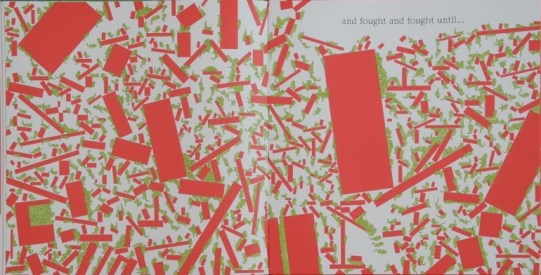
The Green Lizards and the Red Rectangles wage war on one another as first one side – the GLs – is in the ascendant, and then the other, as tricky tactics from the RRs truly test the strength of the GLs.

DSCN5886 (800x600)

Until one Green Lizard has the audacity to question the whole thing.

DSCN5887 (800x600)

He however is firmly squashed and the battle then quickly reaches epic proportions …

DSCN5888 (800x600)

culminating in total exhaustion on both sides.
ENOUGH IS ENOUGH!” declares a small Red Rectangle and indeed it is for the two sides then face one another for a truce.
And, finally they work together to construct a way of living in peace and harmony.

DSCN5889 (800x600)

Long may it continue …
Seemingly simple, this is a brilliantly clever, totally original fable of our time. It packs a powerful punch about peace (and the futility of war), delivering a message that one hopes young children will take on board and keep with them as they mature. Indeed the questions raised here in this allegorical story are equally relevant to older children and adults. I suggest teachers of children in KS2 and beyond share it with their classes too.

Use your local bookshop      localbookshops_NameImage-2