Live Like a Victorian

The Victorian age was a time when, as a result of the Industrial Revolution, inventions, new technology and ideas, great changes took place that transformed people’s lives and work. A timeline early in the book shows some of the main events and changes: try imagining life without bikes, electric street lights, cars, railways, movies and aeroplanes – all of which were invented during Victorian times.

We meet two Victorian children, eleven year old Will from a poor family, and nine year old Dora from a much wealthier family. These two help show how very unequal society and hence life was for those with money and those without. Readers get an insight into the difference between the rights and opportunities men and women had, the contrasting grand homes of the rich and those of the poor, life in the workhouse, the work poor children had to do, education,
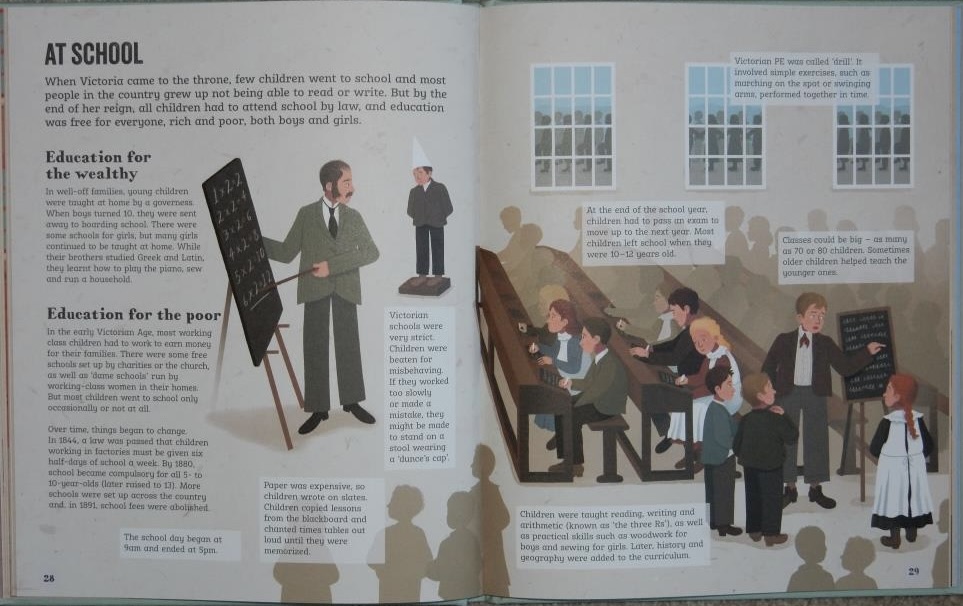
fashion, food, entertainment, law and order and more.

The book also has some hands-on activities – recipes and crafts – particularly useful if a class is studying this period of history and there’s a detailed map showing the British Empire and trade routes. It’s a shocking thought nowadays to see how in 1910 a quarter of the world’s population lived under British rule.

Claire Saunders’ engaging text and Wesley Robins’ fascinating illustrations combine to bring the Victorian era to life. The book ends by asking children, ‘Could you live like a Victorian?’and there’s a final glossary. One to add to KS2 class collections.
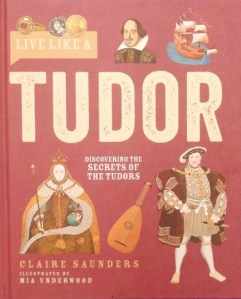
Live Like A Tudor

Primary age readers with an interest in history can step back in time, at the invitation of eleven year old Mary who lives with her family in an English manor house and has a sister who is a maid of honour to Queen Elizabeth 1st.

The latest in the ‘Live Like A … ‘ series covers a wealth of topics including the jobs people did, family life and childhood, education (the poorest children were not even taught at home but had to work instead), religion, trade and exploration when the seeds of the transatlantic slave trade were sewn.

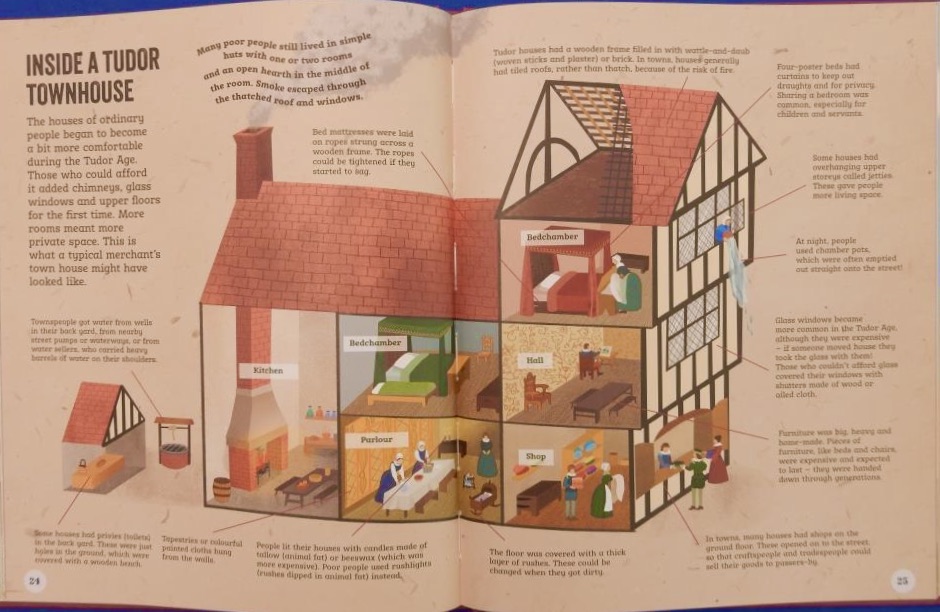
There are spreads on a typical Tudor village, a look at a townhouse both inside and out,

health and medicine, crime and punishment, games, sports and entertainment and fashion as worn by workers and nobles. In Elizabethan England, those who were able to a afford it wore a ruff and so doing was a sign that you were sewn sufficiently wealthy not to have to undertake any hard physical tasks and had servants to look after your ruffs, some of which were very elaborate. One of the craft activities in the book gives step by step instructions to make a ruff and matching cuffs.

Did you know that England’s first theatre was built in 1576 in London and was soon followed by others including the Globe Theatre where William Shakespeare’s play were performed?

Tudor Christmases were celebrated across twelve days and readers can join young Mary and her family and discover what they might have done.

The final spread asks “Could you have lived like a Tudor? and the author poses several questions to discuss. There’s also a glossary.

An engaging book that helps bring the era to life; it’s worth adding to to KS2 class collections, and to home bookshelves if you have a child interested in the past.

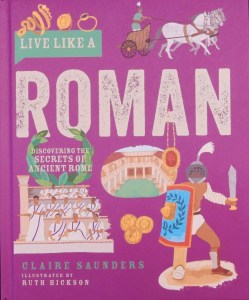
Live Like A Roman

Live Like A Roman
Claire Saunders, illustrated by Ruth Hickson
Button Books

Do you know a primary child who is studying Ancient Rome or the Romans, has an interest in ancient history or just wants to find out more about life in Roman times, then this a book for them especially.

In addition to a wealth of information on a wide range of topics starting with Who were the Romans?, there are a number of practical activities for children to try. For instance alongside the facts about maths including Roman numerals, there are instructions for making an abacus. Having read the spread about childhood and family life, children can try making their own set of knucklebones and then play a game with them. Or what about making a wax tablet similar to those used by Roman children instead of the expensive papyrus paper. What really astonished me was to read that only about half of all Roman children made it to their tenth birthday.

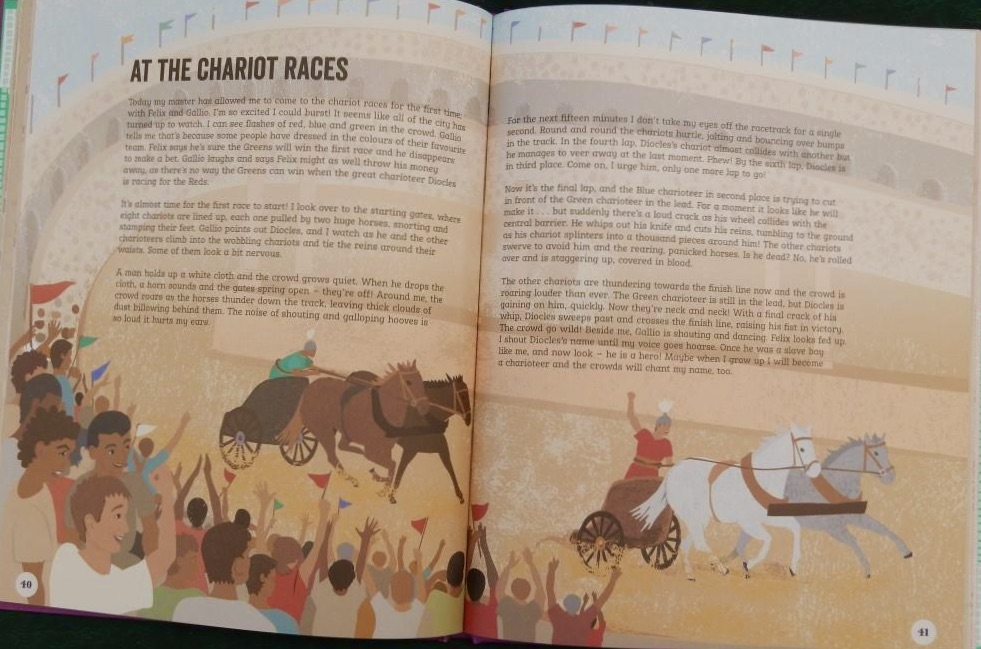
We meet a fictional child named Tito, a slave, who appears at various places in the book; we join him at the chariot races,

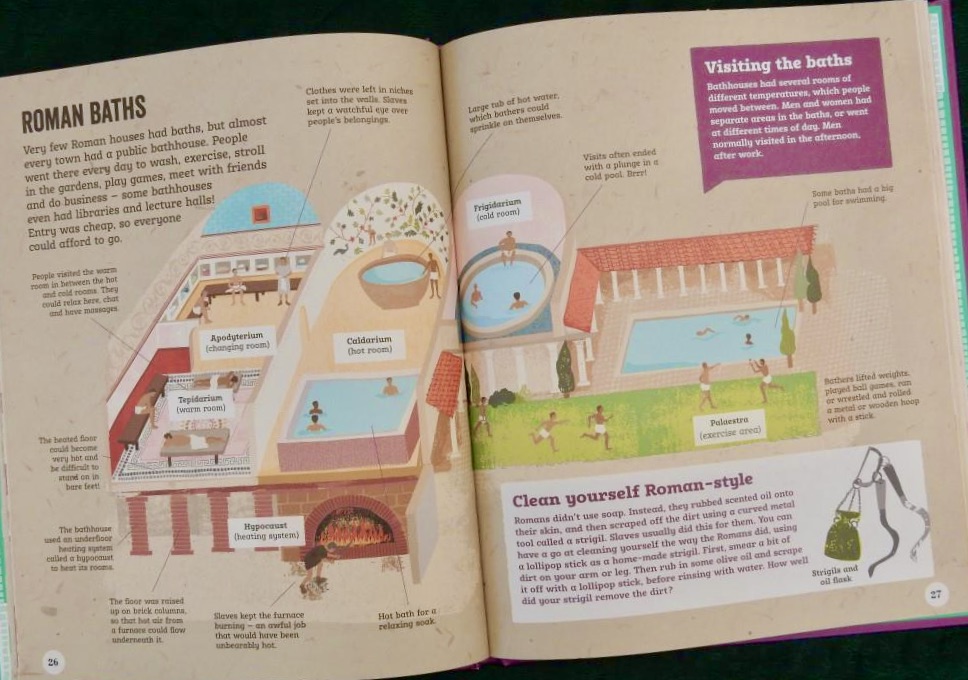
when he accompanies his master to the bathhouse and at the banquet his master hosts especially for an important guest.

The Romans are famous for their public baths, some of which are still in use today, but I’m not sure I’d want to try the Roman means of cleaning my skin by making a tool – a strigil – similar to those they used. The author suggests using oil and a lollipop stick.

Three double spreads are given to in turn food and drink, banquets and roman recipes; the honey cake sounds pretty tasty especially as instead of sugar, the Romans used runny honey; indeed honey was used in lots of recipes.

The final spread before the glossary poses the question: Could You Have Lived Like A Roman? This reviewer would not have survived long in a school: there were no opportunities for creativity and rote learning was the norm. However, the author appreciates the importance of creativity for today’s young readers and asks them to invent three new Roman gods or goddesses for things that are important to them and to give them names.

Ruth Hickson brings all this and much more to life in her detailed illustrations, large and small, helping to make this an altogether fascinating book for individual or primary classroom use.