Autumn Feast

This autumnal offering completes the seasonal series by the same team that created Winter Sleep, Busy Spring and Wild Summer. Both Sean and Alex are great communicators when it comes to writing for children and again this one is perfectly pitched for its intended audience.

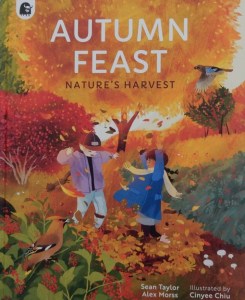
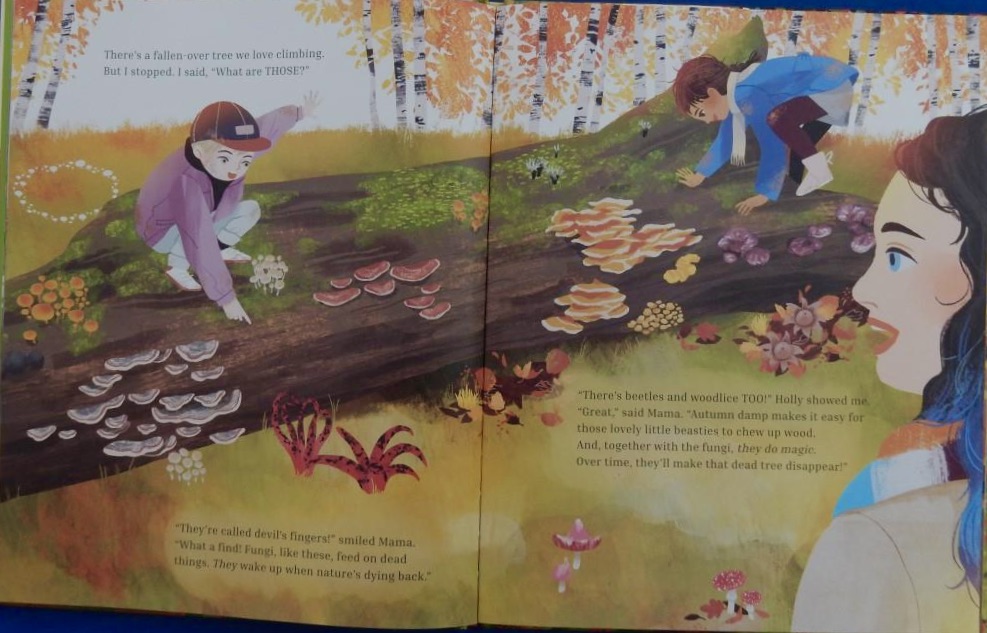
The narrative is set on a bright, chilly autumn morning and Mama suggests the children accompany her on a walk in the nearby park. Somewhat reluctantly in the first instance they wrap up and off they go into the windy street where leaves are blowing every which way. Cheered by the opportunity to romp in the fallen ones Holly and her narrator sibling are ready to embrace the wealth of sights and sounds that surround them. All the while Mama – a nature brainbox – as the young narrator calls her, gently gives the youngsters information about the various plants and animals they come upon: it was a wood mouse that had nibbled at the hazelnuts and has left tooth marks she’s able to identify and some unusual devil’s fingers fungi they see beside a fallen tree.
Having observed minibeasts down low and birds high above, they stop for a while to collect fallen apples before returning home. There excitedly they show Mum the apples
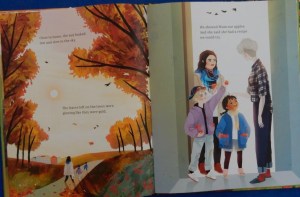
and the four of them chat, bake and consume delicious apple flapjacks together.

All this and more is shown in Cinyee Chiu’s vibrantly coloured detailed scenes.

Following the narrative, the text changes to a more conventional non-fiction style, posing and answering ‘What is Autumn?’ on one spread, after which are a spread on plants, another on animals, one entitled ‘Rotters’ and there’s a final page giving some ways children can help wildlife during the autumn months.
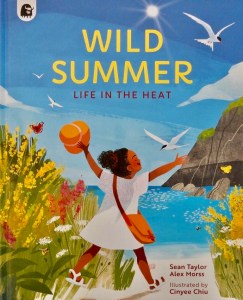
Wild Summer: Life in the Heat

Wild Summer: Life in the Heat
Sean Taylor & Alex Morss, illustrated by Cinyee Chiu
Happy Yak

Like many of us, the little girl character in this narrative non-fiction book, is eagerly anticipating the summer. It’s coming, her nature-loving Grandpa tells her, mentioning some of the signs of seasonal change. He also says that close to his new abode is something exciting he wants to show his granddaughter, who acts as narrator.

Grandpa is right: summer with its blue skies and warmer days, does come. The girl reminds him of the thing he mentioned and together they pack a bag and set out along the track.

As they walk the girl notices the abundance of plants and minibeasts, wondering aloud if they want summer to last forever. Grandpa doesn’t supply an immediate answer but responds by suggesting they continue looking and then decide, although he does mention water as being a factor to consider.
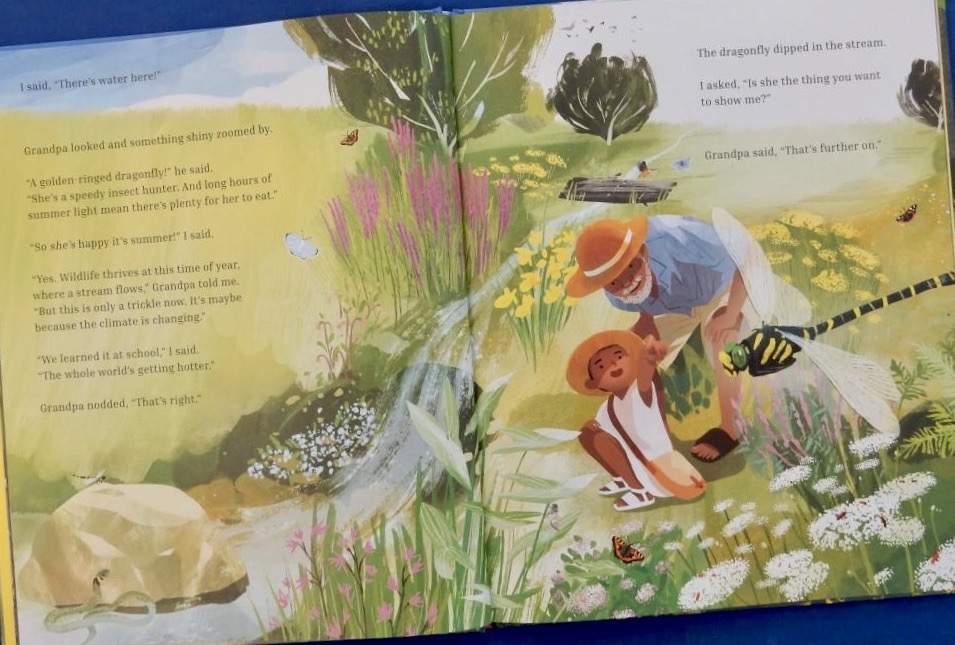
Stopping by a stream Grandpa points out a golden-ringed dragonfly and tells his granddaughter a little about the insect. He also points out the mere trickle of water suggesting this could be a result of climate change, a topic the girl has learned about in school.

Further on in the increasing heat, the child expresses a wish to find some shade, and Grandpa likens her to many of the wild flora and fauna, explaining how some respond. They reach a place with trees blackened due to a fire the previous summer, talking of the pros and cons of such events.

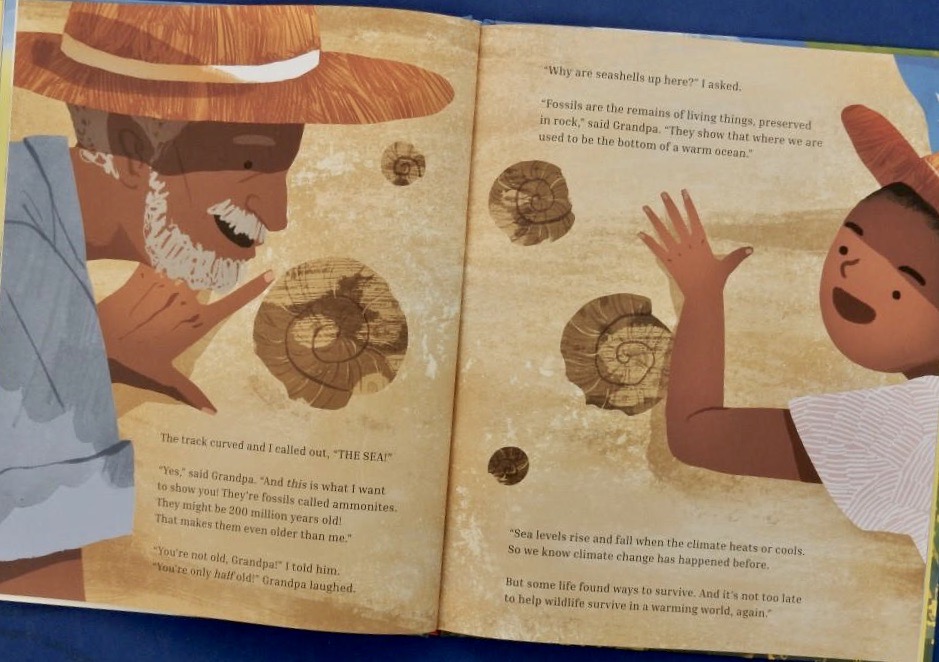
Eventually they reach a spot at the edge of the seashore where they find what they’d come for.

Then they continue walking, on the beach now; Grandpa draws attention to some summer-loving Arctic terns, before with the ‘summer forever’ question duly answered, they cool off in the sea.

A companionable walk, and for the little girl, a wonderful learning journey with her Grandpa who educates her in the best possible way, never forcing, merely gently guiding.

Straightforward back-matter comprises an explanatory spread explaining “What is summer?, another giving facts relating to ways some land animals have adapted to better cope with heat. There’s one looking at the evolutionary changes of plants to cope with hot, dry summers and the final one looks at ocean life and how climate change is taking effect while the last page suggests some ways to get involved in wildlife protection.

With its wealth of ecological information and bright, detailed illustrations bursting with wonderful plants and animals to explore and enjoy. this is a terrific book to share either before or after a walk in nature, whether or not it ends on the beach. There’s lots to inspire awe and wonder here.

Busy Spring: Nature Wakes Up

Busy Spring: Nature Wakes Up
Sean Taylor , Alex Morss and Cinyee Chiu
Words & Pictures

If you live in the northern hemisphere, like me you have probably been noticing beautiful wild flowers – snowdrops, daisies, celandines and primroses springing up, an abundance of catkins, blossom starting to open on trees, pussy willow buds bursting; as well as the occasional bee and butterfly. We even saw frogspawn a couple of times last week (the end of February). Definitely spring, with its promise of so much, is my favourite season and this year it seems even more important than ever to celebrate its arrival.

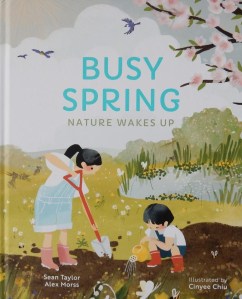
That is exactly what the two children in this beautiful book (written by children’s author Sean Taylor and ecologist Alex Morss) are doing. The older girl acting as narrator, tells us how what starts out as a hunt for Dad’s fork so he can plant some carrots turns into an exploration of the family’s garden. ’Everything smelled like wet earth and sunshine.”

“The spring sunlight is nature’s alarm clock,” Dad says, taking the opportunity to mention pollination.
Both girls are observant, asking lots of questions and noticing signs of new life all around – tadpoles,

a bird building its nest and a wealth of minibeasts – ants, woodlice, worms and beetles and several species of butterfly, as well as playfully emulating some of the creatures they discover.
Throughout, Dad subtly provides snippets of relevant information concerning life cycles, habitats

and what causes the seasons; and throughout the children’s sense of excitement is palpable.

Cinyee Chiu’s illustrations are absolutely gorgeous, beautifully composed and carefully observed.

At the back of the book are several pages of more detailed information about spring and how it affects the flora and fauna, as well as some suggestions for ways children can get involved in helping nature in its struggle against climate change.

A must have book for families with young children, as well as foundation stage settings and KS1 classrooms.