Welcome to Our World

Welcome to Our World
Moira Butterfield and Harriet Lynas
Nosy Crow

To open this book is to get lost in a world of children, children from 97 different countries and when you finally emerge having spent a considerable time immersed in its riches, you’ll be a whole lot wiser and probably happier too. I certainly was!

Covering such topics – I love the choice of headings – as greetings, homes, food, drinks, transport, animals, family names, school uniforms & classrooms, clothes, play – games …

and toys, musical instruments, as well as specific words for ‘happy’, ‘hooray’ …

and sneezing, customs (relating on one page, to losing a tooth), this book truly celebrates children, human diversity, language and world cultures

I was amused to learn that both in Brazil and Hungary children celebrating birthdays get their earlobes pulled. Ow! In Brazil it’s one pull for every year of the person’s life. Ow, ow, ow! … and in Hungary it’s customary to say ‘May your earlobes grow to your ankles’, in other words, ‘May you have a long life.’

Equally I was fascinated to find out about the different sounds animals make according to where they’re found: apparently in Germany, rather than buzzing, bees go ‘sum sum’, whereas in South Korea, it’s ‘wing wing’, ‘bun bun’ in Japan and ‘zoum zoum’ in Greece.

You too might laugh out loud at some of the sayings from various parts of the world: ‘Stop ironing my head’ means ‘Stop annoying me’ in Armenian and ‘There is no cow on the ice’ said in Swedish means ‘There’s no need to worry.’

The absorbing text by Moira Butterfield, in combination with Harriet Lynas’s captivating illustrations, make for a read that is both joyous and informative.

Under the Same Sky / This Is How We Do It!

Under the Same Sky
Britta Teckentrup
Caterpillar Books
I’m a big fan of Britta Teckentrup’s work especially her books with cut out pages so I eagerly anticipated this one. With its theme of connectedness, it’s absolutely beautiful.
We live under / the same sky … / … in lands / near and far.’ So begins the lyrical text, which accompanies superb, soft-focus animal images set against natural backgrounds.
Hugely impactful with its spare narrative and its strategically placed die-cuts on alternate recto pages, through which we see  elements of scenes of universally shared games, feelings,

hopes and dreams, this is uplifting and full of hope. Timely, and exactly what is needed when our world seems to be growing increasingly intolerant, fractured, and with too many people focusing on differences rather than what binds us all together – our common humanity.

Fuelled by this powerful and lovely book, let’s seize every opportunity, transcend those differences and come together for the ultimate good of everyone.
Share, ponder upon, delight in and discuss: it’s a must for every family, early years setting and KS1 classroom collection.

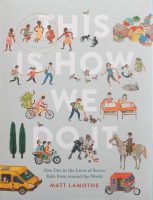
This is How We Do It
Matt Lamothe
Chronicle Books
Children are the focus of this fascinating book, children whose ages range between seven and eleven; children from seven different families, backgrounds and diverse situations tell their own stories. Let’s meet, Romeo (Meo) from Italy; Kei from Japan; Daphine from Uganda; Oleg from Russia; Ananya (Anu) from India, Kian from Iran and the eldest, Peruvian, Pirineo.
These narrators share information about their particular homes, their families, their clothes – in particular what they wear to school; breakfasts, lunches and evening meals (each meal has a separate spread); mode of travel to school.

We meet their various teachers and see how they learn (almost all classrooms looks very formal). Each child shows how his/her name is written …

We also see the children at play, helping at home and finally, sleeping.
Yes, there are differences, each country, each family is unique; but the most important message is that no matter where we are from, we all have similarities: we eat meals, we play and we go to school (at least those children we meet do) and all under the same sky.
At the end of the book we meet all seven families in photographs; and there is a final glossary, an author’s note on how he came to create the book and the endpapers have a world map showing where the children (and author) live.
This predominantly pictorial presentation celebrates our commonalities and our uniqueness. With world travel a commonplace nowadays, the book offers a great way to expand children’s horizons giving them insights into particular ways of life in addition to those in countries they might themselves visit.

I’ve signed the charter