Little Chimpanzee / Little Whale / Little Monkey / Tiny Tadpole

Little Chimpanzee
Anna Brett, illustrated by Rebeca Pintos
Little Whale
Anna Brett, illustrated by Carmen Saldaña
Words & Pictures

These are the latest additions to the Really Wild Families series of fun, informative interactive books for children and adults to share.
Having introduced itself, Little Chimpanzee invites readers to spend a day exploring its African rainforest home and meeting the sociable family community comprising father, mother, older brother, aunts, uncles and cousins. The creature narrator explains how chimpanzees care for and groom each other and talks about the social structures and relationships in the group , including how they communicate with one another.There’s a spread about chimp conservation and another about the vital work of Jane Goodall and the chimps in Gombe Stream National Park.
The narrative is followed by a quiz and a craft activity. A charming, effective way for young children to find out about our nearest relative, while gently reminding them of the importance of caring for creatures in the wild; vibrantly illustrated with gentle humour.

The Little Whale of the title introduces itself and the rest of its pod of humpback whales and readers join their annual journey from warm waters to search for the cold waters of the Antarctic Ocean where there’s plenty of food. On the way we learn about how the creatures move, their external features, breathing, breeding, diet and feeding,

possible predators and whale song.
Following the story are the usual factual spread, a look at conservation, a craft activity, a quiz and we meet Migaloo, a albino humpback that lives off the Queensland coast of Australia. Carmen Saldana’s underwater illustrations are beautiful and really add to the book’s appeal.

Narrative works really well as a means of transmitting information to young children and these are additions to the Amazing Animal Tales series that also successfully use this approach along with straightforward facts found beneath the flaps.
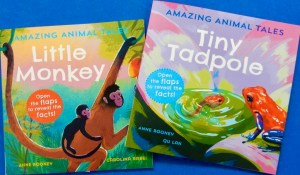
Little Monkey
illustrated by Caroline Rabei
Tiny Tadpole
illustrated by Qu Lan
both written by Anne Rooney
Oxford Children’s Books

Little Monkey is a spider monkey and we first encounter him high in the rainforest treetops clinging round his mother’s tummy as she moves from branch to branch. Lifting the full-page flap reveals two pages of information and a simple question to further engage listeners.
As the story continues there is information about feeding, what this entails.and how it changes as he becomes more independent, an independence that makes him want to go off exploring by himself.

Anne Rooney’s way of presenting the information is appealing and perfectly pitched for an Early Years audience, the special skill being the combination of the two styles, with Caroline Rabei’s delightful illustrations containing just the right amount of detail.

The Tiny Tadpole also lives in the rainforest but further south than the monkey family. Herein we follow the transformation from tadpoles hatching out of the protective jelly eggs and the growth and changes that ensue in their habits and in the care provided by the mother frog,

until the tiny black dot has become a froglet. This one is illustrated using a rich colour palette by Qu Lan and every picture is bursting with life.

Cleo the Completely Fine Camel

Cleo the Completely Fine Camel
Wendy Meddour and Carmen Saldaña
Oxford Children’s Books

Nothing can stop Cleo the camel feeling on top of the world and absolutely fine or can it? She’s such a ‘glass half full’ kind of creature that even when the sand under her feet is burning hot, the sweat is pouring off her face and she’s so thirsty that she licks the surface of a rock, she insists to fellow desert dwellers Lizard, Jerboa, and the circling vultures, that she feels happy.

Suddenly a fearsome sandstorm blows up, almost completely burying Cleo. Her friends dig her out and still she maintains that she is fine, despite her hump having shrunk significantly. Along comes Ostrich who has just emerged from the sand. “I’m fed up. Fed up of sandstorms, Fed up of the heat. And fed up of getting sand in my eyes.” Cleo still tries the ‘we’re desert animals’ line but Ostrich continues with “Yes, I feel rubbish. Totally awful. Absolute pants. How about you?” Will Cleo finally take that leap of confidence and admit how she really feels?

Thankfully for all, yes she can and having faced up to reality, she follows Ostrich’s lead in search of an oasis where welcome refreshment awaits.

Wendy Meddour’s story gently and humorously imparts an important life lesson to young children: it’s all very well putting on a brave face but not to the detriment of your own well-being. Carmen Saldaña makes the searing desert heat radiate from the pages in her illustrations, which show the impact on the animals – humped or not – as they struggle to cope with the harsh reality of desert life.

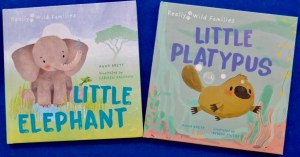
Little Elephant / Little Platypus

Little Elephant
Anna Brett and Carmen Saldaña
Little Platypus
Anna Brett and Rebeca Pintos
QED

In the first of these additions to the Really Wild Families series, Anna Brett takes readers to the African Savannah, home to Little Elephant (our narrator) and family to spend a day with the elephant herd comprising fifteen elephants, almost all of which are female, the oldest and most knowledgeable being Grandma. The youngest member of the herd is a two day old cousin of the narrator.

We see how the elephants search for and eat their food, meet some of the other animal inhabitants of the savannah and then head for the watering hole to drink and have some fun too, all under the watchful eye of Grandma.

It’s she that sounds the trumpet alarm call warning of a lion in the vicinity: time for the adult elephants to form a protective circle around the calves until the danger is over. There’s information about the role of tusks, ways of communicating and more, until at sundown, members of the herd stop to rest for the night.

Following the simple narrative are some additional elephant facts, information about elephant conservation, a case study and some activities. Carmen Saldaña illustrates this one, supporting the information well.

Belonging to a much smaller family (a mother and her two young ones) and living tucked away in a burrow on a riverbank in eastern Australia is Little Platypus, a nocturnal animal. It’s Little Platypus’s voice that tells readers about platypuses’ physical features, habits and habitat, reproduction and how they are born,

what they eat and how they survive. Males such as Little Platypus have a spur on each back leg that is able to release venom in dangerous situations.
Again Anna Brett’s manner of presenting the information is well pitched for young children and Rebeca Pintos’s illustrations are beautifully executed, playful and alluring. The backmatter is similar to the previous book though platypus related.
Like the elephant title, the few photos are especially useful as both illustrators have made their animals look rather more endearing than realistic.

Peggy the Always Sorry Pigeon

Peggy the Always Sorry Pigeon
Wendy Meddour and Carmen Saldaña
Oxford Children’s Books

Try as she might Peggy Pigeon manages to please nobody; all she succeeds in doing is getting in the way and apologising for so doing. The scruffy pigeons, the road sweeper, and a yappy dog all shoo her out of their way, watched unbeknown to Peggy, by a seagull that introduces herself as Joan.

Joan too receives an immediate apology from Peggy but she in response tells the pigeon to stop saying sorry when she’s done nothing to apologise for. She also calls Peggy’s explanations ‘Nonsense’ and goes on to explain why. She insists Peggy must stand up for herself and goes on to support the pigeon in her efforts so to do. Little by little Peggy’s confidence grows as she gives as good as she gets to the very same characters that treated her unkindly.

I love her ‘SOGGY HAT SANDWICH’ and other retorts that definitely give her bossy persecutors a big surprise.

By the end of the day when Peggy and Joan relax together on the water as the sun sets, Peggy thanks her new friend and also gives her supportive seagull pal something of a surprise; seemingly Joan has done her job even better than she thought.

With its lovely, somewhat unexpected finale, Wendy Meddour’s tale of learning to stand up for yourself, supportiveness and friendship is an empowering story to share with young listeners who will love the opportunity to emulate Peggy’s retorts as she stands up for herself and enjoy Carmen Saldaña’s splendidly expressive illustrations of the action: the looks on the faces of the various characters – avian and otherwise – are wonderful.

Bees, Trees and Planet Earth

Bees
Trees

illustrated by Carmen Saldaña
Please Help Planet Earth!
illustrated by Paulina Morgan
Ladybird Books

It’s never too soon to introduce young children to the environment protection cause and these sturdy books offer a good starting point.

Devoting each of its six spreads to a different aspect of Bees, young children are introduced to the vital role these little insects play in keeping the planet healthy; explains the role of bees in pollination; takes readers inside a honeybee hive; looks at honey and beekeepers; explains why the number of bees is in decline and finally suggests some ways in which everyone can help save these important little creatures.

Trees is similar in structure. First is an explanation if their importance to all life on earth. Second is a simple look at the various parts of a tree and their interconnectedness. There’s a spread on seasonal changes; another presenting some of the thousands of different kinds of tree and deforestation and its consequences is briefly discussed while the final spread is again ‘How can you help?’. Carmen Saldana’s illustrations are child-friendly and in both books there are flaps to explore on every page.

In Paulina Morgan’s diverse, alluring scenes Planet Earth itself takes the narrative role in the third book, issuing an earnest plea for help to protect its various ecosystems and their flora and fauna by making small but crucial changes to the way we live.

In keeping with their ‘protecting our planet!’ theme, all three books are made from recycled board and printed with plant-based inks.

Howard the Average Gecko

Howard the Average Gecko
Wendy Meddour and Carmen Saldaña
Oxford Children’s Books

Howard apparently has a very high opinion of himself and a seeming disregard for his fellow rainforest dwellers. So intent on bragging about his camouflage skills is he,

that he fails to notice that same ability in a number of the other creatures, that is until he encounters a stick insect. Stick insect’s “The rainforest is full of camouflaged creatures”

is let’s say, an ego deflater, even more so is its “You’re average”. and Howard has a crisis of confidence about his lovableness.

Suddenly out of the foliage comes a stunning creature

and despite what the stick insect thinks of her, Howard declares the wobbly-eyed reptile “magnificent”. This other gecko introduces herself as Dolores. The instantly smitten Howard invites her to watch the sunset with him and together these two ‘average geckos’ climb up a tree onto …

With its surprise finale, this is a fun story that introduces animal camouflage (look out for the creatures Carmen Saldaña has hidden away in her leafy scenes) while being a smashing book to show all young children that they’re just right as they are. Endless comparisons with others do nothing to foster self-esteem: it’s having people who love you that counts – to them you are in your own unique way, very special.