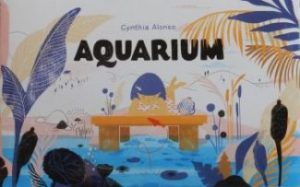
Aquarium

Aquarium
Cynthia Alonso
Chronicle Books

Leaving her home a little girl follows the path towards a river jetty.

There she stops and gazes into the water completely at one with her surroundings. As she imagines herself swimming among fish of all shapes and sizes,
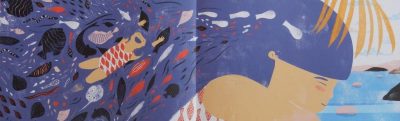
one fish leaps from the water and lands on the jetty.

The girl catches it in a jar and rushes home with it.

Using an assortment of containers and hose piping, she creates a complicated, multi-container aquatic environment and then, inflating a small pool …
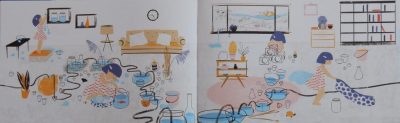
and donning her bathing suit, she enjoys splashing around with the fish.

Suddenly, leaping from the pool, the fish makes a break for freedom and that’s when the girl realises that the creature isn’t happy in its new surroundings.

There is only one thing to do …
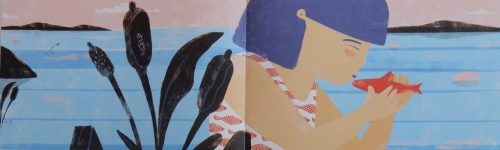
This thought-provoking wordless tale is beautifully told in Cynthia Alonso’s debut picture book. Using a gorgeous and unusual colour palette of blues, pinks, browns and oranges rendered in pencil, pens and by digital means she immerses the reader in her heroine’s world of water, fish and wonderment leaving plenty of room for her audience to story for themselves.

All the Wild Wonders

All the Wild Wonders
edited by Wendy Cooling, illustrated by Piet Grobler
Frances Lincoln Children’s Books
In her introduction to this diverse compilation, now in paperback, Wendy Cooling expresses the hope that ‘just one of the poems lingers in your mind long after the book has been put down’: I suspect more than just one of the thirty-five therein will do so.
Loosely grouped into subjects concerned with the natural world, there are different viewpoints that relate to the beauty of our world, and threats to the environment; and Elizabeth Honey’s opening poem which gives the book its name pretty much sums it up in these final lines:
All the wild wonders, / For you my sweet babe. // For this wish to come true /We have much work to do / All the wild wonders / For you my sweet babe.

Riad Nourallah’s An Alphabet for the Planet (beautifully bordered with letters from a variety of scripts) puts the case for much we hold dear; and is one that might well inspire children to try writing their own either individually, in small groups or perhaps, as a class.
The same is true of Brian Moses’ Dreamer, which has become a lovely picture book in its own right, albeit in a slightly different incarnation.
It’s possible to hit home using very few words as Andrew Fusek Peters does with his Man,the Mad Magician:
Said the money-man “We must have oil! / And that’s my final word!’ / How magical and tragical his final act / As the seagull became a blackbird.
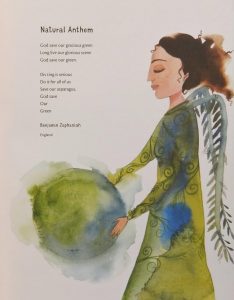
The whole book is beautifully illustrated with Piet Grobler’s delicate watercolours: here’s one of my favourites …

Encompassing gentle and not so gentle lessons on taking care of our precious environment, this thought-provoking book is for families, for schools and for anyone who cares about the natural world; and that should be everyone.

I’ve signed the charter