The Most Amazing Thing / Footprint

Henry is stuck indoors on account of the rain, the other members of his family are at home too: mum is busy working on her novel, his sister Greta is doing an experiment, his father is cleaning his telescope lens and brother Simon is meditating. But Henry with nothing to do, is bored, so he consults his mum who suggests he might draw the most amazing thing. What could that be though? Henry has no idea so he decides to ask his family. Each has a different answer: telling her brother to look down her microscope, Greta says life is the most amazing thing; to Henry, the mind is the most amazing thing, whereas Dad’s response is the universe.

Mum, finally free for a short while, surprises her son with her answer.
Both words and pictures take us through the various parts of the house where Henry goes for inspiration; it’s evident that he learns a considerable amount in his quest for an answer, some of it about himself. Matt Shanks’ watercolour, pencil and gouache illustrations of the images that might be forming in Henry’s brain as he talks to each of his family are full of fascinating details.

A thought-provoking story showing that with an abundance of wonderful things in the universe and a great many different ways to find that wonder, it’s unlikely that two people will have exactly the same view: we all see the world through different lenses. Try asking the children in your class or members of your own family: who or what will they decide is THE most amazing?.

There’s a line in a Native American poem wherein the author prays to the Great Spirit of Life to give him the wisdom ‘to walk softly on the earth’ acknowledging that it is the responsibility of each of us to care for our planet and its natural environment.
In this book, author Phil Cummings and illustrator Sally Soweol Han remind us of the wonders all around us and that we should walk carefully leaving only good behind us. The author’s lyrical rhyming text invites readers to join the children in various parts of the world as they wander out into the morning, looking and listening, but also taking time to pause, ponder upon what they see and hear and to breathe in the beauty,

be that of the deserts, mountains, valleys or wherever they find themselves. Each of the environments – a tropical forest with a river flowing through, the (melting) polar ice, the sandy desert, the smoky city and more – is depicted in Sally Soweol Han’s soft pastel and coloured pencil scenes, each of which shows how we can all, like the children depicted, look after our precious planet. Only that way can the young have the rich futures they hope for and deserve.

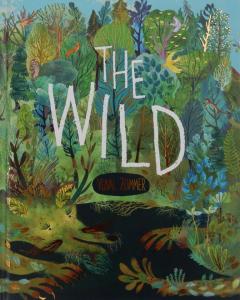
The Wild

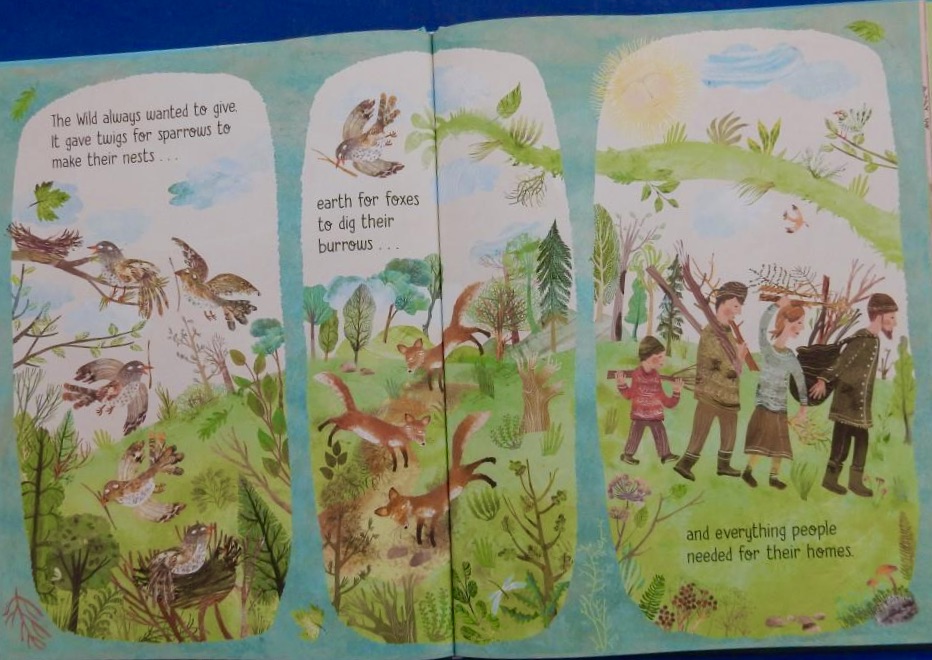
There is a line in a Native American poem where the author asks the Great Spirit of Life to give him the wisdom “to walk softly on the earth”.  This ancient metaphor recognises our human responsibility to take care of the natural environment on which we live and depend for our existence. So it was in the Wild at the start of Yuval’s new fable of our times. The Wild here was a vast place, a place where season followed season and the animals responded to the changes, either by moving or by being still and sleeping. Every living being, be they human, or creatures furred or feathered had all they needed: they lived lightly in the Wild, caring for it and receiving its care in return.

But those humans envisaged that the Wild would always be able to provide what they needed so with the passing years, they became increasingly careless, taking too much as they mined, ploughed, burned and built. They paid no heed to the devastation their actions caused until one day a child looks out of the window and notices a change. “Why does the Wild seem so weak?” he asks but his question goes unheeded. The child continues to worry and question but to no avail until eventually the Wild is unable to give.
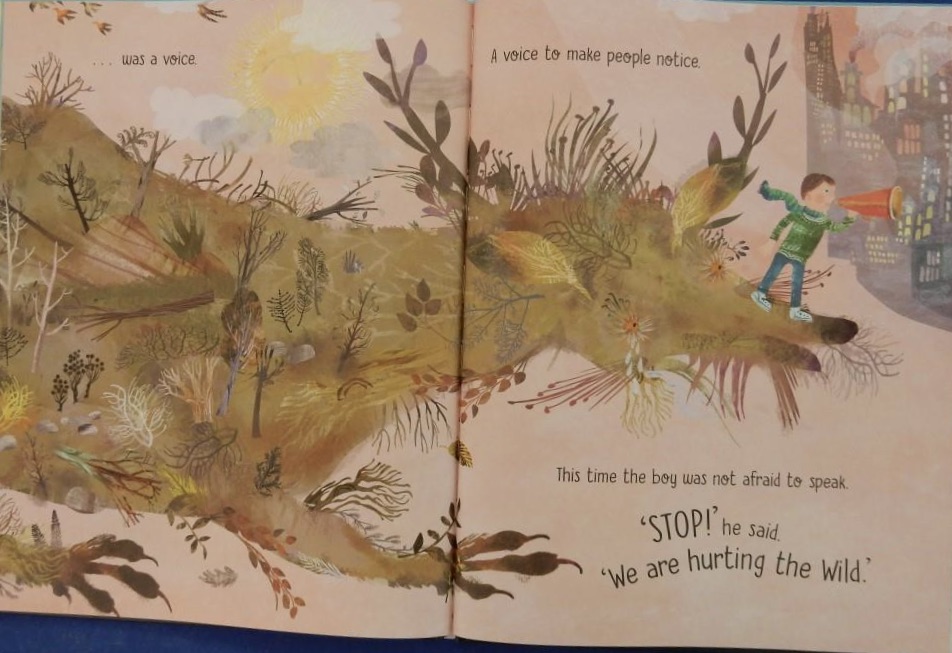
Now it’s time for the boy to speak louder and without fear. And so he does: “STOP!’ he cries, “We are hurting the wild.”

Finally others hear his urgent call and they too take up the cry. Not only do they call, but they also change their behaviour. Little by little, with renewed hope , the Wild begins to recover because no human took without also giving something back.

Yuval’s message is also delivered with stark urgency and his collage like illustrations are full of superb textures and details in the realistic, rich colours of the natural world.
A must to read, share, discuss and act upon.

The Planet in a Pickle Jar

The Planet in a Pickle Jar
Martin Stanev
Flying Eye Books

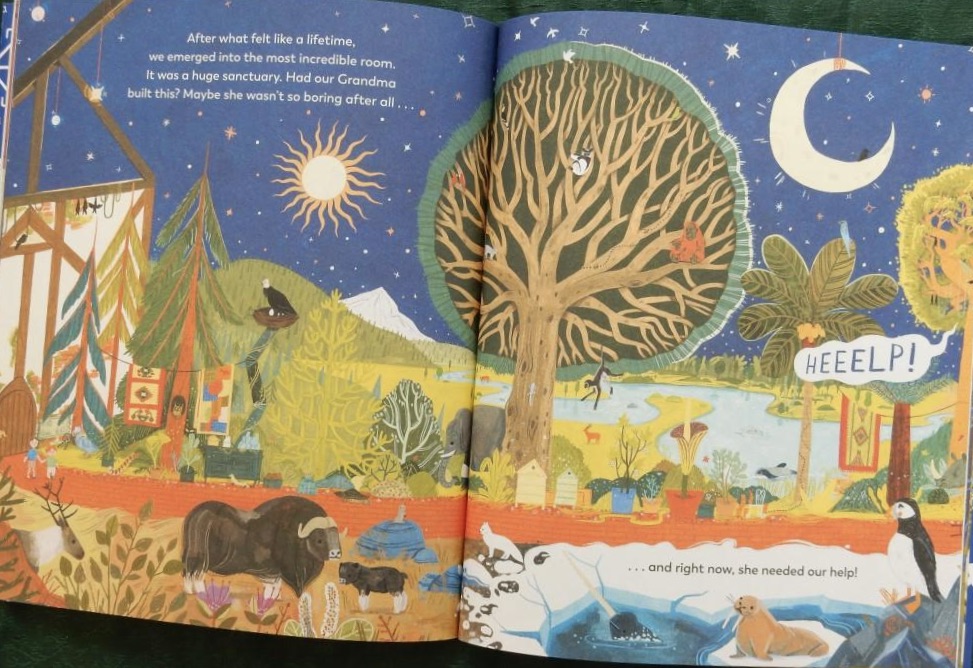
The brother and sister in this story aren’t keen on visiting their Grandma’s house. They consider it boring and would much prefer to spend all their time using their screens. Immediately we see some of what they are missing by so doing. They don’t enjoy her meals, or listen to the stories she tells: but a boring Grandma she is most assuredly not. Just take a look at her shopping, knitting and pickle making.

Then one evening she starts telling them something she considers important and on this occasion the children do listen and even spend time that night thinking about what has been said. As they do so a star falls from the sky and vanishes; so too has Grandma when they go to tell her about it. 

Their search yields only a wild cat that gives chase, and the children flee to the basement via a door they’d not noticed before. There they discover shelf upon shelf of pickle jars in which are preserved everything Grandma considers precious – ‘history, languages, nature, memories, smells, feelings’ and more. In addition, she has created an amazing underground sanctuary for endangered wildlife.

When eventually the children find Grandma, she explains that in order to prevent the complete destruction of the natural world, she now needs help to continue her life’s work. And so it is that , along with Grandma, the two children become custodians of the planet. 

Let’s hope that other children too are inspired by the story. It’s magnificently illustrated by the author and tells much of the tale without the need for lots of words; indeed what is shown is often at odds with what is said.

A book to share and discuss at home and in the classroom, and most importantly, for children and adults to act upon.

Human Town

Human Town
Alan Durant and Anna Doherty
Tiny Owl

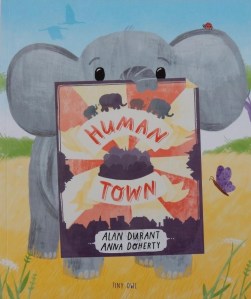
Holding a mirror up to us is this story wherein elephants Junior, Lulu and their parents visit Human Town. Whereas their parents suggest it’s likely to be a boring place, the offspring consider it cool.

On arrival they first peruse the list of rules and then start wandering around, Dad warning of the potential dangers and unpredictably of humans. They pause to watch people entering shops empty- handed and coming out with bags stuffed full of ‘things’. Things, says Dad, make humans happy. The young elephants are shocked to learn that some humans eat sheep, chickens and cows. “You can’t judge them like us, … they’re wild animals,” is Dad’s comment.

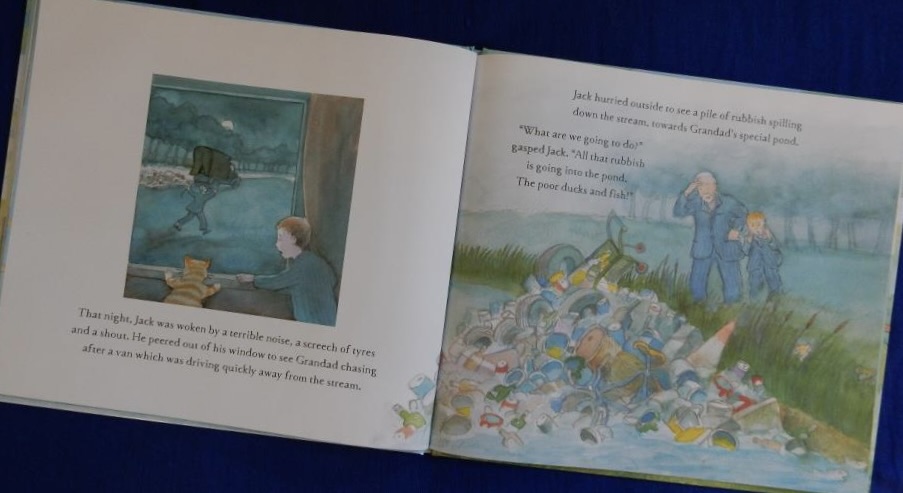
The football game is a disappointment; but even worse is the stream full of rubbish and the foul-smelling air, both the results of human carelessness and hence points out Mum, one of the reasons they are dying out;

so too is the “farting car” Junior spies. The church, cinema and school are completely empty: not a human in any of them; and those outside their homes are shown fighting one another

while inside others watch a boring thing called ‘Teevee”.

Then totally unimpressed, the elephants stop for a family picnic before returning home. First though Junior asks one final question about the likelihood of humans becoming extinct. Mum’s answer along with her young one’s response on the last page are thought-provokingly alarming.

Cleverly presenting consumerism, conflict, pollution and the vital importance of the environment and protecting animals, this book is an excellent starting point for discussions with children on those themes. Yes it’s wryly humorous, but the truths of what we see and read are evident the world over: we can no longer turn our backs on what is happening on this planet that we – humans and wildlife – share.

The Twelve Green Days of Christmas

The Twelve Green Days of Christmas
Barry Timms and Siân Roberts
Farshore

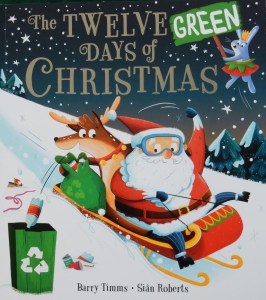
The sentiments are great but I did find when reading this timely rhyming story aloud that it didn’t always quite scan; though if you sing the words using the popular seasonal tune, it works fine, beginning on the first day of Christmas with Santa coming upon ‘A star that had broken in three.’

On the next four days, as we see in Siân Roberts’ humorous, wintry illustrations, he comes upon worn-out wings (five), four party hats,/ three crushed cups, / two tattered gloves ‘ and that shattered star. What a careless lot those forest creatures are.

On the sixth day an unhappy Santa decides something has to be done. He puts up a sign urging the forest dwellers to start recycling.


Day seven brings a snowstorm which results in his sign getting blown away and Santa catching such a bad chill that he has to take to his bed, the result being the rubbish continues to spread and accumulate in piles.

Will Santa ever get his wish for a green Christmas before the big day arrives?

Happily yes, for Owl catches the flying sign, spreads the word spurring the animals to take action and on the eleventh day Santa receives something in the mail that lifts his spirits.

Next day he ventures forth and finds …

as well as five new recycling bins and lots of the animals busily restoring the broken star and putting it where it should be – right at the top of the tree. A Merry Green Christmas at last!

Eco Craft Book / The Extraordinary Book That Eats Itself

Eco Craft Book
Laura Minter and Tia Williams
GMC Publications

In their latest book, Laura and Tia offer some cool ideas for using bits and pieces that might otherwise end up being thrown away.

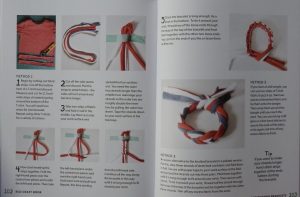
Instead of consigning that old T-shirt or other no longer worn garments to the rubbish or recycling bin, why not suggest your children try a project like the T-shirt friendship bracelets here.

Alternatively, if the T-shirt is white, it can be dyed using a natural plant dye and refashioned into a ‘no-sew tie-dye bag’. Those are just two of the fabric projects.

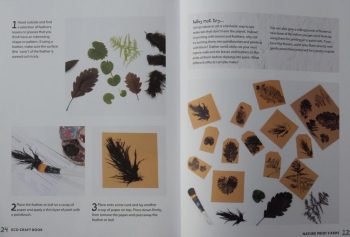
Getting even closer to nature, youngsters can make a collection of interesting shaped leaves, grasses or perhaps feathers and use them to make some printed cards (or perhaps wrapping paper)

and if you want to attract more wildlife into your garden, there are instructions for creating a bug hotel using for example, old tin cans.

Each mini project is succinctly explained with step-by-step guidance and clearly illustrated with colour photos. In addition there are spreads that talk about climate change, what youngsters can do to help protect the environment and why it is important to immerse children in nature.

This book would be a boon to parents who are coping with home schooling, but all of us who work with children have a duty to nurture their creativity and to encourage them to think about the impact on the environment of all they do.

The Extraordinary Book That Eats Itself
Susan Hayes & Penny Arlon, illustrated by Pintachan
Red Shed ((Egmont)

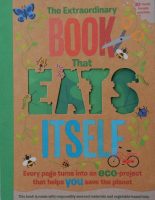
If you’re looking to engage a child or children in some environmental projects here’s a book to try. It’s packed with eco-projects – thirty in all – and each page (as well as the cover) is cleverly designed to be used in an activity – hence the title.

It’s amazing just how much difference simple everyday actions such as turning off the lights when you leave a room, and at night can make, not only for the safety of animals but to reduce electricity consumption. Ditto, saving water by turning off the tap while brushing your teeth or using your bath water to ‘feed’ your plants (of course that takes a bit of effort but every drip and drop counts). There’s a Make a Difference in your home’ page with additional suggestions .

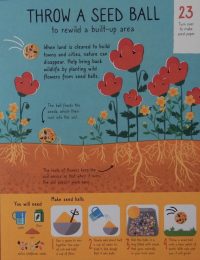
One of my favourite projects is Throw a seed ball to rewild a built-up area, something I’ve never tried, although I have scattered plenty of packets of wild flower seeds. This is really clever though and all that’s needed in addition to wild flower seeds are water, flour and soil to make your mixture. Can’t wait to have a go at this.

(The reverse side suggests making seed paper for writing a message on – another clever idea.)

Whether or not home schooling continues, this is certainly worth getting hold of.

Elephant In My Kitchen!

Elephant In My Kitchen!
Smriti Halls and Ella Okstad
Egmont

‘There’s an elephant in my kitchen’ informs the child narrator of Smriti’s rhyming story but that’s not all. There’s been a veritable invasion of the house by wild animals and they’re doing such annoying things as bouncing on the bed and playing badminton;

but much worse – one has taken the liberty of having a dump when our narrator is absolutely bursting for a wee.

As for the food stores, they’re getting depleted by the second as polar bears, penguins, a wolf and a chimpanzee make short work of all the goodies they can lay their paws and beaks on; not to mention the din created when a chorus of frogs decides to strike up and one of their number flattens the boy’s favourite cuddly. Time to discover what exactly is the cause of all this mayhem and marauding.

Oh dear me! Turns out it’s the result of thoughtless and selfish behaviour on the part of we humans, doing things with no thought for the consequences of our actions upon the wildlife that shares our planet.

An urgent plan is crucial. We need to change our ways and everyone has a part to play otherwise who knows what might happen …

With lots of detail to explore and giggle over, Ella Okstad’s zany illustrations are a great complement to Smriti’s zippy cautionary tale. Humour is an important vehicle when it comes to vital messages: it certainly works here.

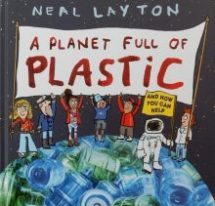
A Planet Full of Plastic

A Planet Full of Plastic
Neal Layton
Wren & Rook

Neal Layton has created an absolutely superb information book on a topic that’s on many people’s minds at present.

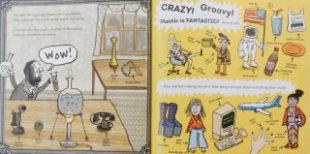
Right away he addresses the reader with ‘Quick question: do you ever think about what things are made of? ’ and goes on to mention other materials such as metal, wood, glass and paper before focussing in on plastic; plastic in all its shapes, colours and sizes.

We learn about the discovery of the material by chemist Mr Baekeland and how rapidly it became enthusiastically used in pretty much anything you might think of.

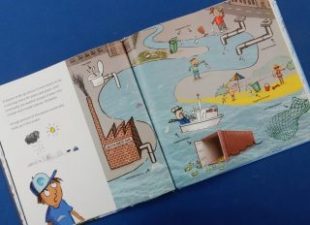
Plastic in the places it should be is all well and good, but the trouble is it doesn’t biodegrade and therein lies the problem. (Neal explains what this means with two sequences of strip pictures)

What eventually happens is that much of this plastic finds its way into our oceans

where it creates big problems for the marine animals as well as forming massive garbage patches in the Atlantic, Pacific and Indian Oceans, especially in the form of toxic microplastic particles.

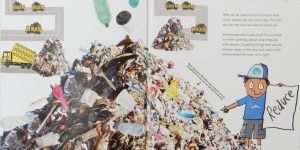
All of us need to cut down on our use of plastic, especially that used only once,  is what we’re powerfully reminded here …

Neal’s narrative style is perfectly pitched for the intended audience – there’s not a scrap of preachiness about it – and his mixed media illustrations are a powerful reminder of the ubiquitous problems of plastic waste.

Children and young people care deeply about the environment as they’ve already demonstrated and the book concludes with a ‘How you can help section’.

If the government is really serious about the environment, and in particular the terrible effects of throwaway plastic, then perhaps they should fund a copy of this timely book for all primary schools and nurseries.

The Green Giant

The Green Giant
Katie Cottle
Pavilion Children’s Books

The natural world and our part in conserving it has never been more in the media than now with children marching for the environment and against climate change; in tandem there’s been a burgeoning of conservation/environment non-fiction books recently. Less so of fictional ones, so it’s especially good to see Katie Cottle’s debut picture book.

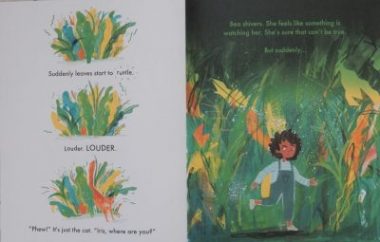
Bea is a little girl who goes to visit her garden-loving Grandad in the country; Bea when we first meet her, seems wedded to her tablet while her Dalmatian, Iris likes nothing better than chasing things.

When Iris gives chase to a ginger moggy, Bea sets aside her tablet and follows her dog, over the fence and into the garden next door.

The greenhouse she finds there is full of plants. From the rustling leaves leaps the cat but could something else be watching the girl, casting an enormous shadow over her?

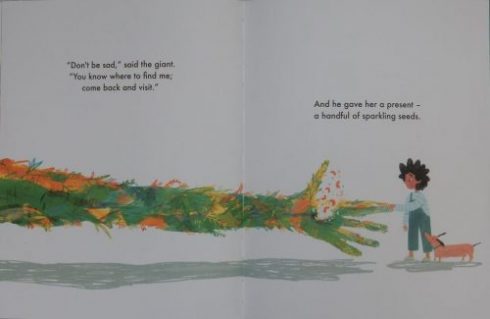
Before her stands a huge green giant, friendly seeming and with a story he wants to share. Bea learns that long ago back in the city he germinated becoming a happy seedling but then as the city air became increasingly toxic, he was forced to flee, eventually finding refuge in the roomy greenhouse wherein he now stays.

It’s a happy summer Bea spends with her green friends but all too soon, the holiday draws to an end.

The giant gives his human friend a parting gift – handful of seeds.

Back in the city once more, Bea is struck by its greyness and she knows just what to do.

Thus with the help of sunlight and water, operation transformation begins to take place … Perhaps it might one day be a place which her giant friend would be happy to visit.

The disconnect with the natural world that has come about in part due to the digital gadget obsession of many youngsters is cleverly understated, while the importance of caring for our precious natural environment comes through more urgently in Katie’s eco-story. There are definite links between them and it’s up to us as educators/parents to set a positive example to youngsters before it’s too late.

A book to share, discuss and act upon at home and in school.