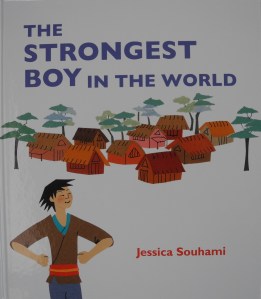
The Strongest Boy in the World
Jessica Souhami
Frances Lincoln
Jessica Souhami’s latest offering is an alternative take on an old Japanese tale, the first records of which go back to the 13th Century. The original story featured an adult warrior whereas here, Souhami’s would-be hero is a plucky though puny boy who dreams of becoming a champion Sumo wrestler. Kaito sets out from his village to the Kyoto tournament and en route meets Hana, a girl with much greater strength. Hana decides to toughen him up but can she do it in the three weeks before the tournament? Training begins in earnest with a strict diet of tough meat, bony fish and semi-cooked rice together with a regime of running, jumping, kicking, lifting and punching.
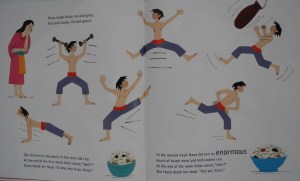
Finally Kaito is declared ready to fight and sets off once again for the city. The enormous and famous wrestlers he meets therein scoff at him but Kaito overcomes every one he comes up against and is declared champion. Greatly impressed, the Emperor invites him to live at his court as Imperial Champion. What is Kaiko’s decision? Suffice it to say he is the strongest boy in the land but both he and readers know of an even stronger young person, someone without whose help he could not have achieved his dream.
Striking collage illustrations, beautifully crafted and suitably energetic, underline the humour of this tale. It’s wonderful to have a female character with such strength of body and mind – a celebration of ‘girl power’, but at the same time, an acknowledgment of male strength, making this a book that will be pleasing to both genders.
Buy from Amazon
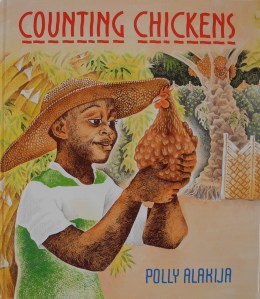
Counting Chickens
Polly Alakija
Frances Lincoln
Young Tobi’s pride and joy is his hen: his village friends have animals of their own too. One Monday, Ade’s cow has a calf and Tobi’s hen lays one egg. The next day, Tunde’s sheep has two lambs; Tobi’s hen lays a second egg and so it goes on.
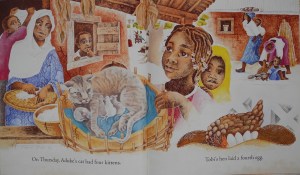
On Sunday it lays a seventh egg. The hen sits, Tobi waits and waits… After three weeks both are rewarded with a brood of seven, newly hatched, yellow chicks. The following year those chicks become mother hens with their own babies – so many Tobi needs help to count them all.
This lovely story with its Nigerian village setting is beautifully illustrated with earthy tones that contrast with the strong colours of the villagers’ clothes and vehicles. Patterns abound in the details of the weaves of baskets, designs on some of the clothing and the natural designs of the African flora and fauna.
With its counting opportunities, days of the week and most important, a great opportunity to share a story with a Nigerian setting, this is a book I would recommend highly to those in nursery and infant settings as well as anybody who wants to expand the horizons of their young child/children.
Buy from Amazon
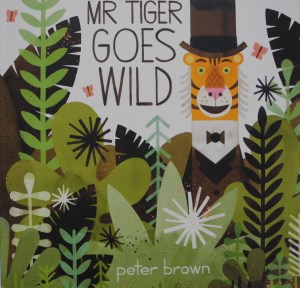
Mr Tiger Goes Wild
Peter Brown
Macmillan Children’s Books pbk
Dapper looking Mr Tiger sports a top hat, suit and bow tie and lives in a street of houses the residents of which are very proper, upright people who drink tea and sit nicely at the table. Mr T. however becomes bored with this dull existence. Time to explore life on the wild side, he decides. Soon he isn’t content with being on all fours; clothing dispensed with, he’s off to ‘the wilderness’ as instructed by his now, horrified friends. There, his wildness is given full rein but roaring and roaming freely in the wilderness proves less than completely satisfying: Mr Tiger misses his friends and city home. Back he goes to discover that not only can he now be more true to his real nature, but that his friends too have become both more accepting and relaxed in themselves.
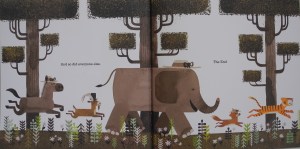
There are echoes of Rousseau in Peter Brown’s digitally edited Indian ink, watercolor, gouache and pencil illustrations. These begin with an almost monochromatic palette (apart from the tiger’s face) becoming brighter in tandem with Mr T growing wildness.
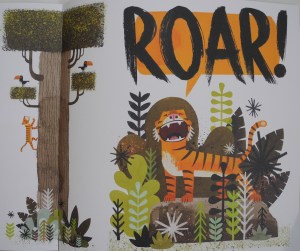
Brown lets his illustrations do much of the talking. The ‘be yourself’ message comes through loud and clear from the pictures whereas he keeps the verbal content understated and to the point.
This clever picture book has much to offer although I wouldn’t suggest using it with under fives unless they have already had exposure to a wide variety of picture books and some experience of talking about and interpreting them.
The book is most assuredly an excellent starting point for discussions relating to being yourself, difference/divergence and acceptance for children in primary and even secondary schools.
Buy from Amazon
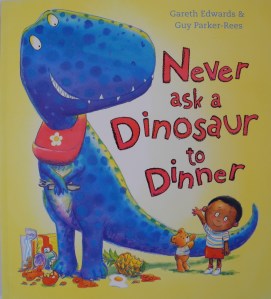
Never Ask a Dinosaur to Dinner
Gareth Edwards and Guy Parker-Rees
Alison Green Books pbk
Definitely don’t do that nor, says the boy narrator of this very funny, rhyming cautionary tale, should you share your toothbrush with a shark, never let a beaver in the basin or use a tiger as a towel. A bison will be a bully so despite its woolliness, don’t choose one for a blanket
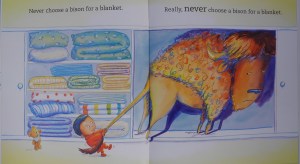
and a barn owl is nocturnal so most certainly not a suitable night-time companion. Shun them all and instead stick with your tried and trusted Ted for a blissful sleep in bed.
Delightfully dotty and made all the more so by Parker-Rees’s illustrations. His glowing colours are gorgeous, the scenes hilarious and the, oh so endearing cast of characters he portrays, make one immediately want to ignore the advice and snuggle up with all of them – well maybe not the shark on second thoughts.
Buy from Amazon
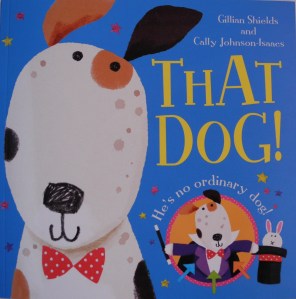
That Dog!
Gillian Shields and Cally Johnson-Isaacs
Hodder Children’s Books pbk
Unloved, indeed virtually unnoticed, the Jones’ family dog is thoroughly miserable. So, determined to get some attention, he ups and leaves home. But then what is a hungry dog to do? Get a job, he decides and tries his hand or rather paws at washing up, taxi driving, farm working, litter picking, fire fighting, nursing and more.
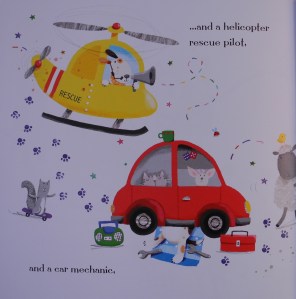
Eventually our canine pal is not only skilled, but also very knowledgeable. It’s then that the Jones spot their erstwhile pet on a TV talent show but of course, it’s too late; that amazing dog now has plenty of people to give him love and friendship.
Believe in yourself and you are unstoppable is the message that dog sends out loud and clear in this off-beat story. The illustrations abound with pattern and there is much else to entertain in the detail too.
Buy from Amazon
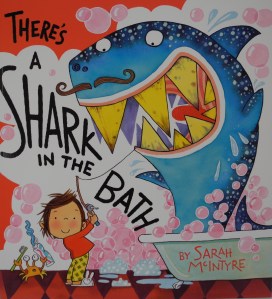
There’s a Shark in the Bath
Sarah McIntyre
Scholastic pbk.
Join Dulcie in a riotous bathroom farce wherein she discovers not one, but three sharks in the bath full of cold water left overnight by her dad. Now being breakfast time, Papa, Mama and Baby Shark have just one thing in mind and you can guess what that is. Quick-thinking Dulcie however, has others. First there’s the ‘Brushety-Brush Game’ with the toothpaste,
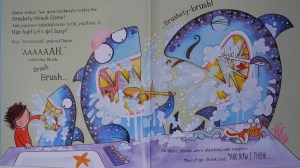
then the ‘Wiggety-Wig Game’ involving masses of pink bubbles, hastily followed by the ‘Happy-Wrappy-Uppie Game’ an excellent diversion that results in a very large entanglement of sharks and toilet paper. No mess at all, she assures Dad who is anxiously waiting outside the door; so then one final game is called for. PHEW! Time for breakfast – Dulcie’s not the sharks’ I hasten to add . . .
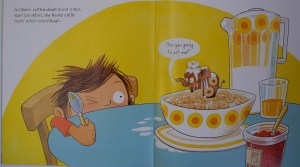
Wonderfully silly both verbally and visually. The wacky, over the top or rather, over the edge, bathroom scenes are cleverly so nearly catastrophic and are a perfect match for the tongue-in-cheek telling.
A brilliant one to share with individuals or groups large and small.
Buy from Amazon
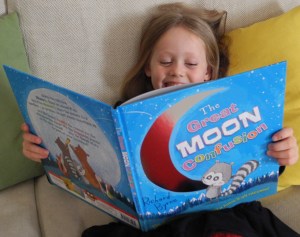
Gracie is highly amused at the exploits of Aldrin and friends
The Great Moon Confusion
Richard Byrne
Oxford University Press
Raccoon Aldrin is something of a know-all; he impresses his friends Fox, Rabbit and Woodpecker, but he’s not quite as clever as he likes to think. So, one night when Rabbit asks why the moon has changed its shape, too embarrassed to admit he doesn’t know, Aldrin proposes an investigation. A week later, with some clues provided by his friends, he concludes, erroneously, that the bears, Hubble and Lovell, are engaged in moon theft.
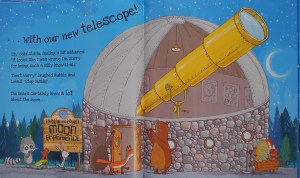
The truth however is something far more constructive.
One cannot help but laugh at, but also have a little sympathy for, self-elected expert, Aldrin who does, before this funny tale is out, learn an awful lot, not only about the moon but also about showing off, jumping to hasty conclusions,
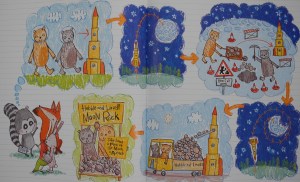
accusing, and apologising and perhaps most importantly, about friendship, as he engages in one hilarious, blunder-making situation after another.
Get hold of this book for its hilarious story and wonderful illustrations, I love the endpapers too. Also, embedded within, is some basic information about the moon that young listeners will absorb effortlessly.
Buy from Amazon
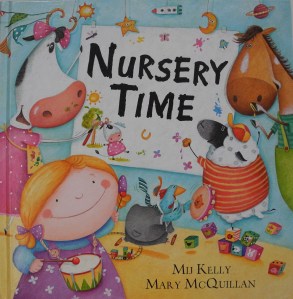
Nursery Time
Mij Kelly and Mary McQuillan
Hodder Children’s Books
The animals are bemused: Suzy Sue has disappeared. They search high and low to no avail and then cow discovers a sign – Sunshine Nursery. That’s where she has gone. The animals pay a visit and discover what a wonderful place it is; but is it so good Suzy Sue will never want to return to her farmyard pals? The animals hatch a plan and enter the nursery in disguise intending to take her home right away. That was the plan but the place is such fun that they want to stay too playing with the sand, water, bouncy balls, building blocks and much more.
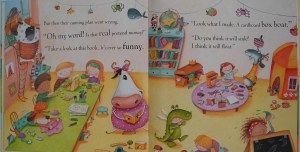
But, ‘oh my goodness’ their cover is blown; Suzy Sue spots them and tells them it’s a children only environment. Quickly though, she explains “I’m not going to live here, I just come every day. I play for a while and then go away.” Much relieved cow, sheep and the others return home with another plan in mind. Then it’s a case of home from home…
A reassuring, indeed enticing view of nursery is portrayed (not sure about the bookshelf though) in this amusing, rhyming tale. There are plenty of details for those already at nursery to spot and enjoy; those yet to start should be filled with eager anticipation. Adults too will enjoy the visual humour especially those who have spent time in a nursery.
Buy from Amazon
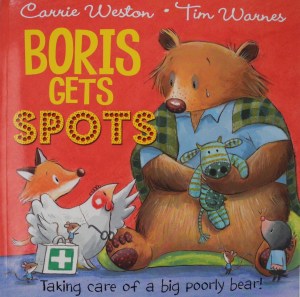
Boris Gets Spots
Carrie Weston and Tim Warnes
Oxford University Press pbk
This is the fourth Boris adventure. Herein his teacher makes an exciting announcement: Mr Gander from Gosling farm is coming to pay the class a visit. There is great excitement with everyone except Boris who merely wants to stay quietly in the book corner. When the special visitor arrives, Miss Cluck and her class go outside and enthusiastically experience all Mr Gander has to offer until Boris’s absence is discovered. Back to the classroom goes Fergus and then comes the cry, ‘Boris is covered with spots!’ Back they all dash to find a red -spotted Boris looking very sorry for himself. ‘Chicken Pox” announces Miss Cluck who fortunately knows just what to do.
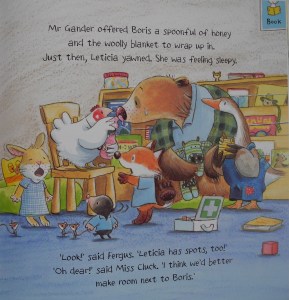
Before long though, she has an epidemic, not to mention an empty classroom on her hands. Time to put that honey cookies recipe to good use with the delicious ingredients Mr Gander left them.
Those who work in early years will immediately relate to this one. On several occasions I’ve had my nursery or reception class decimated by a chicken pox epidemic, perhaps not quite all at once as is the case here however. Authorial license notwithstanding though, this is a thoroughly enjoyable story to share with young children with or without the dreaded spots. There is so much to explore in relation to the food items and other things Mr Gander brings to show Boris’s class.
Buy from Amazon
Find and buy from your local bookseller: http://www.booksellers.org.uk/bookshopsearch




 Red Reading Hub - Jillrbennett's Reviews of Children's Books