I Love You More / Love is in the Little Things / I Turtley Love You

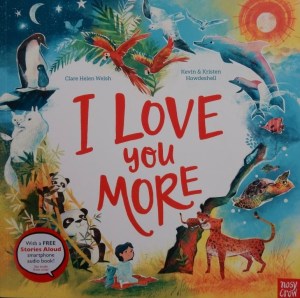
Parental love and the wonders and beauty of the natural world come together one bedtime when Rae’s Mum attempts to tell her daughter just how much she loves her. Clare’s lyrical text in combination with team Howdeshell, the illustrators, convey the heartfelt message effectively, showing that such love is unconditional and life long.

Herein we encounter among other creatures, waddling penguins and snoozy seal pups atop the ice, gliding eagles, desert dwelling camels and lizards, various marine creatures ,
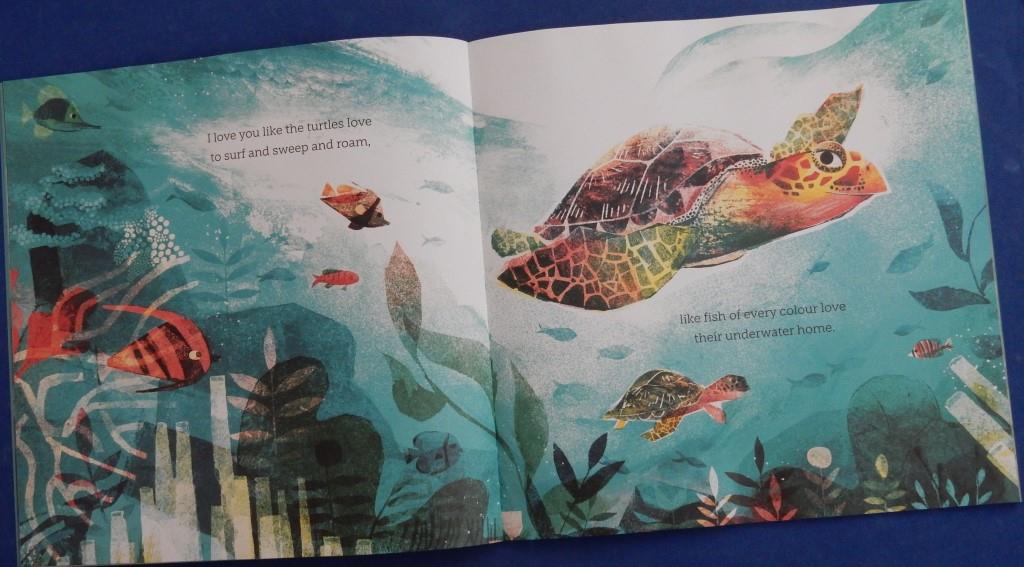
majestic big cats and pandas as well as celestial bodies – ‘sparkly planets shining brightly in the night’ and more. As the two finish counting the stars in the sky, Rae realises the enormity of her Mum’s love, .
a love that even then Mum feels she’s not expressed sufficiently strongly- and we see the two snuggled lovingly together.

The mixed media illustrations of the animals in their home environs suggest that the way is left open for Rae to change as she too explores beyond her immediate home and surroundings.
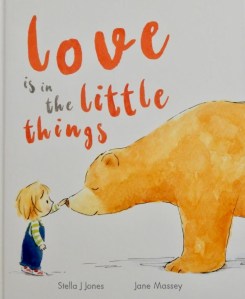
Small – a human child and Big – a large bear love one another very much, but how do they show that love? Stella Jones’s first person text and Jane Massey’s heart-warming watercolour illustrations show that essentially as Big says, ‘ love is made from the little things’ – every day things such as holding hands, making and taking tea together, a goodnight kiss, hugs, saying sorry,
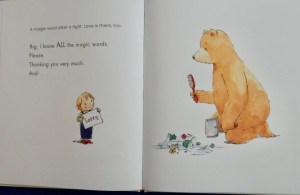
extending a helping paw or hand. As Little realises as they look skywards, “Love is made of ALL the little things. Just like the trillions of tiny twinkly stars make the forever of the deep blue sky.’
Gentle, reassuring, and sometimes exciting like those ‘tingletastic, tummy jumbling, giant-enormous glorious fireworks and starbursts.’
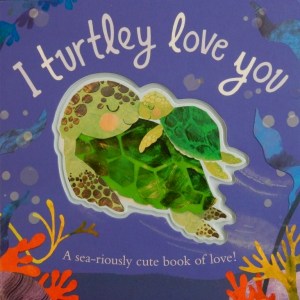
This board book takes readers beneath the ocean waves where, through Harriet’s gentle rhymes and Bryony’s engaging illustrations they will encounter several ocean creatures and their little ones. There are turtles, seahorses, clownfish, jellyfish and more either playing or snuggled up together. The emphasis on each spread is the love the adult gives to the little one.
With cut-outs and stand-outs on each spread, little humans will enjoy the tactile opportunities offered by interesting watery, collage style visuals. Some adults might find the words slightly too sugary.
One Little Leaf / All the Things a Tree Can Be / The Odd One Out

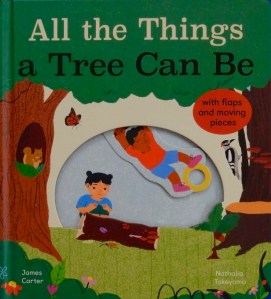
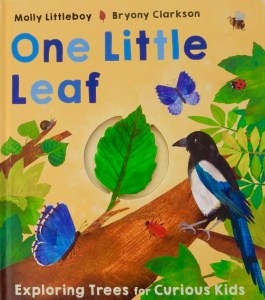
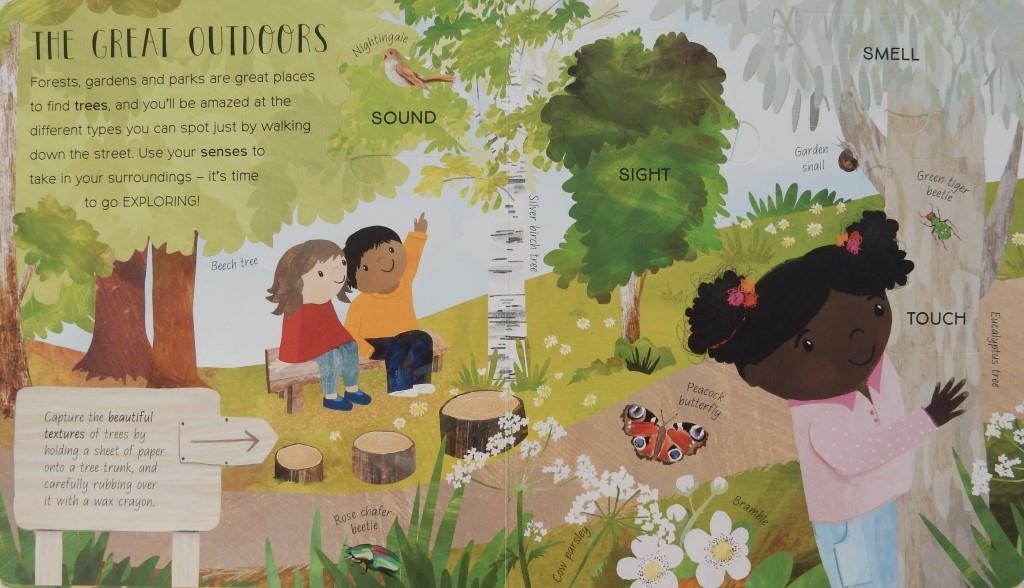
Trees are my favourite thing in nature and I think it’s never too early to introduce young children to their delights. This chunky, large format board book does just that, starting with a spread showing fifteen named leaves from different trees.Four are depicted on flaps, which when lifted reveal a brief paragraph of information about the respective trees on which they grow

Other spreads are devoted to in turn, sensory exploration of the surroundings, 

the growth of a tree, the tree as habitat for other wildlife, some of the uses of tree parts, seasonal changes of a tree and finally, on ‘Happily Ever After’ readers are encouraged to plant a new tree and to explore the themes included further.

A chatty, engaging narrative runs through the whole book, comprising on each page an introductory paragraph and a suggestion encouraging children to become actively involved with the natural world.
With clear, naturalistic illustrations this is a good starting point on things arboreal, to share with children in their early years.

Presenting the wonderful things about trees is difficult in just six double spreads, but author James Carter includes the essentials in this little book. I love the description on the opening page, ‘Trees are ground-hugging / sky-nudging wonders!’ Indeed they are ,be they of the deciduous or evergreen kind, both of which are depicted in Nathalia Takeyama’s first illustration that also includes some woodland birds and animals, and humans.
Deciduous trees change with the seasons and this is the theme of the next spread, which has two flaps for little hands to lift and reveal simple sentences and a different visual.
The third spread takes us to visit a tropical rainforest, rich in both flora and fauna.

‘They are like nature’s tallest hotels!’ so we read on the spread depicting some of the animals that make their homes in trees, some of which benefit the trees in return. Continuing this idea, the final pages present some ways trees are vital to all manner of Earth’s life forms in that they provide food, shelter, warmth, wood, shade and most importantly, they clean the air that we all breathe.
With its integral moving parts, this is a simple introduction to a vast subject for adults and little ones to share.

This book offers a great opportunity for young children to develop their observation skills as they peruse the pages of this ‘spotting book’. The first fourteen spreads present all kinds of interesting animals, a different kind on each, including camels, bats, seals, tortoises, ostriches, pandas, monkeys, rhinos, flamingos, fish, lemurs, penguins and butterflies. In addition a pair of rhyming verses invite the reader to spot the difference on each spread, for example among the camel train, one of their number has a single hump, whereas all the others have two. Another spread asks, ‘Who gets the first fish? Can you spot the winner?’ and depicts a pod of hungry seals, ‘calling out for their dinner’, one of which depicted in the print-like pattern already has a fish in its mouth. 

Some of the puzzles are much harder to spot than others; this reviewer found herself going cross-eyed trying to find the cross-eyed lemur looking at its own nose. Young children will certainly be challenged and entertained by most of the spreads.

On the final spread, a new animal is hidden among the melee comprising several representatives from each of the previous spreads.

A Celebration of Board Books

Here’s a handful of recent Little Tiger Board Books – thanks to the publishers for sending them for review

First Nature: Ladybird
Harriet Evans and Bryony Clarkson

Following on from Caterpillar in this ‘first nature’ flap-book series is the equally playful Ladybird. Very young children will love Bryony Clarkson’s bright alluring, textured art and Harriet’s brief, sometimes alliterative rhyming text as Ladybird scuttles and scurries, hastens and hurries across the cleverly cut-away pages, slowing to feed, feel fear, fall and fly to the nest, finally ready to hibernate.

Elephant Elephant What Can You See?
Pintachan

Accompanied by a questioning chirpy bird friend, Elephant takes a wander in this lift-the-flap book, and the two play a kind of hide-and-seek game with the animals that are tucked away in turn, beneath the lily pad, in the tall grass, under water and behind a tree. Then, on the final spread, when the final flap is lifted, there’s a surprise mirror so tinies will come face to face with their own image.
With Pintachan’s simple, bright images and the repeat patterned rhyming narrative, this is likely to be a winner with little ones.

Beep Beep! Builders
Becky Davies and Gareth Lucas

Be ready for a noisy time when you share this with your little one. Set on a building site, we meet the boss Little B and his five co-workers. There’s Digger, Mixer, Crane, all of which are somewhat over-enthusiastic, as well as a roller and a tip-up truck. Having dug, mixed, built and lifted all day long, come sundown the boss praises their teamwork and suggests it’s time for play.
Tinies will love pressing the squishy bodies of the jolly diggers as they follow their actions and join in the rumbling, tooting, whirring and other sounds.

For a slightly older audience is

Your Body
Harriet Evans and Lirios Bou

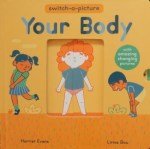
Another of the cleverly designed ‘switch-a-picture’ books with Harriet’s rhyming presentation of in turn, the skeleton, breathing, eating, thinking and the circulatory system accompanied by Lirios Bou’s subtly coloured images of children’s bodies, first clad and then, when the central tab on each page edge is pulled, the related internal working are revealed along with additional relevant information.

A to Z: An Alphabet of Animals
illustrated by Linda Tordoff

Published under the Caterpillar Books imprint this lift-the-flap board book presents animals large and small; but where are they? They’re all hiding, just waiting to be discovered by eager fingers opening their respective initial letter flaps. Little ones can meet creatures feathered, furry, scaly and smooth all stylishly illustrated in subtle colours.

First Nature: Caterpillar / Little Hen Little Hen What Can You See? / When Mummy Goes to Work

First Nature: Caterpillar
Harriet Evans and Bryony Clarkson
Caterpillar Books (Little Tiger)

By means of a lovely playful, descriptive rhyming text – ‘Caterpillar chomps and caterpillar crunches. // Caterpillar chews / and caterpillar munches.’ and clever cutaway pages with flaps, author Harriet and illustrator Bryony present the life cycle of an eponymous butterfly.
Additional information snippets are hidden beneath the flaps making this fun for little fingers to explore, as well as little ears to enjoy.

Little Hen Little Hen What Can You See?
Amelia Hepworth and Pintachan
Little Tiger

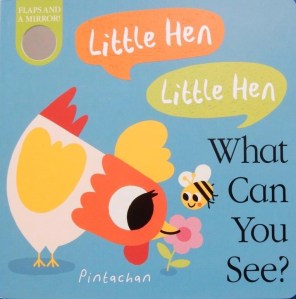
Little humans will love accompanying the little hen as it wanders around the farmyard and in response to the titular question posed on each spread by the friendly little bee, discovers the various creatures hiding in plain sight and named when the flap is lifted to reveal in turn Mouse, Cow, Horse, Sheep. Beneath the final flap is a mirror so tinies will come face to face with their own image.
The simple, repeat pattern text and Pintachan’s bold bright images of the animal characters offer a hide-and-seek game for toddlers and adults to enjoy together, probably over and over again.

When Mummy Goes to Work
Paul Schofield and Anna Terreros-Martin
Templar Publishing

This is a cleverly crafted little book, the first in a new series and it’s ideal for a parent just returning to work after the birth of a child, to share with a little one.

Having breakfasted together, Mum dons her paramedic’s uniform and bids farewell to her child, leaving Nan and Grandad in charge.

Events from her working day are then chronicled in a first person rhyming narrative illustrated with small images on each verso – driving the ambulance,

tending a patient in bed, pushing a wheel chair, examining someone’s ears.

These are mirrored in full page, detailed scenes on the recto, showing the child playing out similar scenarios.

As if speaking directly to the little one, author Paul Schofield uses the mother’s reassuring voice for the sequence of verses; illustrator Anna Terreros-Martin’s visual interpretations are an absolute delight and full of wonderful details to pore over.

A Trio of Little Tiger Board Books

Kindness makes us Strong
Sophie Beer

What is kindness? Sophie Beer provides some examples in this little book beginning each double-page spread with “Kindness is …’ following it with illustrations of children who show care and consideration towards their peers, grown-ups and animals.

It might be something as simple as saying hello, or cheering on participants in a race, giving a warm hug or taking turns.

The bright, enormously attractive illustrations show how much difference acts of kindness make in creating  a happier world.

With its brief, simple repetitive but empowering text, this little book can be shared with the very youngest but equally slightly older children might enjoy reading it for themselves.

A lovely introduction to kindness.

Owl Always Love You
Patricia Hegarty and Bryony Clarkson
Caterpillar Books (Little Tiger)

It’s bedtime for the little forest animals: time that baby rabbit snuggled down in the burrow, time for tiny dormouse and hedgehog to curl up; and up in the tree, for baby squirrel to close its eyes.

The tree is also the place where new chicks in their nest await their mother songbird’s return before they too can sleep.

With die-cut holes to peep through, raised images to feel and adorable little creatures to enjoy in Bryony Clarkson’s nocturnal scenes, sleepy little humans can listen to Patricia Hegarty’s gentle reassuring rhyming narrative before they too succumb to the call of sleep.

Also with a night-time theme is

What Can You See? At Night
illustrated by Maria Perera

With the emphasis on facts, little ones are introduced to a host of nocturnal feeders such as squirrels, owls and foxes in the town.

Moving on to a more rural setting we meet creatures around a pond including singing frogs, bats on the hunt for insects, while in the field rabbits, mice and foxes forage and fireflies flit above them.

It’s not only wild creatures that are out and about at night: postal workers, delivery drivers and sometimes farmers, are at work when most of us are fast asleep.

There’s plenty to interest toddlers on every spread including some humorous items and die cuts.