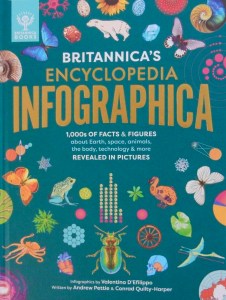
Britannica’s Encyclopedia Infographica

If you are looking for a book to lure your children away from screens then try this. It’s a weighty, highly visual book absolutely bursting with interesting facts, divided into topics – space, followed by in order land, sea and sky, living planet, animals, the human body and the human world. Before these is a “How to Read This Book’ spread that explains the main ways the infographics organise and present the information. This should start youngsters off on the right track thinking about counting and order, measurement and rules, scale, colour and pattern, position and familiar comparisons.

I turned first to the living planet section and was fascinated to learn some new names that describe both leaf shapes and vein patterns. Some were familiar but not pedate (palmate but with indented lobes) and flabellate (fan shaped). Another new term was arcuate that describes a vein pattern (pinnate but the veins curve towards the leaf margins).

I was astonished to learn that the seed of a rare palm, the coco de mer can weight up to 25 kilos and be as long as 30.5 centimetres. I wouldn’t like that to fall on my head.

Moving on to the animals section, I was intrigued by the information on the ‘smallest known’ page. Did you know that the smallest land mammal, the Etruscan shrew is only 6cm long including its tail or that the nano-chameleon, the smallest reptile is a mere 1.4cm long (not including the tail)?

However, it’s true to say that no matter where you open this bumper book, you are likely to be wowed or amused by something that you read. I’m sure a considerable number of children will enjoy the poo and farts’ spread that includes a presentation of the Bristol Stool Scale with visuals of all seven poo types.
With its eye-catching design, key questions, enticing headings and bite-sized paragraphs, this format should work in all manner of settings and situations both at home and in the classroom. It definitely should be in every school library – primary and secondary; just think of the many ways it might be used.

Animal FACTopia!

Animal FACTopia!
Julie Beer, illustrated by Andy Smith
Britannica Books

You never quite know where your inquisitiveness might take you in this engaging and informative book. And you’ll assuredly find yourself laughing at some of the zaniest zoological facts you encounter, every one of which is verified by Encyclopaedia Britannica and every fact is linked to the next. Herein you will encounter – one way or another – creatures scaly, feathery, furry, silky smooth, from the microscopic to the massive, some friendly and others downright dangerous.

You will discover something about skin shedding spiny mice of the African kind, whistling walruses, purple-blooded peanut worms, blue-tonged skinks and lots more – weird and wonderful animals assuredly.

Coincidentally I came upon examples of bioluminescence three times in a single day: the first in this book:’ microscopic male crustaceans called ostracods vomit glowing mucus’ to attract partners.

Then the topic was mentioned in a David Attenborough programme I watched in the evening as well as in the novel I am currently enjoying.

Were you aware that certain monkeys floss their teeth with bird feathers? I wasn’t; nor did I know that ghost crabs have teeth in their stomachs to facilitate digestion or that Western painted turtles are able to hold their breath for four months. Amazing!
With a mix of photographs and Andy Smith’s cartoonish illustrations this will surely satisfy curious KS2 readers and entertain a great many adults too I suspect.

Britannica’s Baby Encyclopedia / Night-Night Animals

Britannica’s Baby Encyclopedia
Sally Symes, illustrated by Hanako Clulow
Britannica Books

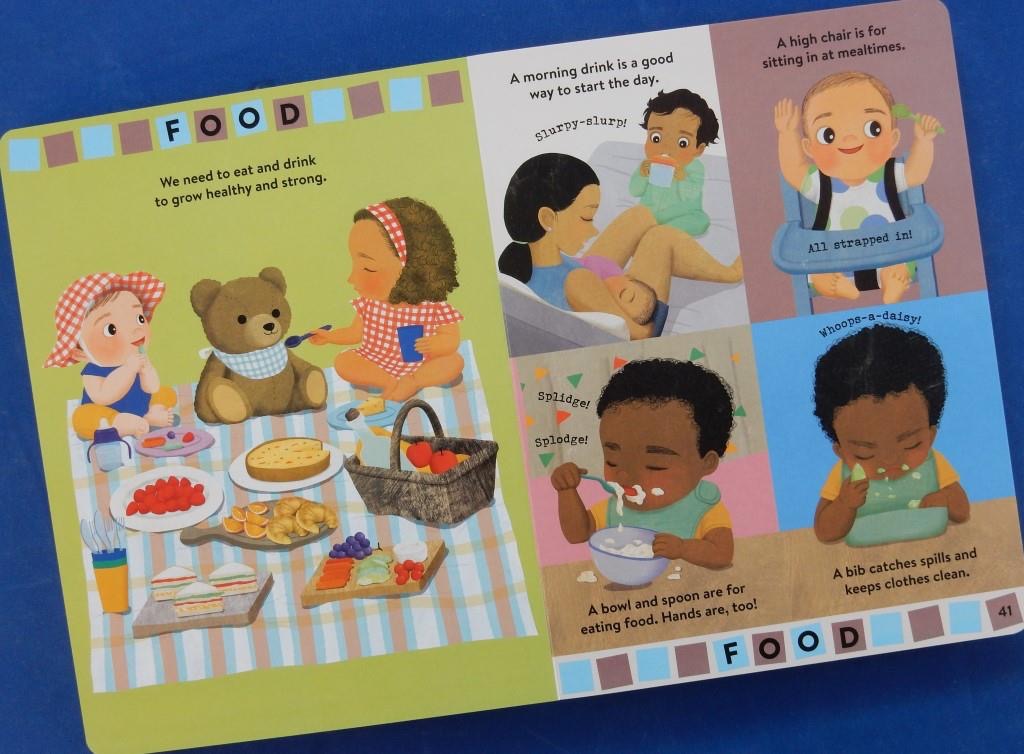
With just over seventy pages in all, this board book first encyclopaedia is divided into sections: our world, animals, plants, body, food, machines, art & music, shapes and numbers, every one of which is beautifully illustrated in bold colours. Each section begins and ends with a full page picture and the accompanying suitably simple text is thoughtfully worded to read like an opening and finale. 

For example Our World starts thus: ‘Our world is a place called Earth. In the morning, the sun comes up and the day begins.’ and concludes, ‘At the end of the day, the moon and stars light up the night sky.’ So, it would work well if an adult and child shared the book, one section per sitting. Little ones will love joining in with all the ‘sound’ words: this section has ‘Plip-plop!’ ‘Flitter! Flutter!’, ‘Gurgle! Burble!, ‘Crash! Smash!’ and several farm animal noises. 

Just the right amount of information is included in each section to engage small children, while also enhancing their vocabulary and knowledge.(A consultant Dr Amanda Gummer was used to this end.) It’s good to see that care has been taken to include a diverse range of humans in every topic presented.
A book to add to family collections if there is a very young child.

Night-Night Animals
Patricia Hegarty and Thomas Elliott
Little Tiger

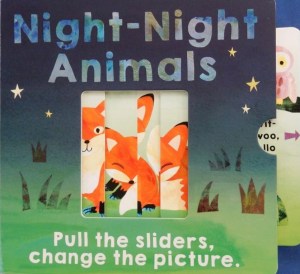
This ‘pull the sliders, change the picture’ title takes little ones to various natural locations where it’s time for the fauna to go to sleep. First visit is the forest wherein there are rabbits, deer, a fox, a mouse and a nesting bird. Which one is nocturnal and needs waking with the help of the slider?
The savannah animals all seem to have shut their eyes already except for one; he needs help to get to sleep. The deep sea has lots of sleepy creatures large and small but one with eight limbs needs the reader’s help. After helping whichever of the rainforest animals is wide awake, it’s the turn of little humans including one very bouncy person who has to stop all those boings.

A fun, interactive bedtime book for the very youngest children who will enjoy assisting the animals before nodding off themselves.

Gross FACTopia!

Gross FACTopia!
Paige Towler, illustrated by Andy Smith
Britannica Books

Prepare to be disgusted as you delve into this compilation of foul facts, every one of which is cleverly linked to the next and every one verified by Encyclopaedia Britannica. Should you choose to start at the beginning you’ll find yourself back in 1858 beside the Thames which at that time was clogged with utterly obnoxious smelling human waste so bad Government thought about moving. Follow the smelly trail and you’ll learn that that was not even the worst smelling place on planet earth. That award goes to Seal Island, just off Cape Town and home to 75,000 Cape fur seals whose poo pongs of rotting fish. There’s a whole lot more about poo

and sewers including that back in ancient Roman times, women sometimes used crocodile poo as make-up. To be sure your olfactory lobes are going to be subjected to an onslaught of gross aromas if you let your nose lead you through the pages.

Of course there are many other ways to go depending on your taste – oops! make that interest takes you. Assuredly you’ll find lots of funny things you didn’t know previously on such topics as gastronomic goriness, what seems like sporting stupidity and much, much more, all somehow connected.

Britannica’s Word of the Day

Britannica’s Word of the Day
Patrick & Renee Kelly, Sue Macy, illustrated by Josy Bloggs, Emily Cox, James Gibbs, Liz Kay
Britannica Books

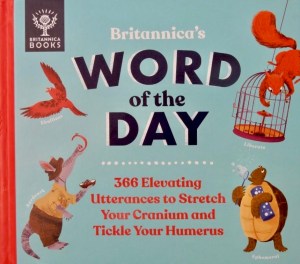
If you want to become a word pundit or turn your child into a logophile, then this book should definitely be on your shelves, or better still, near at hand every day. It features a veritable menagerie of animals large and small, each amusingly portrayed and ready and waiting to introduce the word of the day, over 366 days. So in a single year it’s possible to boost your vocabulary by a sufficient amount to impress your family and friends and have fun so doing. Each word has been carefully chosen by the Britannica team and every one is certainly worth having in your vocabulary.

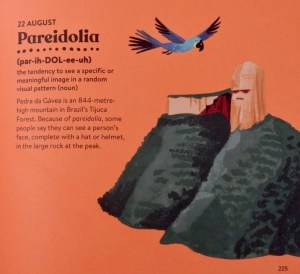
Along with the word of the day is a pronunciation guide, a definition, what part of speech it is, a sentence incorporating the selected word, and some trivia about its usage or etymology.

Each month concludes with a delightfully daft ‘story of the month’ that includes all the new vocabulary learned.

Be prepared to be surprised and delighted: what a great way to learn and to acquire some trivial information too. Did you know for instance that Rolling Stones guitarist Keith Richards ‘defenestrated a TV during a stay in Hollywood in 1972; or that ‘chartreuse’ is named after a green drink created by a 16th century alchemist who claimed those who drank it would have long and healthy lives. And I’m pretty sure I have ‘pareidolia’ – the tendency to see a meaningful image in a random visual pattern –

though I wasn’t familiar with the word until I came upon it in this book.

How To Teach Grown-Ups About Pluto

How to Teach Grown-Ups about Pluto
Dean Regas, illustrated by Aaron Blecha
Britannica Books

If you’ve ever wondered why Pluto lost its status as a planet over fifteen years ago, then here’s a book for you. It’s written in an amusing child-friendly style by astronomer, TV presenter and more, Dean Regas, and illustrated with suitably funky, blue tinged, cartoon style art by Aaron Blecha.
Having briefly introduced himself and the work of an astronomer, in his tongue in cheek style, the author explores the contentious case of Pluto and its demotion from being one of the nine primary planets in our solar system, thus losing its status as a full-blown ‘planet’. This was something even he initially found hard to accept.

Before that though we read of Tombaugh’s discovery of Pluto; how an eleven year old girl came to name it. But then comes it’s downfall – not literally of course. ‘so small, so far away, so alone, so off-kilter and so cold’ was it that ‘people rallied to defend Pluto against anyone who wanted to take away its planethood, … Never before had the public embraced such an inanimate space object as their underdog’, says Regas.

He then ingeniously goes on to explain how the constantly developing nature of space science means that many youngsters’ knowledge of our solar system is likely to be more accurate than that of lots of grown-ups. Having read this book such youngsters will be able to tell any doubting adults that Pluto is a Kuiper Belt Object (KBO) and one of five dwarf planets. They’ll be able to introduce them to Sedna too, as Regas does to readers herein.

So cool and utterly brilliant. If this book doesn’t get youngsters interested in astronomy then I might have to eat my own copy, timeline and all.

Return to Factopia!

Return to Factopia!
Kate Hale, illustrated by Andy Smith
Britannica Books

This second book in the series that invites readers to choose their own paths is every bit as much fun as the first. Again it’s bursting with informative tidbits (more than 400 facts in all) relating to such diverse topics as libraries, lions and loud things, bees to blood and bananas, and morning to musical instruments (of the unusual kind of course). Did you know that certain bumblebees bite plants’ leaves to speed up the flowering process? I certainly didn’t.

Astonishingly, bananas are naturally radioactive? (You’d need to consume at least a billion in a single meal to receive a lethal dose though.)

Equally weird is that a species of ancient whale had four legs and webbed feet, and that scientists are able to tell the age of a whale from its earwax. I’d love to know how that’s done. Those are just a couple of the weird and wonderful things you can discover about various kinds of whales herein.
Equally astonishing and astounding is that ants have been around since the time of dinosaurs; perhaps even more amazing is that certain fungi are able to control the minds of ants, turning them into zombified insects.

No matter whether you decide to follow a jumpy trail, or read straight through, one thing is certain, you’ll put the book down knowing a multitude of things you hadn’t even thought about before.
Easy to read and engagingly illustrated in a variety of styles by Andy Smith, this clever web of information will assuredly bind you in.

Britannica’s 5 Minute Really True Stories for Family Time

Britannica’s 5 Minute Really True Stories for Family Time
Britannica Books

Authored by Alli Brydon, Catherine D. Hughes and Jackie McCann and illustrated by four artists – Anneli Bray, Vivian Mineker, Sophia Moore and Syklar White – are thirty true stories about things families do together. More than two thirds relate to humans whereas the final seven feature animal families, both sections starting with a look at homes in different parts of the world including for the former, Australia and Bangladesh.

Breakfast is the topic for the second story and I was fascinated to discover the varieties and ways families eat their porridge, whereas the thought of consuming some of the items such as those in a Japanese breakfast first thing in the morning (or at any time) turned my vegan stomach right over.

Whether the reader’s particular interest is in things scientific, or related to technology, sociology – festivals or weddings perhaps, history or art of some form there’s something to discover herein. I particularly like that ‘Storytime’ includes the fact that stories can be told in different ways including through paintings, drawings, dance or music.

Each topic is allocated three double spreads and some incorporate more than one interest area.
The question(s) embedded in each story and occasional practical possibilities provide an interactive element to the book.

For this reviewer using the term ‘true stories’ for this kind of narrative non-fiction is something of a misnomer. There’s a wealth of fascinating information in this attractively illustrated book,

but it’s one I see being used in a primary classroom as part of a topic (there are many possibilities), rather more than a family read together as suggested by the title.

Britannica First Big Book of Why

Britannica First Big Book of Why
Sally Symes and Stephanie Warren, illustrated by Kate Slater
Britannica Books (What on Earth Publishing)

Children are forever asking ‘why’ questions and adults quite often scratch their heads to give appropriate answers; now comes this jumbo book that should help both questioners and responders. It contains a lot of information and seemingly being aimed at slightly younger children than usual, with a single question per spread, is far less overwhelming than is often the case.

Organised into eight sections: minibeasts, pets, wild animals, the body, food, how stuff works, earth and finally, space, each part has fourteen questions of the kind youngsters might well ask. In addition to the question, every spread has a paragraph of text in response, accompanied by either a ‘wacky fact’ or a ‘who knows?’ bubble, one or two large illustrations – some are photographs, others are bold bright art work by Kate Slater.

And, each section concludes with a “Wow! What’s that?’ spread containing half a dozen coloured images for children to match with their names from the six listed.

Back mattter comprises a comprehensive glossary and index, source notes in case readers want to know more about a topic, as well as a ‘meet the Why team’ page and the answers to the matching game.

So, if you know a child who might ask such questions as ‘Why do flies like poo?; ‘why do frogs croak?’; ‘why does music make me want to dance?;

‘why do cakes puff up in the oven?’;

‘why don’t skyscrapers fall over?; or perhaps ‘Why does Saturn have rings?’ then you definitely need to keep a copy of this book to hand, be that at home or in your KS1 classroom. It will also go down well with slightly older, visual learners.

Listified!

Listified!
Andrew Pettie, illustrated by Andrés Lozano
Britannica Books

This is a cornucopia of a book that is so easy to get totally immersed in that before you know where you are, a couple of hours have gone by.

Divided into eight chapters on various aspects of our world – space, nature, dinosaur times, animals, the body, being human, inventions and game changers – it’s written in a humorous style, and absolutely bursting with amazing, bite size portions of information and I’m sure the majority of adults as well as children will learn a considerable amount.

Did you know for instance that a corned beef sandwich was smuggled onto NASA’s Gemini 3 space mission by astronaut, John Young? I don’t think much of his taste.

On the topic of taste, I was astonished to read in the Being Human chapter that the average person in Switzerland eats 176 chocolate bars in a year while in China, the average person eats a mere two. I wonder where they have better teeth?

There certainly have been some amazing inventions but this book contains 8 of the weirdest ever made. These include a motorised ice-cream cone that automatically rotates your ice-cream to save you having to turn the cone around to lick the ice-cream on the other side – totally bonkers. I know many people rely on their mobiles for lots of things but did you know there’s a mobile that doubles as an electric beard trimmer? Yes really. On the other hand, I might just have to seek out some of the smart underpants I read about as being in development and give a pair to my partner: these measure how much your buttock and leg muscles are moving and then tell you if you need to up your exercise regime.

You really can’t beat nature as designer though: look at these incredible examples of the Fibonacci sequence found in plants.

In all Andrew Pettie has stashed over 300 lists between the covers of this weighty tome, many with quirky illustrations by Andrés Lorenzo; there are also a fair number of photographs too, plus a glossary and index. Love the playful list headings.

Add to family bookshelves (so long as they’re strong enough it carry its weight) to KS2 collections and beyond, and libraries.

FACTopia!

FACTopia!
Kate Hale, illustrated by Andy Smith
Britannica Books

Surprising and sometimes humorous are the connections between the four hundred statements found within this cornucopia of facts collected by Kate Hale.

With my love of chocolate, and that large tower spanning the gutter of the book, how could I resist savouring first the information on that spread. I was surprised to read that ‘The world’s largest chocolate bar weighed 2,696 kg’ – about the same weight as four male polar bears.” Wow! Now that would take some eating. However with my vegan sensibilities I was horrified to learn that ‘the average chocolate bar contains some tiny insect fragments’. Where do they come from?

I hastily left the chocolate page and turned instead to the linked spread where I was met with a gaping mouth in the process of consuming birthday cakes and discovered that a world record was set by a man who consumed 6.6kg of birthday cake in eight minutes; I assume he didn’t eat the candles as well. That surely must have stopped him having ‘borborygmi’. I have to admit I had to check up the meaning of this word just to make sure it wasn’t a joke but sure enough it is ‘the rumbling sounds made by a body when hungry’.

As somebody who loves to travel I was fascinated to read about the Potato Hotel in Idaho where the rooms are contained within a gigantic replica of a potato, while in India, the country’s fisheries HQ building is fish-shaped.

There is actually some kind of linking thread running right through this entire book but there is more than one trail through the wealth of facts included so divergent thinkers can choose to follow their own path, or even just dip in and out enjoying the range of topics covered from babies to breakfast and popcorn to pets and pirates.
Andy Smith’s 300+ illustrations are huge fun and add to the enjoyment of this collection of facts for curious children (and the occasional adult I suspect).