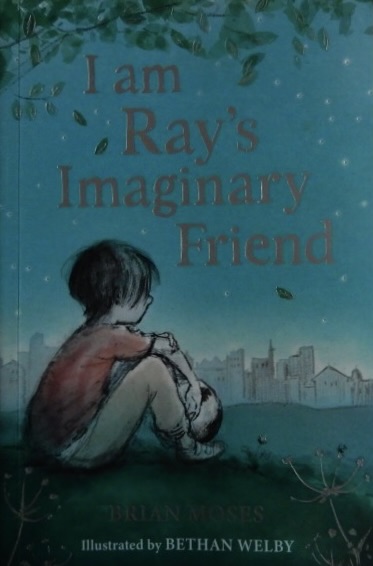
I am Ray’s Imaginary Friend

Written in verse by poet Brian Moses, this is an intensely moving, sensitive story about coping with change. Its narrator is one of the star pupils from the School for Imaginary Friends who is given the name Jacob when he responds to eight year old Ray’s call of distress.

Ray loves his life in Pratts Bottom village but then he overhears his parents talking about moving away because his Dad has a new job. Horrified by the idea he even contemplates running away. Instead he calls into being an imaginary friend. Jacob. Jacob takes his role very seriously, even going so far as to deliver difficult messages to Ray, knowing that in the long run they will help the boy. In addition to being there for him, Jacob particularly likes to say ‘yes’. ‘I like to say yes, / even if I ought to say no. / Saying yes makes Ray feel good / and makes me feel good too.’ we read.
To begin with Ray does lots of everyday things with Jacob as well telling his mum off when she almost drives into him. It’s merely a phase, is what his parents think.

A little while later at his new school, Ray’s teacher talks about what’s happening in Ukraine and this leads to two things: first Ray writes a poem about it which is put on the school website and then his family decide to open their new home to two Ukrainian refugees.
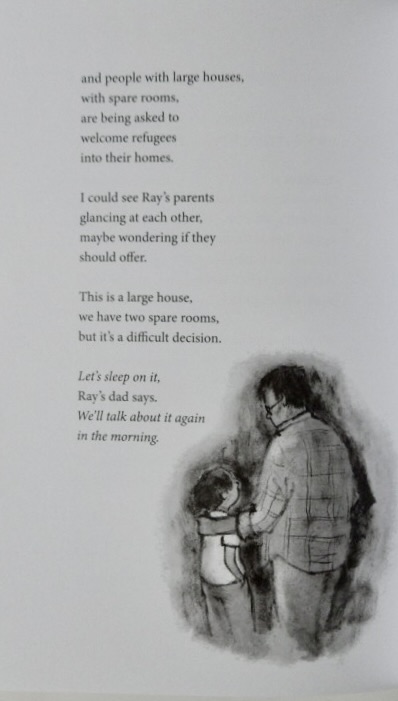
As he hears about and processes what the mother and son have endured, Ray realises that his own problems are not so bad after all and it’s then that Jacob knows it’s time for him to find someone else to help.

Quietly brilliant, this is a book that explores coping with change and becoming mentally stronger and the powerful influence of empathy. The latter in particular is brought out beautifully in Bethan Welby’s black and white drawings. It’s a must read for older KS2 readers either at home or as a shared class book.

A Poem for Every Spring Day / The Best Ever Book of Funny Poems

Here are two recent poetry collections from Macmillan Children’s Books – thanks to the publishers for sending them for review

A Poem for Every Spring Day
ed. Allie Esiri

This is the third in the seasonal series – almost every one of which is taken from Allie Esiri’s A Poem for Every Day of the Year and A Poem for Every Night of the Year and once again it’s brimming over with poetry to lift your spirits.
Among the offerings herein you’ll certainly find many old favourites – lots took me right back to my days in primary school and even before that when my dad read A.A. Milne and Lewis Carroll aloud to me, as well as unearthing some new treasures.
As with the Autumn and Winter books, there are two poems for each day from 1st March through to the end of May and again Allie provides an introductory paragraph for each of her selections. Most of us associate spring with new life and yes, there are plenty of entries reflecting that aspect of the season but it’s more than just longer days, birdsong and buds opening and A Poem for Every Spring Day reflects this. There are poems commemorating specific occasions such as Rachel Rooney’s First Word (After Helen Keller) where she writes of Helen feeling water flowing from a pump with one hand while the letters for ‘water’ were spelt on her other palm. That moment took place on April 5th.
Another one that is hugely moving and also new to me is Duranka Perera’s Bitter State. The poet is also a doctor living in the UK and native of Sri Lanka where horrendous terrorist attacks took place on 30th March. It begins thus: ‘I was angry when it happened. / I was angry when the numbers continued to rise. / I was angry when bitter tongues lashed old wounds. / I was angry when a dying monument drew more /money than / The dying themselves.’
From John Agard to William Wordsworth, whatever your taste in poetry, there will be plenty to savour in this collection.

The Best Ever Book of Funny Poems
chosen by Brian Moses

Poet Brian Moses has chosen an assortment of splendidly silly poems for this compilation of over a hundred giggle inducers.
The selection has ten sections, each named with a line from or title of, one of the poems included. Thus for example we have ‘The red ear blows its nose’ from Robert Schechter’s What’s Mine for the first – Silly and Even Sillier Poems.
The teacher part of me wanted to turn next to the Headmaster’s Welcome where among the thirteen I totally loved Brian’s own The School Goalie’s Reasons
The writer/reviewer part of me just had to turn next to the Fantasy and Fairy Tales offerings where there are some terrific four liners including Rachel Rooney’s Epitaph for Humpty Dumpty: ‘ Beneath this wall there lies the shell / Of someone who had talents. / But (as you can probably tell) / One of them wasn’t balance.’ What a great starting point for a bit of epitaph writing in the classroom using a nursery rhyme theme. On the subject of the classroom, in the Funny Poems About Poems section is Joshua Seigal’s terrific I Don’t Like Poetry that offers a smashing lesson on similes, metaphors, alliteration, onomatopoeia and repetition. An invitation to youngsters to play around with words for sure.
Should your taste be more for pets, dinosaurs, family, space or things spooky, never fear: you’ll find all these covered too.
We all need something to cheer us up at the moment so why not start with this collection: it will long outlast the current pandemic however.

Dreamer

%0A

Dreamer
Brian Moses and Bee Willey
Otter-Barry Books
Subtitled ‘Saving Our Wild World’ we join a dreaming child in this stunningly beautiful book: ‘ I dreamed I was a whale … and no hunters chased after me.’ The child continues to dream; about a world where animals are safe and nobody pursues them for food, for their fur or their ivory …

DSCN8398

a world where the waters of streams and lakes, and the air, are pollution-free,

%0A

where rainforest trees are not cut down and valleys left to nature, locations where animals have territorial rights and can stay safe and perhaps undiscovered.

%0A

Through poet, Brian Moses’ starkly powerful words and Bee Willey’s equally powerful, mixed media collage and acrylic artistry through which she conjures up atmospheric scenes of land, lake, sea and air, we have an almost prayerful visual plea for a world that is environmentally friendly, where wildlife is respected and habitats unpolluted. Every one of the spreads would look beautiful framed and the whole book is a wonderful and wondrous starting point for discussions about protecting our precious planet, and on sharing the earth’s resources. It could well spark off children’s own creative endeavours, both visual and verbal, on this vitally important topic.
To further the environmental cause, there’s a final ‘Take Action’ page with some alarming facts (did you know that every year 3 times as much junk is dumped into the world’s oceans as the weight of fish caught, for instance); and useful websites to encourage children to get involved with various ‘green’ organisations.

WNDB_Button localbookshops_NameImage-2