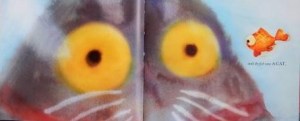
Inside Cat

Inside Cat
Brendan Wenzel
Chronicle Books

Brilliantly playful is Brendan Wenzel’s Inside Cat wherein rather than the cat being an object viewed by other creatures as in They All Saw a Cat, this cat is the subject doing the looking.

Readers share with said cat its view of the outside world through all kinds and shapes of windows. No matter where the moggy wanders, or the condition of the window(s) there’s something of note be it small or large upon which to fix its gaze and wonder – downward, upward or side by side.

There is SO much to behold, to watch – fluffy rats, roaring flies …

Consequently inside, Cat is a veritable fount of knowledge with all this information amassed from various vantage points.

But … then comes a startling surprise. It’s certainly one for the protagonist but readers faced with that final spread will probably wonder what took our feline friend so long to widen its horizons …

The story is told through a seemingly simple, carefully considered rhythmic, rhyming text and a sequence of brilliantly constructed, equally carefully considered mixed media illustrations that demonstrate how our own experience and our emotions shape our view of the world and the personal narrative we construct.

Assuredly this is one of those books that readers will want to return to over and over, with the possibility of new discoveries emerging on each reading. Equally it’s a wonderful starting point for children’s own creativity or a community of enquiry discussion.

A Stone Sat Still

A Stone Sat Still
Brendan Wenzel
Chronicle Kids

As with They All Saw a Cat, Brendan Wenzel explores perspective, this time playfully using a stone as the focal point.

A stone sat still/ with the water, grass, and dirt,/ and it was as it was/ where it was in the world.

A series of spreads, shows the stone as it is experienced by all manner of wild creatures: a snail crawls over it, a chipmunk stops on it to nibble a nut; for an owl it’s a bright place upon which to perch, while a gull cracking a clam shell finds it ‘loud’,

in contrast to the snake for which it was a quiet spot upon which to bask in the sun.

The stone’s texture to a slug is ‘rough’ whereas to a racoon’s paws it’s smooth.

The meditation on the inanimate object continues through the seasons when it takes on a variety of hues – green, red, purple and blue as witnessed by four different animals.

Its size can seem as a mere pebble to a large moose but to a bug, it’s an enormous hill; while in the dark, its sensory qualities are picked up as a feel to investigative racoons, whereas it’s a smell to a sniffing coyote on the hunt.

Readers too experience the stone’s sensory qualities, thanks to Wenzel’s text and his superb mixed-media illustrations, large and small.

As they move through the book, readers will, so long as they are observant, see that around the stone, the water is on the rise

as little by little it is engulfed, becoming a tiny island and then a wave, a memory, ‘and the stone was always.’ Submerged beneath the waves ‘with water, grass, and dirt a stone sits still in the world.’

Assuredly this is a book that invites us to celebrate the changing and the unchanging, and encourages us to look closely and ever closer, not only at the illustrations, but also at the natural world around.

It’s one to have on hand if you are thinking about wildlife, about perception and perspective, even perhaps about existence itself; it’s deep and gently powerful, and has much to offer across a wide age range.

Hello Hello

Hello Hello
Brendan Wenzel
Chronicle Books

An exchange of hellos between a black cat and a white one sets in motion a concatenation of greetings that celebrates the world’s amazing diversity of zoological life forms, as each turn of the page leads on to something different.

First it’s the varieties of ‘Black and White’ showcasing the black cat, a black bear, a panda, a zebra and a zebrafish.
This fish starts off the colour blast on the next spread where we find …

which completes the rhyming couplet.
The salamander greets the striped and spotted animals on the following page and so it continues with more and more animals and greetings as the creatures pose and posture, display their tongues,

avort, turn upside down or strut across the pages leading into a dance of interconnectedness over the final double spread.
Wenzel uses many different media – pastels, markers, coloured pencils, cut paper collage and oils to showcase his arresting animal and human compositions.

Each of the animals portrayed has a vital role in the ecosystem it inhabits and Wenzel reminds readers of this in the final pages of the book. There is also a double spread identification guide – a cast in order of appearance –that includes information on which ones are ‘vulnerable’, ‘near threatened’, ‘endangered’ or ‘critically endangered’ species. We should get to know more about these amazing creatures and the need to protect those under threat.
As Wenzel, himself an animal enthusiast, says in his author’s note, ‘It starts with saying hello.’

A clever and artful book that celebrates both difference and what unites us, and a message about acceptance of all.
Savour, share, and discuss.

They All Saw a Cat / Picture This

%0AThey All Saw a Cat
Brendan Wenzel
Chronicle Books
A cat is a cat, is a cat, no matter what. Right? Perhaps not. The world looks different depending on the lenses through which we view it, surely? I certainly think so. It’s a wonderfully philosophical consideration brilliantly demonstrated by author/illustrator Brendan Wenzel in this creative, thought-provoking mixed media exploration of observation, imagination and perspectives, which begins thus:
‘The cat walked through the world, with its whiskers, ears and paws …’. The child sees the cat, the dog sees the cat – sleek and slinky, the fox sees the cat – chunky and stubby, the fish sees the cat thus …

%0A

and the mouse – well the mouse sees an alarmingly jaggedy, predatory monster, and the bee sees a pointillist image. On walks the cat and is seen by the bird, the flea, the snake, the worm and the bat …

DSCN8621

A dozen sightings, every one through different lenses, lenses which create shifts between texture, colour and tone, underlined after all twelve sightings by ‘YES, THEY ALL SAW A CAT!’

DSCN8622

We’re then told ‘The cat knew them all, and they knew the cat.’ –a lengthy discussion might ensue from this statement alone. But wait, we’re not quite done yet; the cat walks on and comes to the water: imagine what it saw …
Wenzel uses a range of painterly styles borrowed from impressionism, pointillism and others to make readers think about how perception, art and emotion are intricately linked. But that’s not all: the use of italics and capitals and the patterned structure of the narrative all contribute to the impact of the whole.
This is a book that can be used right across the age range from early years to adult students of art and philosophy: what a wonderful way to help the young to begin to understand and give credence to other people’s viewpoints.

The manner in which emotions are engaged and affected by the visual composition of images is explored in the revised and extended edition of a fascinating and insightful book first published 25 years ago:

%0A

Picture This
Molly Bang
Chronicle Books
In the first hundred or so pages, Molly Bang takes the story of Little Red Riding Hood and shows how different placement of cut paper shapes and colours on the page work together to help create and build up emotionally charged scenes, our perceptions of which are bound by the context of our own experience. Why does a triangle placed on a flat base give us a feeling of stability whereas diagonal shapes make us feel tense?

DSCN8650

How come we feel more scared looking at pointed shapes, and more secure or comforted looking at rounded shapes or curves? These questions are explored as are others of colour choice and combination.
In the second, much shorter (new to the revised edition) section of the book, the author takes her story When Sophie Gets Angry – Really, Really Angry, and using four pictures from it, looks at how she created four distinct feelings – one per illustration – of Fury, Sadness, Expectancy and Contentment/contemplation and uses them to explore the principles she’s looked at in the first part. And the final pages invite readers to create and analyse a picture of their own. Perhaps but first I’m off to take another look at some picture books starting with Bethan Woollvin’s Little Red.

WNDB_Buttonlocalbookshops_NameImage-2