Welcome to Ballet School / Pop Art

Welcome to Ballet School
Ashley Bouder and Julia Bereciartu
Frances Lincoln Children’s Books

In this book, we follow a diverse group of beginners from their first day at ballet school where they excitedly don their colourful dance attire and ballet shoes before warming up.

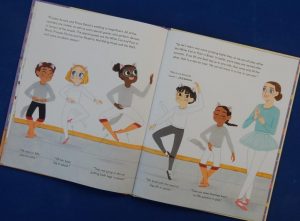
They then learn the five basic positions for arms and feet ready to approach the barre.

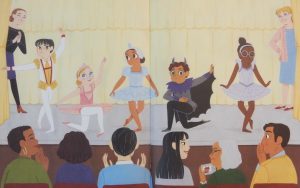
With the basic steps mastered and key techniques acquired, the children are introduced to a special guest who helps them use their learning to tell a story (Sleeping Beauty) with costumes
and a surprise finale.
A firm believer that ballet is for everyone, the author, Ashley Bouder is a principal ballerina and in addition to the concise instructions in the lessons, she’s added a useful glossary of the terms used at the back of the book. But would a teacher, however welcoming s/he wanted to be, really greet children such as those entering the class, as “ little ones”?

Julia Bereciartu’s illustrations are beautifully done and will be a great help to new learners as they zoom in on the five positions and show details of the leg movements in the steps.

I especially like the assertion that ballet is ‘an art form but requires an athlete to perform the steps’ said as the children pause to look at the final gallery of great dancers from various parts of the world.

A book for aspiring dancers and those experiencing their first classes; could that be your child?

Pop Art
Emilie Dufresne
BookLife Publishing

Courtesy of art specialist Chloe, an employee of the gallery, readers are given a preview of a Pop Art Exhibition to be held in her place of work.

Before that though comes an explanation of what Pop Art actually is, when it became popular and why.

We meet several artists – Robert Rauschenberg, Andy Warhol, Roy Lichenstein and Yayoi Kusama –

and as well as an introduction to their particular techniques, there are activity spreads.

These give instructions on, in turn, trying your hand at collage, creating a comic strip and captions; painting a portrait pop art style and painting a pumpkin after the fashion of Yayoi Kusama.

The book concludes with a quiz, encouragement to visit a gallery and a glossary.

Pop Art is a style less frequently explored with primary children; this title in the In My Gallery series provides a useful starting point for home or school.
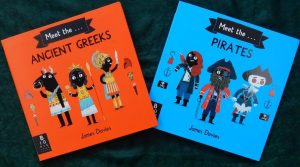
Meet the … Ancient Greeks Meet the … Pirates / Building a Roman Fort

Meet the … Ancient Greeks
Meet the … Pirates

James Davies
Big Picture Press

Now with sturdy flexible covers, are James Davies’ most recent Meet the … books.

As with the first two titles, what characterises these is James’ exuberant writing style and the way he presents a considerable amount of information in a way that is highly engaging, gently irreverent, funny and sometimes surprising.

In Ancient Greeks, definitely one of the greatest civilisations, we find out about buildings, battles, politics, the gods, education, language, festivals, games, arts, science and more, each topic having its own spread; and the book ends with a quick look at Greece today and a timeline.

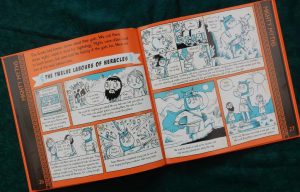
Who could fail to giggle at his cartoonish comic-strip presentations of The Twelve Labours of Heracles

and Pandora’s Box, or chuckle over the depiction of Homer writing his epic blog? And all those speech bubbles are splendidly silly.

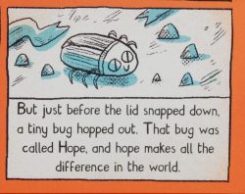
Which brings me to the illustrations in general: the Greek spreads are rendered in orange and black (with occasional use of blue) – let’s give the last words to the final panel of Pandora’s Box – highly pertinent today …

In Meet the … Pirates – equally bursting with facts and fun – we move forwards in time a fair bit (after a Viking encounter) and come face to face with some of the most famous and fearsome pirates, the likes of Blackbeard with his famously smouldering beard and hair. EEEK! You certainly wouldn’t want to come across him or his ship on the high seas.

I was unaware of Black Bart though – the most successful pirate of the Golden Age by all accounts. And we mustn’t forget the women: apparently they weren’t actually allowed to be pirates at all but some made a pretty successful job of it from the 1500s to the late 18th century.

We also discover what life aboard ship was like, – certainly not a life for me, booty or no booty, with the likelihood of scurvy, gangrene, lost limbs and worse.

No thanks! However hard James tries in his hilarious presentation, I’ll restrict my piratical fun to reading this splutter-inducing offering from the safety of my sofa.

Again the book concludes with a look at modern day piracy and a time line.

Building a Roman Fort
Robin Twiddy
BookLife Publishing

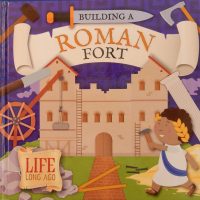
This is one of a history series Life Long Ago that uses a child narrator – in this instance Atticus, son of a Roman centurion in AD 46 – to help make the topic accessible to a young audience.

The boy describes the process of building a fort from the outside inwards; and in addition, readers will discover the answers to where and why. They’ll learn about the various materials used, the design and more.

The text comprises speech bubbles and fact boxes that present the information succinctly using the occasional Latin word. (I was surprised to discover that a centurion was in charge of 80 not 100 men.)

There are plans and diagrams, as well as illustrations of Atticus and his family, making for a clear and informative first guide to use in a primary school topic on the Romans.