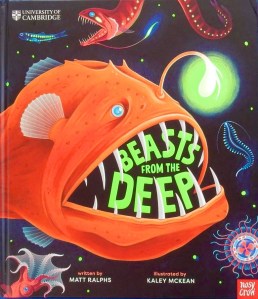
Beasts From the Deep
Matt Ralphs illustrated by Kaley McKean
Nosy Crow
Many of the marine creatures featured in this large format book look like the stuff of nightmares, as you turn the pages that take readers through the five ocean layers. So take the plunge if you dare, down, down first into the twilight zone – a bright and busy area that gives a home to all manner of weird and wonderful creatures – some of the scariest of all. There’s the Atlantic Wolffish, possibly the size of a bath if fully grown, with sharp protruding teeth (hence the name) and a clever natural ‘antifreeze’ protein that allows the blood to flow even in the chilly waters of its North Atlantic home.
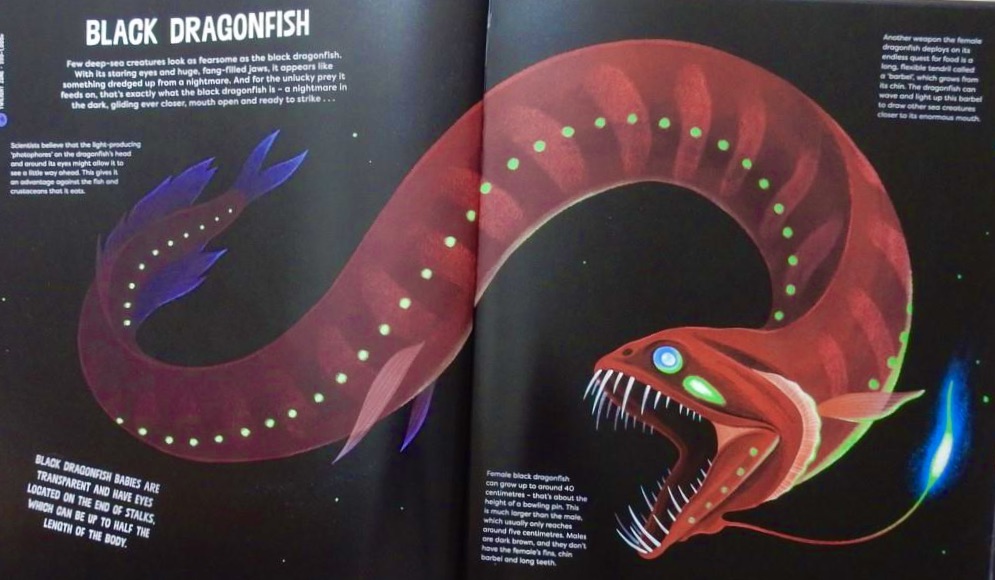
Equally alarming, perhaps even more so, is the black dragonfish. In addition to those horrific teeth, the female beasties use a barbel – long flexible tendril that protrudes from the chin and when lit up can attract potential prey towards its mouth.
With no sunlight penetrating, the midnight zone (1,000 – 4,000 metres) is one of constant dark save for the flashes from bioluminescent creatures. This zone is rich in different species of sharks including Greenland sharks that can live to be 500 years old; as well as some of the weirdest-looking monsters you could imagine, or rather couldn’t. There’s a fish – the Fangtooth -with teeth so long it cannot close its mouth.
I think I’d rather face some of those jellies that pulse, flash and glow in show-stopping colours like the Bloody-Belly Comb Jelly or the Halitrephes Jellyfish, both of which inhabit the midnight zone.
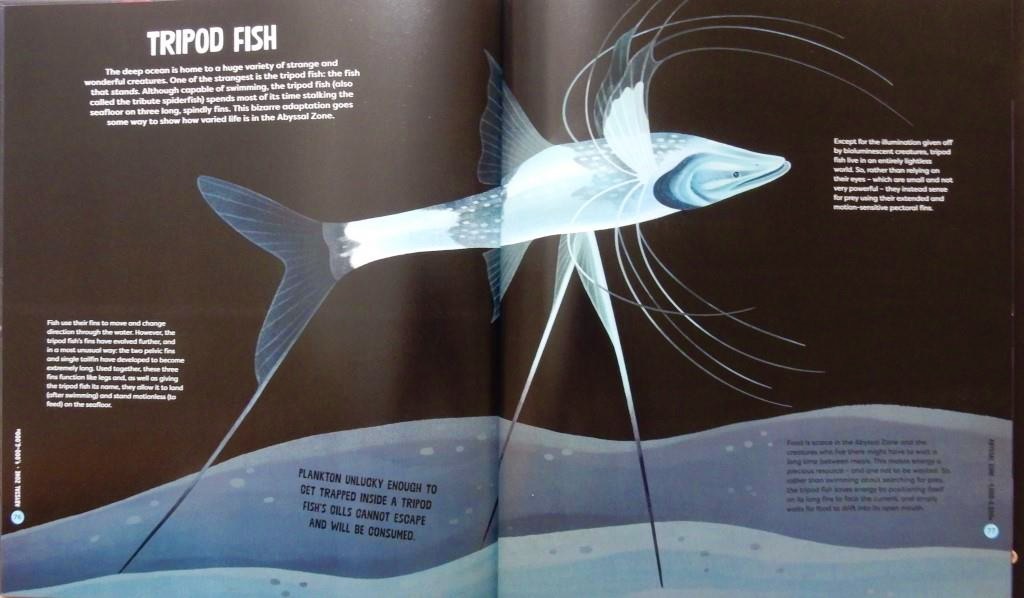
Dive even deeper and there’s the aptly named abyssal zone where the complete absence of light means it has no plant life. There are thought to be various creatures that have adapted themselves to survive, so we read ‘crushing pressure and near-freezing darkness.’ One is the Tripod fish that is able to stand on the seafloor using its specially evolved fins.
A monstrous menagerie indeed exists in our ocean waters, with new kinds of creatures being discovered all the time.
Kaley McKean’s awesome artwork and Matt Ralphs’ captivating text, created with input from biologists from the University of Cambridge, will certainly astonish and inspire young would-be marine biologists and other people fascinated by a largely unexplored world.
 Red Reading Hub - Jillrbennett's Reviews of Children's Books