The Tiny Baker / I Took the Moon for a Walk

These are two books from Barefoot Books – thanks to the publisher for sending them for review

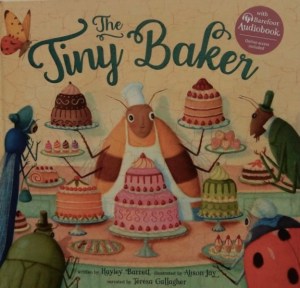
A wonderfully whimsical, tasty picture book told in rhyming couplets by Hayley Barrett and illustrated in oils by Alison Jay.

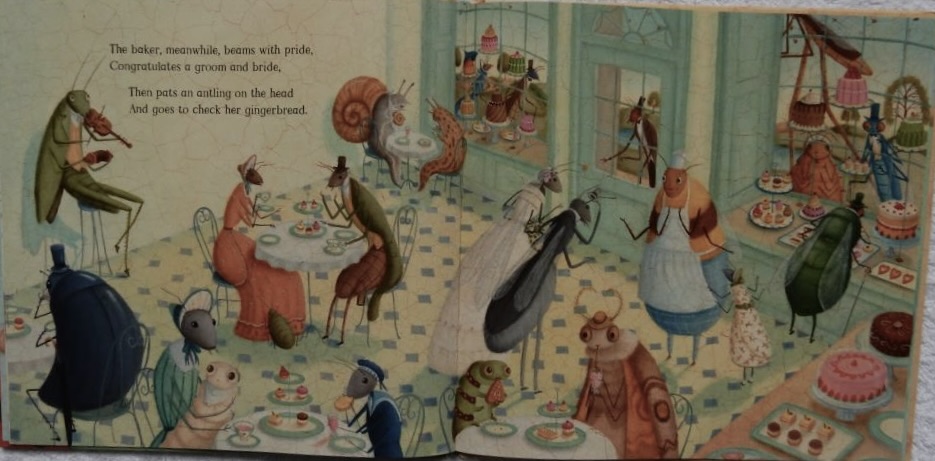
As the story begins the titular tiny baker is listing on a chalkboard the sweet treat she has on sale that day. Outside her establishment is a long line of ant customers elegantly dressed waiting to try her ‘lemon tarts, / Her sugar-sprinkled cookie hearts, / To sample her pecan pralines / And nibble lacy florentines.’ Meanwhile inside, the baker ensures all is ready and with her team of ladybirds busy whisking and mixing the clock approaches opening time.

At three on the dot, the door opens and in come the ants to be ushered to the table ready to enjoy a treat or two.

But in the kitchen the ladybirds have downed tools and are leaving the kitchen through an open window. Disaster! When the baker re-enters the kitchen she’s aghast at what she sees. Every single worker has flown away leaving chaos in their wake and a baker ‘slumped amidst the mess – / Bewildered, flummoxed, in distress’ …

Having heard the to do, cricket sounds a call to action and the ants respond by cleaning, moving, clearing and mending until very soon order and the tiny baker are restored. Overcome by the wonderful gesture of her customers, the baker is even more surprised to learn of the prime reason they make their daily visit to her establishment. As a way of showing her immense gratitude she offers them a tray of her goodies.

As endearing tale of kindness and community that will surely make readers’ mouths water at the yummy pastries and delight in the period flavour provided by Alison Jay’s portrayal of the customers in fashionable Victorian clothes in her detailed scenes created on a craquelure background.

Mysterious and enchanting is this story of a nocturnal walk taken by a boy narrator. With the moon following behind him like ‘a still summer kite’ he has a variety of small but significant adventures. For instance, unused to accompanying a boy on a walk, the moon very nearly gets hooked on a church spire. It’s also serenaded by a canine chorus and later on hand in hand, the two tiptoe through the grass ‘where the night crawlers creep / when he rust-bellied / robins have all / gone to sleep.’ They enjoy a swing flying up high and more before crossing the bridge and returning to the narrator’s home where the Moon shows its thanks by providing a ‘sweet sleepy light’.

Lyrical and rhythmic, Carolyn Curtis’s text reads aloud well and complemented by Alison Jay’s gorgeous scenes of a world bathed in moonlight, would make a comforting pre bedtime tale.
At the back of the book, the author includes information about ‘The Mysterious Moon,’ and ‘The World at Night’, which gives facts about some fauna and flora.

There is a QR code on the back cover of each book: scan them to bring the stories to life with narrations by Teresa Gallagher.

Big Thoughts / Some Days I’m the Wind

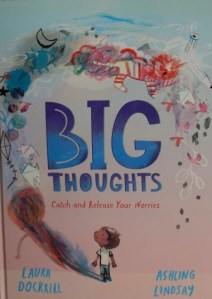
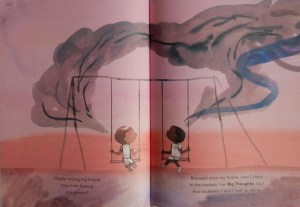
We’re all beset with worries from time to time – ‘Big Thoughts’ as the child narrator of this books calls them. Such thoughts can’t be seen by others despite them being loud inside your head. They might be Big Thoughts about the future, the past or perhaps even make-believe (not telling the truth). Moreover the more one tries to ignore such thoughts, the louder and more all embracing they become.

So what can be done to alleviate a very worried mind? One way is to share them with a an older person who has learned some coping strategies. Strategies that can be passed on and will then stay with the sufferer henceforward. Another way is to talk with a friend who has suffered similarly, so neither person feels alone.

Laura Dockrill’s text is such that readers/listeners are made to feel the centre of attention – seen and heard – and together with Ashling Lindsay’s sensitive illustrations and the final spread entitled Tips and Techniques’ make this a very reassuring and helpful book.

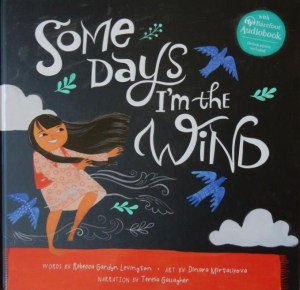
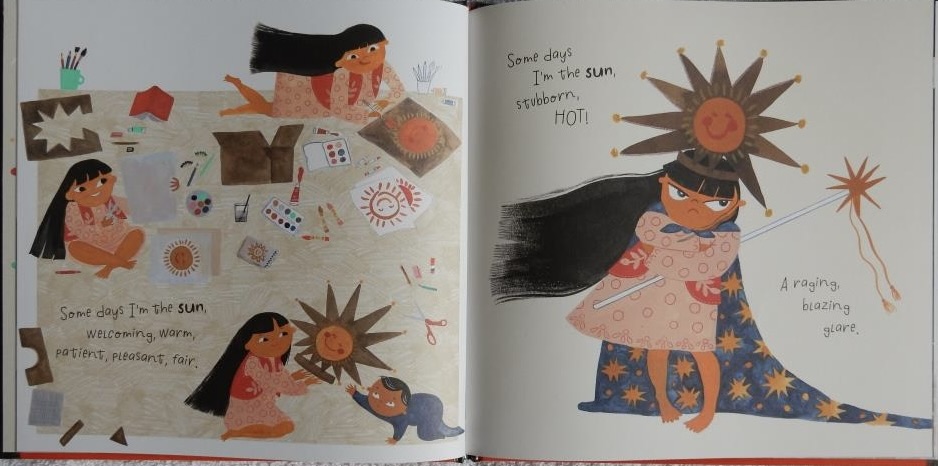
Using metaphors relating to the weather and the natural world, the young narrator of this book tells us how her feelings and emotions can change from day to day or perhaps several times in a single day. “Some days I’m the sun, welcoming, warm /patient, pleasant, fair. // Some days I’m the sun, / stubborn, HOT! / A raging, blazing glare.’

Or, ‘Some days I’m a tree, / flourishing, strong, reaching for the sky/ // Some days I’m a tree / trembling, bare, / bidding leaves goodbye.’

The well chosen, child friendly metaphors combined with the repeat ‘Some days’ of the gently rhythmic text and the vibrant, boldly coloured illustrations, keep readers turning the pages as they, like the narrator come to understand that there are a whole multitude of ways to feel, to act and to be. This is reaffirmed in the final proclamation, “And just like the wind, / or the sun, / or the sea / on some days / I’m some ways, / but all days // I’m me.”

After the child’s narration is a spread entitled “Exploring Our Emotions’ written by a child development specialist. A book to share and talk about at home, or with an EYFS or KS1 class.

Thank You, Old Oak

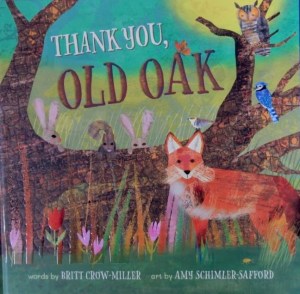
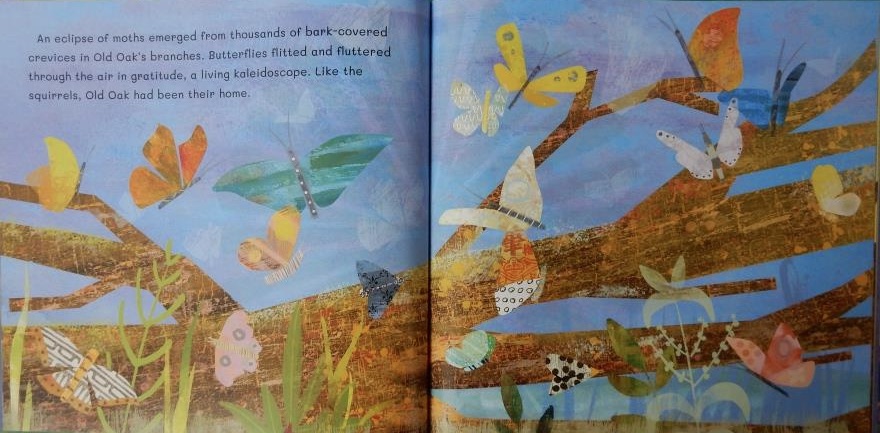
Old Oak has flourished in the forest for more than 400 years but now it’s tired and one morning just as Owl has settled into his hole, down she crashes sending him skywards. Then all manner of forest creatures – squirrels, moths and butterflies,

rabbits, possum, deer and black bears gather to show appreciation for the food and shelter Oak has provided over the years. Indeed every branch in the forest is also crowded ‘with noisy nuthatches, blue jays, and thrushes, each crooning a call of gratitude, creating a symphony of crowing, whistling and lively trills.’ All these and more are shown in Amy Schimler-Safford’s mixed media textured illustrations.

Yes, that might be the end for her rooted life but in other ways it’s another beginning. Old Oak still has a key role bringing new life: trees growing nearby gain strength from her minerals, animals of various kinds feast on her trunk and come the spring rains, her softened logs help young mosses and ferns to grow (nurse logs, they’re called, so the information after the story tells us).

It’s wonderful to see a whole new generation of oak seedlings (Old Oak’s legacy), planted by forest animals starting to grow as sunlight fills the earth that Old Oak once shaded.

A moving story that also contains a considerable amount of information about oak trees. Well worth getting for family bookshelves and primary class collections.

The Remembering Candle

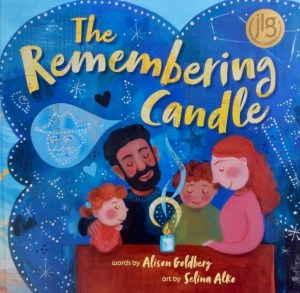
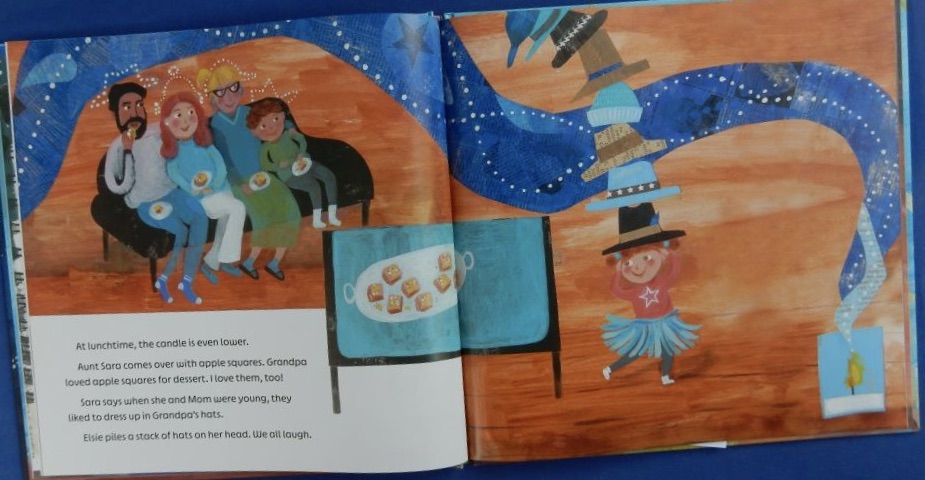
This is a beautiful book that teaches young children about the Jewish tradition, Yahrzeit, for remembering lost loved ones. Herein, with a small boy acting as narrator, we join a Jewish family on the anniversary of Grandpa’s death one year ago.. They are observing the tradition of yahrzeit by lighting a candle in honour of his memory. The candle burns from one sunset to the next and during this time the various family members share the wonderful memories they have of him.

Each of their reminiscences links to something Grandpa used to enjoy: looking through a telescope at the night sky, and being shown Orion in the summertime is recalled by the boy;

this prompts him to start creating a memories collage and his sisters joins in making images of Grandpa’s hats. These hats are also remembered by Mum and Aunt Sara who joins the others for lunch bringing one of Grandpa’s favourite desserts to share.

Then Mum sits at the piano and recalls how she and Grandpa used to play duets. All the while the candle burns, then come nighttime again they gather to watch it go out. Yes, there is sadness but Grandpa’s memory still remains bright in their hearts and minds.

Alison Goldberg’s poignant tale shows so well how the ritual and the memories help the family to deal with their grief and Selina Alko’s sensitive, beautifully crafted collage illustrations wherein she uses white dots to great effect throughout, enhance the family’s feeling of connection to the memorial custom and one another.

(After the story are notes from both author and illustrator and information about Yahrzeit, Jewish Memorial traditions and the Jewish Calendar.)

First Friends: Colours, First Friends: Opposites / Don’t Ever Mess with a Monkey

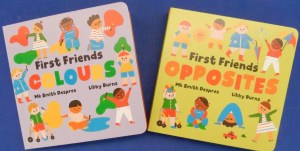
Colours begins with the nursery children and their teachers heading outside to play. The instruction is, ‘Look high, look low. / Look all around!// So many colours/ to be found.’ There are black ants marching across the sand, pink worms wiggling on two children’s hands, a red slide, a blue swing and a purple bar to swing along, as well as a wonderfully messy opportunity to use mud and leaves to create mudpie faces. Meanwhile at the water tray a floating and sinking activity has yellow, orange and white objects to test. Then just before snack time everybody blows bubbles with rainbow colours. The final spread encourages interactive learning with a ‘can you find’ showing all the coloured items featured throughout the book.
In Opposites, we join the children preparing for a rest time with some winding down movements that involve stretching high and low, then yawning, mouths open and sleepy eyes closed. When everyone wakes up, some are smiling, others frowning as they stack the mats up and take down the toys.
During the remainder of the session the narrative builds in other opposites – empty/full, small/big, behind/ in front and the final spread asks listeners to act out eight pairs of opposites.
Both books have bright, inclusive illustrations that show a diverse cast of characters.

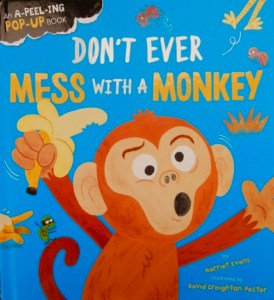
The latest in the Don’t Ever pop-up series features five wild animals that live in the savannah region. Readers/listeners are warned against riding a zebra, boxing with hyenas, question the decision of rhino, rob an ostrich or give a monkey food that isn’t to its taste. For sure, the results will be far from pleasant for anyone who ignores the warning on each spread.
Harriet’s rhyming text accompanies David Creighton-Pester’s dramatic scenes, each of which includes one or more bit part players that young children will enjoy spotting

Won’t Go! / Not Tired!

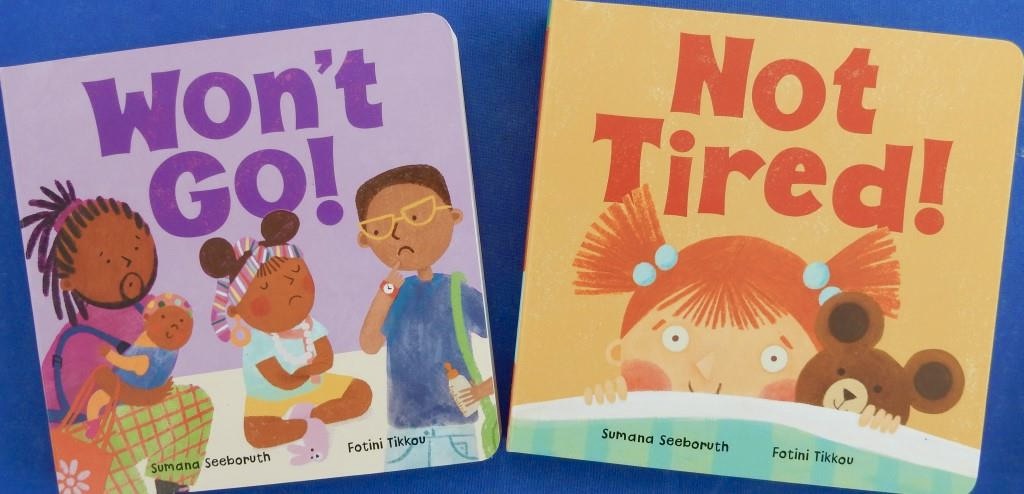
Both books are part of the publisher’s Feelings & Firsts series and with their bright expressive illustrations and simple words told from the featured child’s perspective, are worth having if you have a very young child.

Won’t Go! shows a small girl busy playing at home and protesting about being told she must stop and go elsewhere. Eventually though, after some playfulness on the part of one of her dads, it’s off to the ballet class. There however, all the other pupils are wearing blue, but fortunately the teacher has a pink dress and shoes in a similar hue to those of the little protagonist. This makes all the difference both during the lesson and afterwards when her dads arrive to collect her with the baby.

Not Tired! presents another situation that the majority of parents/carers will be familiar with. A small child wants to continue playing and certainly isn’t ready for bed. There follow a plea for another book, another snuggle and some shenanigans over a missing teddy bear until at last the little one has tired herself out and is ready for that goodnight kiss before falling fast asleep. In this book the mother is differently abled but this is shown rather than spoken of in the text.

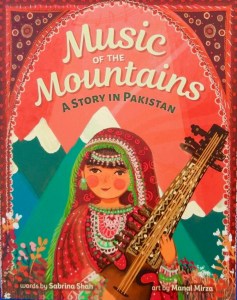
Music of the Mountains

This story is set in the Northwest mountainous region of Pakistan where, taught by her Neeka Baba (grandfather), young Roohi, a Pashtun girl, is learning to play the rabab, a lute-like folk instrument. Eid-ul-Adha is approaching and she yearns to become sufficiently proficient to play well in the school concert. When she tells Neeka Baba that she’ll never be as good as he is, he responds thus: “You must feel the rhythm, feel the beat of your people … “You must believe in yourself … You must play with the courage of all those who came before you.” Every day she has a lesson but one day Neeka Baba is coughing and despite his reassurance that all is well, he cannot teach her as he has to rest in bed.
So great is the pressure of letting everybody down Roohi feels she just can’t pick up her rabab. “I’ve heard you play. We are all so proud of you” reassures her Mama … “Maybe play like yourself.”

Come the day of the concert, Roohi bravely walks on the stage and begins to strum. Can she find courage within herself to continue after a fumbled first note? Can she now at this vital moment find her own rhythm?

A lovely interweaving of family bonds, music and culture. Sabrina Shah’s rhythmic text conveys so well Roohi’s feelings and with richly-hued illustrations by Manal Mirza, capture the cultural setting beautifully. I love the patterns and detail on the clothing. (Backmatter gives additional information about the rabab, the Pathan/ Pashtun people of northwest Pakistan, as well as Eid-ul-Fitr and Eid-ul-Adha,, and on Roohi’s kamees partug. There’s also a short Pashto glossary.)

First Friends: Numbers / First Friends: Shapes

The setting for both these board books is a nursery or pre-school where we join a group of young children.
Numbers takes the little ones through their time there from fond farewells from parents/carers right up to collection time by the same adult. In so doing the children share their play activities both indoors and out, eat lunch together, visit the loo and then rest on their mats, play again and bid each other and the teachers, goodbye before once again embracing a waiting parent/carer. The rhyming text and inclusive illustrations introduce the numbers 1 to 10 as we go through the day and there’s an interactive element in that the final ‘Can you find?’ will send little ones back searching for and counting the labelled items depicted.

Similarly presented is Shapes. Herein we join the same children as they, and those sharing the book find various 2D shapes – circles, rectangles, squares (actually cubes though they are are all shown face on), diamonds, moons and hearts, triangles. These are used to make winged insects, a rainbow arc, then ovals and stars as they play with soft toys. Come time to clear up, everyone joins in before gathering together for a circle time.
Finally there’s a spread depicting the ten shapes encountered introduced with a ‘How many can you find … ?’challenge. I wonder how many youngsters will include in their shapes counting the squares, circles on clothes and eyes etc. depicted in the bright scenes.

A fun way to reinforce basic maths alongside the all important play experiences.

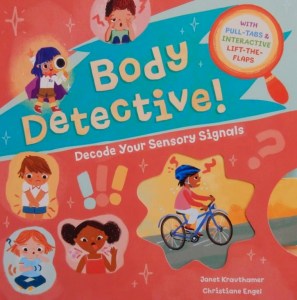
Body Detective!

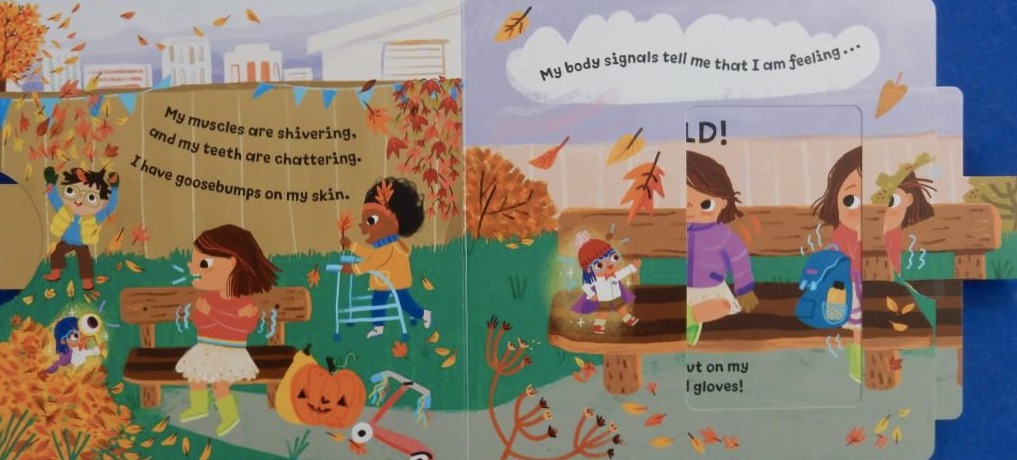
Written by an occupational therapist, this board book presents interoception to very young children. It’s important for little ones to be able to know and name what they are feeling: to that end author Janet Krauthamer and illustrator Christiane Engel use clear explanations, bright illustrations with flaps to lift, tabs to pull and mindful actions.

A playful, interactive, fun learning exploration of the human body’s signals: little ones will enjoy being body detectives and learning by means of descriptive language that for example, a dry, sticky mouth and lips are signals from the body that the person is thirsty and need to drink water. Chattering teeth and goosebumps on the skin are body signals indicating a person is feeling cold.

The last two spreads provide more information about interoception, and relevant body parts and describing words including discombobulated – now there’s a great word for tinies to use.

Use at home and in an early years setting for promoting health and well-being.

The Midnight Mitzvah

Hanina Chipmunk loves collecting nuts and sharing them with her hungry friends; she knows that helping others is a mitzvah (good deed) but not everybody welcomes her thoughtfulness. One such person is Mathilda Squirrel; she rejects a nut offering from the puzzled Hanina. Then mouse Leon explains that Mathilda was herself a champion nut gatherer but now, on account of her waning ability to move around she feels embarrassed about needing help. Yes, it’s a mitzvah to help but so too is not embarrassing somebody while so doing.

Hanina ponders on the problem and finally, at night the answer comes to her: she’ll work under cover of the dark thus accomplishing both objectives.

Aware that she’s breaking the forest rules by going out gathering at night, Hanina is much more troubled by the thought of Mathilda going hungry that the possibility of angering the nocturnal creatures.

As she gathers nuts the little chipmunk is suddenly confronted by the Great Horned Owl; this night creature, a possible chipmunk predator, questions Hanina and having heard what she has to say, ends up sympathising with her explanation, calling the little creature kind and wise: “A gift given in secret is a very great mitzvah” says the owl.

Based on one of Judaism’s central texts, the Talmud, the tale has a sweet message concerning the real meaning of charitable giving, Tzedakah, as the author’s end notes tell us.

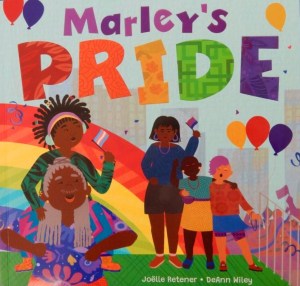
Marley’s Pride / You Are Brave

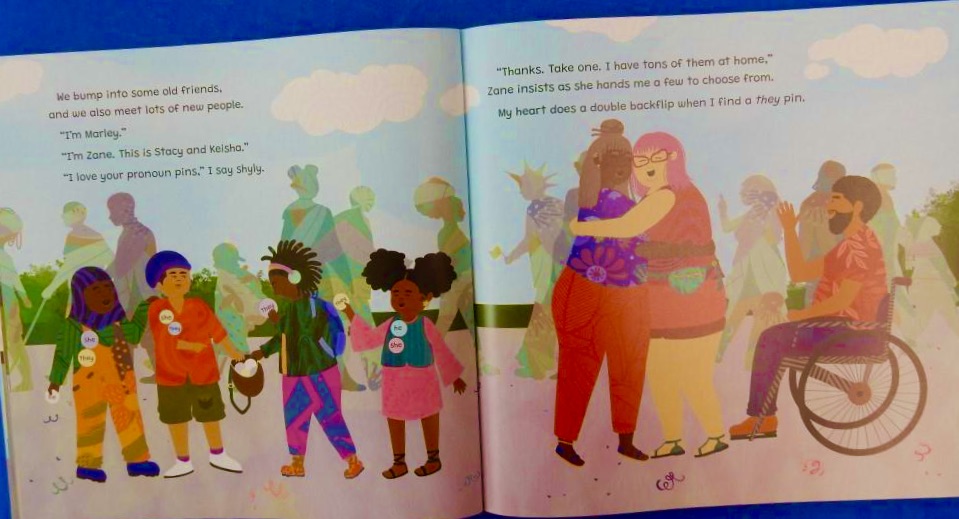
It’s June and for Marley and for Marley’s grandparent Zaza, that means Pride month with its parades and other celebratory activities. Marley really wants to join Zaza at the festivities when they’re to receive an award for transgender advocacy, but with sensory sensitivities noise and crowds making the child tense up at the very thought, it’s a no go for the young narrator.
Come the morning of the parade, the child decides to give it a go after all. Into a bag go noise-cancelling headphones a fidget spinner and favourite lavender bunny and off go Zaza and Marley, the latter feeling very uncertain.
At the venue, just as things threaten to overwhelm Marley, Zaza’s reminder, “Pride isn’t just a big ole party. It’s about celebrating who we are, about community, and love” gives the child a boost of courage to go among the crowds. By the end of the day, Marley feels a part of that community with new friends

and a personal delight at belonging.

Author, Joëlle Retener’s telling is a celebration of Pride’s communal spirit brought wonderfully to life with DeAnn Wiley’s inclusive, splendidly textured, bold digital illustrations.
Backmatter comprises double spreads entitled the History of Pride, that includes paragraphs about sensory sensitivities, the other, with lots of definitions and explanations is called More About Marley’s Pride. An invaluable resource for primary schools especially.

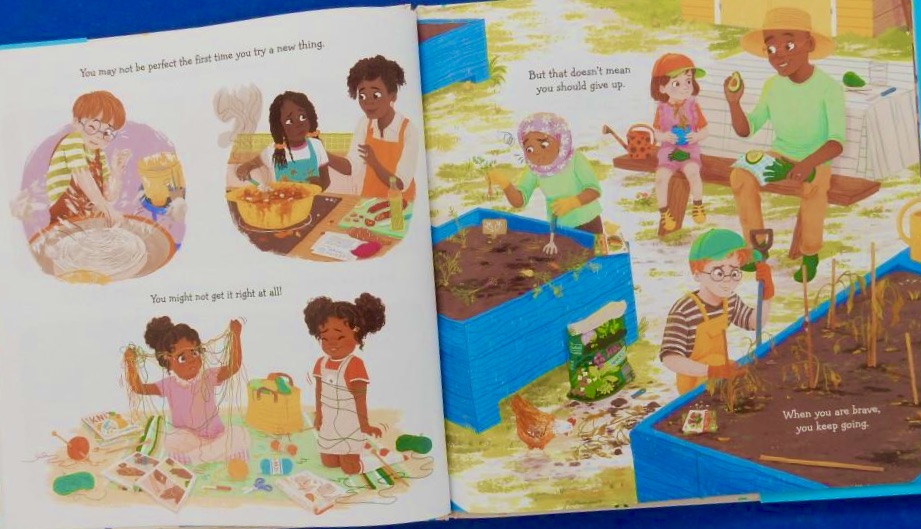
‘Being brave does not mean you are not afraid. It means you are afraid, but you do the scary thing anyway.’ Inspired by Sofia Sanchez, a young actress and model who happens to have Down syndrome, that is the vital life lesson contained in this book.

‘Every day, says author Margaret O’Hair, we meet people who inspire us – people who are amazing at the things they do.’ Sofia Cardoso illustrates a guitarist, a vet, a pilot, a baker, a gardener and several others. Before they became amazing though, they had to make the ‘tough decision’ to try something new, which likely meant they had to be brave. This is something that needs to be learned like everything else and no matter what ‘being brave means doing something you want to try.’ Of course, success seldom comes at the first try, but that’s no reason to give up;

Inclusive and optimistic in tone, this is surely an encouraging invitation to challenge yourself, have a go and try something new. With its important messages, this is a book to share and discuss in primary classrooms.