All Cats are on the Autism Spectrum

All Cats are on the Autism Spectrum
Kathy Hoopmann
Jessica Kingsley Publishers

This book is an updated version of the author’s 2006 All Cats Have Asperger Syndrome and since then what is considered acceptable terminology has changed and the author says in her note for this edition that people’s views are not all the same and that she hopes ‘readers will see past the finer details of disagreement and join me in celebrating, and deepening our understanding of, the richness and diversity of the autistic community.’ You can’t say fairer than that.

Essentially the book shows a sequence of photographs of cats/kittens in various situations accompanied by a sentence relating the visual to an element of being on the autism spectrum or as I prefer to say, neurodiversity. Thus the book opens with a shot of a kitty wrapped in a scarf and wearing a woolly hat introduced by ‘The first signs of autism are usually picked up very young.’ Now I could from my own experience challenge that for several reasons, but will say no more other than it’s generally truer for boys than girls, and remember the author’s words on her introductory page.
What I think Kathy Hoopmann is intending to present to readers how a child with autism might view the world: thus we have ‘Autistic people often have exceptionally good hearing, and loud sounds and sudden movements may scare them.’ 

and ‘Daily rituals comfort them, and they get worried if their schedules or surroundings are changed.’ 

as well as ‘When they are spoken to, they may refuse to make eye contact. When they talk, they go on and on about the same topic or ask the same questions over and over again …’

It’s great to read the acknowledgement that ‘with their unique perspective on life, their eye for details that others often miss and their passion for researching something they love, many will reach the top of their chosen fields … those on the spectrum are just like everyone else. They need love, encouragement and a purpose for life … and then everyone can sit back and enjoy the unique individuals they become.’

Poignant at times, funny at others, this book is a useful resource for teachers, parents, siblings, therapists; indeed everyone could benefit from reading it.
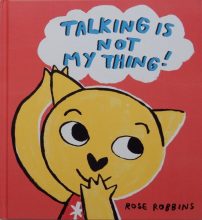
Talking Is Not My Thing

Talking Is Not My Thing
Rose Robbins
Scallywag Press

Having a neurodiverse member of the family can be challenging for everyone as Rose Robbins, the author/illustrator of this, her second book knows so well for she has a brother on the autism spectrum and she also teaches young people who have autism.

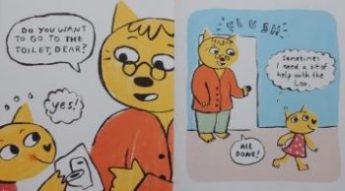
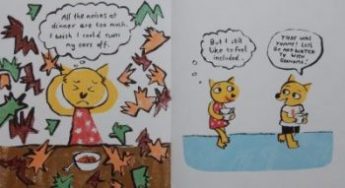
Much of this story is conveyed through the female narrator’s thought bubbles; the rest through her brother’s words in speech bubbles and Rose’s dramatic illustrations. The narrator’s opening thought is ‘I don’t speak. But my brother finds it easy.’

Having followed her brother’s call to come indoors as dinner is almost ready, we learn how she does sometimes attempt to speak using her voice but the words come out wrong. Furthermore as the narrator is sound sensitive the noises of dinnertime cause her some distress, but she likes to feel included.

She also on occasion needs to convey how she feels or what she needs by means of one of her flashcards ( PECS symbol cards perhaps),

It’s great that brother and sister are able to play games together and that sometimes little sister acts as teacher.

Clearly understanding is not a problem, for shared story sessions with her brother reading aloud from a book, give his sister much pleasure.

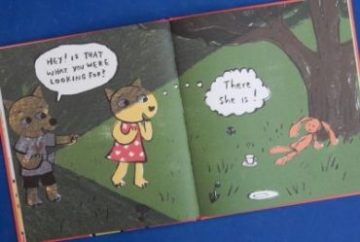
At other times, such as when things go missing, mutual assistance is enormously beneficial. First a beloved soft toy bunny is located

and then once his sister is safely in bed, she finds her brother’s lost car. A highly satisfactory ending to their shared day.

Once again, Rose has created an enormously empathetic story that she conveys with subtle humour and a sense of respect for the siblings she portrays in Talking Is Not My Thing.

That sense of respect and understanding is what I saw yet again very recently while walking in the grounds of Ruskin Mill College, a specialist education establishment near my home that caters for neurodiverse students of between 16 and 25. A fairly newly admitted boy whom I’ve never seen stand still before, stood transfixed watching a heron that had perched atop a tree in the grounds. At least three members of staff stood fairly close keeping a watch on his wellbeing, allowing the boy to take as long as he wanted to observe, what was for all of us an awe-inspiring sight.

Why Johnny Doesn’t Flap/Artistic Autistic Colouring Book

DSCN6324 (800x600)

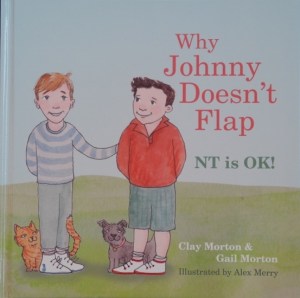
Why Johnny Doesn’t Flap
Clay Morton, Gail Morton and Alex Merry
Jessica Kingsley Publishers
A young male narrator with autism discusses the behaviour of his friend Johnny who can at times act strangely and unpredictably. “Mom says it is because he is NT, or neurotypical. He doesn’t have autism, so his brain works differently from mine.” he explains.
Johnny also looks his pal straight in the eye, which our narrator finds unsettling, he’s not really interested in knowing everything about WW2, dinosaurs or forklift trucks. Johnny understands   the school rules, never has a meltdown and, in the school playground he’s keen to play with the other children. And all of that’s OK. His use of language is sometimes way off –

DSCN6326 (800x600)

he never seems to understand that he should say what he means; describing a maths test as “a piece of cake” well really. Despite all this our young narrator ends positively with these affirming words: “I like Johnny. I think being NT is OK.“
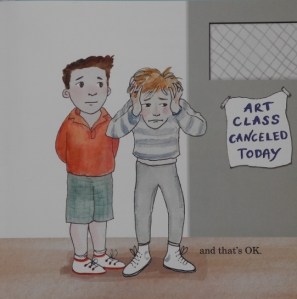
This cleverly constructed role reversing text is effective and it’s always good to try to see things from another person’s viewpoint. The watercolour illustrations are I suspect kept dispassionate for the benefit of those readers who have autism

DSCN6325 (800x600)

(even in the meltdown scene there doesn’t really look to be much emotion on the narrator’s face, nor in his stance) .
The final ‘Note for Parents’ endorses the call for understanding and acceptance whether their own child/children be on the autism spectrum or NT …… ‘ if your child does not have an NT kid in their life, they almost certainly will at some point. … Children with autism often find it very difficult to interact with NTs … But it is important for autistic people to understand that NTs are people too, and the fact they are different doesn’t mean that there is anything wrong with them.’

One characteristic of many people on the autism spectrum is an obsessive interest in a particular topic or activity; here – created by someone who himself has Asperger’s syndrome – is just the thing for those with a creative obsession.

DSCN6321 (800x600)

Artistic Autistic Colouring Book
Peter Myers
Jessica Kingsley Publishers
Amazingly these finely detailed illustrations are hand drawn in pen and ink.

DSCN6323 (800x600)

In many instances their complexity is astounding: some of that minute detail is truly awesome in its precision and beauty.

DSCN6322 (800x600)

Buy from JKP

Use your local bookshop       localbookshops_NameImage-2

Special Books for Special Children

Can I Tell You About Stammering?
Sue Cottrell
Jessica Kingsley Publishers pbk
Eleven-year-old Harry has a stammer. He tells us in a straightforward, matter of fact manner how this makes him feel, how his stammer manifests itself and in what situations, and talks about ways that people can be helpful and supportive when he starts to stammer. We hear about his visits to a speech therapist and also about his older brother, who also stammers and how his case differs from Harry’s. The author of this helpful little book is an education consultant and mother of a son with a stammer. She has researched the subject in depth and offers her expert advice via her character, Harry. In her advocate’s words, “Living with a stammer takes bravery and courage.” Sue Cottrell provides all of us, be we teachers, parents, friends or other professionals, with a sensitive and insightful introductory read. The book’s layout and the numerous line drawings by Sophie Khan make it suitable for young readers from around seven or eight; adults could learn from it too.
Buy from Amazon DSCN1566 From the same excellent series is:

Can I Tell You About Adoption?
Anne Braff Brodzinsky
Jessica Kingsley Publishers pbk
Herein Chelsea, a young girl who has been adopted as a baby, gives readers a frank account of the process of her own adoption as well as introducing two of her friends, Adilu from Ethopia and Kira from China who were also adopted. In contrast to Chelsea, they spent time in orphanages and their adoptions were transracial. There is a short section wherein the three children talk of the unanswered questions in all of their lives, there is information about foster homes and discussions on how teachers and parents can help adopted children or those undergoing the process of being adopted. The overall tenor of this book is upbeat and I can envisage it being a great help both to adopted children and those with whom they have regular contact – teachers and children – at school.
Buy from Amazon

DSCN1567 Babies Are Noisy
Anne-Marie Harrison
Jessica Kingsley Publishers
The time around the arrival of a new baby in the family can be one of anxiety and uncertainty for any young child; for children on the autism spectrum that time with all the changes a new baby entails, is likely to be particularly challenging. Subtitled ‘A book for big brothers and sisters including those on the autism spectrum’ this has a boy narrator, Andre who relates his story about having a noisy new baby. “My Baby” he calls the developing infant and we hear how he watched his mother’s stomach growing larger, about visits to the clinic, see a scan and learn how Andre was able to feel the baby kicking when he sat on his mum’s lap.

RSCN1569

Then after the birth come more challenges – presents for the baby, nappy smells, noise – lots of it – and general busyness at home. Being a big brother though can also be rewarding and Andre starts to help with the caring and he anticipates being able to play with his little brother one day. Such is the sensitivity with which the book is written, there is a real sense of it being a child with autism’s voice in this account. The illustrations too have a child-like style. All in all, this unassuming book will be of great benefit to families and professionals working with children particularly those on the spectrum, as part of the preparation for the arrival of a new baby.
Buy from Amazon

Find and buy from your local bookshop: http://www.booksellers.org.uk/bookshopsearch