The Spectrum Girl’s Survival Guide

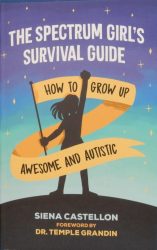
The Spectrum Girl’s Survival Guide
Siena Castellon, illustrated by Rebecca Burgess
Jessica Kingsley Publishers

Sienna Castellon, the seventeen-year-old author is an award winning anti-bullying campaigner and autism advocate; she is on the autism spectrum, and is also dyspraxic and dyslexic, and has ADHD. She is also gifted in physics and maths.

As we learn, her journey thus far has been anything but easy, so who better to write this book subtitled ‘How to grow up Awesome and Autistic’ than she, especially, as she writes in the first chapter, ‘I view my autism as a strength and as an advantage, a modern day superpower.”

Essentially Siena has compiled a comprehensive and detailed manual for readers of twelve plus about living the best life a young female with autism possibly can in a predominantly neurotypical world.

She covers such diverse topics as embracing who you are then deciding with whom to share your autism and how, to clothes and fashion ,

dating, sex and sexuality.

Other sections focus on bullying: face to face
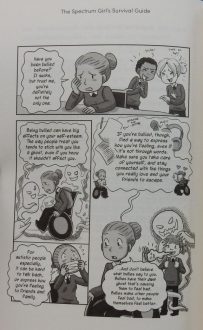
and cyberbullying are covered in separate chapters and strategies for coping with both are discussed.

Self-esteem is key throughout: people with autism do not need pitying, they need understanding is another key message. The neurotypical brain is wired to socialise; in contrast most autistic brains need a fair amount of time alone for the mind to settle and the senses to be soothed.

On the topic of senses, Siena devotes a whole chapter to ‘Managing your sensory sensitivities and sensory overload.’  Siena mentions the relatively simple steps that some supermarkets, cinemas, airports and the like have taken to create a more inclusive environment for people with autism.

Throughout the authorial voice remains both earnest and compassionate; and in between her narrative are some comic style pages drawn by Rebecca Burgess that encapsulate what has been said in a particular section.

Yes, this book has a specific target audience in mind; however the insights it offers need to be shared with everyone. I’m a primary/foundation stage teacher and over the years have taught dozens of children with autism (mainly boys) and have some degree of understanding of neurodiversity. Nonetheless I welcomed the insights I gained from this guide and thoroughly recommend that all educators, parents, indeed anyone who hopes to ensure that all females on the autism spectrum have the very best possible chance to flourish, should read it and carefully consider this enormously wise young woman’s words. Surely that is every one of us, isn’t it?

Tomas Loves …

DSCN4892 (800x600)

Tomas Loves …
Jude Welton and Jane Telford
Jessica Kingsley Publishers
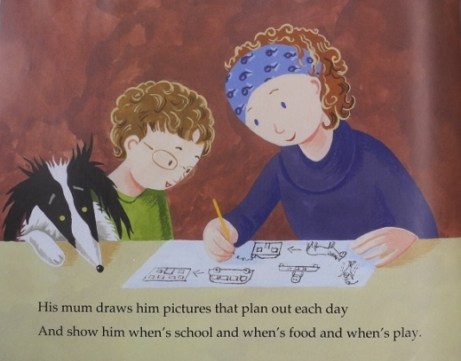
Herein we meet Tomas and his canine companion Flynn (ever present to provide support and comfort). Tomas lives with his loving parents who understand his likes and disilikes and help him cope with his autism. Mum provides him with a daily visual diary

DSCN4895 (800x600)

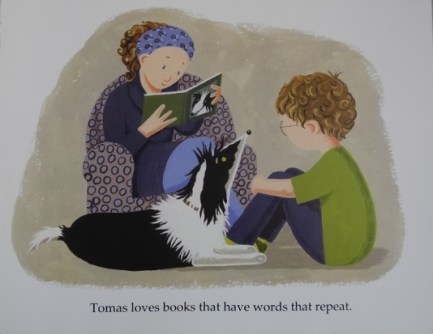
and ensures that as far as possible, he is forewarned of any changes in routine early in the day;  and Dad is always there to read him a goodnight story. Thus they create a calm environment wherein Tomas is able to enjoy books with repeating words …

DSCN4894 (800x600)

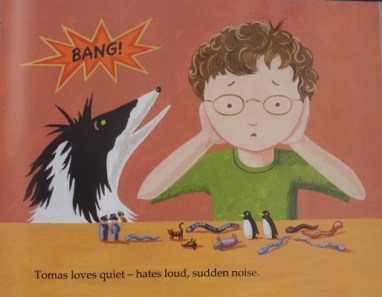
He loves strange-sounding names like ‘thingamybob’ or ‘flipertyjane’ and will repeat them over and over, he also loves to play with his toy trains on the track and also with tiny toys, bouncing on a trampoline, riding a horse and feeding it; and he has a special diet ‘that won’t hurt his tummy’. Sudden loud noises are one thing Tomas hates …

DSCN4893 (800x600)

and sometimes if he is feeling very stressed he might start flapping his hands
Although we are told of all the things about Tomas in particular, things that are fairly common in children who have autism, the overall impression is that he is not so different for:
Tomas loves Flynn, and his Flynn loves him too.
Tomas loves fun and friendship – just like you.
Warmly illustrated and affirming with a gentle rhyming text, this is a book for all early years and primary settings and one that offers a good way to introduce the idea of autism to young readers who haven’t come across the behaviours Tomas exhibits.
Buy from JKP

For a slightly older audience is

DSCN5009 (800x600)

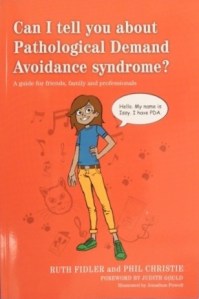
Can I Tell You about Pathological Demand Avoidance syndrome?
Ruth Fidler and Phil Christie, illustrated by Jonathon Powell
Jessica Kingsley Publishers
This informative little handbook is narrated by Issy, an 11 year old girl with PDA (an autism spectrum condition). She shares with readers what it is like to have this condition – one that relatively little is written about in comparison with other ASDs. (Although I have taught a fair few children on the spectrum I’ve never known one with a PDA diagnosis although retrospectively I can think of at least one child who perhaps should have had one.)
We learn from Issy what makes her feel particularly anxious – “loud noises, new shoes and sitting on the smelly floor at school” and being asked to do something someone else wants them to. The latter can make her come up with rather outlandish excuses and if pushed, a long-lasting tantrum or meltdown can result. On particularly sensitive days, Issy and those like her need special consideration and help.
The last part of the book is written from an adult perspective and takes up this topic in the section ‘How other people can help’. Careful prioritisation of the issues to address, making requests in an oblique manner (‘I’d like someone to help me with this task’, rather than ‘do this’, flexibility of approach, anxiety reduction and support with friendship making/maintaining are some of the topics discussed.
For me, what is particularly good about this useful resource is its positive approach to the topic.

Use your local bookshop  localbookshops_NameImage-2