Fly Free!

Using a chain of simple interactions between a variety of people and the repeat refrain, “Fly free, fly free, in the sky so blue. When you do a good deed, it will come back to you!” the narrative of this story comes full circle.

Set in Vietnam, the story opens with young Mai who visits the temple early one morning. Before going inside she feeds the birds kept in a cage near the entrance. As a Buddhist, it is her hope that someone will be able to do what she cannot afford: to pay for the release of the birds. On this particular morning Mai notices another girl Thu, who removes her red slippers before going in; Mai waits and when she comes out, offers her some bird seed so she too can feed the birds. She also whispers the “Fly free …” refrain. This sets off a concatenation of good deeds and having performed a kind action each person sings the same refrain as a kind of suggestion to pay it forward when an opportunity arises.

Eventually the chain comes full circle and as Mai watches, a man pays for the birds’ release, nodding to her to open the cage.

In a final note the author explains that her story of the characters’ actions is based on the Buddhist doctrine of karma as well as the principle of the wheel of life.

Using earthy tones and subtle texturing Eujin Kim Neilan’s striking scenes show the gentle joy each character experiences as they perform a kind act.
It’s vital that all children come to understand the importance of empathy and generosity and sharing this heartwarming tale of selfless actions and having a circle time discussion is one way of demonstrating these qualities.

A Trip to the Top of the Volcano With Mouse / Gotta Go!

These are both Toon Books an imprint of Astra Books for Young Readers – thanks to GMC Distribution for sending them for review.

Mouse and a human have embarked on an expedition few people would contemplate: they are going to climb Mount Etna. Mouse though is much more interested in when there will be a pizza eating opportunity. The entire story is told through speech bubbles and Viva’s striking graphics, and includes a number of non-fiction elements including the necessary climbing equipment and is followed as they start their ascent, by basic information about volcanoes and their structure, plants and animals.

All the while Mouse interrupts with comments relating to the pizza he desires and complaints about the climate conditions.

An enjoyable, satisfying excursion for the climbers and for readers too, especially those with a preference for visual stories or under confident readers of prose. The inspiration for this came from the story creator’s own experience of a Mount Etna climb.

Having assured his mum that he doesn’t need to use the loo before setting off to Grampa’s, ten minutes from their destination Owen looks up from his on-screen game and announces “I gotta go!” Mum offers some advice but the result is thoughts about water-related items. However the boy manages to hold it in until Grampa’s where he makes an immediate dash up three flights of stairs, to the bathroom … ‘Ahhh … “ the relief.

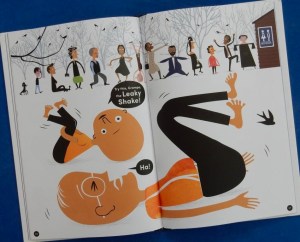
Off they go to the park accompanied by dog, Whizzer. Owen learns why Grampa and other older people get up early and they play a ball game with Whzzer who also pauses to wee against a tree. Grampa and Owen start discussing holding-it tactics. “I find that dancing helps me!” Grampa says and before you can say, ‘wee’, the two of them are going through Grampa’s repertoire of preventative dance moves, including the Tinkle Twist and the Wee-wee Walk, then Owen introduces the Pee-pee Hop, the Piddle Patter and the Leafy Shake.

All the while the queue to use the restrooms is growing ever longer behind them and some of those waiting also try out the moves.

Enter Mum to collect her son; she wonders what is going on and asks Owen if he needs the loo before they leave for home. Once in the car she comments, “Well, that was a great learning experience, wasn’t it?”

I’m sure readers of this comic tale will agree wholeheartedly with that. I’ve yet to meet a child who doesn’t enjoy toilet humour stories and Frank Viva’s with its apt colour palette, is sure to make them giggle from start to finish. I’ve never encountered this author/illustrator before and I wholeheartedly recommend his take on an experience we can all relate to.

The Ogre in the Hall

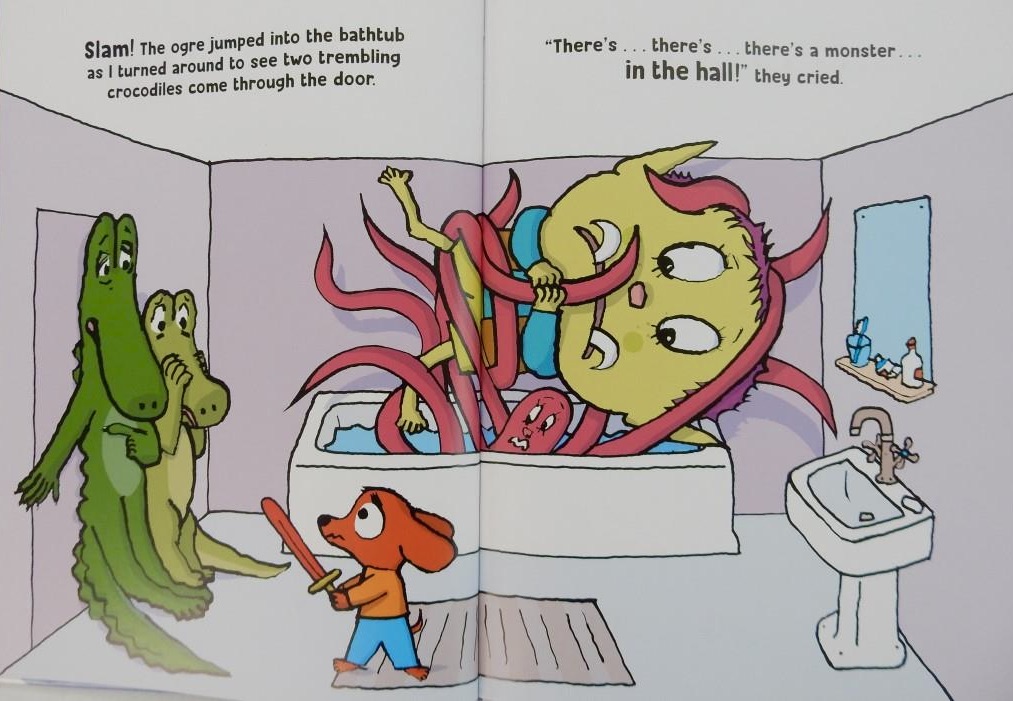
Jojo is in urgent need of a wee but it’s night-time and although the bathroom is close to his bedroom, the presence of an ogre makes it a dangerous walk through the hallway. Nonetheless, needs must, so, sword in paw, Jojo ventures forth into the darkness only to find that the bathroom is occupied, but who is within? Not his mum or dad but sitting on the loo is the ogre; moreover he has a tummy ache. But why use somebody else’s bathroom? It turns out that this ogre is scared of the dark and there’s no light in his own bathroom.

Having used the loo, the ogre needs to wash his hands, however this too is problematic. Jojo’s other bathroom – the one with a sink – is also in use, by an octopus that’s languishing in the bathtub. Henceforward further mayhem unfolds in the shape of a pair of crocodiles and they are scared of a ‘monster’ in the hall.

All this time poor Jojo is still holding on, increasingly afraid he’ll wee in his pyjamas. How will this all end? To tell would be to become a story-spoiler so you’ll need to find a copy of this highly amusing book with its hugely funny illustrations and discover for yourself. Young listeners will certainly enjoy it but whether you’ll want to share it at bedtime is open to doubt.

The Book From Far Away

This image has an empty alt attribute; its file name is dscn0007-1.jpg


This tale unfolds over 48 pages, which is longer that the average picturebook. It’s an intriguing, wordless story that begins with a little boy wandering in the woods, having spent some time sitting in a tree reading a book he removes from his backpack. Ahead of him, he spies a spaceship landing in a nearby clearing. Out come four otherworldly beings, two seeming adults, a youngster plus a pet.

There follow several spreads showing the extraterrestrials playing and picnicing together,

This image has an empty alt attribute; its file name is dscn0010-1.jpg

after which they return to their spacecraft and take off. The human child emerges from behind the tree where he’s been watching them and finds on the ground a large round, elaborately decorated golden disc that appears to have several transparent overlays – pages possibly.


Suddenly up behind the boy comes the young extraterrestrial, who has seemingly been left behind. The two communicate wordlessly; the Earth child hands the golden disc to the owner and taking his own book from his backpack, gives it to the visitor. Then back comes a spacecraft, the two hug each other farewell, the space child enters the spacecraft and it flies off.


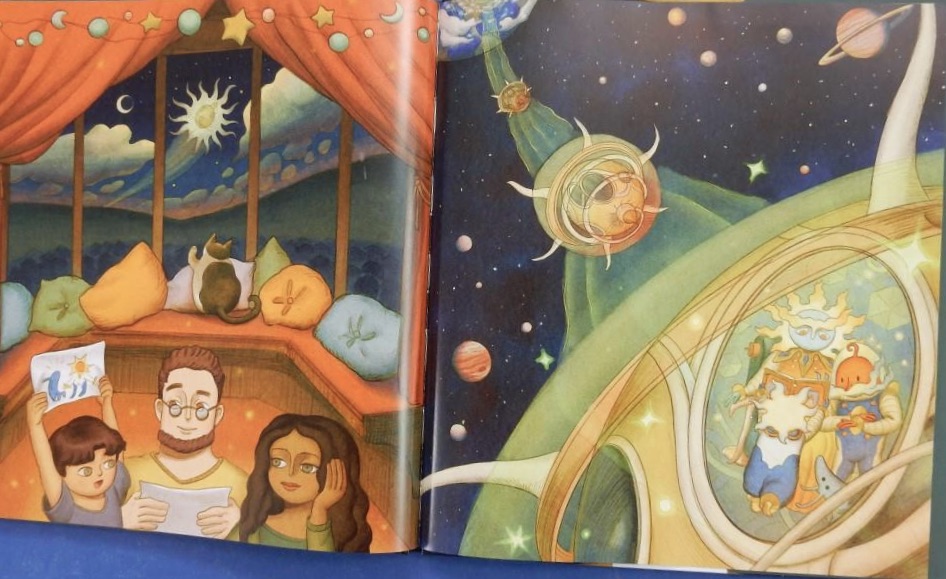
At home later, the Earth child shares with his parents, images of the day’s happenings. Meanwhile, somewhere else in the universe, the outer-space child and family share the Earth book,

This image has an empty alt attribute; its file name is dscn0011-1.jpg

and on the final page, the cat makes an astonishing discovery in the backpack. What might this lead to, one wonders.


A confirmation that books have a universal appeal, and that children are able to understand one another no matter from where they come. Young (and not so young) readers will relish poring over the amazing details in this brilliantly imagined sci-fi tale: who needs words when the mesmerising visuals herein speak volumes?

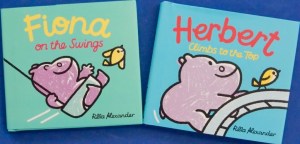
Zeki Hikes With Daddy / Fiona on the Swings & Herbert Climbs to the Top

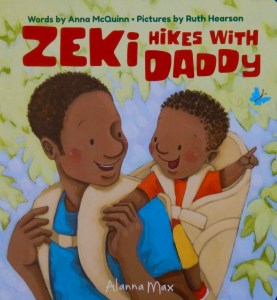
This latest Zeki story is so full of joy from the front cover illustration right through to Ruth Hearson’s final scene showing a blissfully slumbering infant being carried home on the back of his smiling father after their wonderful day together.

As they explore the great outdoors Zeki notices small details such as a tiny falling leaf, crisp footprints left by a bird in the squelchy mud beside the water, a delicate feather and a bumpy pine cone: what lovely rich descriptive language Anna uses in her verbal pictures of these natural objects and the others mentioned.

It’s great to see both father and son being excited by the natural world,

as well as spending quality time in each other’s company. Spending time in the company of Zeki and his family is always a delight for small children and their adult sharers; both audiences will surely cherish this shared time too.

Like all the others in the series, this book deserves to be part of the early experiences of every toddler. It’s pitch perfect for encouraging talk and new learning.

Just like little humans, Herbert and Fiona Hippo love using the equipment in the park: Hippo Park is where they meet their friends including a frog, a mouse, and a turtle.

Fiona is eager to learn to swing though needs help to get herself up onto a swing seat but Herbert is on hand to assist and provide an initial push to give her some momentum. Following his instructions, she’s soon kicking and tucking her legs as she swings back and forth till Herbert too starts his swing and then it’s time to let their imaginations take flight …

The top referred to in the second title is that of the arched climbing ladder. Urged on by his pals, Herbert takes tentative steps gradually gaining confidence as he goes step, pull, step, pull right to the very highest part. Overcoming sudden wobbliness and the dropping of Teddy, back down he climbs and off into a flight of fancy with frog et al.

Endearing, cartoonish drawings of the activities at the park combined with simple, chatty storylines of friends at play will please the very youngest.

When I Became Your Brother / Some Do, Some Don’t

When I Became Your Brother
Susannah Shane and Britta Tekentrup
Nosy Crow

Written in rhyme that shows tenderness and devotion, and illustrated with gorgeously warm scenes by Britta Teckentrup, this book told from the viewpoint of the older one, celebrates the bond between a brother and his new sibling.
From sunrise to sunset two fox cubs love to spend time exploring their woodland surroundings and playing together. They dash through the fields, play with pinecones

and laugh and leap together beneath the setting sun before snuggling up under the stars. Being an older sibling brings companionship, responsibility for guidance and above all, love.

With its comforting text and sparkling art, this is a book to give a young child when a new sibling arrives in the family.

Some Do, Some Don’t
Dipacho
Mineditions

Dipacho uses jabiru storks in this presentation of individuality. By means of a simple, straightforward text and elegant images of these storks he depicts them in various sizes and in a range of situations starting thus: ‘Some of us have no family’ accompanied by an image of a solitary bird. Turn the page and we see two jabirus flapping, almost dancing and the words ‘Others do.’
Some take off alone to explore what the world has to offer, others stay behind. Some like to be in the company of others, in family groups or more of a crowd; some want solitude. Some live together reluctantly; some are distanced but want to be near another.
Some have families with differences, indeed many do

and sometimes new family members arrive; some in contrast have left for ever. Some jabirus prefer to ‘stick to our own kind,’ whereas others are interested in a variety of types of birds. The author concludes, ‘Some of us fly off and follow our own path. …Actually we all do.’
In eighteen double spreads Dipacho covers almost each and every experience a child may have.
The final page provides three factual paragraphs about jabirus including that they are the second largest birds in the world. I didn’t know that; thanks to this book now I do.