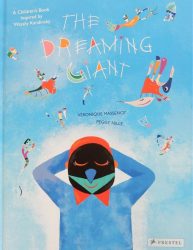
The Dreaming Giant
Véronique Massenot and Peggy Nille
Prestel
Imagine a giant dropping in on your neighbourhood: what on earth might he want? This is exactly what happens to the tiny world of Krobz, the inhabitants of which are less than one inch tall. Unsurprisingly everyone is alarmed at the new arrival with his harlequin trousers and shoes sized 612. Is he peaceful or hostile? A plan is formulated while the being naps.
There follows an internal investigation of the sleeper …
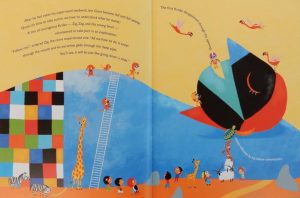
undertaken by a brave trio: Zig, Zag and Swirl. They visit various organs such as his heart, and his brain (the command room) wherein they discover how the visitor is feeling …
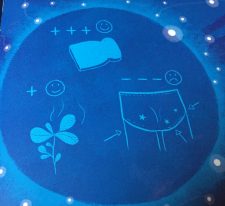
“The Giant apparently liked the taste of his sandwich but his buttocks seemed to find the ground a little too hard.” Their search however, reveals nothing about the possible reason for the Giant’s visit; and having reported back to base from where they are informed that the subject of their observations is in a dream state, an amazing sight meets their eyes, and an extraordinary experience unfolds …

An experience which leads them to conclude ‘There is nothing to fear from someone who lives and thinks so beautifully and whose dreams are so GIGANTIC!’
Kandinsky’s dreamlike abstract paintings were the inspiration for this unusual picture book and in an afterword, both author, Massenot and illustrator Nille talk about how his Sky Blue in particular gave them space within which to let their own imaginations get to work. We also learn something of Kandinsky’s interest in physics, in particular Einstein’s theory of relativity and its possible influence on the artist’s painting.
A splendid introduction to the work of a hugely important 20th century artist, and a delightfully fanciful story to boot.
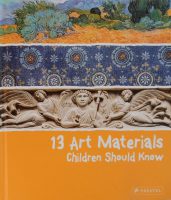
13 Art Materials Children Should Know
Narcisa Marchioro
Prestel Publishing
With the disastrous scaling back and cutting of arts subjects in education, in both schools and colleges, books that educate children in respect of the arts are increasingly important.
This absorbing volume takes young readers on a tour around the world and back in time to find out about the evolution of materials artists and craftspeople have used, some of them such as bone, wood and ivory, right back as far as the Palaeolithic Era …
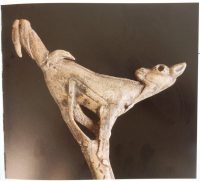
Part of a spear-throwing tool made from reindeer horn.
From objects discovered, we can learn a lot about how those ancient peoples lived and what occupied their thoughts. Now contemporary artists such as Vik Muniz use discarded materials in their work; and before him, Joseph Cornell made use of found objects as inspiration for complex assemblage creations …

Joseph Cornell’s ‘The Hotel Eden’ 1945
These too in their own way have much to teach us.
Each material considered has a time line across the top of the spread(s) which helps readers see how certain materials, gold for instance, were used at different points in time, often centuries apart.
A particularly fascinating section looks at the use of parchment right back to the time when monks painstakingly created illuminated manuscripts, and up to its 21stC use as a medium for collage and sculpture.
In addition to finding out about the materials, readers are introduced to particular artists some of whom, Henri Matisse for example, are well known, others less so. I was fascinated to learn that Chinese artist, Li Hongbo created these sculptures using only paper, scissors and glue.
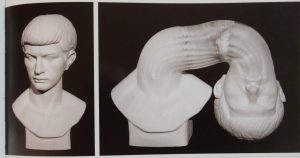
‘Roman Youth’ Li Hongbo, 2013
Both educational and fun, this book is likely to inspire individual readers to turn to other sources to find out more about some of the topics that are of particular interest to them. A worthwhile addition to the family bookshelf or primary/ lower secondary school library.
I’ve signed the charter 

 Red Reading Hub - Jillrbennett's Reviews of Children's Books