One Boy’s Choice

One Boy’s Choice
Sueli Menezes (translated by Kathryn Bishop) and Annika Siems
minedition

Set in the Amazon jungle, this is a story about a boy who goes out in a canoe to spend a day fishing with his grandad. The boy is eager to catch a really big fish to take home and show his friends. Grandad navigates the boat around the huge water-lilies while the boy peers into the water, watching and waiting for that fish. They wait and wait and wait, then move on and cast the net instead of a line. Still nothing, and while they wait Grandad tells stories about the various fish that live beneath the water-lilies.

Hours later lo and behold to the boy’s delight, there’s a water-lily fish – an Arowana – in the net. However, his delight quickly disappears when Grandad says they must release the fish – and then he shows the lad this male Arowana, has a mouth full of tiny fish and explains that for a month that’s where the little fish live safely, as well as telling him of the Arowana’s importance in eating mosquitos that can make humans ill. Grandad puts the choice in his grandson’s hands: keep the huge fish and impress his friends or let it go free so male and children can continue living safely in the river. The decision the boy makes pleases his Grandad who remarks, “I am very proud of you. Today you have become a really grown-up boy.”

Showing how our actions affect wildlife, Sueli Menezes’ thought-provoking story becomes even more so in tandem with Annika Siems’ richly hued portrayals of the beautiful Amazon forest in which it’s set.

Into the Deep

Into the Deep: An Exploration of Our Oceans
Wolfgang Dreyer and Annika Siems
Prestel

Prepare to be swept away at the sights you’ll see as you plunge into this exploration of the awesome life forms that lie beneath our oceans.

We journey, with marine biologist Wolfgang Dreyer, courtesy of the research vessel Meteor aboard which is a submersible that enables us to meet some of the incredible creatures from plankton, the tiniest microscopic life forms, to the enormous mammalian creatures such as the sperm whale, and its prey, the giant squid, the largest invertebrate on earth.

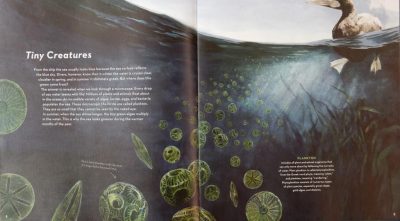
Did you know the reason the sea looks greener during the warmer months is down to the proliferation of phytoplankton, the minute chlorophyll-containing organisms.

These are a vital food source for many kinds of aquatic animals; indeed phytoplankton are at the base of the ocean food chain.

I was totally fascinated to read about the atolla jellyfish, in particular Atolla wyvillei a species of crown jellyfish, and the way in which it uses bioluminescence, flashing first blue and then red, the latter being invisible in the deep sea and thus acting as a protective mechanism.

Perhaps even more surprising is that there are other unrelated deep-sea creatures that also use red for protection including, the world’s largest crab, the Japanese spider crab.

The author has packed a considerable amount of information into this book but at no time does it overwhelm despite the fact that he never talks down to his audience, rather he uses scientific terminology throughout to discuss such things as morphology and physiology.

The nature of this book is such that readers are unlikely to encounter in the flesh most of the animals featured, but Annika Siems’ oil paintings, some in really large format, bring them to life and allow for close scrutiny of the wonders of the deep.

A terrific book for the curious, for those inspired by David Attenborough’s Blue Planet 2 series and budding marine biologists alike. It ends with a heartfelt plea from author and artist to stop littering our oceans with plastic and other garbage.