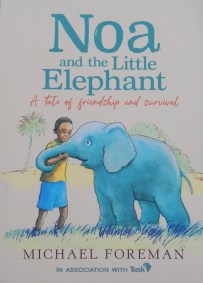
Noa and the Little Elephant

Noa and the Little Elephant
Michael Foreman
Harper Collins Children’s Books

Michael Foreman takes up the cause of wildlife protection in this lovely little book published in association with TUSK a charity that helps protect African wildlife, in support of which Ugandan ranger and wildlife authority, Julius Obwona, has written a forward.

Young Noa’s favourite animals are the elephants he watches every day after school as he returns home in the little boat built for him by his father. One day though, they aren’t in their favourite wallowing place in the river so a concerned Noa decides to follow their tracks into the jungle.

When he emerges on the far side he sees what he first thinks is a new game the little elephant is playing with his mother. On closer inspection though – horror of horrors – this is no game. The mother elephant is lying dead and her tusks have been removed.

After a while the baby elephant overcomes his fear and allows Noa to approach and comfort the creature. The boy makes a decision: he resolves to take the little tusker home and care for him in his village.

Back at home, his father tells Noa about the cruel poachers that shoot elephants for their valuable tusks and how the villages have grouped together to try and prevent such cruelty. Noa’s sister, Eva names the elephant Tembo and it’s not long before he’s part and parcel of village life. 

One night at the start of the rainy season a terrific storm arrives causing the river to overflow its banks so Noa rushes down to the water to secure his boat and in so doing is caught in the wild roaring current and is swept away. 

Fortunately however ‘something solid ‘is in the water that enables him to haul himself to safety.

Thereafter a beautiful rainbow appears over the village and a thankful Noa resolves that when he’s older, he’ll join his fellow villagers in protecting the elephants: “We are all one family living under the same sky and sharing the same world” he tells Tembo.

Superbly illustrated, and simply and movingly told, this tale of love and survival is most definitely a book for young animal lovers be they solo readers or listeners.

10 Reasons to Love a Lion / 10 Reasons to Love a Penguin

10 Reasons to Love a Lion
10 Reasons to Love a Penguin

Catherine Barr and Hanako Clulow
Lincoln Children’s Books

The latest additions to this environmentally concerned series that introduces children to, and encourages their positivity towards, animals in the wild, takes readers to some highly contrasting locations.
In 10 Reasons to Love a Lion we discover that sadly, there is only one species of lion remaining in the wild, living in central and southern Africa

and the Gir Forest National Park in Gujarat, India.
Unlike other big cats, lions are social animals, living in prides and in Africa, so we learn, huge territories of arid savannah are patrolled by each pride which might comprise as many as three magnificently-maned males, plus lionesses and their offspring.

I was unaware that despite their having quills that are potentially lethal to lions should their skin be pierced and become infected, the large cat predators – the females do the hunting – like eating these prickly creatures. Ouch!

In addition to this information we’re told about lions’ ability to see in poor light when hunting, thanks to their ‘glow-in-the-dark eyes; hear of the playfulness of cubs; their manner of greeting and becoming friendly towards, other lions using their individual oily scent; and their propensity to sleep, particularly after fully sating their appetites.

Other birds and animals are also featured in Hannah Clulow’s realistic-looking scenes; so for instance we can tell which location – African or Indian – it is by say, the presence of an Indian peacock, or ostriches.

Scattered throughout the book are 5 ways in which we all can show our appreciation towards lions and thus perhaps help in their preservation.

In contrast there are 18 penguin species, which, with the exception of the Galapagos penguin all live in or near Antarctica. Each one is pictured on the opening spread of 10 Reasons to Love a Penguin.

Ecologist and environmentalist, Catherine Barr adopts a similarly engaging style as she writes of these flightless birds as ‘super speedy swimmers’ using their ‘underwater wings’ to ‘twist and turn’ as they hunt for fish. She talks of their specially shaped eyes that help underwater vision while searching for ocean food, some of which unfortunately is being depleted by large floating nets that might also entangle the penguins.

We see and read of penguins tobogganing on their tummies,

sneezing salty water, some species huddling close together to fend off the chill – their feet still suffer though; discover the mating habits of adelies; the chick rearing of emperors penguins; the loss of waterproofing during their ‘catastrophic moult’ and more.

Again, interspersed throughout are 5 ways we humans can help the cause of penguin preservation.

Written in collaboration with the Natural History Museum, these are two to add to primary classroom collections, and for ecologically aware individual readers.