
How to Chat Chicken
Dr Nick Crumpton, illustrated by Adrienne Barman
What on Earth Books
Zoologist Nick Crumpton clearly enjoyed writing this splendidly quirky book on creature communication, for which he uses a chatty, matter-of-fact style.
Beginning with primates – chimpanzees, gorillas, orangutans, night monkeys and common marmosets – he focuses on the wonderful sounds these animals make to let others of their kind know they need food, investigate something new, want others to stay clear of them,

want to make friends, want a mate or are defending their territory. If your garden is frequented by a fox at night you could listen very carefully through an open window and you might just catch the ACK-ACK-A-ACK-ACK-A (This is my garden) of a fox indicating to another fox to vamoosh.
Not all animal sounds are vocal however. Some animals including grasshoppers and leaf cutter ants use a process called stridulation. Grasshoppers stridulate to advertise their whereabouts in order to attract a mate; leaf cutter ants stridulate when they want help from their nest-mates.
Then there is echolocation; dolphins use CLICKCLICKCLICKCLICK when they want to find their prey or to indicate they want to play.
Some creatures, dogs for instance, use pheromones (special chemicals) to communicate. I had to smile at the description of lampposts being used as ‘doggy chat rooms’.
And can you believe, there is even a form of animal dialect: the squeaks and clicks made by naked mole rats sound slightly different depending on which colony they are from.

There’s a concluding explanation of the science behind the sounds, a meet the author and the illustrator spread, a glossary and an index.
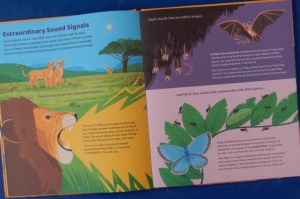
The book is very visual: Adrienne Barman’s playful cartoon style illustrations work really well with the written text. Add to primary school collections and home bookshelves.


 Red Reading Hub - Jillrbennett's Reviews of Children's Books