An Ocean Full of Stories

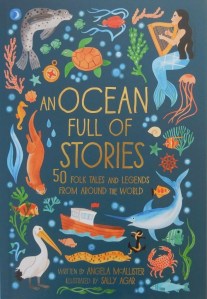
This is a fascinating collection of fifty folk stories, legends and traditional tales from all over the world retold by Angela McAllister. All are centred on different aspects of ocean life and the book is divided into six sections: Fishy Tales, Crossing the Water, Pools, Lakes and Rivers, Tricks and Trials, Ocean Gods and Water Spirits and finally, Beside the Sea, Beneath the Waves.
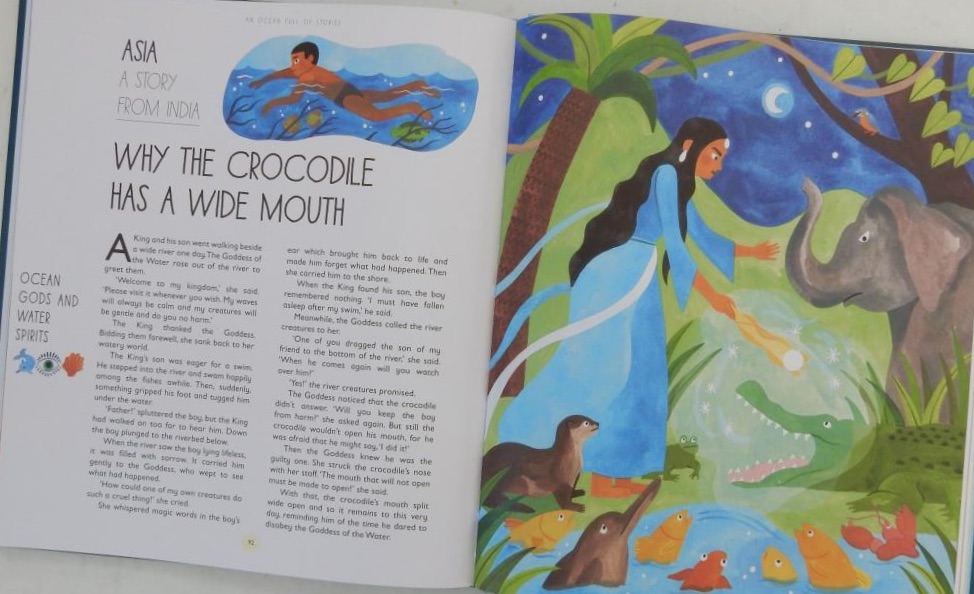
Some, including the North American Why River Waters are Never Still, Why the Sea is Salty (from Japan) and Why the Crocodile has a Wide Mouth (also from North American) are pourquoi tales that seek to explain why things are as they are.

You’ll discover several stories about greed and its consequences such as The Fisherman and his Wife and The Sea King’s Gift.

Not all the stories have human characters, indeed many are all about animals: a story from England that’s new to me The Magic Mackerel has anthropomorphised fish and we discover what happens when Lord Shark decides to hold a grand ball although he doesn’t have a ballroom.

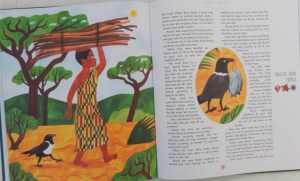
As with many traditional collections, Anansi the trickster manages to find his way into this one. He’s taught a lesson by Anene the crow that he endeavours to get to do all his work for him in Anansi’s Fishing Trip.

That Ghanian tale was also new to me: indeed one of the joys of collections such as this is discovering new stories. If you read them aloud to a class or group, make time to let your listeners enjoy Sally Agar’s bold, lively illustrations.

A World Full of Winter Stories

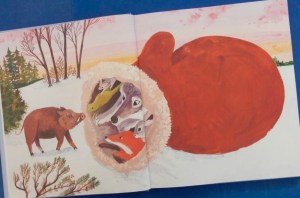
This is a veritable cornucopia of folk tales, myths and legends – fifty in all – gathered from around the world and retold by Angela McAllister. There are six sections: Birds and Beasts, Tricks and Troubles, Ice and Snow, Quests and Journeys, Spirits and Magic and the shortest, Christmas. Each contains stories I was familiar with, but also several new to me. One such was the very first, a tale from Japan telling how snowballs made by the children of the Sky Goddess become the ‘The First Rabbits’. Also new to me, from the same section is an amusing Ukrainian story about a dropped mitten that, unbeknown to its boy owner, becomes a temporary shelter for seven animals.

From the Tricks and Troubles section, a story from Kazakhstan that made me smile was The Marvellous Coat wherein a crafty man tricks another into exchanging coats, ending up with a thick warm coat plus a fine horse, instead of his original holey coat and worn out steed.

Bears feature quite often in wintry tales and this book is no exception. The Long Winter. a Dene story from Canada, in the Ice and Snow section tells how a group of animals struggling from the constant winter climb up into the sky to search for the world’s warmth. There they discover some bear cubs from whom they learn of the whereabouts of that which they seek, although reclaiming it from the mother Bear and restoring sunshine is anything but an easy task.

If you’ve ever wondered why some trees and bushes never lose their leaves, The First Evergreens, a Mongolian tale in section four, offers an explanation that involves a good-hearted swallow.
There’s an Inuit story in Spirits and Magic that took my fancy. It tells how a stolen wife was reunited with her husband, a village chief thanks to an old woman, a special charm and some magic words remembered just in the nick of time.

You might be surprised to learn that a scarecrow features in the final section, in a story from North America, a scarecrow that ends up helping Santa.

This book is a joy to share with children at home or in the classroom during the winter months. The tales are just the right length for a story time session and Olga Baumert’s illustrations, be they large or small, bring an extra touch of magic to each one.

A World Full of Spooky Stories

A World Full of Spooky Stories
Angela McAllister, illustrated by Madalina Andronic
Frances Lincoln Children’s Books

This collection of fifty traditional tales from all over the world is organised thematically into eleven parts – by geographical feature or location – and celebrates things spooky (but not terribly so). Some are very familiar: Hansel and Gretel and Little Red Riding Hood being two from the ‘Into the Woods’ section, which comes first.

One witch I wasn’t familiar with is the Water Witch. In this tale originally from France, William the hero goes to the bottom of an enchanted lake to find riches so he can afford to marry his beloved, a dairymaid, but is tricked by the witch, transformed into a frog and thrown into a fish tank. All ends happily I hasten to add, though maybe not for the witch.

Readers are more likely to know Baba Yaga who resides in the house that stands on a pair of chicken legs: she’s the one Vasilissa the Beautiful gets the better of when she goes into the forest, in a Russian tale of the same name.

If you follow a mountain path it might lead to a man-eating ogre. This fearsome being is found in the mountains of Tibet and he tricks a girl into believing he is her mother and thus is able to carry her off to his cave. Do you think he eats the girl? Possibly, but it’s also possible that a fox helps the girl’s mother and in so doing causes the demise of the old ogre. Also feared for consuming humans is the Chenoo that features in a North American Passamaquoddy story. This giant creature had once been a man but on account of his wickedness, his heart had turned to ice. Can that ice perhaps be melted again and with it the wickedness? …

Certainly there are spooky elements in all the stories, but very few are really spooky and one or two are even humorous. Helping to bring the tales to life are boldly coloured folk art style illustrations by Madalina Andronic. Yes, this could be a book for reading while snuggled up on chilly autumn and winter evenings, but equally, folk tales are entertaining whenever you encounter them.

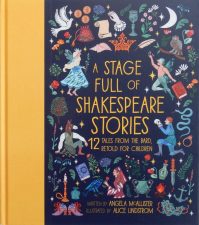
A Stage Full of Shakespeare Stories

A Stage Full of Shakespeare Stories
Angela McAllister, illustrated by Alice Lindstrom
Lincoln Children’s Books

I was one of those not turned off Shakespeare at school despite having to study several plays between the ages of 11 and 16 and my favourite, despite having to ‘do’ it for O-level, remains Twelfth Night. This is largely thanks to an amazing English teacher that I had throughout my time at grammar school, who managed to bring out the magic of the plays we read and now the beauty of the language completely enthrals me. So, I wasn’t sure what I’d make of A Stage Full of Shakespeare Stories wherein Angela McAllister retells a dozen of the bard’s most popular plays, both comedies and tragedies.

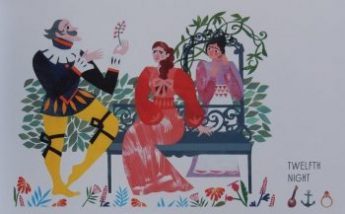
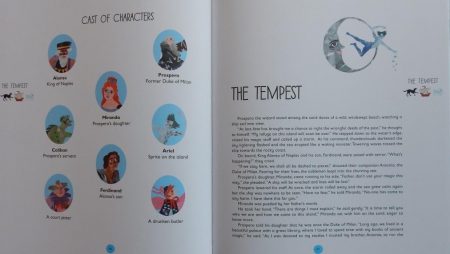
However, she does it in such a way that young readers will be engaged immediately . Each one is introduced with a quote and a pictorial cast of characters, and the tellings themselves are up to date so that youngsters will quickly find themselves immersed in the story, be that of A Midsummer Night’s Dream, Twelfth Night,

Much Ado About Nothing, King Lear, The Tempest

or any of the others included.

Alice Lindstrom’s artwork, whether a full page illustration, or a smaller one, is absolutely fabulous, really capturing the atmosphere of each tale, drawing in the audience and making them feel as though they’re watching a staged performance.

Also included is a wealth of information about the great man himself, a complete list of his plays and a taster paragraph about each of the twelve plays herein.

Yes, we have lost the Bard’s awesome language here, but instead, what Angela McAllister offers is access to that language for youngsters by way of stories that can be read aloud to an individual or class; or read alone, before the exam treadmill turns them off from the riches that are Shakespeare’s legacy.

Samson the Mighty Flea

%0a

Samson the Mighty Flea
Angela McAllister and Nathan Reed
Andersen Press
Samson the Mighty Flea is top of the bill at Fleabag’s Circus, which is no surprise: he can lift a match, a pea and, the lovely Amelie – all at once. Despite this, he’s not satisfied; Samson longs for the big time so he bids farewell to fellow Fleabag performers and off he goes determined to be “the biggest star in the world“.

%0a

But the world is a very big place and he’s such a small flea: “Go back where you belong,” a bug tells him. There’s no going back for Samson though, not until he’s performed before a huge audience. That does eventually happen …

%0a

but so does something else: Samson realises that however much he’d longed for fame, it’s worth nothing without his old friends and one in particular.
Meanwhile back at Fleabag’s that particular friend is about to give the performance of her life too …

%0a

Thought provoking and funny, this circus romp moves in and out of rhyme and so requires careful perusal by an adult reader aloud before public performance. I loved the offbeat nature of the whole thing: its unlikely characters are portrayed with finesse by Nathan Reed, who provides visual delight at every turn of the page.

London Bound

DSCN4935 (800x600)

Katie and the British Artists
James Mayhew
Orchard Books pbk
In this recent Katie reissue, our charming young heroine accompanies her Grandma to The National Gallery. On route she ponders on the question of what job she might have when grown up. Then, in the gallery while Gran has a snooze, she takes a look at some of the pictures, starting with Constable’s The Cornfield. Her comment that she’d love to be a shepherd, receives a surprise response from the shepherd boy in the painting (called Ben in the story) and the two then strike up a friendship …

DSCN4937 (800x600)

and together go in search of alternative occupations. Turner’s Rain, Steam and Speed offers a train-driving experience, George Stubbs’ Whistlejack leads to an opportunity for Ben to try his hand as a horseman, albeit not very successfully,
The two then climb into a Gainsborough – The Painter’s Daughters Chasing a Butterfly

DSCN4936 (800x600)

and therein Ben discovers an artist’s life isn’t for him and finally Turner’s The Fighting Temeraire furnishes a brief sea voyage after which Katie returns to her gran and Ben to his sheep.
For anyone visiting the National Gallery with young children or a primary class, this delightful book is an excellent introductory starting point to some of the 18th and 19thC paintings therein.


DSCN4941 (800x600)

London Through Time
Nick Maland and Angela McAllister
Frances Lincoln Children’s Books
Nick Maland (of the Oliver series fame) has illustrated what is essentially a concertina fold-out time line of London. We join two children, Maisie and Max (and a friendly pigeon) as they time travel from Roman Thameside London, through the plague ridden city of the Black Death, thence to Fleet Street of Tudor London, on to 1666 to view the Great Fire and along a Georgian street with its aromatic, mid 18thC coffee houses. From there we drop in on the city in 1865 where chimneys belch filthy smoke and poor children work for a mere farthing and thence, onto Victorian times where the city is shrouded in a filthy black smog. Flip the fold out and move into Edwardian times with the Votes for Women marches, then in 1914 watch the soldiers leave for the Great War; visit the Roaring Twenties, the Blitz of the World War 2 and join the Coronation parade of 1953 for Elizabeth 11. The swinging sixties are the penultimate destination when boutiques grew up all over London and finally after almost 2000 years, our guides bring us back to the present, to Trafalgar Square and the familiar sights of Big Ben,with the London Eye in the background.
A final page asks readers to spot items shown in fourteen tiny vignettes which will in all likelihood send them back for a second look at this fascinating visual trip through England’s capital city.
Nick Maland’s art work is packed with fine details and superbly executed and Angela McAllister supplies the informative written accompaniment to Max and Maisie’s historic wanderings.

Use your local bookshop   localbookshops_NameImage-2

Wintry Worlds

DSCN1422

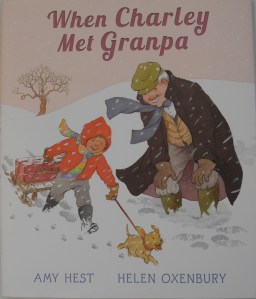
When Charley Met Granpa
Amy Hest and Helen Oxenbury
Walker Books
This is the second story from the transatlantic Hest/Oxenbury partnership to feature Henry and his dog, Charley. Now it’s a cold, snowy Sunday and Granpa is coming to visit. Henry sets out for the station dragging a sledge behind him for Granpa’s big suitcase, Charley frisking in front. Henry is apprehensive about Granpa’s reaction to his canine pal; he has never had a dog for a friend he tells Charley as they wait for the train to arrive. But, as readers of Charley’s First Night will already know, Charley is no ordinary pup, he’s an adorable, playful little chap. Granpa finally arrives and as the trio start to make their way back home, the wind whisks Granpa’s hat high into the air and with a swish of his tail, Charley is off chasing it into the whirling snow. Happily, he returns before long with the green cap between his teeth.
This small incident is lyrically portrayed through both words and pictures. Told from Henry’s viewpoint, Hest’s attention to detail in her narrative has a child-like simplicity while at the same time capturing the warmth between the characters. Oxenbury’s gorgeous illustrations too, glow with warmth despite the chilly landscape and as always, her attention to detail is impeccable.
Buy from Amazon
DSCN1423

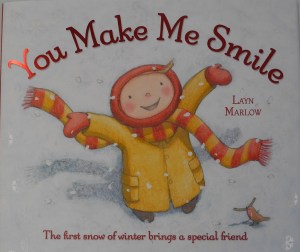
You Make Me Smile
Layn Marlow
Oxford University Press
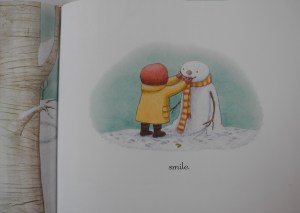
One can almost feel the chill in the air as those first snowflakes fall, watched by a little girl from her bedroom window. Softly they cover the ground all around her house and she rushes down to join her waiting parent. In the hall she puts on her outdoor clothes and then it’s out into the snowy world to start making a snowman. As she works, the rosy-cheeked little girl talks to the ‘friend’ she is building; she even wraps her own scarf around his neck before adding the final, all-important smile.
DSCN1428

Then it’s time for a photo-shoot with her new friend; and the two smile together – a smile that can last the whole year through.
A special event in the life of a small child, captured to perfection in Layn Marlow’s spare text and heart-warming pictures – simply beautiful.
Buy from Amazon
DSCN1421

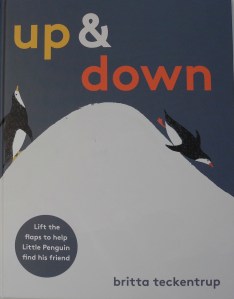
Up & Down
Britta Teckentrup
Templar Publishing
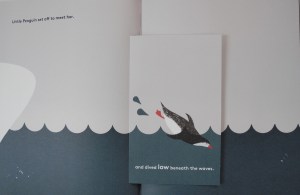
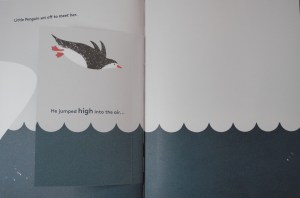
Perched atop a large ice-block, Little Penguin thinks about his friend far away on another iceberg; he misses her. So off he goes to meet her, launching himself high in the air,
DSCN1431

then diving low under the waves,

DSCN1432

up towards a tunnel, down through seaweed, inside the tunnel, first pausing bravely outside … and reaching the end of that small tunnel, then out into the big ocean… There he negotiates various marine creatures moving in turn in front, behind, above, below, over or under them before finally catching sight of his destination. His once sad friend, having spotted Little Penguin is now happy as she watches him walking from the bottom of the slope to the top, where they are finally together.
As this brief synopsis shows, Little Penguin’s journey is filled with opposites. The opposing pairs being completed by opening the series of flaps (one per spread) as he moves through the grey murky seascape to his destination atop the distant iceberg.
As well as being a fun book to share with the very young, this straightforward story of friendship has lots of potential for language development with young children especially those for whom English is an additional language.
Buy from Amazon

After reading the story you can use either puppets or small world toy penguins for the characters, and marine small world creatures. Then with children’s help, build up an Antarctic scene with a short drain-pipe for the tunnel, murky coloured ‘water’ (screwed up tissue paper works well) and small pieces of white fabric draped over shoe boxes or similar. First you and then individual children can then move ‘Little Penguin’ at your instructions, following the route taken in the story. As they gain confidence, the children can tell you where Penguin is and then at a later stage, take over the activity themselves.
DSCN1736

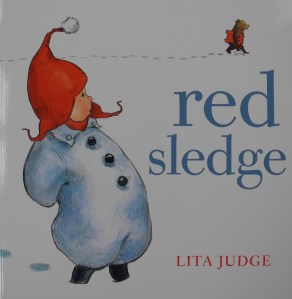
red sledge
Lita Judge
Andersen Press pbk.
This near wordless picture book story is sheer delight.
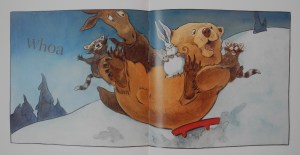
A small child leaves a red sledge propped up outside the house one chilly night. It is found by a large bear who decides to take a joyride. On the way he accumulates a whole host of other woodland creatures and soon they are all enjoying a moonlit descent,
DSCN1735

which ends in a glorious eeeeeeeeeee fluoomp …….. ft as the sledge takes flight, crash lands and the riders come tumbling off to land in a huge heap. And what a wonderful sight that is; both bear and rabbit at least, look totally blissed out; Bear spread-eagled on his stomach and white rabbit peering over his head. Bear then picks up the sledge and returns it to the place he found it. Next morning the child notices animal footprints outside leading away from his house. That night, animals and child enjoy another ride – together this time. Wheeeeeeeeee
The whole exhilarating story is told with wonderfully dynamic watercolour illustrations and a sequence of glorious onomatopaeaic sounds. Scrunch scrinch scrunch scrinch scrunch scrinch is just the perfect sound for bear’s footsteps in the snow. But my favourite of all accompanies moose crouching dog style on the sledge with rabbit between his hooves and bear – open mouthed – spread eagled atop moose’s antlers as the sledge bounces
Gadung  Gadung  Gadung  Gadung
down the snowy hillside.
So clever, so spot on for young listeners and beginning readers. Who could possibly want to use dull boring contrived phonic ‘reading’ books when there are brilliant real books like this one?
Destined to be read over and over and …
Buy from Amazon
DSCN1738

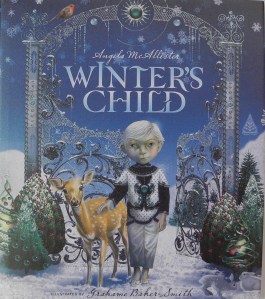
Winter’s Child
Angela McAllister and Grahame Baker-Smith
Templar Publishing
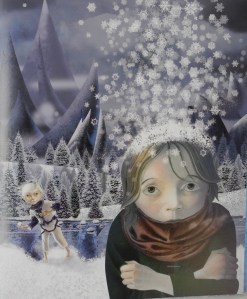
Tom loves the winter days: he spends them skating and sledging. His Nana in contrast is old and feels the cold badly. Out playing one day, Tom meets a pale boy with ice-blue eyes and they become friends. His new playmate tells Tom he wishes winter could last forever.  At their parting, Tom asks the blue-eyed boy where he lives; “Everywhere and nowhere,” is the reply. That night Tom is unable to dry his wet clothes and he gives his blankets to a now ashen Nana . In the morning it’s a heavy-hearted Tom who goes out to play . He tells his friend about his ailing Nana who is in desperate need of some warm spring sun.
Now both boys have a dilemma.
The winter is long and cold. Tom loves it, but each day the boys play, his Nana grows weaker.
DSCN1737

Little does Tom know, when he meets his new friend, that the two of them are prolonging winter. As their friendship blossoms, Tom’s mother uses up all the logs, so he sacrifices his skis and his treehouse ladder for fuel. But there is a much greater sacrifice to be made if Nana, who is becoming increasingly ashen and wasted, is to survive to see another spring. For, unbeknown to Tom, his friend is Winter’s Child and unless he heeds his father’s call to rejoin him and sleep, Spring cannot wake.
This is a magical modern fairy tale of friendship, hardships and difficult decisions. It is wondrously illustrated in shades of blue, white and grey. Baker-Smith’s snow is truly brilliant; he achieves dazzling effects without a single touch of added glitter and his small framed  scenes of the potential human tragedy and the dilemma inherent in the boys’ friendship, set into the snowy landscapes, are a stark contrast to the beauty of the landscapes surrounding them. Hauntingly memorable; a book for all ages and one to return to again and again.
Buy from Amazon

Find and buy from your local bookshop: http://www.booksellers.org.uk/bookshopsearch