History’s Biggest Show-Offs

History’s Biggest Show-Offs
Andy Seed, illustrated by Sam Caldwell
Happy Yak

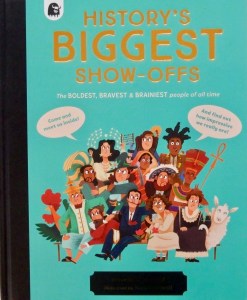
What is it about some people that makes them want to show off about their achievements? Have you ever wondered who the biggest braggers of all time might be? If so then Andy Seed has done the work for you, presenting in his lighthearted style, the flashiest boasters in the history of humankind.

The book is divided into three main parts entitled People in Charge, People Who Think Up Stuff and People Who Create Things; however if readers prefer they can look instead at different time periods: ancient (c.6000 BCE to 500 CE), post-classical (c.500-1500 CE), early modern (c1500 – 1800 CE) and modern (c. 1800 to the present).

We’re introduced to eleven rulers, five of whom were women. These include Hatshepsut, an ancient Egyptian pharaoh, Tarabai who at just twenty five, took over the leadership of the Marathas after the death of her husband and proceeded to show off her military skills to overcome the Mughals; and Christina of Sweden, she who was super-brainy and loved to read. Among the men was Mansu Musa who when on Haj, took 12, 000 servants each with a bag of gold to give away en route to Mecca.

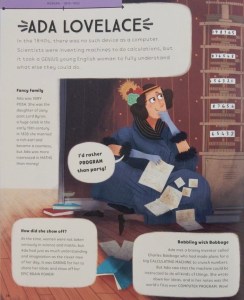
Those with a scientific or technological bent include the first ever computer programmer, Ada Lovelace
and Ynes Mexia, an intrepid plant collector from the early 20th C who discovered 500 new species and had fifty plants named after her. Having studied at Brunel University, I have to mention the ace engineer, Isambard Kingdom Brunel who, with help from his father, built the first ever tunnel beneath a river (The Thames) and who sadly died before his exceedingly costly Clifton Suspension Bridge was finished.
Finally come the creative types: Ustad Ahmad Lahori was asked by Shah Jahan to create a building in memory of his beloved wife Mumtaz and that’s how the magnificent Taj Mahal came to be. Another show-off architect Antoni Gaudi is famous for Barcelona’s still unfinished Sagrada Familia.
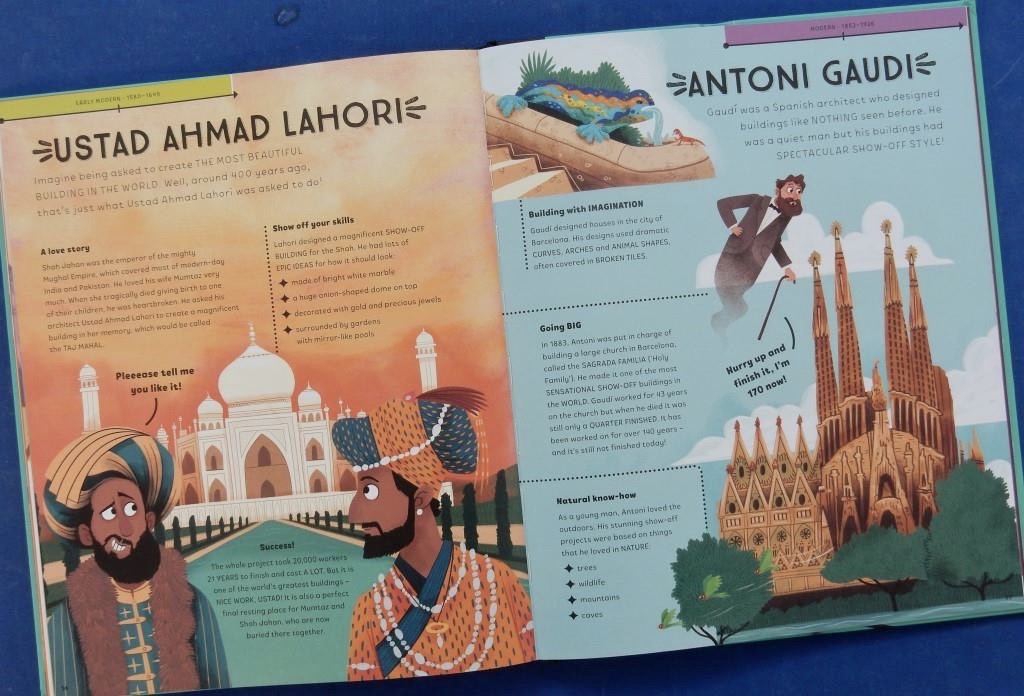
There’s a wealth of bling too, as Andy Seed’s humorous writing brings all these and more back to life and he’s even included some quizzes to ramp up the fun. Talking of fun, Sam Caldwell’s zany illustrations certainly add more of that in abundance: even the timeline will make readers giggle.

The Curse of the Tomb Robbers

The Curse of the Tomb Robbers
Andy Seed and James Weston Lewis
Nosy Crow

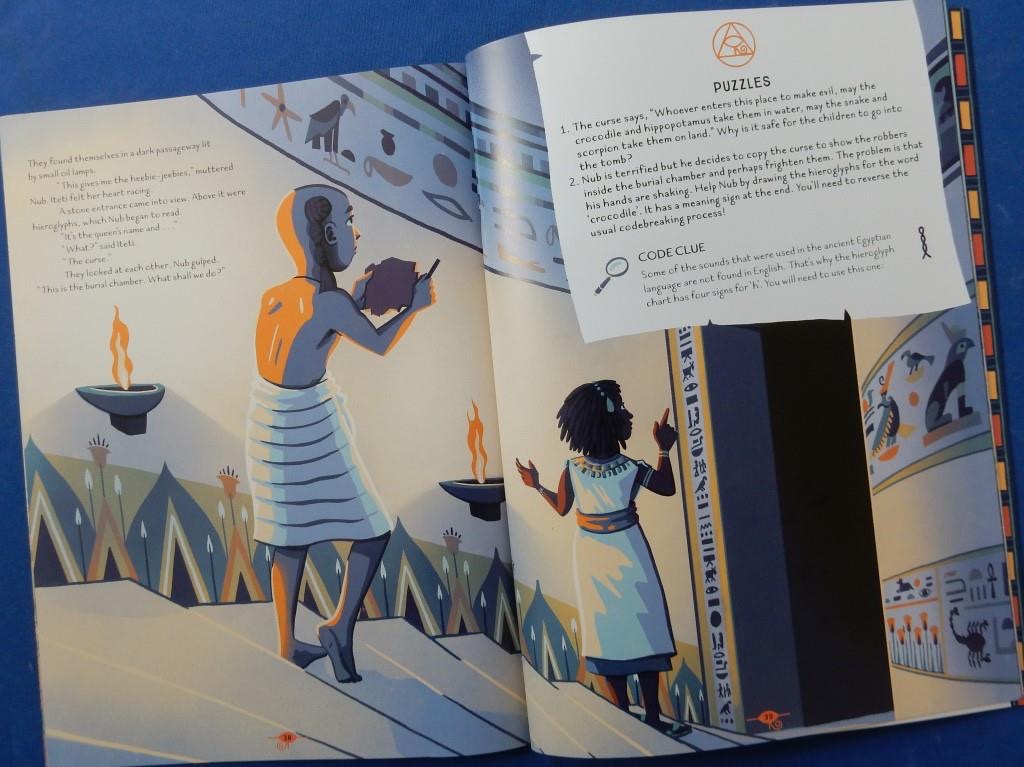
In this puzzling adventure set in ancient Egypt 1422 BCE readers are asked to assist apprentice scribe Nub and his friend Iteti to stop a gang of robbers intent of stealing items from the tomb of Queen Neith.
To do so the two friends need to discover the exact location of the burial place and halt the robbers before a terrible curse is unleashed. 

When they try to find Iteti’s father the vizier to let him know of the robbers, they are told he’s away, so leaving a message with a trusted servant telling him to go with soldiers to Queen Neith’s tomb. they decide to go ahead and follow the robber gang to the pyramids.

There’s a hieroglyph puzzle to solve on most spreads and lots of ‘Did You Know’ information bubbles as the story proceeds, as well as the possibility of whether or not there really was a curse to ponder upon. If you find yourself stuck over any of the puzzles all the solutions are at the back of the book as is a glossary, a codebreaking guide, hieroglyph charts and a list of 70 Egyptian words with their English translations.

Written in collaboration with The British Museum, readers will learn a lot as they participate in this adventure and James Weston Lewis’s stylish illustrations do an excellent job of capturing life in Ancient Egypt. KS2 readers, especially those with an interest in history will enjoy this and it’s a good one to add to primary school libraries too.

Interview with a Shark

Interview with a Shark
Andy Seed and Nick East
Welbeck Publishing

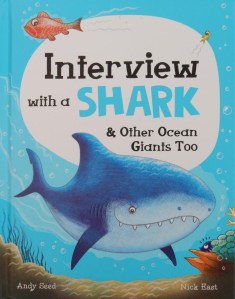
For those who like their information delivered with a degree of quirkiness then the results of Andy Seed’s latest expedition with his ‘tranimalator’ machine will definitely appeal.

In this book he dons his wet suit and dives into the ocean where, feeling more than a tiny bit nervous he faces his first interviewee, a massive bull shark. Like the author, this subject (and the others) seem to have a great sense of humour as they respond to his questions (just the sort of things a child might ask), with more than the occasional leg pull. The answers though are informative too, revealing such things as what they eat, what might eat them, where they live, (I wasn’t aware that bull sharks sometimes live in rivers as well as salty sea water.)

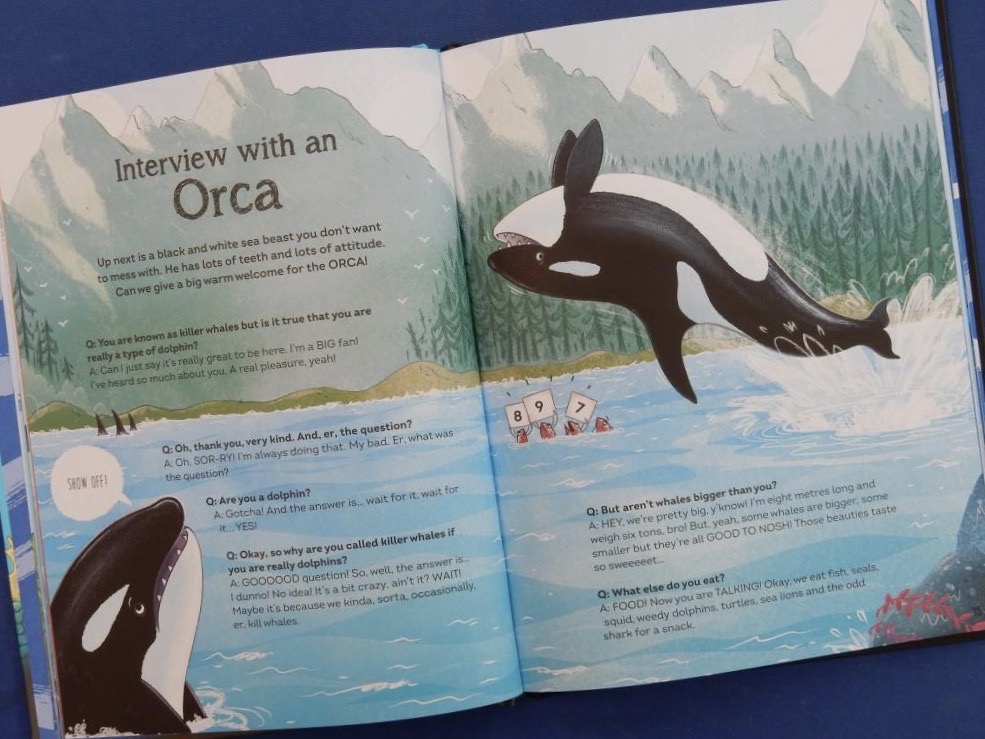
Andy has close encounters with nine marine giants – an awesome blue whale (the kind of whale with no teeth and the world’s biggest poos); a very toothy orca – actually a type of dolphin, 

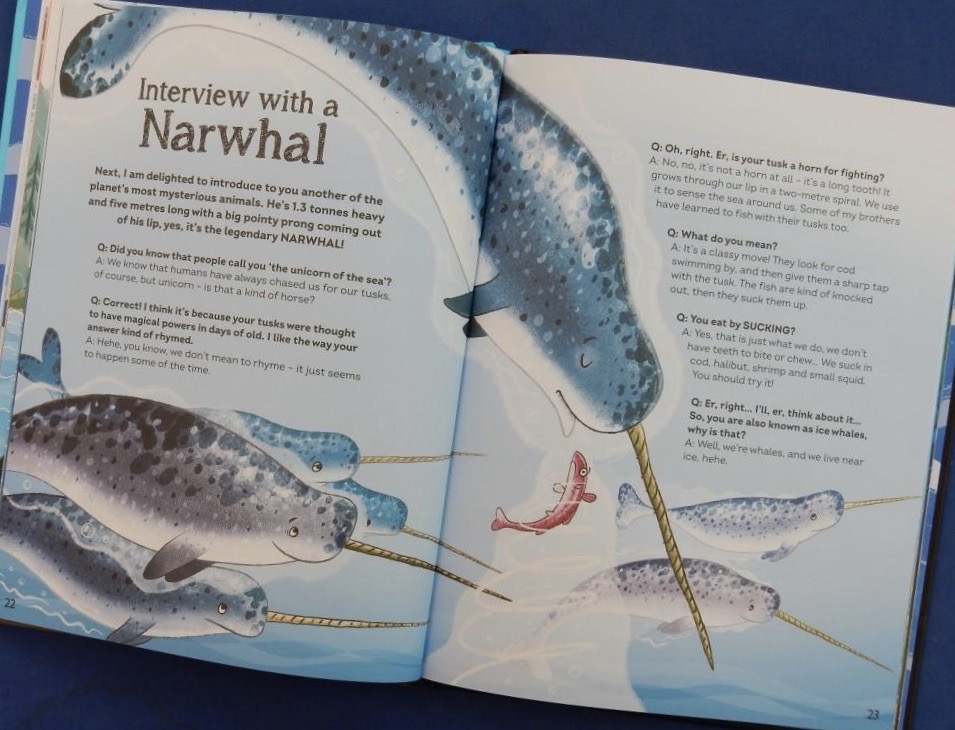
a giant squid, a narwhal (of the stamp collecting, yoga practising variety – told you they have a sense of humour); 

a manta ray – most unhappy about the rubbish we humans dump in the oceans, as are several of the other creatures; an ocean sunfish; an octopus, a conger eel (bites like a bulldog) and finally a creepy anglerfish. 

One of this creature’s claims to fame is its soft bendy bones and stretchy belly that enable it to gobble up BIG things. 

Along with the moans about plastic pollution, we also hear grumbles reminding us of the effects of global warming and fishing (nets and noise). Andy provides a “How you can help’ spread suggesting ways readers can help take better care of our planet and its wildlife; and, there’s a final fun quiz (no cheating).

Nick East provides the visuals – they’re hugely appealing and some almost leap off the page. Young readers (and some adults) can assuredly learn a considerable amount if they dive in with Andy and Nick.

Interview with a Tiger

Interview with a Tiger
Andy Seed and Nick East
Welbeck Publishing

Ever fancied getting close up and chatty with some clawed creatures? Probably not but nevertheless, the creators of this book, author Andy and Nick (illustrator) would have readers believe that is just what they’ve done. Courtesy that is of a unique invention named a tranimalator that enabled Andy at least, to speak directly with ten creatures of the chelate kind. (Maybe Nick had his own ‘viewing from afar’ machine to facilitate creating his funky illustrations.)

Now, without further delay, let us too meet the interviewees, starting with a Bengal tiger hailing all the way from the wild grasslands and jungles of India.

The questions are tailor made for each animal, so our tiger is asked about her stripes, hunting, food preferences and catching thereof, offspring, her partner, her ideal day, dislikes, adversaries and rivals. Oh! And apparently, Def Leppard is her favourite band.

Other big cat interviews are with an extremely rare Snow Leopard; a (don’t call me spotted, call me rosetted) Jaguar from the Mexican wetlands, (3rd biggest in the cat ranking order); and the mighty African lion(ess).

There’s a yellow-eyed wolf that only howls to keep in touch with pack members or scare off other wolves. Apparently, such animals eat not only the flesh of their catches but also pretty much every other part too. Cheeky creature this one, talking of the online ordering habit of humans.

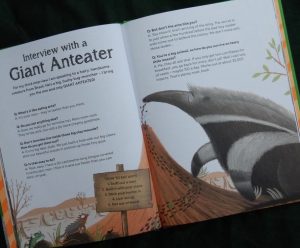
If you prefer bug-munchers then head straight to the Giant Anteater pages where you’ll discover how they extract their next meal – ants or termites – by licking up the tasty treats from their holes with their long, sticky-spit covered tongues. Interestingly anteaters lack teeth and have tiny mouths.

Or, why not try meeting the tough, fearless Honey Badger (though it will eat all manner of plant and animal fare) but it’s pretty small (think little dog size).

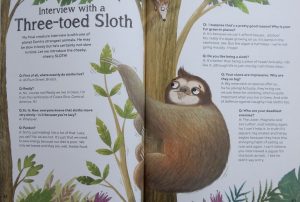
Don’t miss the chat with a Polar Bear, or the Giant Armadillo and the final, Three-toed Sloth either. The last one clearly has a sense of humour and will make readers laugh at his responses. Tee hee!

This is such a fun, hip way of presenting information – a considerable amount of it – in a memorable fashion that will appeal particularly to young humans that prefer a touch of light-heartedness to their learning.

The Clue is in the Poo

The Clue is in the Poo
Andy Seed and Claire Almon
QED

The author of this book is passionate about getting children (and their teachers) enthusiastic about reading and a great one for making non-fiction fun. Here’s his latest and let’s say, enticingly titled offering  that as well as investigating their faecal matters, looks at animals’ footprints, homes, nests, skulls,

coprolites (fossilised dung to you and me), and more. And yes, it’s terrific fun.

Poo, so we’re told is a good indicator when it comes to clues regarding which animals you’re likely to come across on your foray into the wild; and generally speaking the larger the animal, the larger its poo. Hmm! A rhino for instance leaves deposits of between 50 and 90 cm whereas that of a wolf is only 12 to 15 cm and shrew poos are a minute 2-4mm.

For those interested in classifying things we’re given half a dozen different turd types – tubular, lumpy, pea-like, pancake, shiny blocks/clumps and twisted/hairy, deposited by various mammals to start us off.

Bird droppings, you’ll be interested to learn, are generally more tricky to identify than those of mammals and should you want to become a bird poo detective, illustrations of seven types of bird plops are provided.

Now who would have thought that an adult reviewer could become completely engrossed in a book that focuses on excretory matter? It was certainly so where this one is concerned: my next forest expedition will perhaps take on a completely different focus; and yes, I’ve read the rules of tracking provided at the front of the book along with the annotated list of things needed on an expedition.

I must mention the illustrations: bear in mind that Claire Almon whose watercolours grace the pages is from the USA; thus her blue robin’s egg is of the North American robin whereas the European robin lays creamy eggs with light reddish-brown markings.