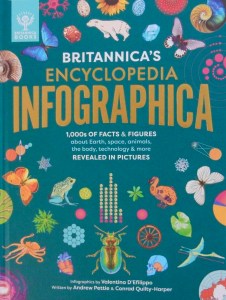
Britannica’s Encyclopedia Infographica
Andrew Pettie & Conrad Quilty-Harper, illus.Valentina D’Efilippo
Britannica Books
If you are looking for a book to lure your children away from screens then try this. It’s a weighty, highly visual book absolutely bursting with interesting facts, divided into topics – space, followed by in order land, sea and sky, living planet, animals, the human body and the human world. Before these is a “How to Read This Book’ spread that explains the main ways the infographics organise and present the information. This should start youngsters off on the right track thinking about counting and order, measurement and rules, scale, colour and pattern, position and familiar comparisons.
I turned first to the living planet section and was fascinated to learn some new names that describe both leaf shapes and vein patterns. Some were familiar but not pedate (palmate but with indented lobes) and flabellate (fan shaped). Another new term was arcuate that describes a vein pattern (pinnate but the veins curve towards the leaf margins).

I was astonished to learn that the seed of a rare palm, the coco de mer can weight up to 25 kilos and be as long as 30.5 centimetres. I wouldn’t like that to fall on my head.
Moving on to the animals section, I was intrigued by the information on the ‘smallest known’ page. Did you know that the smallest land mammal, the Etruscan shrew is only 6cm long including its tail or that the nano-chameleon, the smallest reptile is a mere 1.4cm long (not including the tail)?

However, it’s true to say that no matter where you open this bumper book, you are likely to be wowed or amused by something that you read. I’m sure a considerable number of children will enjoy the poo and farts’ spread that includes a presentation of the Bristol Stool Scale with visuals of all seven poo types.
With its eye-catching design, key questions, enticing headings and bite-sized paragraphs, this format should work in all manner of settings and situations both at home and in the classroom. It definitely should be in every school library – primary and secondary; just think of the many ways it might be used.


 Red Reading Hub - Jillrbennett's Reviews of Children's Books