Mummies Unwrapped

Mummies Unwrapped
Tom Froese
Nosy Crow (in collaboration with The British Museum)

Ancient Egypt is a popular topic for the KS2 History curriculum but the subject of mummies is given relatively little attention.

Now illustrator Tom Froese reveals their mysteries in this book unravelling both those of humans and animals. To allow them to remain together in the afterlife, sometimes pets were mummified at the same time as their humans.
First of all is an explanation of what a mummy actually is, and the origin of the word. We then learn how a mummy was made. It was crucial to start the embalming process as soon as possible to prevent the body rotting in the hot sun.

An embalmer’s toolkit is depicted and the entire process is described.

If you’ve ever wondered what the wrappings were made of, they were generally linen torn into long strips that look a bit like bandages.

We learn the grisly details of what was done with internal organs (only the heart was left in place as this was thought to be needed in the afterlife), as well as reading of the outcomes of embalmers’ errors.

There’s information about the funeral procession (after 70 days) to the tomb and what took place thereafter. There’s also a spread introducing some of the most famous mummies including Tutankhamun and one called the ‘unlucky mummy’ said to have been cursed.

Unearthed too are stories of tomb robbers, and what took place when archaeologists discovered mummies thousands of years after their burial; there’s mention of fake mummies and other shenanigans. Apparently the French King Francis 1 always carried a packet of powdered mummy with him in case he was ever in need of urgent healing. Bizarre!

Froese’s stylish illustrations have touches of gentle humour, plenty of detail and pattern making this a book I would definitely recommend adding to primary school collections and the bookshelves of youngsters with an interest in ancient history.

Myths, Monsters and Mayhem in Ancient Greece

Myths, Monsters and Mayhem in Ancient Greece
James Davies
Big Picture Press

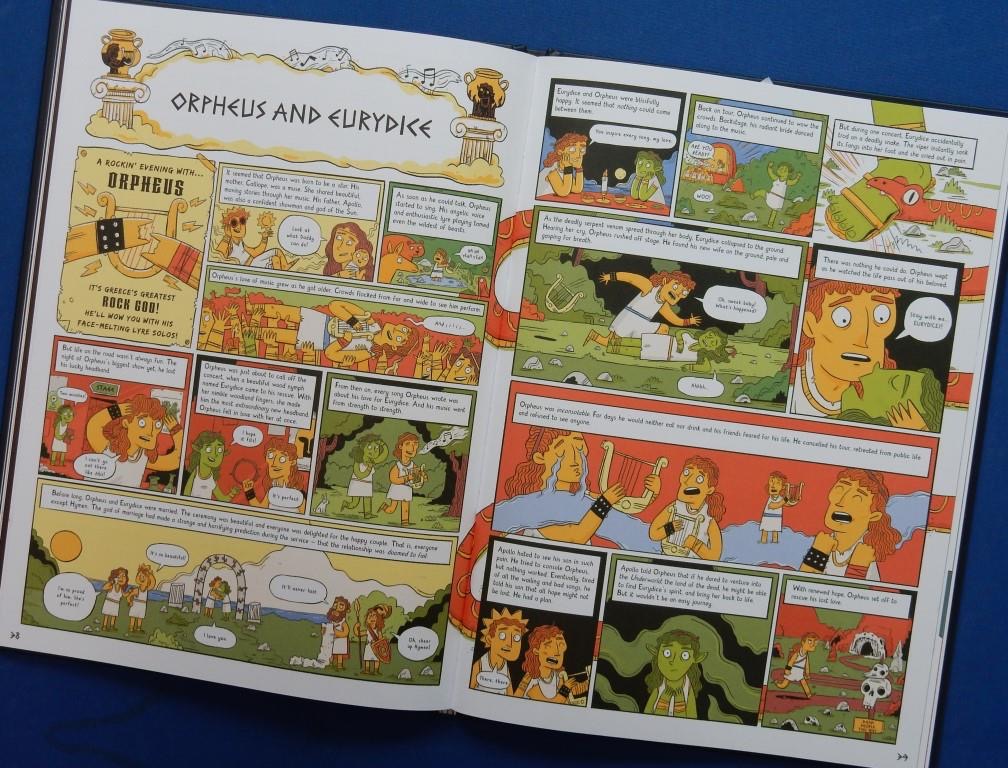
However famous the Greek myths might be, retellings of these ancient tales for youngsters can sometimes be pretty dull, turgid even; now here’s a book that makes them anything but.

In a dramatic comic book style James Davies presents half a dozen tales making them highly accessible to primary age readers wherein they will find bravery, loss, love,

greed and envy. Interspersed between the stories are thematic spreads on various topics that offer a broader look at such aspects of Greek mythology as the Greek gods and how the Greek myths explained the world; there’s a presentation of heroes and heroines including Atlanta, Achilles, Penthesilea and Odysseus. We also take a journey through the Greek underworld, a place that could be downright scary or delightful depending on your actions during your life.

James Davies’s bold graphic artistic style means that he manages to make even the most terrifying monsters such as the many-headed Scylla and the gigantic Hydra look amusing.

Right now I think we definitely need that tiny little shining insect that popped out of Pandora’s Box spreading light wherever there was darkness and hope wherever there was despair. Definitely now would not be a good time even to contemplate hiding away inside that ginormous wooden horse like those Greek soldiers did when Helen was rescued in The Trojan Horse story. However there’s much to learn from all six stories: that of Theseus and his quest to defeat the horrendous Minotaur,

the Twelve Labours of Heracles, Orpheus and Eurydice and Perseus and Medusa.

With Ancient Greece being one of the oft used topics in KS2 history, a couple of copies of this enthralling book would make a worthwhile, up to the minute addition to primary school topic resources as well as the school library.

Find Tom in Time: Ancient Egypt


Find Tom In Time: Ancient Egypt
Fatti Burke
Nosy Crow

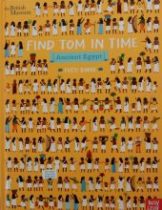
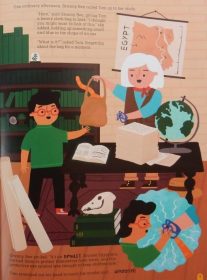
When Tom’s adventure-loving, archaeologist grandmother, Bea holds out an amulet for him to touch,

he finds himself transported back to a desert in Ancient Egypt surrounded by huge pyramids. In front of one stands a large statue called the sphinx. That though is only the first of the fascinating sights and activities that he encounters on his time travelling trip.

A funeral procession passes by and Tom follows behind to witness the burying of a mummy. He suddenly realises that there’s a cat on the scene that looks uncannily like his gran’s Digby. Surely not, but it is, and thereafter the creature is one of the numerous items readers are asked to spot in the locations Tom visits.

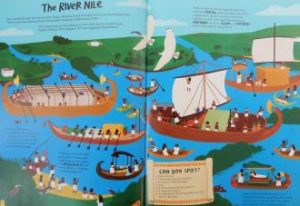
There’s the River Nile

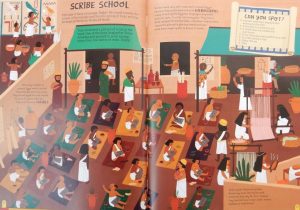
and farmland close by, flooded annually by the river that puts additional nutrients into the soil; the busy town marketplace; the huge temple close to which is a scribe school where fortunate students sit writing on stone blocks.

From there Tom follows a boy to the embalming workshop that is full of dead bodies , priests and workers.

Outside again he takes a look at some of the houses, one of which belongs to a nobleman and is full of expensive wooden furniture, ivory and gold.

Somehow the lad finds himself at a banquet where guests feast on such things as duck, goose, fresh fruit, sweet cakes and pastries.

By now dusk has fallen, Digby still eludes him but Tom makes a stop at a riverside festival having heard a familiar meow. Surely that can’t be Granny Bea holding the errant moggy?

It is; and as Tom reaches out to hug her, there’s a ‘whoosh!’ and they’re back home in the present. It’s then that readers learn that Granny Bea has accompanied Tom at every stage of his journey: time to go back and start searching for her in every scene.

The Ancient Egyptians is a very popular unit of study in the KS2 curriculum and with detailed art by Fatti Burke, this book, published in collaboration with The British Museum, will make a fun, immersive and educative addition to a primary school collection as well as one to enjoy at home, especially by those who are eager search and finders. It’s fortunate perhaps that there are solutions showing the location of all the seven items hidden in each spread.

Find My Rocket / Elephants on Tour / Egypt Magnified

Find My Rocket
Aleksandra Artymowska
Laurence King Publishing

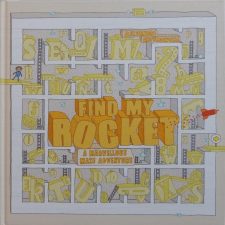
Aleksandra Artymowska is a terrific illustrator; I first came across her amazing work through another maze book, Amazed. Now it looks as though the same boy from that book has returned needing help in another puzzling adventure. This time having sent his red rocket jetting off into space he needs our help to locate it in eleven differently themed maze scenes. It’s easy enough for readers to spot the whizzing spacecraft but finding the right way through the intricately detailed possible pathways presents a real puzzler.

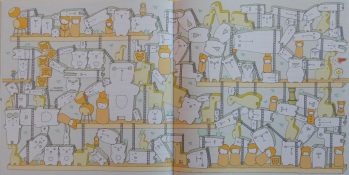
Every one of Aleksandra’s scenes be it the paper cranes, the building blocks, the toolbox or the teddies,

is packed with wonderful small objects, visual jokes and more – love the alliterative manoeuvres the lad performs during his search– catapulted through the cars, dodged all the dominoes, for instance, before he finally succeeds in retrieving the object he launched.

A great book to immerse oneself in as the evenings draw in; if you’ve yet to discover Aleksandra Artymowska, then this is a great place to start.

Elephants on Tour
Guillaume Cornet
Laurence King Publishing

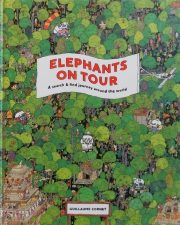
Having packed their trunks, five elephants are ready to embark on a world tour and we’re invited. First though we need to get to know something about our fellow adventurers: there’s the highly organised guy with his bags full of maps and tickets. He’s accompanied by a food connoisseur; the arty one, the photographer and the energetic one who insists on taking his skateboard along.

Having done London aboard a red double decker, the next port of call is Amsterdam with its canals and cycle lanes to explore. No doubt they sampled the syrupy waffles, a speciality of the city.

I’m sure they would also have tried the blinis in St. Petersburg and kayaked along one of the rivers or taken a ride on the Mongolian railway.

After visiting sixteen locations on five continents the final stop in their frenetic journey before returning to home shores, is Paris.

Along the way we receive a running commentary from the five travellers and for each location a fact file and other useful information. We’ll definitely need all that because at the outset, we are asked to make sure we find each of the elephants and their favourite belongings at every stopping place. No easy task with so much to look at. (Answers are supplied at the end of the tour.) My head is spinning after that.

With Guillaume Cornet’s intricately detailed scenes, this search and find journey is totally engrossing; those cityscapes are mind-boggling.

Egypt Magnified
David Long and Harry Bloom
Wide Eyed Editions

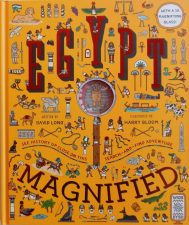
One possible way to get youngsters interested in times past, especially those who can’t get enough search-and-find books is this offering from Long and Bloom. Readers are invited to travel back through the centuries and visit sixteen Egyptian scenes, including the Great Pyramid and Tutankhamun’s tomb that are absolutely teeming with tiny figures.

Once in ancient Egypt, there are  ten items or people to spot in each illustration and on reaching the end, readers are encouraged to go back and hunt for another 57, plus a hidden mummy on every spread. (There’s a magnifying glass to facilitate the search inside the front cover, because, so we’re told, every Egyptologist needs one.)