The Story of Conservation

The Story of Conservation
Catherine Barr and Steve Williams, illustrated by Amy Husband
Frances Lincoln Children’s Books

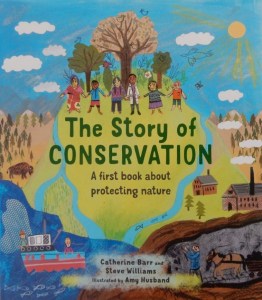
Catherine Barr and Steve Williams present an overview of the interaction of humans with planet earth. They take readers on a journey from prehistoric times to the present, highlighting the changes in people’s habits, the ways nature has been harmed, the natural resources used, and the ways people have worked to counter those changes to protect nature, citing Rachel Carson’s work as key when it came to the use of chemicals on crops in North America.

As well as highlighting the importance of changing global habits, the book also gives examples
of problems that different countries are facing – the consuming of ‘wild-caught’ meat in some parts of Africa being one, and the displacement of indigenous people.

Along with scientists’ attempts to stall the onslaught of global warming and pollution, the book discusses protests and attempts at conservation solutions.

Amy Husband’s gently humorous illustrations and the integral timeline show how human life has changed, and the way we use natural resources has evolved over time as practices like hunting and farming have altered the way we live. All of this should help children to develop their understanding of climate change globally and hopefully accept the authors’ final challenge to join in and make a difference.

A terrific introduction to the most pressing issue currently facing us all; this is a book to share and discuss in primary classrooms, and this, one hopes, will galvanise children into taking action.

The Story of Inventions / The Great Big Brain Book

Two new titles from Frances Lincoln each one part of an  excellent, established series:

The Story of Inventions
Catherine Barr & Steve Williams, illustrated by Amy Husband
Frances Lincoln Children’s Books

Have you ever wondered how some of the things we take for granted such as paper and books,

clocks and watches, computers, electricity, vaccinations, cars, planes, the current pollution-creating scourge – plastic, as well as the internet came about? If so then this book will supply the answers.

Written in a reader friendly, informative style that immediately engages but never overwhelms, the authors will fascinate and inspire youngsters. Add to that Amy Husband’s offbeat detailed illustrations that manage to be both accurate and amusing,

and the result is an introduction to inventions that may well motivate young readers to become the inventors of tomorrow.

Add to classroom collections and family bookshelves.

For all those incredible developments to happen, people needed to use their brains; now here’s a smashing look at how this wonderful organ of ours works:

The Great Big Brain Book
Mary Hoffman and Ros Asquith
Frances Lincoln Children’s Books

There’s so much to like about this book, that is a great introduction to an amazing and incredibly complicated part of the body. How many youngsters will have thought about the notion that their brains are responsible for every single thing that they do, be it breathing, walking, chatting, eating, thinking, feeling, learning for instance. Moreover the brain enables us to feel happy, sad, powerful, and much more.

So how does this ‘control room’, this ‘miracle of organisation’ as Mary Hoffman describes the brain, actually function? She supplies the answer so clearly and so engagingly that young readers will be hooked in from the very first spread.

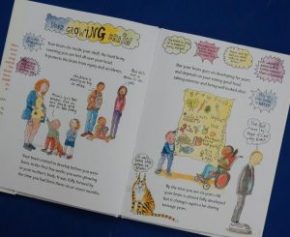
Each double spread looks at a different but related aspect such as the brain’s location and development;

another explains how the brain functions as a transmitter sending messages around the body by means of neurons. Readers can find out about how we’re able to move our muscles, do all sorts of tricky, fiddly things such as picking up tiny objects, a jigsaw piece for instance.

Lots of other topics are discussed including the two sides of the brain and what each is responsible for, as well that of neurodiversity. Some people’s brains develop differently, while others might have problems if something goes wrong with their brain.

Every spread has Ros Asquith’s smashing cartoon-style illustrations that unobtrusively celebrate diversity and make each one something to pore over.

A must have in my opinion.

The Story of People

The Story of People
Catherine Barr, Steve Williams and Amy Husband
Frances Lincoln Children’s Books

I greatly enjoyed the two previous titles in The Story of … series and this new addition is another winner.

It’s a whistle-stop tour of the historical development of humankind that begins with the earliest humans – Homo erectus – two-legged hunter-gatherer apes that lived in Africa.
Did you know that the larger brained Homo sapiens also appeared first in Africa? Travelling out across Europe and Asia, these are the people we are descended from.

The account moves to early farmers, then the Bronze Age when cities grew; diseases were caught from animals and mark making in relation to harvests was used.
The Iron Age, trading voyages across oceans and land and decisions based on philosophy are also covered, taking readers to 1CE – 1000CE during which Islam in the Middle East and Christianity in Europe were growing.

Thereafter came religious wars, trade routes opened up and between 1700-1800CE Islamic science experiments inspired new discoveries in science and nature around the world.
Technology as well as science then started to change how people lived and continues to do so. At this point the author acknowledges that in addition to the numerous changes for the good, human actions are damaging our precious world.

The book ends with a consideration of what might happen in the future ending on an optimistic note: ‘By sharing, polluting less, respecting wild places and farming alongside wildlife, there is hope for the future. We can all live in harmony with nature on our beautiful blue planet.’ Let’s hope it’s so for the young children who are the book’s audience.

Amy Husband’s alluring naïve, cartoon style collage and crayon illustrations together with Catherine Barr and Steve Williams’ highly accessible narrative provide a lively introduction to a fascinating topic.

The Story of Space / 100 Steps for Science

The Story of Space
Catherine Barr, Steve Williams and Amy Husband
Frances Lincoln Children’s Books
Subtitled ‘A first book about our universe’ this follow-up to The Story of Life is an equally fascinating exploration of another ‘big’ topic: what is thought to have happened 13.8 billion yeas ago when the Big Bang created our universe; and what followed in space thereafter going right up to the present time …

even projecting future possibilities. We’re told how the sun came into being; how, over billions of years, stars ‘are born, grow old and die’; how the planets – and hence our solar system – were formed. As well as that, there is a spread on comets and asteroids; another on how/why the seasons vary in different parts of the Earth; and one looking at oxygen and how it supports life.

This awesome journey is taken in the company of two young space investigators who comment and ask questions alongside the authors’ main narrative. Both Barr and Williams have a science background and manage perfectly, to avoid talking down to primary school aged readers. Amy Husband’s vibrant illustrations have an exuberance about them, making the whole book all the more inviting for the target audience.
I’d most certainly add this to a home collection or primary class library.
The same is true of:

100 Steps for Science
Lisa Jane Gillespie and Yukai Du
Wide Eyed Editions
Ten STEM topics are explored in this fascinating book (written by a doctor of chemistry), that offers thoroughly digestible, bite-sized introductions to Space, Wheels, Numbers, Light, Sound, Particles, Medicine, Materials, Energy, and Life.
Each one is allocated several spreads wherein its evolutionary story is explored and the key scientists are introduced. In this way, what might for some, seem formidable topics, are given a human element making them more easily engaged with and intriguing. Add to that Yukai Du’s detailed visuals, which include some amazing perspectives …

and science becomes exciting for everyone.

I’ve signed the charter 

The Story of Life/Wild Life Adventures

DSCN3894 (800x600) 

Wild Adventures
Mick Manning and Brita Granström
Frances Lincoln Children’s Books
From making shelters to lying in a tent listening to the dawn chorus or evening serenade, and creating a beach sculpture to cloud watching, there is something to interest and capture the imagination of seasoned ‘outdoorers’ and would-be discoverers of the natural world.
Instructions for all these activities, along with safety warnings and information about the various flora and fauna one might encounter is provided,

DSCN3895 (800x600)

as well as some questions and other comments to prompt further investigations.
The children in the exciting and detailed watercolour illustrations are clearly having great fun and one suspects, learning a lot about the great outdoors at the same time. The whole book made me want to go and join them: I think it will inspire children to do likewise.

DSCN3932 (800x600)

The Story of Life
Catherine Barr, Steve Williams and Amy Husband
Frances Lincoln Children’s Books
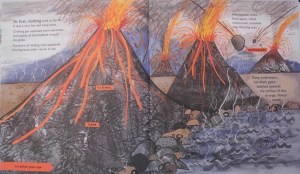
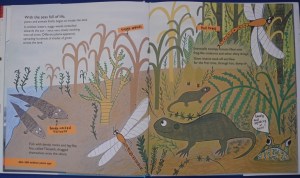
Evolution is a daunting subject to tackle, especially in just 32 pages. The time scale involved- 4.5 billion years, the hostile nature of the newly-formed earth,

DSCN3930 (800x600)

the formation of ‘tiny bits’ – cells in the ocean three billion years ago is so fantastical it is difficult to get one’s head around. However, without talking down to them, Barr and Williams (both of whom have a biological background) have managed admirably to weave together the basic elements of the story of the evolution of life on earth as presently understood into a very accessible, readable narrative for primary school aged readers. It’s certainly not a topic I was introduced to until I began studying zoology at A-level but ‘Evolution and Inheritance’ is now a part of the KS2 science National Curriculum.
There is an abundance of labels and speech bubbles in Amy Husband’s brightly-coloured, mixed media illustrations,, which have a gentle playfulness about them.

DSCN3931 (800x600)

There is also a time line and a glossary and teacher’s notes are available to download at http://www.franceslincoln.com/the-story-of-life.
All in all, a book to excite its readers and perhaps lead them on to further exploration of this engrossing topic.

Use your local bookshop localbookshops_NameImage-2