Spot the Mistake: Journeys of Discovery

Spot the Mistake: Journeys of Discovery
Amanda Wood, Mike Jolley and Frances Castle
Wide Eyed Editions

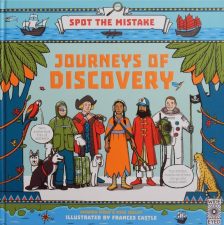
If my experience with the previous Spot the Mistake title, Lands of Long Ago, is anything to go by, children will eagerly seize upon this follow up that encompasses ten explorative expeditions with famous travellers from Marco Polo to the NASA Apollo moon mission.

Each of the journeys is allocated two double spreads, the first being a large scene featuring the explorer and aspects of the journey undertaken, and contains 20 visual incongruities for spotters to discover.
The subsequent spread identifies the ‘anachronisms’ (some are much more easily spotted than others,) in a smaller annotated scene and provides some explanation; and there’s also a paragraph about the particular journey and the explorer(s) involved.

With explorers as diverse as Zheng He from China who, in the 15th C, led voyages that took him and his fleet to Africa, the Middle East and parts of Asia, and Edmund Hillary who, with his trusty guide, Sherpa Tenzing Norgay reached the top of Mount Everest, the world’s highest mountain in 1953.

Young eagle-eyed spotters will definitely enjoy finding the Elvis picture among those displayed on the Zheng He spread; the basket of apples and incomplete lunar calendar in Columbus’ ‘New World’ scene;
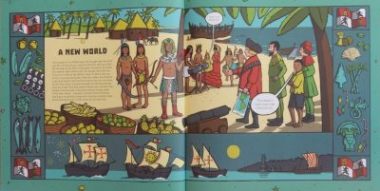
and the laptop lurking in the early 20C South Pole scene that features Captain Scott.

Frances Castle’s diorama style scenes are both engaging and contain just the right amount of detail to be inviting but not overwhelming.

Between the covers of this book there’s a wealth of learning potential in the form of a game.
Search-and-Find Alphabet of Alphabets

Search-and-Find Alphabet of Alphabets
Allan Sanders, Mike Jolley and Amanda Wood
Wide Eyed

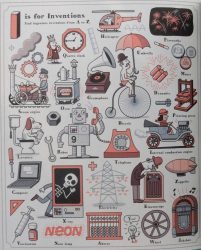
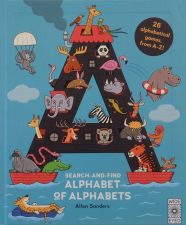
There are countless alphabet books for children, mainly aimed at youngsters who are learning about letters and their order. This is altogether different: a search-and-find book where each of the 26 letters in the alphabet has a different theme.
Thus A is for Alphabet and introduces the remaining letters and their topic – B is for birds; C for Creepy-Crawlies; D is for Dinosaurs, E is for Earth and so on.
Within each topic is another A to Z, so for instance, readers need to find the bird that represents each letter from Albatross to Zebra finch.

In some spreads the items to find are captioned …

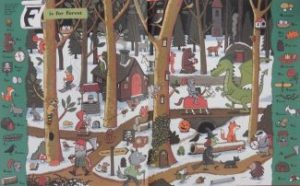
whereas in others such as the Forest spread there’s a key on the edge of each page showing and captioning the things to look for within the main illustration, adding an extra dimension of fun.

The vocabulary is at times fairly challenging: the Toyshop spread for example includes a Zoetrope while Neighbourhood has a Viaduct and an Underpass as well as a Duck pond and a Road.

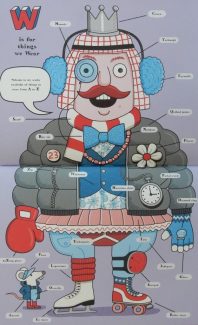
Two of my favourite spreads are W whereon we’re welcomed to a ‘wacky wardrobe of things to wear’…

and School where it’s the pupils’ names that represent the letters of the alphabet and we have to name their associated objects.

The authors admit to the odd spot of rule bending when it comes to X: some of the words don’t begin with X but have it somewhere within them and as for Q well, there’s a crown wearing queenie who insists on popping up everywhere!

Allan Sanders has a superb eye when it comes to design: every spread looks totally different and enormously inviting.

All in all, 1 crackingly clever, original book; 26 awesome alphabets and 676 terrific things to find.

Spot the Mistake : Lands of Long Ago

Spot the Mistake: Lands of Long Ago
Amanda Wood, Mike Jolley and Frances Castle
Wide Eyed Editions
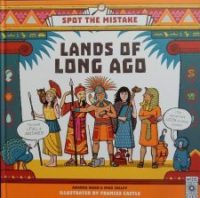
Many children love to point out the mistakes made by adults. This large book capitalises on this, giving them the opportunity to search Frances Castle’s ten historic scenes to identify the 20 impossible elements that have found their way into each one, as they accompany two young detectives who are on the hunt for those visual errors.
Their first visit is right back to the Stone Age or more precisely around 12,000 years back to the Late Stone Age when humans started living in communities, building permanent homes, growing crops and keeping animals.
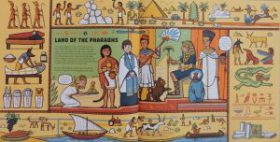
From there the questers move forward to 5,000 years back and the Land of the Pharaohs.

The double page scene is followed by another about the same location and provides reasons for the 20 visual anomalies as well as facts about what the ancient Egyptians would have had instead. This pattern, spot the mistakes followed by information spread, is used for each stop throughout the entire time travelling adventure.
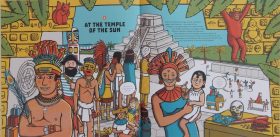
Other scenarios are ‘An Outing to the Acropolis’, ‘The Emperor’s Palace’ in ancient China; ‘Life in Ancient Rome’; ‘At the Temple of the Sun’ – the Mayan Empire;

Sailing with the Vikings’; ‘Jousting with the Knights’; ‘The (Mughal) Emperor’s Parade’; and finally, there’s a beach location for ‘Pirates Ahoy!’.
Frances Castle’s aptly bordered, alluring scenes have an ironical, lightheartedness about them that is just right for this time-travelling investigation. I envisage groups of children captivated as they play visual detective together.

I’ve signed the charter  

Natural World

DSCN8020

Curiositree Natural World
Amanda Wood, Mike Jolley and Owen Davey
Wide Eyed Editions
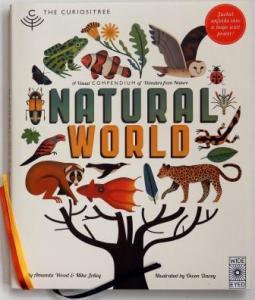
This is a weighty tome chock full of wonder: ‘ Visual Compendium of Wonders from Nature’ is how it’s billed and it most definitely is: essentially, almost a visit to the Natural History Museum in a book.
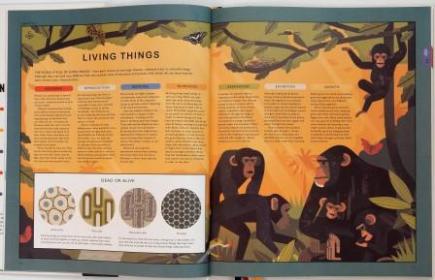
And what better way to begin than with this Albert Einstein quotation: “I HAVE NO SPECIAL TALENTS. I AM ONLY PASSIONATELY CURIOUS.” That sets the scene for an amazing investigative odyssey based on sixty-seven colour-coded wall charts. This is indicative of the subject matter: yellow informs about habitats; orange focuses on particular plant or animal species; blue charts look at animal behaviour or adaptations. The first spread introduces the seven characteristics of all living things be they animal or plant.

DSCN8039

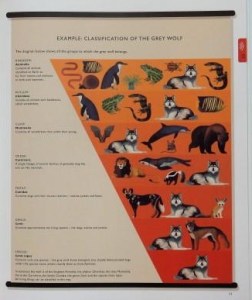
This is followed by a look at the classification of organisms with an example of the Grey Wolf broken down into the seven levels from kingdom through to species.

%0A

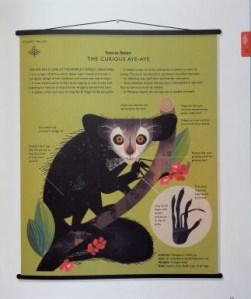
There is a natural flow through the chart topics: groups lead into habitats, and thence into ‘The fight for Survival’. Thereafter a loose logical organisational path is followed: Life in Tropical Rainforests leads to ‘Who Lives Here?’ (yes, there are specific questions for consideration every so often), followed by a close look at one specific rare creature, The Curious Aye-Aye.

%0A

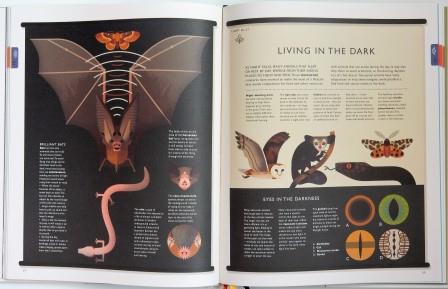
Then follows a look at ‘Living in the Dark

DSCN8024

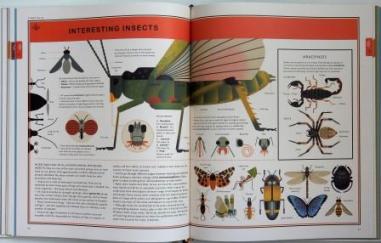
Insects have always held a particular fascination for me so I flipped through and came upon a spread entitled Interesting Insects:

DSCN8025

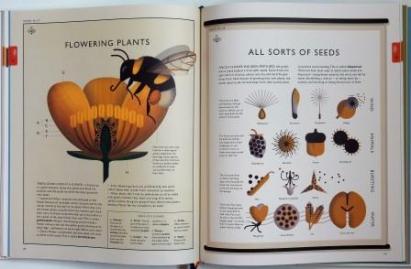
after which came – entirely logically – this one:

DSCN8026

followed by Life in the Honeybee Hive.
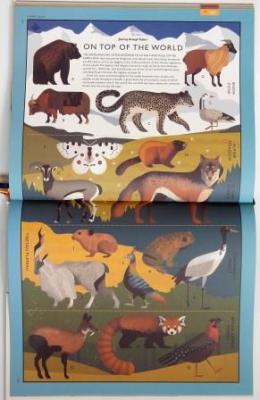
Most spreads are landscape though an occasional one has a portrait orientation like here in On Top of the World:

DSCN8028

that allows the animals found at different levels from forest floor to Snow Zone to be shown to greater effect.
In the final spread, The Changing Planet, the mood shifts from celebratory to solemn as we see a polluted landscape with belching chimneys, aircraft and much more, harming air, land and water and threatening the survival of a whole host of species, plant and animal. It’s up to we humans – Homo Sapiens (wise man) to take responsibility and protect our precious planet for those who come after: a compelling message we ignore at our peril.
Owen Daveys’ art work is stupendous: a fusion of retro-style and ultra mod. computer graphics that is perfect for this book.
Every possible consideration is given to design, right down to the dust jacket which, when removed opens out into a large poster to display on your wall. There are even three marker ribbons, one orange, one yellow and one blue, in keeping with the colour-coding of the charts.
A must buy for the family bookshelf, the school or college library; in fact for any organisation that cares about life and the interconnectedness of everything.
WNDB_Button localbookshops_NameImage-2