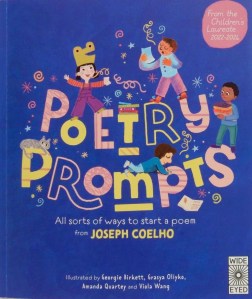
Poetry Prompts
Joseph Coelho, illustrated by Georgie Birkett, Grasya Oliyko, Amanda Quartey Voila Wang
Wide Eyed Editions
Children’s laureate, Joseph Coelho provides 41 ways for readers to ‘discover the poet within.’
His first prompt is to have a dedicated notebook of your own that you can always have to hand when an idea arises; he even demonstrates how to make such a book from a single sheet of paper.
He then proceeds to one word poems; the trick so we read, is to have a long title. If this idea works for you, you can he suggests, in his first ‘poetry power-up,’ write several on the same theme for example: ‘The Sound of Water / Splash. // The Feel of Water / Cold. // The Taste of Water / Nothing.’
There are suggestions for penning poems that use rhyme and repetition, alliteration, onomatopoeia, similes, and metaphors as well as certain poetic forms such as haiku, and more challenging, triolets.
Most of the ideas are relatively light-hearted but there are also prompts for a ‘Home Is …’ poem in relation to World Refugee Day, and another for plastic pollution.
The four illustrators portray a diverse cast of children, as well as playful images of fauna, flora and an abundance of food ,

which offer further inspiration. The message that poetry is “about having fun with words” comes through loud and clear. I envisage lots of primary age children having great fun with the ideas in this book. (If used in a classroom though, it would be advisable, I think, to include prompts for some non-Christian festivals as well as those for Christmas and Easter.)


 Red Reading Hub - Jillrbennett's Reviews of Children's Books