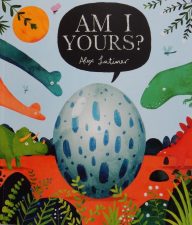
Am I Yours?
Alex Latimer
Oxford University Press
Alex Latimer certainly keeps his audience guessing in this rhyming tale concerning an identity issue.
If you’ve never heard of an egg that speaks, you’re about to in this review.
Said egg, having been blown from a nest and spent a cold dark night at the foot of a hill emits a gentle ‘Excuse me, please, but am I yours? I’m sure I am a dinosaur’s.’
Yes it’s another dinosaur tale with lots of children’s favourites making an appearance.
First to come along is Stegosaurus but the egg doesn’t fit its specifications, says so, but remains upbeat.
Nor does it fit those of Brachiosaurus, Triceratops, Corythosaurus
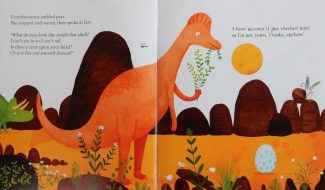
or Tyrannosaurus, by which time an entire day has passed and the egg, feeling lonely begins to cry out ‘… I can’t stay out in wind and storm! / I’ll freeze alone! I must stay warm!’
The sun sinks and in so doing renders the eggshell translucent allowing the five concerned adult dinosaurs a view within.
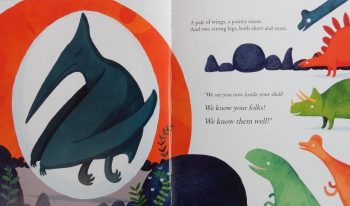
Now they know what to do with the lost egg: back it’s rolled up the hill from whence it came, and there, to the sound of heavy feet, it makes a final plea:
‘One last time – I must be sure – / Are you the ones I’m looking for?’ …
In addition to the enjoyment of meeting some of their favourite prehistoric creatures in the story, with its invitation to join in the telling through the rhyming repeat refrain, ‘What do you look like inside that shell? / I can’t see in so I can’t tell.’ children will love becoming co-inquisitors of the egg,
(There’s lots of potential for small world play here once you’ve shared the story.)
For dinosaur enthusiasts who like to colour:
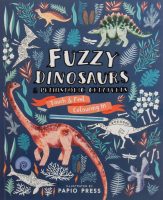
Fuzzy Dinosaurs & Prehistoric Creatures
illustrated by Papio Press
This is a touch-and-feel book with 7 spreads to add colour to, featuring animals of the prehistoric land, sea and sky, set out in chart-like form with brief snippets of information relating to each featured (numbered) animal one side of the spread, opposite which is the colouring page on a dramatic black background with the numbered creatures and other flora and fauna.
The book is written in association with, and fact-checked by, the National History Museum.

