Baby Touch: Playbook Baby Touch: Animals / Little World: In the City Little World: To the Moon

Baby Touch: Playbook
Baby Touch: Animals

illustrated by Lemon Ribbon Studio

Little World: In the City
Little World: To the Moon

illustrated by Allison Black
Ladybird Books

I’ve always advocated that adults should share books with babies almost from the time they’re born so it was good to receive these samples of two new series from Ladybird Books.
With their simple, colourful images, differently textured objects to feel, and texts that are baby appropriate, the Baby Touch books are ideal for the very youngest.

The Playbook even introduces lines from such classic nursery rhymes as ‘Twinkle, twinkle, little star’ and “Teddybear, teddybear’.

In the Animals book the focus is on the animal names and their sounds. Both offer lots of sensory stimulation for babies from around 3 months although it very much depends on the child.

The Little World books are smaller in format and have a simple narrative running right through; and there’s an alternate push-and-pull element or slider on each of the four double spreads.

In the City keeps feet firmly on the ground – almost – as two very young children in the company of what could be grandparents encounter the hustle and bustle of urban life. There’s lots of traffic, a square to relax in for a while and perhaps watch some performers, an exciting museum to visit and the trip is rounded off by a boat trip down the river.

To the Moon blasts listeners off into space and thence to the Moon and is billed as being ‘based on the Apollo Moon landings’.

There’s a final fold-out vertical flap to add to the fun, as the explorers fire up the engines ready to lift off back home to Earth.

Both have lively illustrations that keep toddlers engaged and extend the potential beyond the basic narrative.

Oh! and there’s also a ladybird to find on every spread of all four books.
What Do They Do With All That Poo?

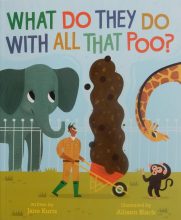
What Do They Do With All That Poo?
Jane Kurtz and Allison Black
Simon & Schuster Children’s Books

Of zoo books there’s an abundance, but when it comes to talking about the animals’ poo and what happens to it after passing out of the animals, is another matter. A faecal matter one might say and the author Jane Kurtz knows exactly how to grab the attention of young listeners even before the text begins with poo-filled endpapers – don’t miss those.Then, from the start (with a clever page turn) ‘At zoo after zoo / the animals chew. / And then … // they poo!” she holds that attention throughout.

Thereafter she digs into the diverse nature of droppings using rhyming couplets:‘A hippo sprays a shower / with its flipping, flapping tail. // To weigh a day of elephant’s poo, / you need a sturdy scale.’

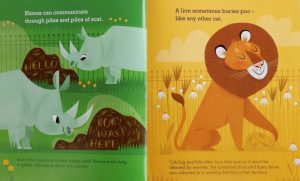
Beneath each illustration in smaller print come further facts concerning the animal’s business: ‘Hippos use dung to mark their territories and warn off predators. They shoot their dung out while flapping their tails to spray it around.’ ‘Rhinos can communicate / through piles and piles of scat. // A lion sometimes buries poo – / like any other cat.’
‘Each rhino’s poo has its own unique smell.’ ‘Rhinos smell dung to gather information about each other.’

Cats big and little often bury their poo so it won’t be detected by enemies. But sometimes lions and tigers leave poo unburied as a warning that this is their territory.’

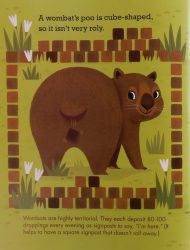
In her playful, scatological scenes Allison Black succeeds in giving each animal a personality with its distinctive shape and wide-open eyes; I love the hippo’s cheeky grin, the snake’s sneaky smile and the wombat’s look of seeming wonder at the shape of its turds.

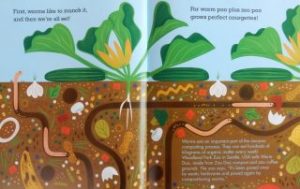
Having discussed a dozen zoo inmates, the author turns her attention to vast quantities of poo deposited each day (possibly as much as 2,270 kg). Much is taken away in lorries to landfills while some goes to scientists and vets for study and gardeners use some for compost:

did you know carnivore poo can be spread around gardens to prevent deer eating the plants and trees?

In addition to concluding the book with a huge grin on their faces, (apart from the squeamish few who might be feeling somewhat nauseous) little ones will end up having ingested a considerable amount of information to inwardly digest, not the least being that elephant poo can be made into attractive paper products – hmm!

Educative and enormous fun; if used in a school context, children might wish to find out what their nearest zoo does about poo.

Clumpety Bump / Barnyard Boogie!

Clumpety Bump
Phil Alcock and Richard Watson
Maverick Arts Publishing
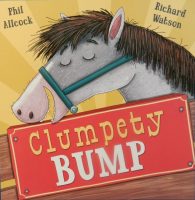
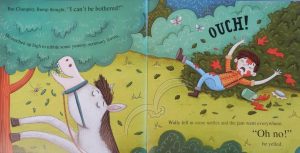
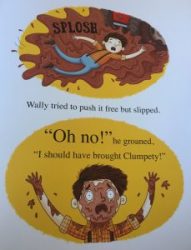
Wally Wobblebottom is a kind-hearted soul; he has a horse named Clumpety Bump, a very lazy animal indeed. So lazy that when Wally sets out to deliver goodies to his various friends and neighbours, the horse’s response to his master’s words of encouragement on each occasion is “I can’t be bothered!” which leaves Wally more than a little frustrated, especially as the items he intends to deliver all go to waste.

By Thursday Wally has had enough; he decides to use his tractor when he goes, bearing flowers, to visit his lady-friend. However it seems machines can be just as unreliable as horses …

and in the end it’s Clumpety that takes Wally, at full speed this time, all the way to Ann Kacheef’s house. There disaster strikes … but all ends happily for everyone.
With its playful phrases and refrains to join in with, this story, with its themes of thankfulness and friendship, is one to encourage audience participation and promote the message that language can be fun.

More playful language in:

Barnyard Boogie!
Tim McCanna and Allison Black
Abrams Appleseed
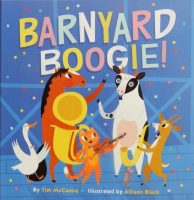
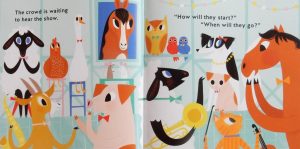
Be prepared for a noisy storytime if you share this one: it’s a riotous read aloud thanks to the musicians of the Barnyard Animal Band.
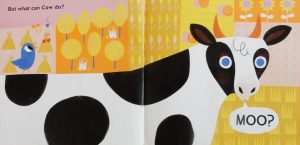
All the animals have their instruments poised: Horse has a tuba, Goat plays a sax, Cat fiddles, Pig is a pianist, Sheep blows a trumpet and Dog bangs the drums. But what can Cow do? …

The crowd’s assembled ready to hear the performance; but how will the show start and who will lead the band?

Crazy rhyming onomatopoeic instrumental sounds, and a repeat refrain that young children will love to join in with, are part and parcel of the brief text that scans beautifully. Put together with bright, zany illustrations, the whole thing makes for a fun session with young children actively involved both vocally and physically.