A Poem for Every Spring Day / The Best Ever Book of Funny Poems

Here are two recent poetry collections from Macmillan Children’s Books – thanks to the publishers for sending them for review

A Poem for Every Spring Day
ed. Allie Esiri

This is the third in the seasonal series – almost every one of which is taken from Allie Esiri’s A Poem for Every Day of the Year and A Poem for Every Night of the Year and once again it’s brimming over with poetry to lift your spirits.
Among the offerings herein you’ll certainly find many old favourites – lots took me right back to my days in primary school and even before that when my dad read A.A. Milne and Lewis Carroll aloud to me, as well as unearthing some new treasures.
As with the Autumn and Winter books, there are two poems for each day from 1st March through to the end of May and again Allie provides an introductory paragraph for each of her selections. Most of us associate spring with new life and yes, there are plenty of entries reflecting that aspect of the season but it’s more than just longer days, birdsong and buds opening and A Poem for Every Spring Day reflects this. There are poems commemorating specific occasions such as Rachel Rooney’s First Word (After Helen Keller) where she writes of Helen feeling water flowing from a pump with one hand while the letters for ‘water’ were spelt on her other palm. That moment took place on April 5th.
Another one that is hugely moving and also new to me is Duranka Perera’s Bitter State. The poet is also a doctor living in the UK and native of Sri Lanka where horrendous terrorist attacks took place on 30th March. It begins thus: ‘I was angry when it happened. / I was angry when the numbers continued to rise. / I was angry when bitter tongues lashed old wounds. / I was angry when a dying monument drew more /money than / The dying themselves.’
From John Agard to William Wordsworth, whatever your taste in poetry, there will be plenty to savour in this collection.

The Best Ever Book of Funny Poems
chosen by Brian Moses

Poet Brian Moses has chosen an assortment of splendidly silly poems for this compilation of over a hundred giggle inducers.
The selection has ten sections, each named with a line from or title of, one of the poems included. Thus for example we have ‘The red ear blows its nose’ from Robert Schechter’s What’s Mine for the first – Silly and Even Sillier Poems.
The teacher part of me wanted to turn next to the Headmaster’s Welcome where among the thirteen I totally loved Brian’s own The School Goalie’s Reasons
The writer/reviewer part of me just had to turn next to the Fantasy and Fairy Tales offerings where there are some terrific four liners including Rachel Rooney’s Epitaph for Humpty Dumpty: ‘ Beneath this wall there lies the shell / Of someone who had talents. / But (as you can probably tell) / One of them wasn’t balance.’ What a great starting point for a bit of epitaph writing in the classroom using a nursery rhyme theme. On the subject of the classroom, in the Funny Poems About Poems section is Joshua Seigal’s terrific I Don’t Like Poetry that offers a smashing lesson on similes, metaphors, alliteration, onomatopoeia and repetition. An invitation to youngsters to play around with words for sure.
Should your taste be more for pets, dinosaurs, family, space or things spooky, never fear: you’ll find all these covered too.
We all need something to cheer us up at the moment so why not start with this collection: it will long outlast the current pandemic however.

A Poem for Every Winter Day

A Poem for Every Winter Day
edited by Allie Esiri
Macmillan Children’s Books

I’m still relishing my daily reading of A Poem for Every Autumn Day as I start writing this review of Allie Esiri’s latest selection, the first month of which is December. The riches herein take us through, with two offerings per day, to the end of February, by which time one hopes, we’ll have a spring selection.

As in the previous book, Allie prefaces each of her selected poems with a brief introductory, background paragraph linking it to the date on which it appears.

You’ll surely find some of your favourites and take delight in making some new discoveries too: I was excited to find a fair few that were new to me and lots of familiar ones both traditional and new, from Coleridge to Wendy Cope and Robert Louis Stevenson to Benjamin Zephaniah.

Ist December remembers and celebrates Rosa Parks and all she stood for, with a poem by Joseph Coelho, and another by Jan Dean, both superb; also on the theme of Black American experience is Maya Angelou’s very powerful Still I Rise that follows straight after.

Wearing my teacher hat, I was enormously moved especially to discover spoken word artist, George Mpanga’s (aka George the Poet) The Ends of the Earth. It begins ‘A child is not a portion of an adult. It’s not a partial being. /A child is an absolute person, / An entire life.’ And concludes ‘Go to the ends of the Earth, for children.’ Equally moving and as pertinent now as when W. H. Auden wrote it in 1939 is Refugee Blues chosen here for 10th December which is Human Rights Day.

Inevitably snow features several times: there’s Brian Patten’s Remembering Snow that talks of the transformative effect on a little residential street and Snow in the Suburbswherein Thomas Hardy highlights its effects on animals. Then as expected there are a number of poems celebrating aspects of Christmas both secular and religious.

Strangely, three consecutive early January choices, Sara Coleridge’s The Months, A.A. Milne’s Lines Written by a Bear of Very Little Brain and Stopping by Woods on a Snowy Evening (Robert Frost) are poems I’ve learned by heart and can still recite – the first at primary school, the second at around the same age, at home, and the third at the beginning of secondary school.

What more uplifting way than Edward Thomas’ Thaw to look forward to the coming of Spring: ‘ Over the land freckled with snow half-thawed / The speculating rooks at their nests cawed / And saw from elm-tops, delicate as flower of grass, / What we below could not see, Winter pass.’

This superb seasonal celebration is an ideal companion for dark chilly evenings and bright days too, to read alone and to share with the family.

A Poem for Every Autumn Day

A Poem for Every Autumn Day
ed. Allie Esiri
Macmillan Children’s Books

Allie Esiri has selected 61 autumnal poems for this terrific poetry collection to take readers through from 1st September to 30th November.

For this poetry-loving reviewer much of it was a trip down memory lane, some of which, including Christina Rossetti’s Who Has Seen the Wind?, William Blake’s The Tiger, Someone Came Knocking (Walter de la Mare) and Leigh Hunt’s Abou Ben Adhem took me right back to my primary school days when I learned them by heart.

I’m back in my secondary classroom with my English teacher reading us Edward Thomas’ Digging, Hardy’s Drummer Hodge, Betjeman’s Diary of a Church Mouse and Robert Frost’s The Runaway with that beautiful soft Welsh lilt to her voice.

Then I’m up on the stage in my final year at the same school performing those lines from Longfellow’s The Song of Hiawatha.

Some of my favourite poems are included: there’s Shakespeare’s Sonnet 116 ; and Robert Frost’s The Road Not Taken; I can think of no better way to start October than with that.

It’s great to discover new things too.
Surprisingly I’d not comes across John Agard’s terrific poem about bullying, The Hurt Boy and the Birds, beginning ‘The hurt boy talked to the birds / and fed them the crumbs of his heart’ , the final lines of which are, ‘But the hurt boy talked to the birds /and their feathers gave him welcome – // Their wings taught him new ways to become.’

Bang up to date is Michaela Morgan’s Malala: the opening verses  are: ‘A girl with a book. A girl with a book. / That’s what has scared them – / A girl with a book. // They get on to the bus. / They call out my name. They aim. And they fire. / A shot to the brain.’

I was greatly moved by all the war poems chosen for November, and by James Berry’s Benediction, also new to me, that goes like this:
‘Thanks to the ear / that someone may hear // Thanks for seeing / that someone may see // Thanks for feeling / that someone may feel // Thanks for touch / that someone may be touched // Thanks to flowering of white moon / and spreading shawl of black night / holding villages and cities together’

Reminding us of the way smell and taste can bring back long forgotten memories, Crab Apples (Imtiaz Dharker) is another exciting discovery for me: ‘My mother picked crab apples / off the Glasgow apple trees / and pounded them with chillies / to change / her homesickness / into green chutney.’

Much as I really don’t want the summer to end, this treat of a book will assuredly help me feel my way through the shortening daylight hours as I read A Poem for Every Autumn Day.

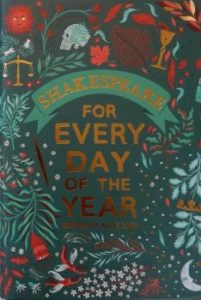
Shakespeare For Every Day of the Year

Shakespeare For Every Day of the Year
edited by Allie Esiri
Macmillan

As with Esiri’s A Poem for Every Day of the Year, and A Poem for Every Night of the Year, this weighty, beautifully produced book is, despite its title, one to get lost in; I certainly did. Having said that it could equally be used daily, or as a book to dip in and out of whenever the reader felt like it. Shakespeare after all, had a wonderful way of creating a whole story in a single sonnet or a few brief couplets.

Covering the sonnets, extracts from the 37 plays and sections of longer poems, all of which are given an introductory paragraph relevant to the particular time of year. For instance, one of my favourite sonnets (116) for November 28th tells of the episcopal register at Worcester containing a note of the bard’s marriage in 1582. As a result not only do we get Shakespeare’s words – the familiar and well-loved, alongside the lesser known – but also insights into his life and times: the light and the dark no less.

Many of us will have learned chunks of Shakespeare by heart often at school, and I found myself going to the Index of Works and looking up first lines and turning to those first; some with voices like that of Judi Dench sounding in my ear.

No matter how you read it or where, school classroom, home or with a group gathered elsewhere, this is an enormously exciting, enriching compilation (love the endpapers) that one hopes will make Shakespeare accessible to a very wide audience.

What an awesome present Shakespeare Every Day of the Year would make at any time.