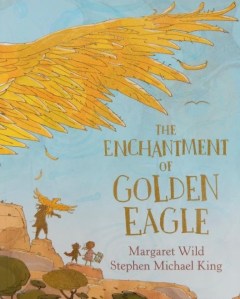
The Enchantment of Golden Eagle

Ella and her younger brother, Leif, live with their father in a small village at the edge of a forest. One day the siblings discover a fledgling Golden Eagle with a broken wing. They take it home and with their father’s help, they care for it for seven days and seven nights. With its wing mended, the bird is then ready to fly away but despite having looked longingly skyward, the bird promises to remain with them.
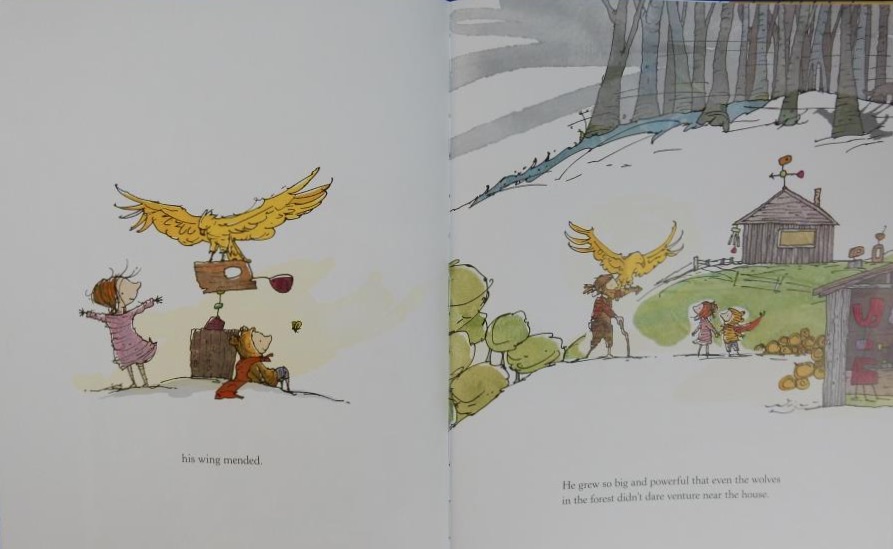
After a while their father is called away and it’s then that the Golden Eagle senses the wind calling and decides to take to the air – ‘just for a moment’. While he’s gone, the children are very frightened.

They tell the eagle that when he returns some time later and Ella even pushes him away when he tries to enfold them in his wings, cursing him thus, “You will fly without stopping for a year and a day.” Off he flies through all kinds of weather, longing for a rest, for the chirping of other birds and for warmth from a wing.
Eventually, completely exhausted the eagle drifts home once more and is greeted by Leif. As they face one another, eagle and Ella, the girl says that the curse wasn’t real and apologies are made. The three celebrate that night and Ella imagines the future when the Golden Eagle is once again well and strong, ‘larking about in the sky as all birds do.’

This is a multi-layered story that can be interpreted in many ways depending on the reader. Stephen Michael King’s wonderful ink and watercolour illustrations of Lief, Ella and their world work in harmony with Margaret Wild’s text with its themes of letting go, forgiveness and appreciation.

The Most Amazing Thing / Footprint

Henry is stuck indoors on account of the rain, the other members of his family are at home too: mum is busy working on her novel, his sister Greta is doing an experiment, his father is cleaning his telescope lens and brother Simon is meditating. But Henry with nothing to do, is bored, so he consults his mum who suggests he might draw the most amazing thing. What could that be though? Henry has no idea so he decides to ask his family. Each has a different answer: telling her brother to look down her microscope, Greta says life is the most amazing thing; to Henry, the mind is the most amazing thing, whereas Dad’s response is the universe.

Mum, finally free for a short while, surprises her son with her answer.
Both words and pictures take us through the various parts of the house where Henry goes for inspiration; it’s evident that he learns a considerable amount in his quest for an answer, some of it about himself. Matt Shanks’ watercolour, pencil and gouache illustrations of the images that might be forming in Henry’s brain as he talks to each of his family are full of fascinating details.

A thought-provoking story showing that with an abundance of wonderful things in the universe and a great many different ways to find that wonder, it’s unlikely that two people will have exactly the same view: we all see the world through different lenses. Try asking the children in your class or members of your own family: who or what will they decide is THE most amazing?.

There’s a line in a Native American poem wherein the author prays to the Great Spirit of Life to give him the wisdom ‘to walk softly on the earth’ acknowledging that it is the responsibility of each of us to care for our planet and its natural environment.

In this book, author Phil Cummings and illustrator Sally Soweol Han remind us of the wonders all around us and that we should walk carefully leaving only good behind us. The author’s lyrical rhyming text invites readers to join the children in various parts of the world as they wander out into the morning, looking and listening, but also taking time to pause, ponder upon what they see and hear and to breathe in the beauty,

be that of the deserts, mountains, valleys or wherever they find themselves. Each of the environments – a tropical forest with a river flowing through, the (melting) polar ice, the sandy desert, the smoky city and more – is depicted in Sally Soweol Han’s soft pastel and coloured pencil scenes, each of which shows how we can all, like the children depicted, look after our precious planet. Only that way can the young have the rich futures they hope for and deserve.

Last-Place Lin / Where Will the Sleepy Sheep Sleep?

These are both recent Allen & Unwin titles: thanks to the publishers for sending them for review.

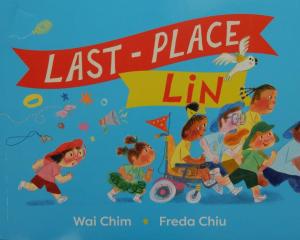
It’s young Lin’s first opportunity to participate in the school sports day and she’s in the red team. Dressed entirely in her team’s colour, she enters first the sack race and then the obstacle race, finding them anything but easy. Next she competes in the water balloon toss but finds it very hard. Unfortunately despite heaving with all her might, another child makes fun of her, calling out to her ‘Last-Place Lin’. Lin doesn’t give up though: she does the crab walk, the wheelbarrow race and the tug of war. Further name calling ensues but still she keeps trying, dropping the baton in the relay. 

Then comes the last race – a fun run – and a must compete for everyone so there’s no getting out of it by hiding. After encouragement off she runs, adopting the ‘Last-Place Lin’ as a kind of mantra that enables her feet to follow its rhythm as she puts one foot in front of the other encouraged by a friend and the cheering crowd … 

all the way to the finish line

The author Wai Chim’s experience of participating in an Australian TV show was the inspiration for this story. Essentially it’s a celebration of trying, endurance, doing the best you can and never giving up, no matter what. An important message for young children, who can all too easily get swept up in the ‘must win’ mentality that prevails in the sporting world. Freda Chiu’s expressive illustrations show so well how Lin gives the events her all and the difference a bit of encouragement makes to how she feels. Definitely a book to share and discuss with a KS1 class.

This is a bedtime tale of the tongue-twisting kind. A sleepy sheep is endeavouring to find a suitable spot for a night’s shuteye. But the places he tries are in turn ‘too deep, steep and stony’, ‘too dangerous’ (not to mention noisy), ‘too scary’, ‘too small, dark and damp’, ‘too cold and uncomfortable’, ‘too grimy and gritty’, 

or ‘too lonely’ . Having wandered hither and yon, it seems that luckless ovine is destined to have a miserable night but then … yes young listeners do eventually get an opportunity to bid ‘goodnight’ to the by now, exceedingly sleepy sheep.

Jonathan Bentley’s bold scenes show the sheep’s eyelids becoming heavier and heavier until his eyes are barely open at all as he stands in the corner of the great big paddock almost overcome by somnolence.

Young children love repetition and enjoy alliteration and this fun book has both; it’s just right for a bedtime story, but also, the repeat refrains mean that those in the early stages of reading will soon be taking over from the adult reader aloud.

Kind

Kind
Jess McGeachin
Allen & Unwin

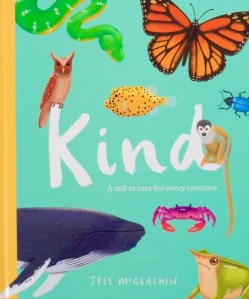
‘In this book you’ll find / Many kinds of things / Some have slippery scales / Some have feathered wings. // But kind is more than type / Kind is how to care / For creatures that you meet / And places that we share.’ Thus begins the beautifully illustrated, rhyming narrative that urges readers to show kindness to all living creatures and to our precious planet.

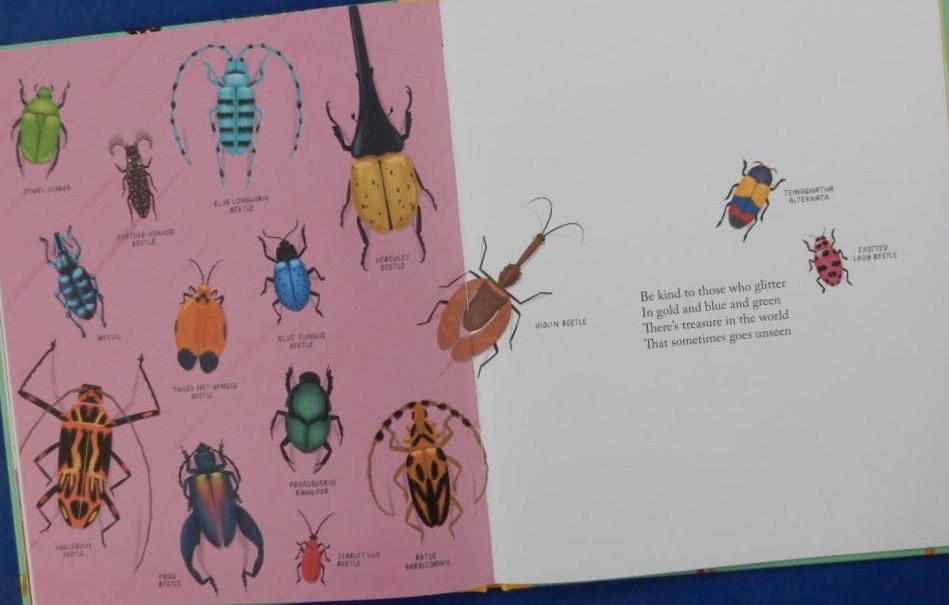
Making each spread a joy to explore, the author takes us first on a tour of the animal kingdom and presents flutterers, weavers, animals with shells, fish, the horned, the waddlers, owls and more, including some of the most spectacular. Every creature illustrated is clearly labelled with its Western common name; and each kind has a four lined verse that reads aloud well: ‘ Be kind to those who glitter / In gold and blue and green / There’s treasure in the world / That sometimes goes unseen’.

Having presented us with that wealth of wonderful creatures, Jess McGeachin moves the kindness focus, first to the planets, particularly Earth, and finally having gone large, he comes back small to remind readers that we humans are part of nature and we need to treat other people kindly too.

It’s good to see the author’s carefully considered afterword includes recognition that many of the animals depicted have names in the languages of the First Peoples who shared the land with them.
This is a book to add to family shelves and primary school collections.

Dear Grandpa / Where?

These are two recent titles from Allen & Unwin Children’s Books: thanks to the publisher for sending them for review

Dear Grandpa
Kate Simpson and Ronojoy Ghosh

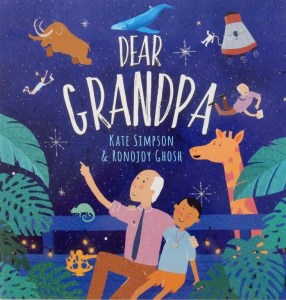
Separated by a huge distance, a little boy Henry and his grandpa sustain a very special relationship through their letter writing that begins when the child moves to a new apartment in the big city 2003 km from his grandpa’s house. The first letters are factual and Henry talks of things in the city that he hopes just might encourage Grandpa to come and visit (ice-cream shops, cinemas and me). As their exchange proceeds, the two become imaginative, inventing and deflating one another’s way out visiting plans – riding on a whale, 

catching a shooting star – and readers are presented with a series of facts that the letter writers share while coming to terms with the physical distance between them.
I love the way the author brings us full circle with Grandpa’s closing letter mirroring Henry’s opening one with talk of that needle and magnet to point the way to one another’s abodes.

A gorgeous demonstration of how it’s possible for a loving human connection to transcend distance, with Ronojoy Ghosh’s imaginative illustrations being quirky visual representations of each of the letters. A smashing book for a grandparent and grandchild to share.

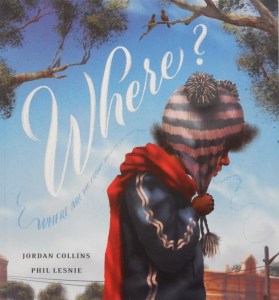
Where?
Jordan Collins and Phil Lesnie

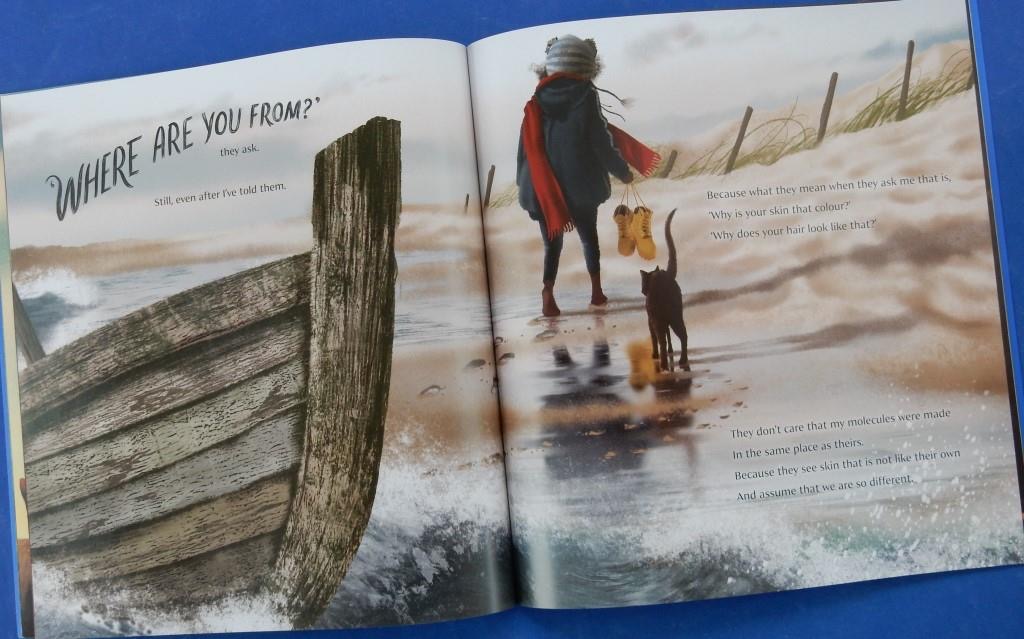
Where? is an enormously powerful, heartfelt slam poem by Jordan Collins written when the author was in his teens, in response to the ‘where are you from’ question. Thoughtless racist comments such as that can be incredibly hurtful yet still some people continue to ask such things. Here the author makes a plea to be seen in the same way as everybody else (everybody with white skin that is) as opposed to somebody entirely ‘other’. Readers cannot help but feel for the young narrator, and by implication, every other person who is being judged not by who s/he is, but on account of their skin colour, type of hair, way of speaking, from where they’ve come. 

lllustrator Phil Lesnie has taken Jordan’s words and brought them to life in a stunning way that expands on those words which quite rightly, (and optimistically), end thus ‘I’m from the same place that you are. // So no need to ask again.’ Every spread is one to ponder over and think deeply about and one can but hope that the book finds its way into all primary school classrooms wherever they are. For sure, we all need to celebrate our common origins and shared humanity.

The Very Hard Book

The Very Hard Book
Ian Ben-Barak and Philip Bunting
Allen & Unwin

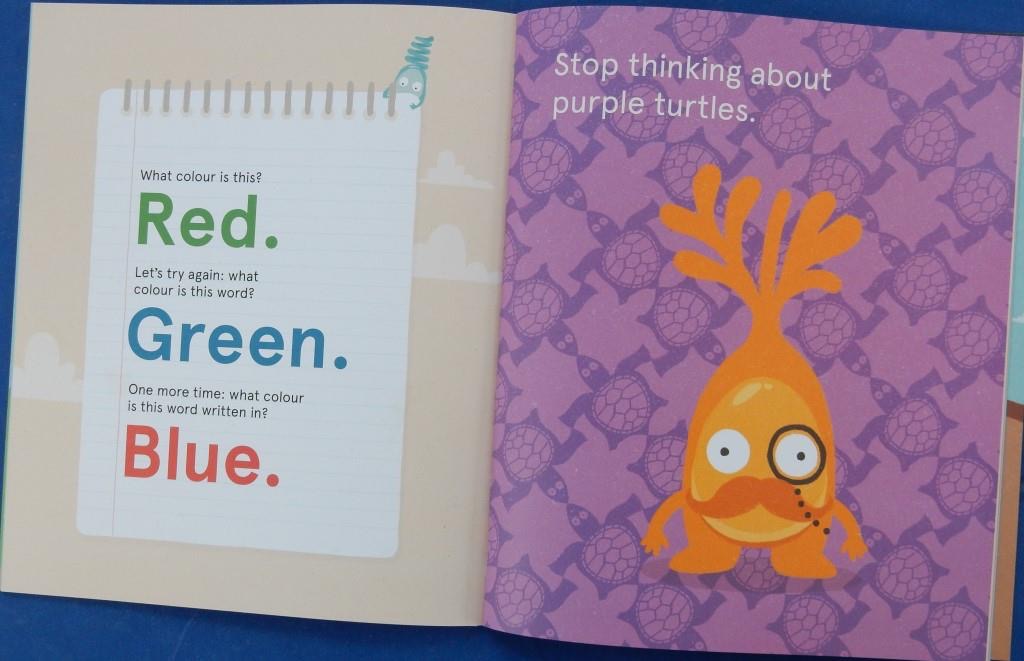
In this zany book readers are asked to try some very challenging things and it’s all in the name of helping us to become aware of our thought processes (metacognition). Are you up for the challenge of some open-ended thinking? Right … ‘Sit in an empty room.’ ‘Drop something by accident.’ ‘Dig half a hole.’

Each page (almost) gives a different instruction or asks a different question and by the time you’re half way through you’ll be giggling (partly thanks to Philip Bunting’s quirky creatures) and your brain will be going into overdrive with the creators’ comical ideas. Certainly however you will be more conscious of the limitations of your own mind.

You might even be prepared to have a look at The Very Hard Gallery at the back of the book. Here you will find a more detailed exploration of the paradoxes presented: you’ll see some interesting sounding names such as the Stroop Effect (your mind having to process two conflicting messages; in the example given, they are meaning and colour); then there’s Panta rhei. You will need to find out what this means for yourself, which means getting hold of a copy of the book (no cheating by using google).

Try putting this in a KS1 classroom; as well as introducing them to some surrealism, it will surely get everyone’s little grey cells working hard as they embark on a fun-filled thinking journey.

Catastrophe! / Noni the Pony Counts to a Million

These two picture books offer fun ways to introduce mathematical ideas to young children:

Catastrophe!
Anne Marie Stephens and Jenn Harney
Boyds Mills Press

This is a clever book about a crew of cats sporting either green or orange lifejackets that embark on a dinner-catching fishing trip. They begin well enough as they line up beside the lake with all their gear intact but then some of their lines become entangled and they’ve paid no regard for the colour of their jackets. ‘This is a CATastrophe!’ declares their leader, ‘We need a pattern.’ With the core pattern duly discovered the cats reorganise themselves ‘green, orange, green, orange and so on and climb aboard the canoe.
Captain Cat now calls the rowing pattern ’Row, row, meow’ to synchronise their paddle strokes but the kitties make a mistake which sends them into a spin. And so it goes on till the bait is dropped, but the fish have a trick under their fins and that leads to another CATastrophe …

Will this crew end up going hungry perhaps?

Author Anne Marie Stephens and illustrator Jenn Harney have created a simple, fun learning tale: youngsters will love to join with chanting the patterns, while also enjoying the playful scenes of the comedic crew.

Noni the Pony Counts to a Million
Alison Lester
Allen & Unwin Children’s Books

If you are looking for a number/ counting book that goes beyond ten, then join the lovable Noni for a whole day of counting fun that begins when she stops one morning beside one tree to watch her two friends Dave the dog and Coco the cat as they dance beside the sea.

From there Noni gives a ride to a trio of speckled hens, races with cows, then come encounters with some wallabies, the watching of swooping swallows (six), a game of puppy hide-and-seek (seven), followed by fluttering butterflies (eight) and nine spotty fish swimming through the reeds.
That takes us through to ten.


Unlike many counting books though, this one doesn’t stop there; rather it introduces ‘dozens’, ‘hundreds’, ‘thousands’ and finally, we see the three friends fast asleep beneath ‘millions of stars’.

Not only is this a delightful book about numbers, but with an interesting, short rhyming text well matched to Alison Lester’s playful scenes, it’s also great for beginning readers.

The Katha Chest

The Katha Chest
Radhiah Chowdhury and Lavanya Naidu
Allen & Unwin Children’s Books

Despite all that has happened since 2018, the UK retains its rich cultural tapestry, one that we all should celebrate.

I have never before seen a picture book that celebrates Bangladeshi culture so I was thrilled to be sent this one by an author and illustrator who draw on their own Indian Hindu and Bangladeshi Muslim heritage respectively.

Together they have crafted a fascinating story of young Asiya’s visits to her Nanu’s house which is full of treasures, Asiya’s favourite being the large katha chest containing quilts Nanu has made over the years from old saris. The little girl loves to immerse herself among these soft warm quilts and imagine the stories they hold just waiting to be whispered; stories both sad and happy, told to her by family members.

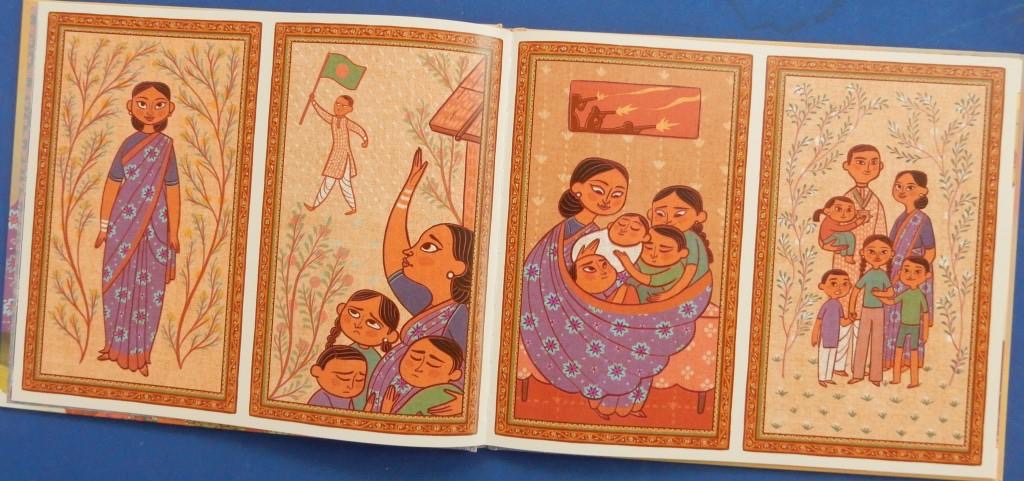
To begin with she shows readers a purple and blue quilt and we learn of Bora Khala’s medal from the war represented by the circular patterns on the fabrics. These help recall a sad time when he had to leave his wife alone with the children, to return after many years.

Then follows the first of Lavanya Naidu’s beautiful wordless double spreads of framed illustrations showing that time of the family’s life.

This and the five other four panel strips are in the style of Pattachitra – Bengali folk art cloth paintings, with simple colours, bold lines and intricate details, each one conveying a story within the main narrative. So it is that through these heirloom quilts, family history – the story of each aunt, mother and grandmother that wore the fabric – is passed on from generation to generation.

Each of the quilts holds a special memory and they’re also taken out when Asiya’s mother and aunts come together for sessions of tea drinking, story telling and reminiscing.

Both author and illustrator’s presentations of family history are imbued with so much tenderness and love that this a book for everyone regardless of their ethnic background.