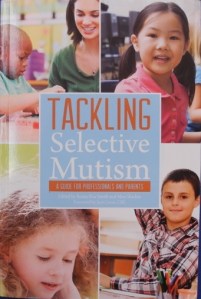
Tackling Selective Mutism
edited by Benita Rae Smith and Alice Sluckin
Jessica Kingsley Publishers
Subtitled A Guide for Professionals and Parents this book is edited by two experts who have brought together research and practice in a manner that can be useful to anyone who has dealings with a child who in certain situations (often at school) is persistently mute but uses spoken language in other situations – at home or with friends in the playground or perhaps when that individual thinks they’re not being watched by say, their teacher. Such children are said to be selectively mute (SM).
My very first teaching job was with a vertically-grouped class of 5 to 7 year olds. There was one little girl I remember as clearly as if it were yesterday. C. joined the class aged 5 and for over two years spoke to nobody in school – child or adult. Then one day in her 3rd year in the class we were having a storytime session and she suddenly burst into tears. Instinctively I asked ‘What’s wrong, C?’ “I’ve wet myself,” she said, sobbing: her first words to me. ”C. can talk,” said one of her classmates. And, from then on she began talking, not confidently always, but gradually over the rest of that year she became, not just a silent participant but, a talker in almost all classroom activities. If only I’d had the knowledge and understanding this book contains, I might have been able to support her better than I did at that time. She’s not the only girl with SM I’ve taught; there have been several, but that case was the most severe and protracted. Fortunately, since then things have moved forward:help and advice have become more readily available over the last twenty years.
Even so, there seems to have been relatively little attention paid to SM in comparison with other conditions such as autism spectrum disorders. This is certainly the most approachable and useful I have come across in that it speaks both to parents and professionals and covers a great deal that is both informative and helpful.
Many voices – those of children and young people, their families and professionals (speech and language therapists, psychologists, psychiatrists, educators, music therapists)– are included and offer a variety of perspectives. There are also, in the concluding part of the book, some powerful, touching stories from ‘Families no longer affected by SM’.
The first section deals with Current Understandings of SM; the second with related and co-morbid conditions. Herein a speech and language therapist looks at the relationship between SM and ASD; and another speech and language therapist discusses the similarities between SM and stammering.
In the third section we learn of some of the successful strategies and treatments that have been used (I particularly enjoyed the account of music therapy intervention with a 4 year old who was also learning English as an additional language in his nursery school). And there are some detailed case studies that are absorbing and particularly helpful.
The book also includes an extensive list of references and a useful resource list.
All in all, this is an important book that brings together much that is of interest to anyone who works with children and young people with SM.
Order from JKP
Use your local bookshop 
 Red Reading Hub - Jillrbennett's Reviews of Children's Books