Big Questions About the Universe

Big Questions About the Universe
Alex Frith and Alice James, illustrated by David J. Plant
Usborne

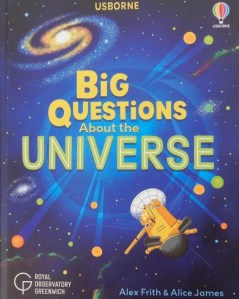
Written in conjunction with experts from London’s Greenwich Royal Observatory this book addresses both the common and some of the less common questions children ask about outer space and the universe. Readers join two inquisitive children and a friendly robot programmed to do just that; though to answer ‘… where does gravity come from?’ help is required from Albert Einstein.

It starts with the basics: Where is space? What is in it? How far does it go? Where does it begin? Here and throughout the book, the bot is up front about the answers given, saying that it’s not always entirely possible to give a straight answer to such questions; then going on to show how to approach those that are unanswerable. To their question ‘How BIG is the universe?’ comes this opening to the response, ‘Unknown. Completely unknown.’ Further explanation follows of course including that the universe is constantly expanding. There’s a spread about telescopes of various kinds, another looking at the spherical nature, or not, of things in space, a look at how the universe began, big bang – or not?

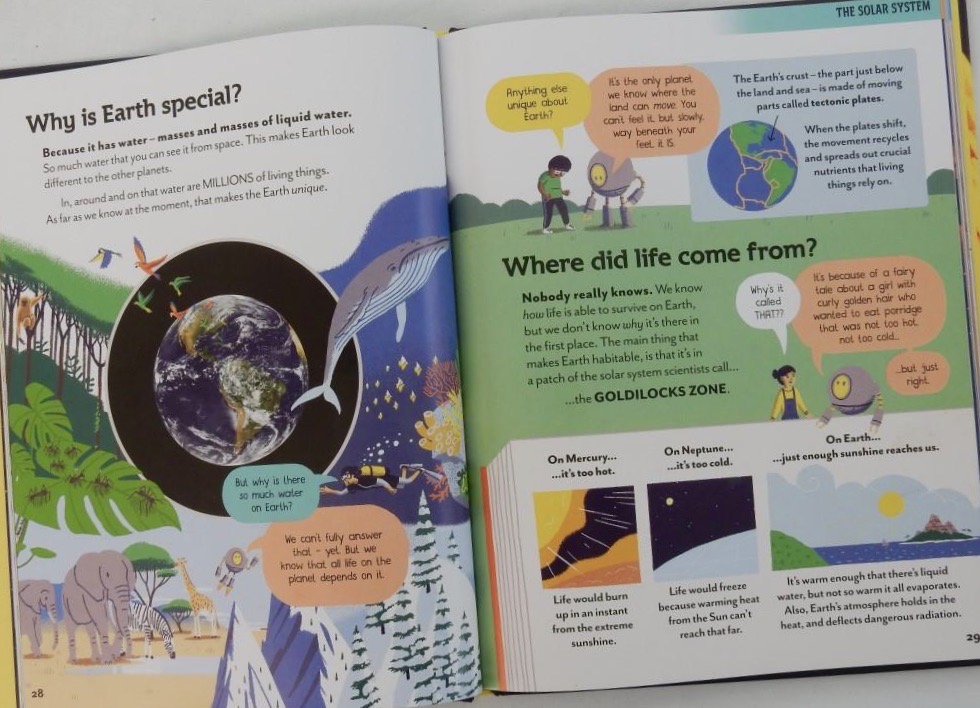
The next chapter is devoted to the solar system. Did you know that 1300 Earths could fit inside Jupiter, or that astronomers have discovered over 200 moons in our solar system and that Jupiter has at least 80 of them? So far as we know Earth is unique in having so much water: why this is so is a tricky question and it leads on to a mention of what scientists call the Goldilocks zone – I love that name.
Stars and their secrets has a whole chapter, as does ‘People in space’ and ‘The Biggest questions’ are left to the last chapter. I like the way readers are left to answer for themselves whether or not the vast amount of money spent on space research is worth it; what the authors do is put forward the spin-offs such as air and water purifies, mobile phone cameras and instantaneous world-wide communication through satellite networks.
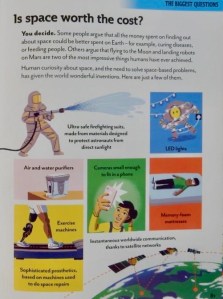
Though packed with information, its presentation with photos, diagrams, cartoon style illustrations, dialogue boxes and blocks of text, is never overwhelming and draws the reader in and through its pages on a fascinating journey of exploration and discovery. Perfectly pitched for upper KS2.
The Unworry Book

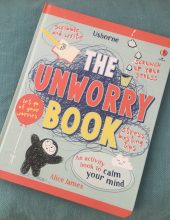
The Unworry Book
Alice James and Stephen Montcrieff
Usborne

Enormously reassuring and full of practical ideas for managing stress is this alluringly presented book written by Alice James, with expert advice from clinical psychologist, Dr Angharad Ridkin, and designed and illustrated by Stephen Montcrieff.

Having explained that we all worry from time to time and why, the book devotes the next few spreads to working out how you really feel – worried, excited, or nervous perhaps? It’s really beneficial to become emotionally aware (an emotional map is included to help) and know the kinds of things you can do to alleviate your worries.

Next comes the wealth of coping suggestions, many of which are designed to develop mindfulness. Most require nothing more than a pencil or pen like those on ‘Peaceful pencils’ which takes a multi-sensory approach -listen to the sounds of the writing implement brushing across the paper; ‘notice the glistening wet ink … or grain of the paper as your pencil draws across it’; smell – the book’s pages, the wood of your pencil or ink of your pen; feel the pencil’s ridges, or barrel of the pen; feel the textures of the page and how it seems?

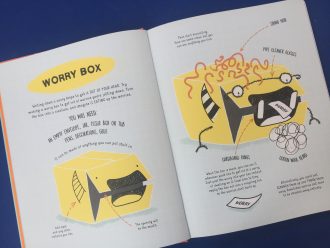
What about making a decorated worry box – an example is included here – I love the idea of it being a creature that can eat up worries.

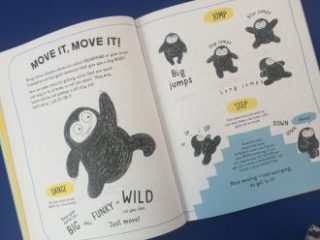
It’s impossible in the space of a fairly short review to include all the excellent strategies offered so I’ll just mention a few. There are pages highlighting the importance of breathing and laughing (both are yoga techniques) to help cope with excess adrenalin, as well as a spread with an amorphous creature demonstrating a sun salutation.

A couple of ‘arty’ ones are tearing up paper (preferably rubbish) and using it to be creative; creating peaceful patterns being mindful of the shapes and how the space is filled. And doodling is a great stress reliever – how many of us doodle our way through stressful meetings I wonder?
It’s well accepted now that being physically active is good for our mental well-being; it releases those mood-boosting, feel good endorphins so get moving.

There’s a focus on language too – some starting lines for limericks (great fun) an instant giggle inducer I think; a focus on the physicality of writing various words in different ways; a (behind the door) story starter; as well as a host of brain puzzles.

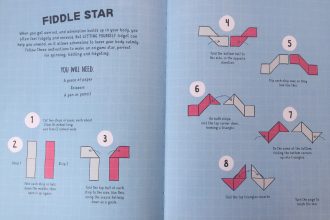
Another smashing idea is a ‘fiddle star’ – the making of which is a worry distractor,

as is the finished article.

Getting off to sleep tips form the final pages; while in conclusion are a ‘helping hand’ and a ‘who to/where to go’ for times when worries become overwhelming (including a link to the publisher’s website).

Stress among children – even very young ones is on the increase – I refrain from elaborating on the negative effects of the current ‘numbers before children’ education system, though it is a huge stress-inducing factor. There are others of course and a veritable gold mine such as this book is invaluable for both youngsters and those who live or work with children.