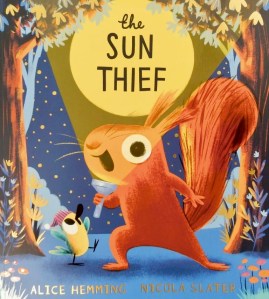
The Sun Thief

Team Hemming and Slater’s Squirrel is back and as the season is changing he’s once again confused about what is happening. When his friend Bird declares that it’s bedtime Squirrel disagrees, professing that he could never fall asleep when it’s still light. What he says and what he does though are two different things.

Then come bedtime a few weeks later there’s further confusion when he brushes his teeth as it’s dark when he expected it to be light. Squirrel insists to Bird that the dark is due to there being a sun thief, especially as he heard a peculiar “Hoo’ sound. This he’s told was merely an owl and the following morning just as Bird explained to him, joy of joys, the sun is back shining.
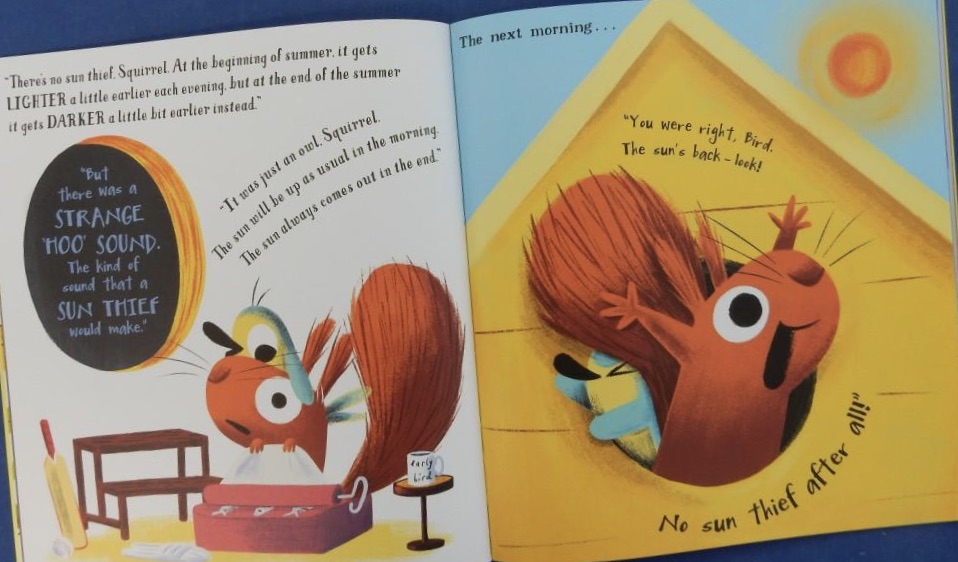
A similar thing happens as Squirrel is languishing in his bath the next evening but he tells himself it cannot be the sun thief. Venturing outside onto a branch with a torch he gives Bat a bit of a fright. “The sun thief just crashed into my tree” he shouts to Bird who explains about Bat being nocturnal.
Still unconvinced that a sun thief isn’t lurking somewhere Squirrel sets an early alarm that only serves to further convince the rodent that there IS a thief,. he wakes his friend before sunrise
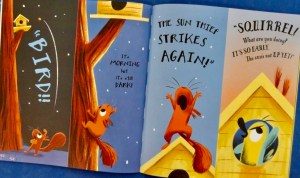
and the ever patient Bird explains yet again. At last, Squirrel understands.

The final spread takes elements of the story – why the hours of darkness change throughout the year and the difference between diurnal animals including Squirrel and Bird, and nocturnal ones such as Bat.

Funny and gently educative,. Young children will thoroughly enjoy Squirrel’s over-reacting to a seasonal happening and delight in Nicola Slater’s close-ups that serve to enhance his verbal histrionics.
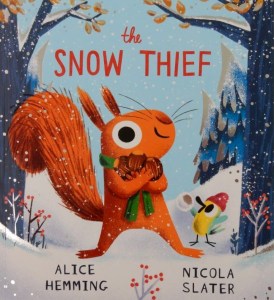
The Snow Thief

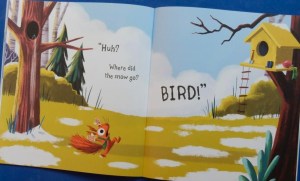
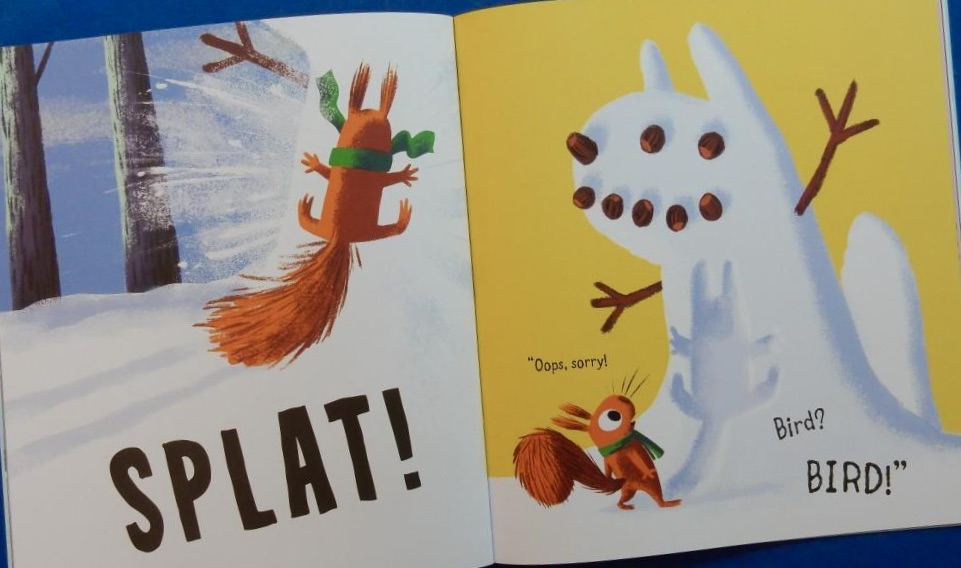
Squirrel receives another practical lesson on the changing seasons with the help of his friend Bird. It begins as the bushy tailed rodent looks out onto – shock horror – no grass. Bird is on hand to explain all about snow and invites Squirrel to participate in a fun exploration beyond the tree, an invitation that receives a firm “No, thank you”. Later however into Squirrel’s home comes a snowball thrown by Bird in an attempt to get Squirrel to enjoy the possibilities snow offers.

Down comes Squirrel enthusiastically, over-reacting as you might expect as Bird explains that every snowflake is different. Squirrel’s next misguided response to the cold concerns “smoke coming out of my mouth”. As for ice-skating – let’s say a showy-offy performance results in

and so the concatenation of dramatic reactions continues with reference to missing hazelnuts, culminating in the disappearance of most of the snow –

surely the work of the titular snow thief, who has left one thing behind.

Farcical fun thanks to one character’s absurd pronouncements, comical facial expressions and body language in Nicola Slater’s boldly hued portrayal of Squirrel’s theatricality, and the clever use of different type faces. (In a final spread after her story, Alice Hemming gives explanations of a more scientific kind relating to snow and some of its effects.)

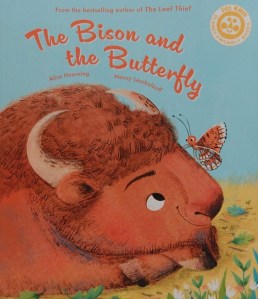
The Bison and the Butterfly

Free to roam wherever she chooses and well fed, Bison should feel happy but she doesn’t. Woodpecker suggests that she needs a friend. Woodpecker’s place is in the treetops so off sets Bison in search of that “Someone to trample through the woods with”. But why would any creature want to befriend a big hairy animal like her, she wonders. Woodpecker explains how Bison’s stripping of bark from the trees, provides access to food, a great help for a bird seeking breakfast.

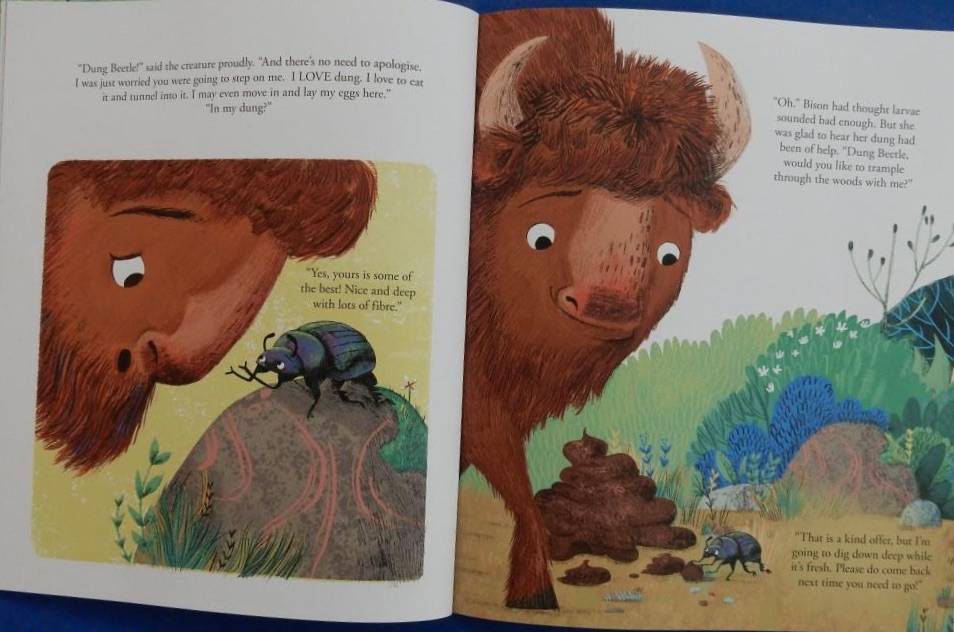
As she goes about her regular daily activities, Bison encounters some of her smaller forest neighbours – Dung Beetle,

Lizard – in particular but although both say they benefit from her actions, (Dung Beetle eats her poo and Lizard enjoys sunbathing in the bare patches of earth the large animal makes as she rolls) neither is that special friend.

Suddenly Bison hears what sounds like crying; she stops and asks, “Is everything all right?” Resisting the ‘Go away” instruction because the voice sounded so sad, Bison responds thus, “It sounds like you need a friend.” .

Now despite not wanting to trample through the woods, it turns out that this lonely butterfly is the ideal companion for woodland rambles. So begins a wonderful friendship …

Produced in collaboration with Kent Wildlife Trust, the author uses a sweet tale of searching for a friend to show how an ecosystem works. Backmatter gives information about Bison’s role as a ‘keystone species’ that helps keep nature in balance enabling key plant species to flourish, which act as a food plant for heath fritillary butterflies. Following that is an outline of The Wilder Blean Project launched two years back – an exciting success story so far.

With its expressive illustrations and narrative style writing, sharing this story containing messages about the impact we have on those around us, and the importance of kindness, empathy and friendship.with young children would provide a good starting point for learning about ecosystems.

That’s My Flower!

That’s My Flower!
Alice Hemming and Nicola Slater
Scholastic

The rather possessive rodent and his feathered friend from The Leaf Thief return in a new story.

When Squirrel wakes one morning he’s excited to discover that the leaves are back on the trees: hurrah! it’s spring.

Suddenly Squirrel is surprised by unusual buzzing and cuckoo-ing sounds. Then a strange bird flies at his head. Fortunately Bird is close by to explain about spring’s arrival being heralded by a bumblebee, a cuckoo and a swallow.
Then Squirrel notices a small, yellow flower that reminds him of the sun: another sign of spring explains Bird. By now Squirrel has decided that he likes spring but goes on to claim ownership of the flower and starts trying to protect it.

It mustn’t get wet, nor be attacked by bees, he decides until Bird tells his pal that the flower needs rain and that visiting bees help flowers. Moreover, “Your flower is a wild flower … It’s there for everyone to enjoy,”

Still Squirrel continues his safekeeping activities by covering the flower with a bucket, with disastrous results, he later discovers.

Happily though, Bird persuades Squirrel just to leave the flower alone. The following morning, a wonderful surprise awaits when the two wake up.

Bird’s gentle lesson has been a success. Such a fun lesson it was too, for young readers and listeners certainly. They will be sure to laugh at Squirrel’s lack of understanding regarding the natural world, made all the funnier by Nicola Slater’s portrayal of Squirrel’s custodial antics and his friend’s reactions.

Let’s hope Alice Hemming’s story will encourage respect for the natural world in children.

The Leaf Thief

The Leaf Thief
Alice Hemming and Nicola Slater
Scholastic

Much as I hate to admit it, there are already signs that autumn is upon us and yes, it is as Squirrel says at the outset of this story,  ‘a wonderful time of the year’ with the sun shining through the leafy canopy ‘red, gold, orange … ‘

This particular squirrel however, is a highly observant creature for suddenly comes the cry …” one of my leaves is missing! Where is it?’.

So distressed is Squirrel that implications of stealing follow as first Bird

and then Mouse are interrogated, all the while the former attempting to convince Squirrel that it’s merely seasonal change that’s occurring.

The following morning though, with more leaves missing, Squirrel starts up again and after more accusations, little Bird suggests some relaxation techniques.

These at least calm Squirrel temporarily but next day poor Bird is on the receiving end of Squirrel’s ‘leaf thief’ allegations.

It’s time for the frustrated Bird to provide a fuller explanation about this ‘Leaf Thief’ and convince Squirrel once and for all about what has been happening.

Finally Squirrel seems satisfied and heads off for a good night’s sleep. What though will happen the following morning? …

Let’s say no more, except that the finale almost had me spluttering my hot chocolate everywhere.

Actually not the absolute finale, for on that spread Alice gives information about some of the seasonal changes that happen every autumn. Her story, told entirely through dialogue is a smashing one to read aloud (so long as you can manage not to giggle too much).

Nicola’s autumnal scenes provide the perfect complement to the telling, showing with aplomb, the high drama unfolding, and turning the characters into a talented cast of actors no matter whether they’re playing a major or minor role.

The Rescue Princesses: The Amber Necklace / Arlo, Miss Pythia and the Forbidden Box

The Rescue Princesses: The Amber Necklace
Paula Harrison
Nosy Crow

In the 15th and final adventure in the series, it’s up to Zina and her friends to save the tamarind trees of their rainforest home. These trees are the only ones that provide year round food for the lemurs but they’re scheduled to be cut down to make way for the carnival that has been re-routed on account of the usual road being flooded.

Princess Zina is horrified at the prospect; but the princesses must use their intelligence, co-operative skills, kindness and courage to protect the animals and their precious tamarinds.

With their camouflage ninja gear and Zina’s special amber necklace, said by her grandma to hold the heart of the forest it might just be possible to persuade Ando and his workmates to find another path. If not, could the amber jewel works it magic? …

Another exciting tale with short chapters, plenty of line drawings and an exciting and intriguing plot to keep readers turning the pages, this is ideal for new solo readers.

For readers who like longer stories there are two new fiction titles from Maverick Publishing coming soon: one is

Arlo, Miss Pythia and the Forbidden Box
Alice Hemming, illustrated by Mike Garton
Maverick Publishing

4X have become 5P and they’re back with another highly unusual teacher, not from the stone age this time but nevertheless there’s something not quite normal about Miss Pythia.
For a start, she always seems to know exactly what is about to happen; she has a weird-looking symbol tattooed on the back of her neck; she never seems to change her clothes, and there’s that box she keeps on her desk. Mmmm! And could it be sheer co-incidence that she shares her name with a priestess of the Ancient Greek world?

When I taught nursery children we often did an activity called, ‘What’s in the box?’ Singing a little ditty based on those words served to arouse the children’s interest and enthusiasm before the lid was lifted and we investigated its contents. And that is just what Miss Arlo does when she instructs her class that opening the particular box she has in her safe-keeping, is strictly forbidden.

But then 5P are selected to participate in A Play a Day, electing to perform a version of Pandora’s Box and Arlo is chosen to act as director. Can his classmates resist the temptation to open Miss Pythia’s actual box as they rehearse?

What Arlo doesn’t immediately spot as he gets engrossed in his directing role is that the replica box made for the drama has been switched.

Then with the play in full swing a terrible realisation comes upon him …

Another winner from Alice Hemming; it’s full of suspense, gently humorous and splendidly complemented by Mike Garton’s lively, expressive drawings, which provide additional details and humour.

Now set fair to become a super series, this story is great for solo reading as well as highly appropriate as a class read aloud especially if the Ancient Greeks are on the agenda.

Arlo, Mrs Ogg and the Dinosaur Zoo / Why is the Cow on the Roof? & Smart Girls Forever

Arlo, Mrs Ogg and the Dinosaur Zoo
Alice Hemming, illustrated by Kathryn Durst
Maverick Arts Publishing

At Purple Hill primary School there’s yet another supply teacher in 4X; they’ve gone through quite a few already so the question is, how long will the strange-looking Mrs Ogg survive, particularly when she decides to take the class on an outing – their first ever – to the zoo? Can she possibly keep seventeen unruly children under control for a whole day? It’s particularly important, for their attendance at the end-of-year party depends upon the trip being 100% trouble free.
Arlo decides it’s unlikely, so he assigns himself the role of chief back-up.

Mrs Ogg however is no ordinary supply teacher and the zoo she’s taking them to is no ordinary zoo, which probably accounts for the inclusion on the ‘don’t forget’ letter sent to parents just prior to the trip, of a T-bone steak.

Is the outing a success and do they arrive back at school with all seventeen children plus teacher safe and sound? And, are they allowed to go to that eagerly anticipated end-of-year party? You’ll have to get hold of a copy of this action packed story and find out.

With its twisting-turning plot, it’s certainly lots of fun. Packed with zany illustrations by Kathyrn Durst

and promises of further adventures to come, let me just say, there’s a whole lot more to class 4X than previous teachers had thought: Mrs Ogg manages to unearth a whole lot of hidden talents therein.

Why is the Cow on the Roof?
Smart Girls Forever

Robert Leeson illustrated by Axel Scheffler
Walker Books

These two books of short stories were first published 20 years ago and they’re as amusing now as ever – great for reading aloud or for solo reading.

Why is the Cow on the Roof? is one of the five folk tale based renditions in the first book, the story being based on the Norwegian, ‘The Husband who was to Mind the House’ and is a hilarious account of what happens when a husband and wife swap their round of daily tasks to see who works hardest.

The other four stories also pose questions including ‘Why are you such a Noddy, Big Ears?’ and “Who’s Next for the Chop?’, the former, a pourquoi tale being based on a Native American ‘Rabbit’ character and the latter from a story in the Arabian Nights..

In each case, Leeson’s renditions are full of humour with plenty of dialogue used to great effect; if you’re reading them aloud to a group, don’t forget to share Axel Scheffler’s funny line drawings that introduce each story.

Smart Girls Forever contains six tales from various parts of the world, all of which have resourceful female lead characters; they are, Leeson tells us ‘Russian, Indian, Irish, Scottish, Persian and English’ but ‘could be from anywhere’.

Look out for Natasha who outwits the devil and Oonagh who gets the better of the terrible giant Cucullin, an act for which her husband Fin M’Coul will be forever grateful.

Maverick Junior Fiction

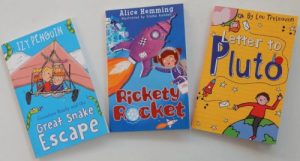
Maverick is already well established itself as a picture book publisher; now they make their first foray into junior fiction with a trio of exciting titles:

dscn8899

Grandma Bendy and the Great Snake Escape
Izy Penguin
Rickety Rocket
Alice Hemming and Emma Randall
Letter to Pluto
Lou Treleaven
Maverick Arts Publishing
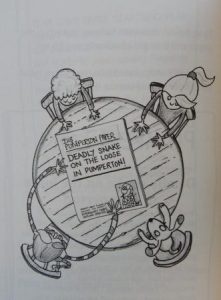
Grandma Bendy boasts an interesting cast of characters including Grandma’s grandchildren Max and Lucy, Mike Grimace – he’s the school bully, Lady Lavender, Sergeant Nevil Rodent and Mr Brain Freeze, all residents of Pumperton (twinned with Bottumburper and Le Pongue) where the story unfolds. Already you’ll be guessing that this is a funny book and one likely to grab the interest of newly confident readers. The story starts on the first day of term with 4B embarking on a session of ‘Show and Tell’. Mike Grimace has brought his pet snake to school and he has a wicked grin on his face as he transfers it from his school bag to Lucy’s as she’s about to open the session and talk about her Gran.
Before long there’s a snake on the loose, the school is empty and the entire town of Pumperton is beside itself with ‘snakeitis’.

%0aThen it’s down to Lucy, brother Max and the indomitable Grandma Bendy to apprehend the snake and put things right.
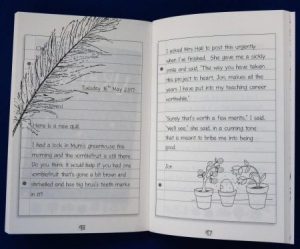
Funky illustrations by the author adorn every page and add to the fun of the whole crazy experience.
Rickety Rocket contains three short stories starring adventure-loving Spacey Stacey, her friends Timble the robot, twins Zip and Zap and creative Moondoodle. Then there are their rivals, Astro Pete, Jack Boom and Jill Zoom. The first story tells what happens when they all take part in The Great Space Chase. Who will be first across the finish line: Spacey in her Rickety Rocket or Astro Pete in his shiny shuttle? It’s going to be a close thing for sure.
In the second adventure Stacey is overwhelmed with orders for her special jellies and resorts to using a jet-pack to speed deliveries up a bit. Things don’t quite go to plan of course but her aeronautics are certainly a crowd-pleaser.

%0a

Picnic Planet sees the friends heading off for a day out but there are warnings not to feed the space bunnies scattered around. Then when food begins to vanish, those innocent-looking creatures are under suspicion: they couldn’t be the thieves surely …
Letter to Pluto revolves around an interplanetary penpal programme initiated by Jon’s teacher, Mrs Hall. Jon happens to be paired with a Straxi and he’s not happy about it: firstly she’s a girl and secondly she lives on Pluto, which is the smallest and the most boring planet in the entire universe; and it’s smelly! Almost the whole book takes the form of illustrated letters between Jon and Straxi …

dscn8902

and through their correspondence we learn how the two eventually become firm friends and manage to save Planet Pluto from ecological catastrophe. Great fun!
All three are ideal for that taking off stage of reading but would also work well as read alouds for KS1 classes.

Bad Behaviour and Good

DSCN4620 (800x600) (2)

Rude Cakes
Rowboat Watkins
Chronicle Books
If you’re looking for a quirky take on manners bad and good, then this entirely crazy confection is certainly one you should bite into. The tale shows what happens when the two-tiered character of the title – a far from sweet, indeed thoroughly ill-mannered, badly behaved object – that bullies and totally disrespects his four-tiered parents is whisked away

DSCN4622 (800x600) (2)

to a place inhabited by Giant Cyclopses and one of their number starts sporting “Rudey” as my audience named him as a ‘jaunty little hat.’

DSCN4623 (800x600) (2)

From upon a Cyclops’ head, the cake discovers a completely new way of being: one where sharing, politeness and respect for one’s elders is the thing and is then returned, a reformed character, to his bedroom safe and altogether sweeter.
Watkins has used watercolours in pastel shades, and delicate lines, to portray his wonderfully silly cakey characters and somehow manages to create sufficient solidity and gravitas in the Cyclopses to give them a powerful presence, a presence that began in the form of a toy stolen from a chocolate cupcake and a poster above the chief protagonist’s bed. (Observant readers will have noticed these.)

DSCN4621 (800x600) (2)

And the moral of the tale? Well, that’s pretty clear but the deliciously playful manner of telling means that there’s no preaching. Rather the whole thing is a cleverly concocted metaphor showing how greater forces for good can prevail.
Would that it were so in our world of conflicts and catastrophes.
Powerful stuff: I wonder what Watkins will cook up next.

DSCN4597 (800x600)

A Gold Star for George
Alice Hemming and Kimberley Scott
Maverick Arts Publishing
I’m not a fan of the rewards and punishments system that is so prevalent in schools but I have to applaud, and wholeheartedly endorse George Giraffe’s endeavours in this story, set in The Heavenly Hippos Wildlife Park.
When the notice announcing Heavenly Hippos Gold Star Awards is posted George ponders the possibilities of getting a shiny gold star for that special place on his fence.

DSCN4598 (800x600)

He’s always on hand to assist his pals in their endeavours but could he be a winner? All the other animals have talents to display but George cannot win that category; what about the most stylish animal perhaps? No – that’s goes to the only unadorned of the animals.
It’s a somewhat downhearted George that celebrates his pals’ prizes but goes to sleep without one of his own. What then is that sound he hears on waking … and that bright twinkle? …

DSCN4600 (800x600)

Kindness and consideration win through in this story, which I envisage being shared as a prelude to circle time sessions in early years settings especially. Amusingly expressive illustrations grace every spread and celebrate an endearing character.

Use your local bookshop  localbookshops_NameImage-2

Family Matters

15 1

15 Things NOT to do with a Baby
Margaret McAllister and Holly Sterling
Frances Lincoln Children’s Books
Sibling jealousy (mixed with anticipation, love, anxiety) is a familiar scenario when a new sister or brother arrives in the family, though the topic is anything but new when it comes to picture books. Three that immediately come to mind are The New Small Person by Lauren Child, There’s Going to be a Baby – a collaboration between Helen Oxenbury and John Burningham and the Anholt’s Sophie and the New Baby .
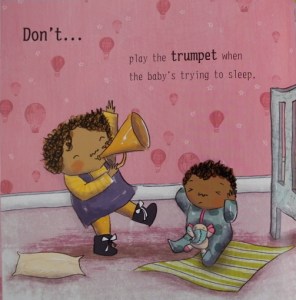
Margaret McAllister takes a humorous approach to what can often be a mixture of strong feelings, presenting – rule-book style – a selection of Don’ts – a delicious mix of flights of fancy

15 3

and some plausible situations.

15 5

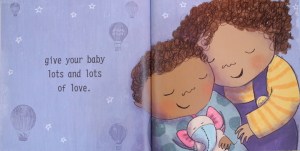
These are followed by a series of ‘Do’s culminating in an adorable

15 2

all so beautifully depicted by new picture book illustrator, Holly Sterling whose work I first came across in Over the Hills and Far Away. Her illustrations herein exude both joie de vivre and a strong sense of love and affection. Who can resist smiling at such scenes as the baby planting, for instance?

15 4

This is one loving family realistically portrayed, at a time of big change and emotional upheaval, with an endearing naturalness and modernity.

There’s a broader look at families in:

15 6

Who’s In My Family?
Robie H. Harris and Nadine Bernard Westcott
Walker Books pbk
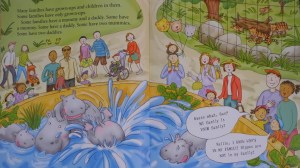
This is essentially an exploration of all manner of families through the speech bubble conversations of brother and sister Gus and Nellie, and a straightforward narrative information text. We join the siblings as they and their parents leave home and visit the zoo where they encounter and discuss a variety of familiies.

15 8

’Some have two mummies. Some have two daddies.’ … ‘Some children live with their mummy part of the time and with their daddy part of the time.’
The whole tone of the book is positive, “FAMILIES LOVE BEING TOGETHER” … ‘But sometimes families have angry times. And sometimes families have unhappy times.
Illustrated in a suitably upbeat, digitally created style, this inclusive book is full of potential for discussion with under sevens,

15 9

ROBOPOP
Alice Hemming and James Lent
Maverick Arts Publishing pbk
Subtitled ‘A Dad in a Box’, this is an offbeat look at one particular dad, Dylan and Daisy’s who, so they tell him is “not like normal dads,”. Their dad is an inventor and knows nothing about football (my kind of person perhaps?).
Dads don’t come in a box,” he tells them and goes on to prove his point in no uncertain terms by creating a robotic super dad complete with packaging.

15 11

This invention speaks in rhyme and is eager to demonstrate his soccer prowess in the big match

15 12

as well as cooking up a special dinner for football players.
By the end of a very unsatisfactory and exhausting day, Dylan and Daisy have come to an all-important realization about their own father and are more than happy when he makes a timely reappearance.

15 13

Quirky illustrations and opportunities for joining in with the ‘robot speak’ add to the fun.

Use your local bookshop localbookshops_NameImage-2

Don’t forget February 14th ibgdposterlarge