Super Sports Stars Who Are Changing the Game

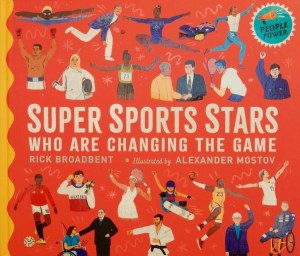
I couldn’t help but feel rather insignificant when reading about the twenty sporting legends featured in this book. Each one is allocated a double spread, characteristics of which are a brief resumé recounting how the star got to be where they are, a ‘Fair Play’ paragraph, a ‘super sport power’ and an activity for the reader.

All these superstar legends have one thing in common: they’ve all had to overcome obstacles to be where they are at the top of their game, but in addition have spoken out about a cause they passionately believe in and in so doing, have changed not only their sport, but also the world, for the better.

Most of the names are familiar to me – Tom Daley, Marcus Rashford and Ellen MacArthur for instance, but several are new. One such – I’m well aware of his achievements, but not his name – is Ludwig Guttmann a German doctor. Because he was Jewish and therefore in great danger, he left Germany eventually coming to live in England. He set up Stoke Mandeville’s National Spinal Injuries Centre for wounded soldiers. A firm believer that sport was important in their treatment, he organised the first Stoke Mandeville Games and eventually in 1960, those games were staged alongside the Olympics in Rome. This first Paralympics featured 400 athletes from 23 countries and since then, they too take place every four years. 

Also new to me is Tesla Loroupe who grew up in Kenya, looked after cattle in the fields and ran ten miles to school every day. Her talent was spotted and in 1994 she became the first female African athlete to win the New York City Marathon. Wanting to give something back to her community, Tegla set up the Peace Marathon, a race that encouraged members of warring tribes to run together. She also works with refugees offering training to athletes in refugee camps, helping youngsters to continue their education. She is the founder of the Tesla Loropue Peace Foundation that aims to promote peace through sport and to highlight the suffering of refugees. Another of her achievements is the Olympic refugee team, which is the result of her petitioning the Olympic committee.

These are just two of the amazing men and women you’ll find in this inspiring book, the final spread of which issues a challenge to readers: identify something you would like to change and set about so doing: everyone has the power to make a difference is the vital message.

Board Book Bundle

Who Says Peek A Boo?
Who Says Hippity Hop?

Highlights for Children

It’s absolutely NEVER too early to introduce children to books.
In this pair of photographically illustrated books, babies can engage in a game of peek-a-boo with some favourite animals; or join some lively animals chasing after colourful eggs as they decide whether to hippity hop, flippity flop, drippity drop, slippity slop, clippity clop with kitten, duckling, piglet, pony and bunny.
Each book has a mirror on the final page, which completes the question and response sequence.

More questions in:

Do Cats Moo?
Salina Yoon
Sterling

Salina Yoon’s latest in her lift-the-flap rhyming series for tinies that features animals and the sounds they make. This one showcases the titular cats along with pups, hamsters, birds, goldfish, bunnies, hedgehogs and turtles, all of which assemble for a gloriously cacophonous final double gatefold farewell wherein toddlers too can participate with their squeaks, sniffs, snuffles, splish-splashes, glubs, chirps, barks and meows.

Go, Boats, Go!
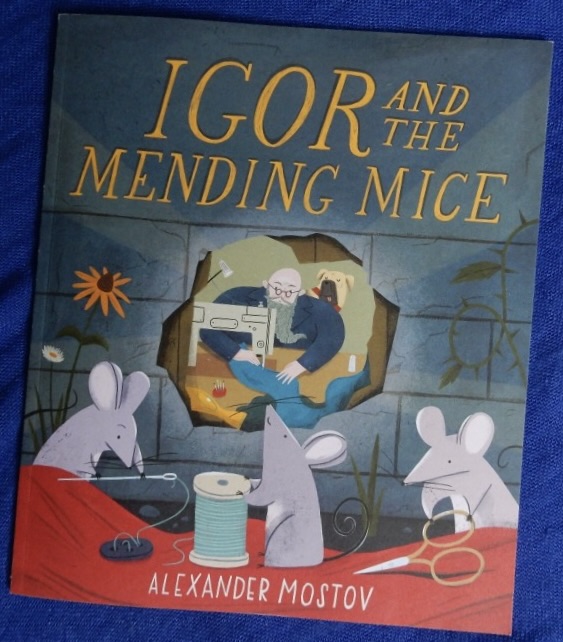
Addie Boswell and Alexander Mostov
Little Bigfoot

Boswell and Mostov add a new title to their In-Motion board book series with their rhyming introduction to water craft of all shapes and sizes. There are boats, old and new, pedal boats, boats to row and boats to sail, boats for work and boats for leisure, some powered by humans, others by machines; there’s even a boat that appears to fly, in this playful assembly of vessels each one colourfully illustrated in the ten double spreads.

That’s Silly! Rhyme Time
illustrated by Mar Ferrero
Highlights for Children

In just half a dozen double-page spreads, each with a gatefold on either side, youngsters can have fun discovering over 90 daft rhymes in such silly places as a Bog Fog and a Snowflake Lake.
The locations visited vary from a park to the moon, and include a busy town (good to see a bookshop there) and the seaside.

There are hours of potential fun, rhyme style herein; and with rhyme being one of the 3Rs of reading, this is definitely worth sharing with little ones who will also develop their observation skills in response to ‘What else do you see? What else is silly?’ on every page.

D-Day

D-Day
Michael Noble and Alexander Mostov
Wide Eyed Editions

This book commemorates the 75th anniversary since D-Day, exploring through 20 real-life stories, eye-witness accounts of the D-Day landings and through whose eyes young readers can re-live the events- stories of ‘bravery, sacrifice and innovation’ as the introduction says.

Through historian Michael Noble’s text, we follow the invasion from the planning of the landings, right through to its consequences, meeting both men and women who served in various ways.

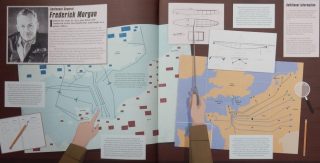
There’s Lieutenant General Frederick Morgan who fought as a junior officer in WW1 and went on to be, in WW2, part of the Supreme Headquarters Allied Expeditionary Force, one of the planners of the invasion of Europe under the joint responsibility of the British and the Americans, and in particular the Normandy landings.

Moreen James served in the WRNS as a plotter, keeping track from her Portsmouth subterranean base, of the movement of ships in the channel; a crucial task in enabling commanders to know the whereabouts of their boats and planes.

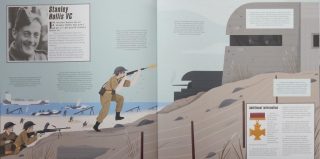
We meet the extraordinarily brave Sergeant Major Stanley Hollins, the only recipient of the Victoria Cross, considered the highest honour members of the British armed services can be awarded, for actions on D-Day.

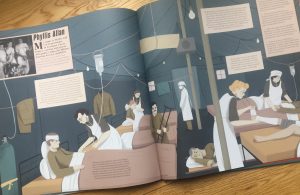
Phyllis Allan served with the Queen Alexandra’s Imperial Military Nursing Service and was based in France where she tended the wounded soldiers, some of whom had suffered horrendous injuries. “It’s just a job, really’ she said.

American Richard Winters, aged 26 calls himself ‘ancient compared to some of my men’. A paratrooper, he took command of his unit when the original commander was killed in action. WW2 was the first major conflict to make use of paratroopers, a highly dangerous role with many losing their lives before hitting the ground.

Much less would have been known about the war without the journalists who reported on what was happening. One such was American, Ernie Pyle who not only wrote numerous articles, but also came to know many of the soldiers engaged in the fighting.

Through the use of collated photographs, personal accounts such as those mentioned, and testimonies from all sides, set into Alexander Mostov’s full-page illustrations that dramatise the roles of all individuals included herein, this is an enormously inspiring book.

Include it in KS2 class collections and on family bookshelves.