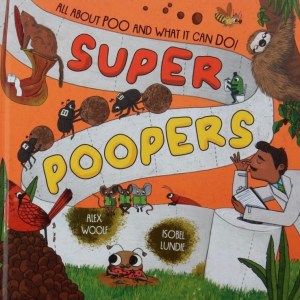
Super Poopers

Super Poopers
Alex Woolf and Isobel Lundie
Little Tiger

The topic of poo almost invariably raises interest in young readers and this book will surely do so with its humorous approach to those often whiffy bodily emanations. Before you turn your nose up though, consider this statement that concludes the author’s introduction: ‘In short, there seems to be no end to human and animal ingenuity when it comes to finding uses for poo’.
A fair bit of ingenuity is also presented between the covers of this collaboration between author Alex Woolf and illustrator Isobel Lundie.

They start by presenting a handful or two of the weirdest facts about creatures and their poop. Did you know for instance that a hippopotamus whirls its tail while pooing. The result being flying faeces (sometimes reaching as high as 10 metres) that can be used to mark their territory and to show off to the opposite sex. 
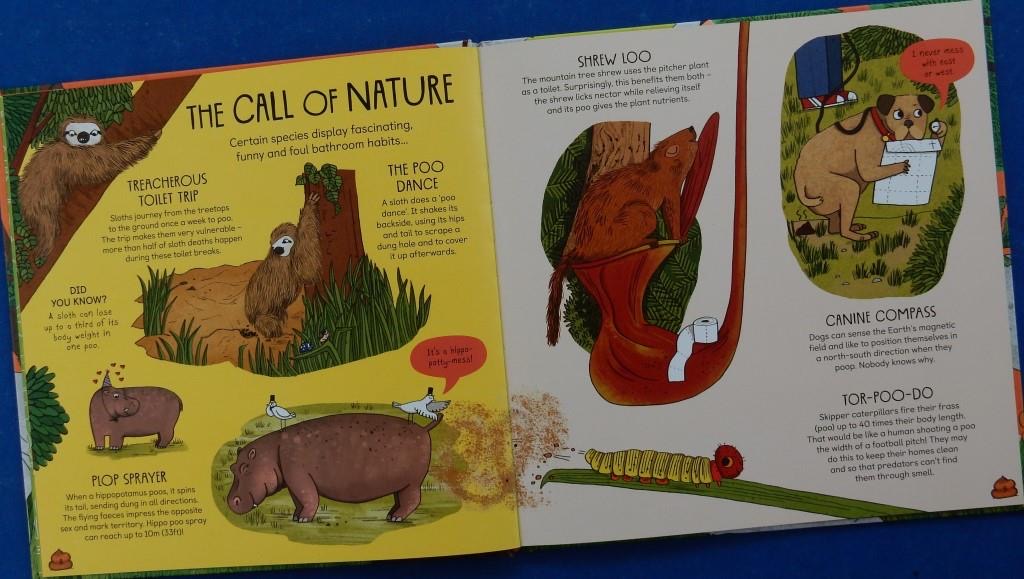
Imagine being a pitcher plant in the vicinity of a mountain tree shrew; said animals use pitcher plants as toilets, which is of mutual benefit: the plant receives nutrients in the poo and the shrew licks the plant’s nectar.

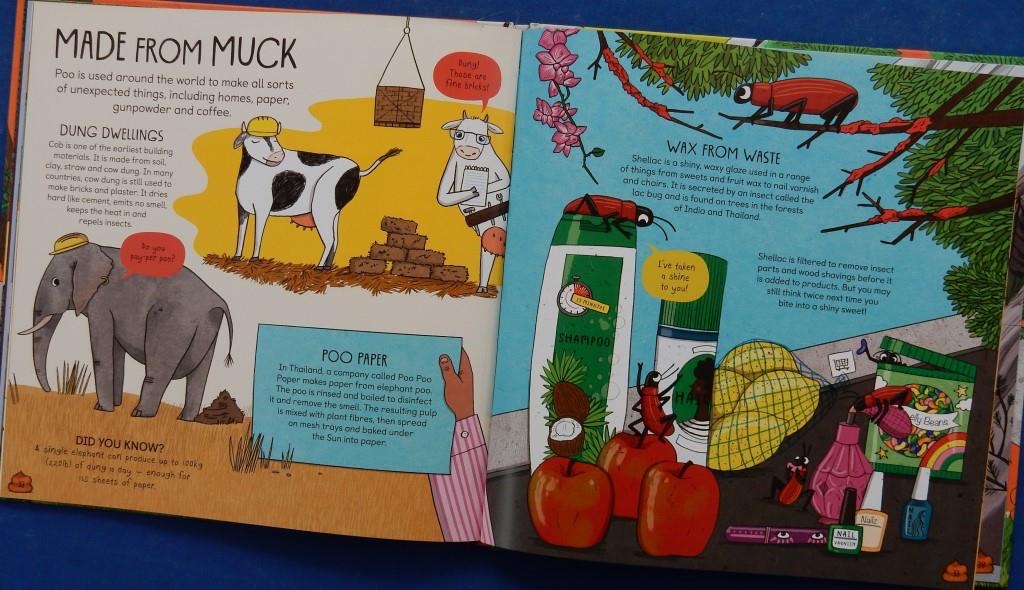
Child readers may well be aware that poo makes a fantastic fertiliser – there’s a spread on that topic herein – but how many are aware of some of the things it can be used to make. For instance there’s a company in Thailand aptly named Poo Poo Paper that uses elephant poo to make paper. Of course, the pong is removed during a process of boiling that also disinfects the pulp before it’s mixed with plant fibres, spread on mesh trays and left to bake in the sun. The result is paper. Apparently one elephant’s daily dung dump is sufficient for over 100 sheets of paper. 
There’s also a luxury coffee that uses beans collected from the poo of Asian palm civets and it’s said to cost way, way more than your usual cup of coffee. I don’t think I’ll be trying that though.

Covering twelve topics in all, Alex Woolf’s playful, punning text is both fascinating – yes really – and full of amazing information and includes such topics as diverse as ancient fossilised faeces and what it can teach us, and ways poo can or might be utilised to produce power for heating, lighting and even vehicle fuel. In keeping with the tone of the verbal content, Isobel Lundie’s bright, detailed visuals are appropriately amusing and the resulting combination is sure to produce giggles aplenty in readers.

Trail Blazers: Stephen Hawking / Little People Big Dreams: Ernest Shackleton

Trail Blazers: Stephen Hawking
Alex Woolf, illustrated by David Shephard
Little Tiger (Stripes Publishing)

‘Be inspired’ says the first line of the blurb of this book. Who could fail to be inspired by reading about Stephen Hawking, an incredible individual who refused to be defined by his illness and which he never allowed to hold him back from pursuing his awesome scientific dreams, and whose life story is told therein by historian Alex Woolf.

It’s both a biography and a science book – ‘A life beyond limits’ as the subtitle says. Alex Woolf explains by means of an informative narrative together with David Shephard’s illustrations and clear diagrams, Stephen Hawking’s scientific discoveries (panels giving theoretical summaries are provided)

and the challenges he faced through much of his life.

There’s just enough detail of the genius’s revolutionary theories and of the key questions cosmologists have sought answers for, to inspire but not overwhelm readers from the top of KS2 onwards.

The narrative begins with a summary of the history of black holes theory, a brief explanation of the space-time continuum and a mention of other mathematicians and physicists involved in the theory.

There’s also information about Stephen’s formative years: I was particularly interested and amused to read of his family’s trip to India when the car got caught in monsoon floods and had to be towed to safety. (Sounds to me like an almost familiar incident!).

Children will be interested to learn that during his under-grad. days Stephen was far from hard-working and later calculated that he’d spent on average just one hour a day studying, spending much of his time rowing or at the boat club; getting by on his utter brilliance and managing to talk his way into getting a first in his Oxford degree.

It was when he became a student at Cambridge that both Stephen’s clumsiness and his resulting focus on his intellect began to take hold. A diagnosis of the incurable amyotrophic lateral sclerosis (ALS) might have overwhelmed even the most determined of people. Not so Stephen whose propensity to ask difficult questions and to put forward new theories without fear of being wrong is exemplary.

“Look up at the stars and not down at your feet. Try to make sense of what you see and wonder about what makes the universe exist. Be curious. “ So says the final quote – truly inspiring and one hopes, motivating …

Strongly recommended reading for older children.

Little People, Big Dreams: Ernest Shackleton
Maria Isabel Sánchez Vegara, illustrated by Olivia Holden
Frances Lincoln Children’s Books

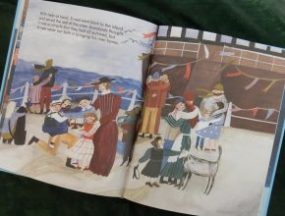
This addition to the popular series of biographical stories presents the famous Antarctic explorer Ernest Shackleton from the time he was a child growing up in rural Ireland dreaming of wider horizons, when even at a young age, he showed the qualities of a good explorer – optimism, idealism, patience and courage.

We learn of his participation as a young man, in expeditions endeavouring to reach the South Pole. Then how, inspired by Roald Amundsen, he planned to cross Antarctica from sea to sea, via the pole.

This expedition aboard Endurance, began in August 1914 with a crew of 28 enthusiastic, optimistic men and assorted animals. After months crossing the ocean, the ship became trapped in ice;

and so it remained for nine months with their calm leader doing his utmost to keep the spirits of his crew high, until the ice began to break up their ship.

Though there was scant hope of a rescue, Ernest never lost hope of saving his crew, and finally he and five of his men reached a whaling station. Then, having found help, he returned and brought his crew back home, Incredible though it may seem, every one of them survived.

With his unfailing optimism, Shackleton, a true inspiration to countless others, died at the young age of 48, as the final timeline shows. A true inspiration to young readers too, especially at this time when remaining optimistic is to say the least, challenging for us all.