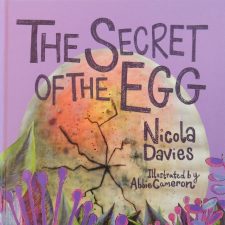
The Secret of the Egg
Nicola Davies and Abbie Cameron
Graffeg
What a cracking book this is; the first one I’ve seen in this series by zoologist, poet and author, Nicola Davies and illustrator Abbie Cameron.
Through a highly engaging rhyming narrative, Nicola introduces children to animal eggs of all shapes and sizes;
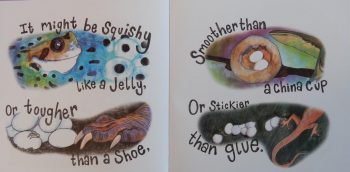
eggs that might be found in puddles or high in a tree; those you might have to dig for, or search in the sea or pond to discover. There are reptiles’ eggs, birds’ eggs, amphibians’ eggs, fishes’ eggs, even mammalian eggs.
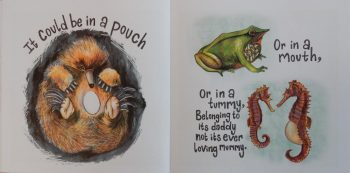
With the exception of the platypus, none of the creatures featured are named so identifying whose eggs are whose is left to Abbie Cameron’s richly detailed, painterly pictures so adult assistance or some additional research may be needed.
This would make a great way to introduce a ‘new life’ topic to young children.
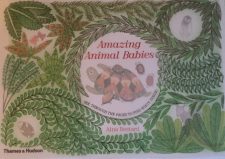
Amazing Animal Babies
Aina Bestard
Thames & Hudson
Animals large and animals small, from various parts of the world feature in Aina Bestard’s book.
Using as many as six intricately detailed transparent overlays the author/illustrator documents in words and aptly coloured visual images, how each animal produces and rears its young.
Herein readers will discover that the penguin parents, as well as the other members of a penguin colony play a part in the rearing of penguin chicks but it’s the Dad penguin that keeps the egg warm while Mum penguin goes off searching the ocean for food. After a chick is hatched however, both parents take turns to find food until their little one can care for itself.
In contrast, having found a safe place to lay her eggs, a mother tortoise leaves them alone to hatch and feed on the surrounding vegetation.
Once they’re laid it’s the father seahorse that takes care of the eggs inside his pouch, whereas with the kangaroo, the baby kangaroo is kept safe in its mother’s pouch.
The monarch butterfly and the common toad never meet their parents and grow up entirely on their own.
The final animal, the blue whale is reared on its mother’s milk, sometimes with the help of other whales.
The illustrations are exquisite and the narrative chatty: prepare to be amazed as you turn the pages of this fascinating book.

 Red Reading Hub - Jillrbennett's Reviews of Children's Books