How to Chat Chicken

Zoologist Nick Crumpton clearly enjoyed writing this splendidly quirky book on creature communication, for which he uses a chatty, matter-of-fact style.

Beginning with primates – chimpanzees, gorillas, orangutans, night monkeys and common marmosets – he focuses on the wonderful sounds these animals make to let others of their kind know they need food, investigate something new, want others to stay clear of them,

want to make friends, want a mate or are defending their territory. If your garden is frequented by a fox at night you could listen very carefully through an open window and you might just catch the ACK-ACK-A-ACK-ACK-A (This is my garden) of a fox indicating to another fox to vamoosh.

Not all animal sounds are vocal however. Some animals including grasshoppers and leaf cutter ants use a process called stridulation. Grasshoppers stridulate to advertise their whereabouts in order to attract a mate; leaf cutter ants stridulate when they want help from their nest-mates.

Then there is echolocation; dolphins use CLICKCLICKCLICKCLICK when they want to find their prey or to indicate they want to play.

Some creatures, dogs for instance, use pheromones (special chemicals) to communicate. I had to smile at the description of lampposts being used as ‘doggy chat rooms’.
And can you believe, there is even a form of animal dialect: the squeaks and clicks made by naked mole rats sound slightly different depending on which colony they are from.

There’s a concluding explanation of the science behind the sounds, a meet the author and the illustrator spread, a glossary and an index.

The book is very visual: Adrienne Barman’s playful cartoon style illustrations work really well with the written text. Add to primary school collections and home bookshelves.
Plantopedia / Summer

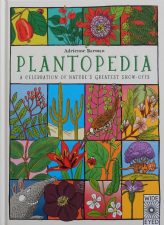
Plantopedia
Adrienne Barman
Wide Eyed Editions

Barman follows up her Creaturepedia with a celebration of more than 600 plants that includes trees, fruits, flowers – wild and cultivated, vegetables, herbs, weeds, healing plants and more from all over the world.

Somewhat strangely for this reviewer at least, we start indoors with ‘The air fresheners’ – plants to grow indoors that clean the air. This section is followed by ‘The all-blacks’ and then ’The aquatics’ ‘The big eaters’ and another colour section – ‘The blues and purples’. I’m not sure whether the author had a plan in mind when she arranged the spreads but to me the section sequencing seems quirky and perhaps random which creates something of a surprise element.I particularly liked The Stars pages.

Having said that the whole book is packed with learning possibilities in various curriculum areas such as science, geography, history, art perhaps (although it’s better to use real plants I suggest) and almost every topic could be an inspiration for further investigation.

In contrast to the rest of the book, the appendix devoted to three aspects of leaves – shape, arrangement and edges/veins – is straightforward botany.

The illustrations are bright, engaging and gently humorous – look out for animals popping up on lots of spreads, and the odd human from time to time.

One for budding botanists, the family bookshelf or school library.

For younger readers, with plants also taking centre stage is:

Summer
David A. Carter
Abrams Appleseed

Just in time for summer comes David A. Carter’s fourth and final pop-up in his seasons series. Carter has created six plant pop-ups –one of which he places at the centre of each spread,

and in and around them are to be found various animals including birds, butterflies and other minibeasts, small mammals, a snake, a turtle and a fish.

A brief accompanying text invites children to get involved by asking such questions as ‘Who eats the flowers?’ or ‘Who swims in the creek?’

Fun and captivating, this is an American publication so some of the named items will be unfamiliar but that offers a good talking point for readers in parts of the world other than the USA.

Wild Life Wonders

DSCN3842 (800x600)

Creaturepedia
Adrienne Barman
Wide Eyed Editions
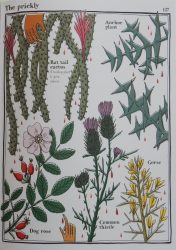
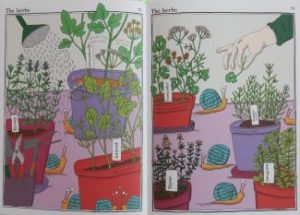
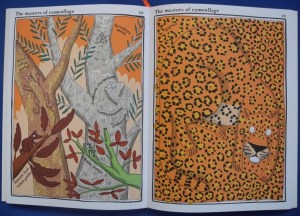
This large volume is a superb visual treat and exemplification of nature as designer, illustrating six hundred or so animals large and small, real and imagined. These are divided into categories such as The architects, The champion breath-holders, The big mouths, The masters of camouflage,

DSCN3840 (800x600)

The pretty-in-pinks, The prickly ones, The mythical, The vanished, The showoffs, which cut across class barriers so that fish, insects, mammals, birds, reptiles etc. may be grouped together under a single heading. Every animal is captioned, with many having a short information snippet. A fair few of the animal names may be unfamiliar (unless of course you happen to be a zoology specialist); the likes of binturong, kakapo or Cory’s shearwater – what deliciously strange sounding creatures – are likely to send you off on further explorations, on line or in other books, of the animal kingdom.
There is humour, both verbal – the Tiger,

DSCN3839 (800x600)

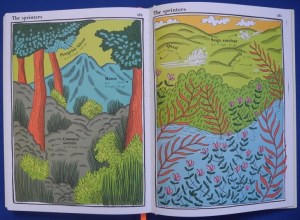
Orca, Little owl and Montagu’s harrier are among ‘The munch-it-uppers’ and visual – I love the way The sprinters are shown (or rather not shown)

DSCN3838 (800x600)

for example and The big-eared beasts surely cannot fail to make you smile.

DSCN3841 (800x600)

Highly recommended for the family bookshelf, for primary and secondary school libraries, art departments and of course, science departments, in colleges.

DSCN3836 (800x600)

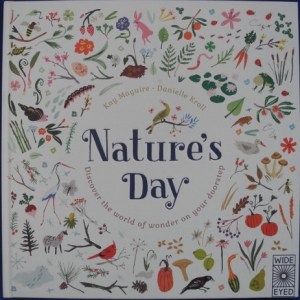
Nature’s Day
Kay Maguire and Danielle Kroll
Wide Eyed Editions
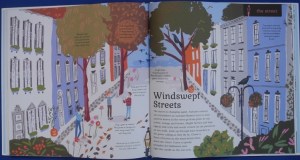
In this stylishly illustrated book we visit eight different locations – the garden, the vegetable patch, the woods, the farm, the fields, the pond, the orchard and the street.

DSCN3833 (800x600)

Starting in the spring, each place in turn is visited and then revisited during summer, autumn and winter chronicling the seasonal changes to the flora and fauna of the specific natural environment.
There is a seasonal narrative running throughout the whole which describes what is happening, gently urging us to stop, look and listen and then each location also has an introductory paragraph as well as interwoven with the illustrations, more specific information about for instance, bird song in the spring garden.

DSCN3835 (800x600)

The author realistically points out that in addition to the buzzing of bees and the birdsong of the richly coloured summer garden, one is likely to hear – on account of the speed that the grass grows – the weekly hum of a lawnmower.

DSCN3834 (800x600)

My slight reservation with this otherwise excellent book is that although beautifully painted, some of the birds and animals have only a passing resemblance to the species referred to in the text. Nevertheless it is certain to make you get outside and enjoy the natural world all year round, no matter where you live.

Use your local bookshop localbookshops_NameImage-2