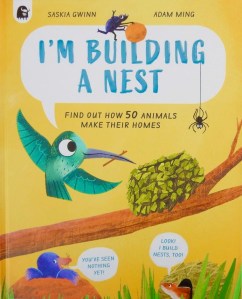
I’m Building A Nest

Author Saskia Gwinn entrusts Bird to act as our guide in this journey to discover how other creatures build their homes.. We meet more than fifty large and small : can any of them surprise Bird and show that their home is best?

First Bird visits other nest builders including a stork that reuses its stick nest year after year, a trumpeter swan that builds a nest on a beaver’s floating lodge and a red-headed woodpecker that pecks a hole in a tree trunk.

Next to be investigated are spiders. these eight-legged arachnids make webs for a variety of purposes. The garden web spider’s web is an insect trap; the golden diving bell spider weaves a web under water to trap air then uses it as a submarine and the crab spider makes a balloon of silken threads that float on the wind, enabling it to find a new home. Is Bird impressed by these? Well yes, but not persuaded.

Do you know which animal’s home has a feeding tunnel, a larder and a bedroom as well as a super-speedy escape tunnel? It’s a mole, one of the tunnellers we meet.
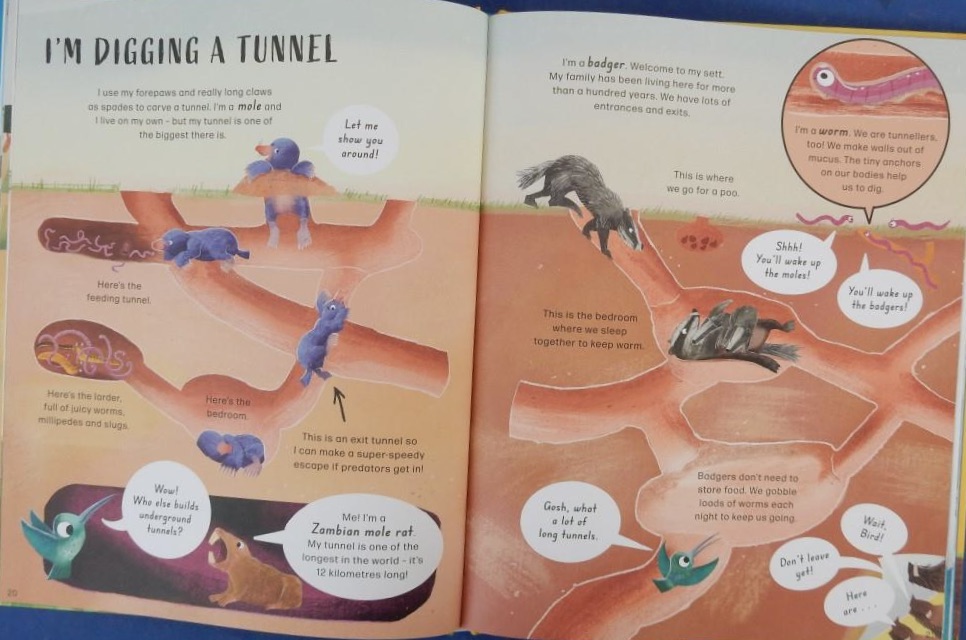

These are just some of the places of residence Bird discovers, but at the end of a long learning journey, there’s been a change of heart in our feathered escort. It concludes, ’Every home is best for the clever creature that made it.’

Curious young readers will enjoy discovering the wealth of animal homes on our planet and be amused by the speech bubbles and Adam Ming’s playful illustrations.

Does A Bear Wash Its Hair?

In this sequel to Does a Monkey get Grumpy? author Moira Butterfield turns her attention to animals’ daily routines. You may well be surprised to read that many animals – certainly the fifteen featured in this book – devote a considerable amount of their time doing the same things we humans do, although they don’t go about them in the same way. They are nonetheless, creatures of habit.

Whereas we humans normally use soap and water to keep ourselves clean, brown bears lick their fur, slurping up whatever is attached to it, sometimes tasty bugs, so they get a reward as well as a wash. Certain fish including green moray eels visit coral reef cleaning stations where cleaner wrasse nibble off unwanted bugs and flaking scales: a win/win process.

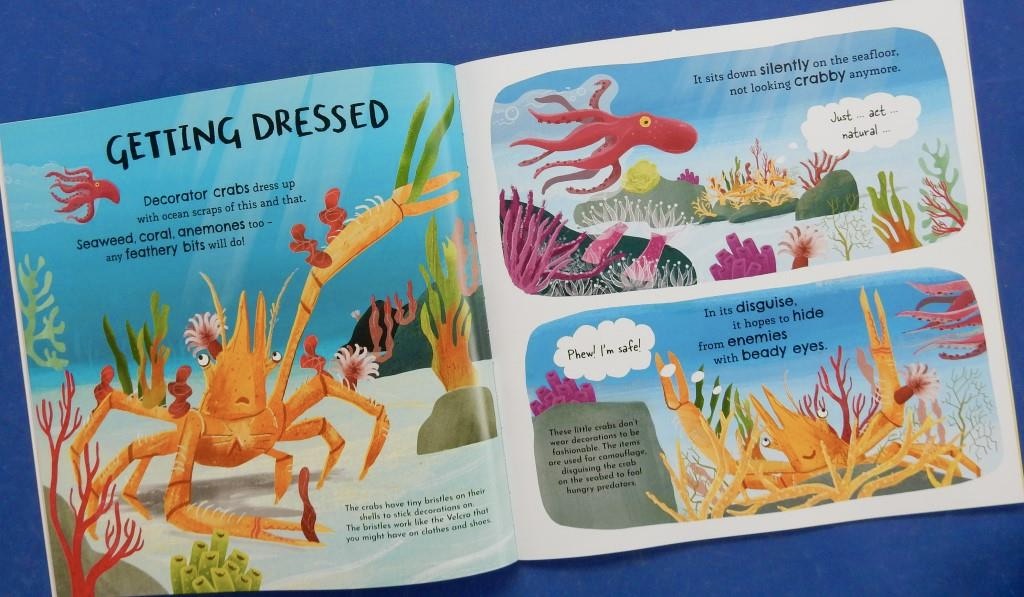
Did you know that decorator crabs dress themselves up with bits and pieces from the ocean, these they stick onto tiny bristles on their shells, the intention being that so disguised they won’t be easily preyed upon by hungry enemies.

Young readers will be amused to discover that young meerkats have lessons – hunting lessons where they learn how to bite off a scorpion’s sting. Before swallowing a scorpion though, they roll it in the sand to rub off any poison.

Poo is a topic that seems to fascinate most young children and I suspect they will laugh at the thought of a sloth descending from its tree once a week to take a ‘big poo’ excreting a third of its body weight. Having made a poo pile, sloths then need to bury it to prevent enemies discovering where they live.

Tidying,

co-operating, making friends, teeth cleaning, eating meals and sleeping are habitually done by animals of various kinds.

All these are described in Moira’s bouncy rhythmic text (with additional factual snippets) and illustrated in Adam Ming’s amusing scenes making this a really fun way of teaching children the many similarities between humans and other animals..