
Hedy Lamarr’s Double Life
Laurie Wallmark and Katy Wu
Sterling
Elegant film star Hedy Lamarr’s first love wasn’t in fact for making movies – she wasn’t at all interested in glitz and glamour – rather her passion was science and technology. It’s this lesser known side of her that’s the focus of this book.
Her greatest invention was ‘frequency–hopping spread spectrum’ a wonderful technological idea developed in collaboration with musician George Antheil, that helped allow the communication devices of torpedoes to change frequency quickly cutting down the opportunities for radio signals to be altered, intercepted or blocked completely; sadly it wasn’t used by the US navy during WW2 though.
Still relevant today, their invention now helps to keep our mobile messages private and defends computers from hackers.

Hedy’s various inventions are described and each spread includes a quote from her: here’s one I particularly love.
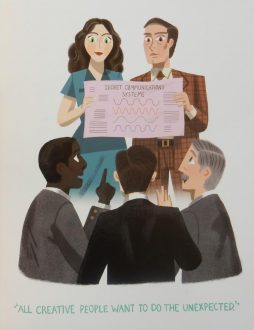
We also learn of her childhood in Austria in the early 1920s and how her father, who also had a love of science and technology was such an encouragement to her curiosity and thirst for knowledge, and her creative ideas.

Laurie Wallmark’s engaging text is both inspiring and concise; and Katy Wu’s stylish, retro feel illustrations transport readers to the time when women’s achievements were under played and often undervalued (it took 50 years for her awesome brilliance to be fully recognised). However when Hedy and George finally received in 1997 the Pioneer Award from the Electronic Frontier Foundation for their contribution to computers, Hedy commented thus.’” It’s about time.” … “My life was full of colours, full of life … I don’t regret anything … I learned a lot.” Brilliance recognised at last.
So too will readers of this picture book, which also includes a timeline, bibliography, suggestions for further reading about women in STEM, a list of her films and an explanation of her secret communications system.
Equally inspiring, for older readers is:

Dreaming in Code
Emily Arnold McCully
Walker Books
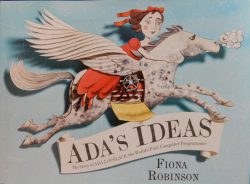
This is a fascinating biography of Ada Lovelace, daughter of poet Lord Byron, who is celebrated for being the first computer programmer.
Ada’s childhood was anything but conventional; she never got to know her father and was brought up by her domineering mother who, despite showing little emotional warmth, provided for her daughter through private tutors, an intellectually stimulating education, a protection in part from any instincts towards developing her father’s poetic talent. Thus Ada developed a terrific thirst for mathematical and mental puzzles and scientific discovery.
At age seventeen, the young aristocrat Ada, was introduced at a party to widower and famous inventor and mathematician, Charles Babbage, who was to transform her life. We learn of their collaborative friendship and how Ada’s leap of imagination took her pioneering thinking beyond that of her friend and his ‘Analytical Engine’. This is what she wrote, ‘Many persons imagine that because the business of the engine is to give its results in numerical notation, the nature of its processes must consequently be arithmetical and numerical, rather than algebraical and analytical. This is an error. The engine can arrange and combine its numerical quantities exactly as if they were letters or any other general symbols.’
We read of her marriage to William King who admired Ada’s intellect as well as being rich and handsome; her motherhood years, her addictions and death at an early age from cancer.
Beautifully written by Caldecott-Medal winning author, Emily McCully this carefully researched, accessible portrait of Ada Lovelace is likely to inspire future groundbreakers to follow their dreams and not let anyone or anything stand in their way.
(There are also photographs from archives, illustrations, source notes, a glossary and a bibliography.)


 Red Reading Hub - Jillrbennett's Reviews of Children's Books