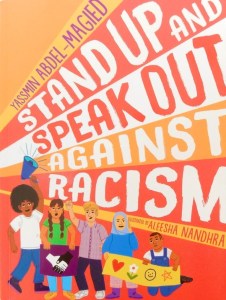
Stand Up and Speak Out Against Racism

A social activist, broadcaster and engineer, the author of this book visited schools and asked children what they wanted to know about racism and how to fight for social justice: herein she tries to answer their questions impartially. At the outset, she presents life as being like ‘climbing up a big, tall, scary mountain, and when we are born, we all get a different set of tools to climb it.’ For some the way is blocked, some get access to a cable car, while others must use the stairs and the most fortunate get a ‘jetpack’ is how she puts it, immediately drawing readers into the book.

After that, the book is divided into three main sections: how racism started, what racism looks like today and finally, how do we stand up and speak out against racism? There’s a timely reminder to readers to take the book at their own pace and if something gets too much, stop and return to it when it feels okay. I know that I find myself getting really upset when I hear of people’s racist behaviour in the UK and feel ashamed to be British by some of what I see and hear on the news, for instance. The author states here that the English colonisers created slave codes or rules that formed the roots of the racism so entrenched in today’s world and in her conversational style leads readers through to the book’s final part: what to do – how to stand up and speak out. There are lots of practical suggestions such as asking someone who has made a racist joke why they think it’s funny, 
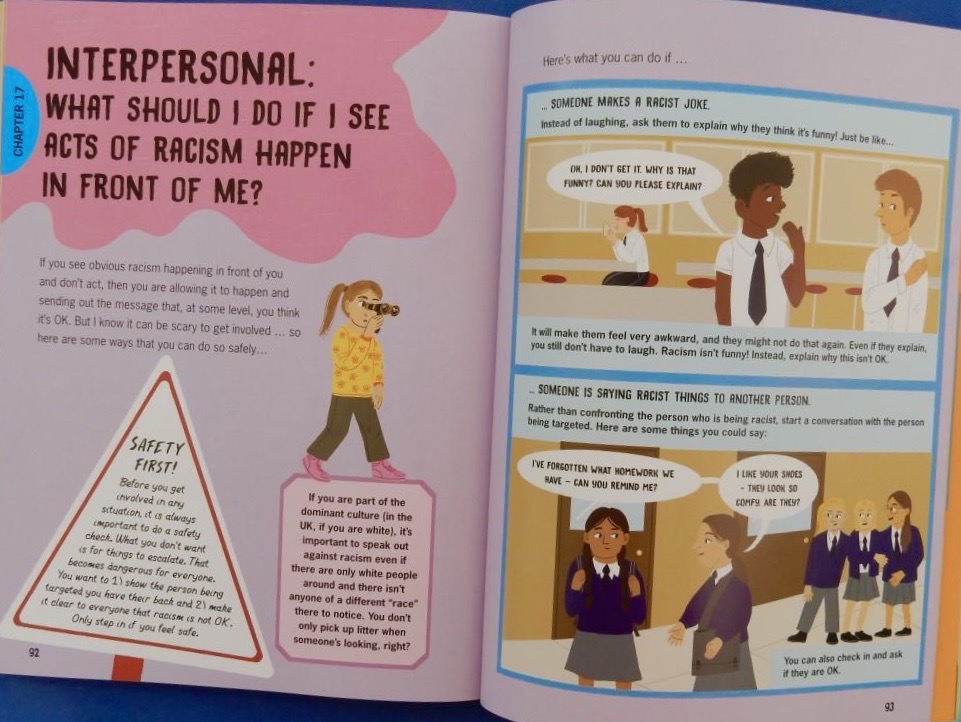
and questioning somebody who has made a judgement about others on account of their race. And of course, if you happen to be the person in the wrong, even by mistake, it’s important to apologise to the one wronged and to try and make reparations.
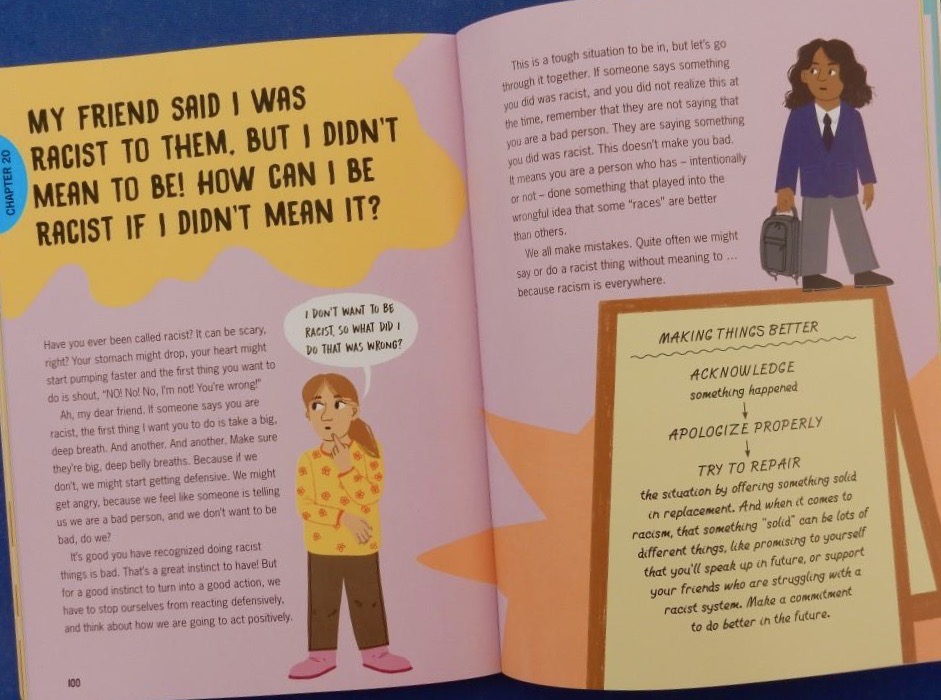
This is an important book that needs to be in all schools to instigate class discussions; many adults would do well to read it too.

A Hero Like Me

A Hero Like Me
Angela Joy, Jen Reid and Leire Salaberria
Frances Lincoln Children’s Books

‘They call him ‘HERO’, but he’s no HERO – not to me.’
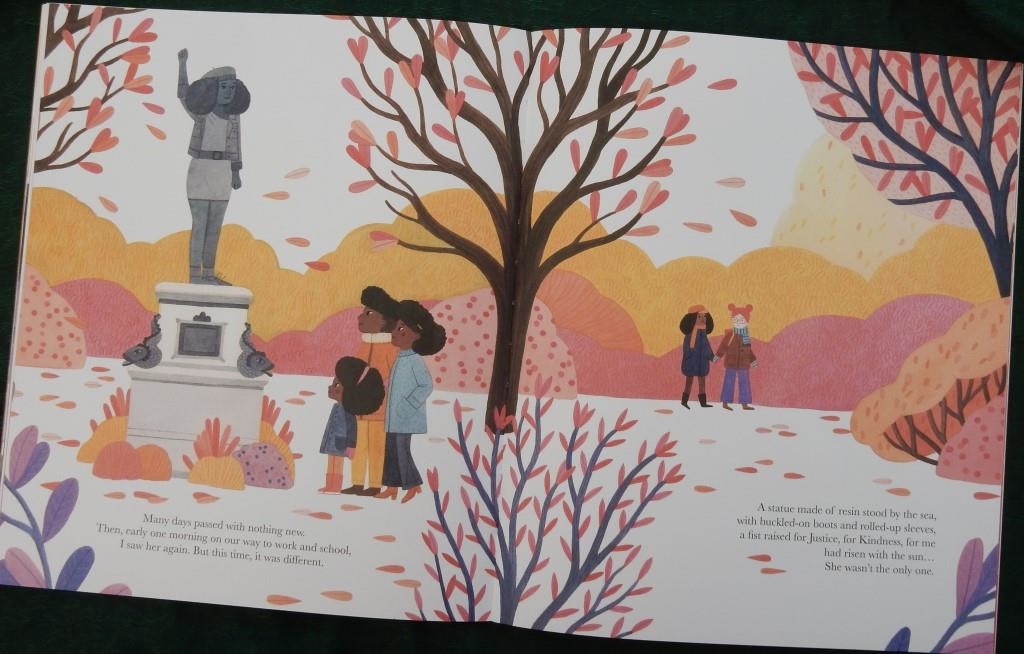
So it says on the first spread of this picture book – a fictional account – inspired by the events of 7 June 2020, when, during an anti-racism protest, prompted by the killing of George Floyd by police in the USA, a statue of seventeenth-century slave trader Edward Colston was pulled down and thrown into Bristol Harbour.

Co-author Jen Reid was among the protesters that day, and despite being afraid of heights, she felt compelled to climb onto the empty plinth and raise her fist above her head in a black power salute  – a moment that was captured on camera and shared all round the world.

Written together with Angela Joy, this wonderfully inspiring story relating the events of that memorable day are retold through the eyes of a girl who every day on her way to school sees the huge statue of the so-called hero, in reality a man who sold freedom for cotton and tea. She knows this man is not a hero.
However, it’s not easy to find real heroes: people who stand up for Justice, Peace and Kindness so our young narrator takes things into her own hands. She, her family and friends create placards and march, shouting out for what they believe in.

They march towards that bronze statue of Colston and eventually that towering statue becomes a toppling one that is dragged by many pairs of hands to the harbour’s edge and thrown into the water. Then in it’s place stands a real hero, a young woman with fist held up for Black Peace and Black Power

A few weeks later, (15th July) on her walk to school, the narrator sees a statue of Jen Reid by artist Marc Quinn had been added to the empty plinth. Called A Surge of Power, it was only in place for 24 hours.

Adding even more impact to Angela Joy and Jen Reid’s empowering words are Leire Salaberria’s distinctive, bold, stylish illustrations. Together they have created an important book for young readers; one that shows them a hero can be just like themselves, as well as offering them hope in humanity, in particular in those who stand up for what is right: activism can lead to change. It’s a must for primary classrooms and family bookshelves.

She Heard the Birds

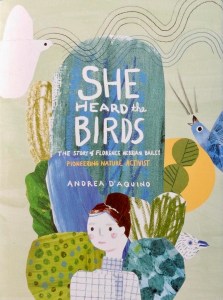
She Heard the Birds: the story of Florence Merriam Bailey
Andrea D’Aquino
Princeton Architectural Press

In this inspiring picture book biography author/illustrator Andrea D’Aquino shines a light on key moments in the life of the pioneering American ornithologist and nature activist Florence Merriam Bailey who was born in 1863.

Daughter of a camping enthusiast father and astronomer mother, Florence grew up surrounded by nature in which she developed an early interest, especially when it came to birds. These she found the most fascinating and she spent time learning as much as she could about these feathered creatures.

As a young woman, while visiting the city, Florence was appalled by the sight of people – dedicated followers of fashion – wearing hats decorated with feathers and the bodies of birds. She was even more disgusted by the sounds of the gunshots in the woods of those ornithologists who thought it acceptable to shoot birds in order to study them.

Determined to make a difference, Florence, armed only with her tools for observing birds – knew she must answer the calls for help of the birds and to do so she must dream big.

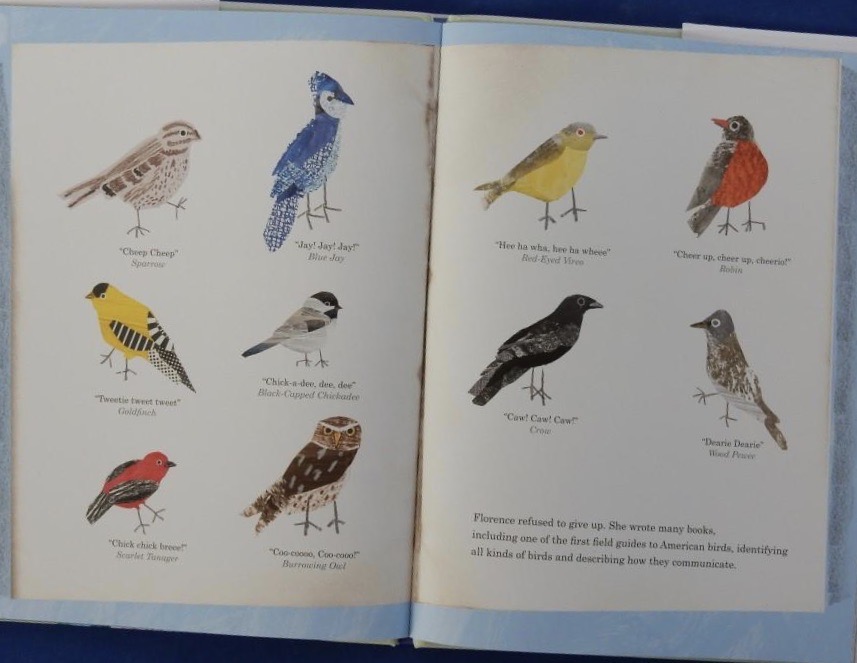
She put the information she’d collected into print, writing field guides, and other bird books some giving suggestions about how readers too could learn about these precious creatures becoming peaceful observers of birds in nature too.

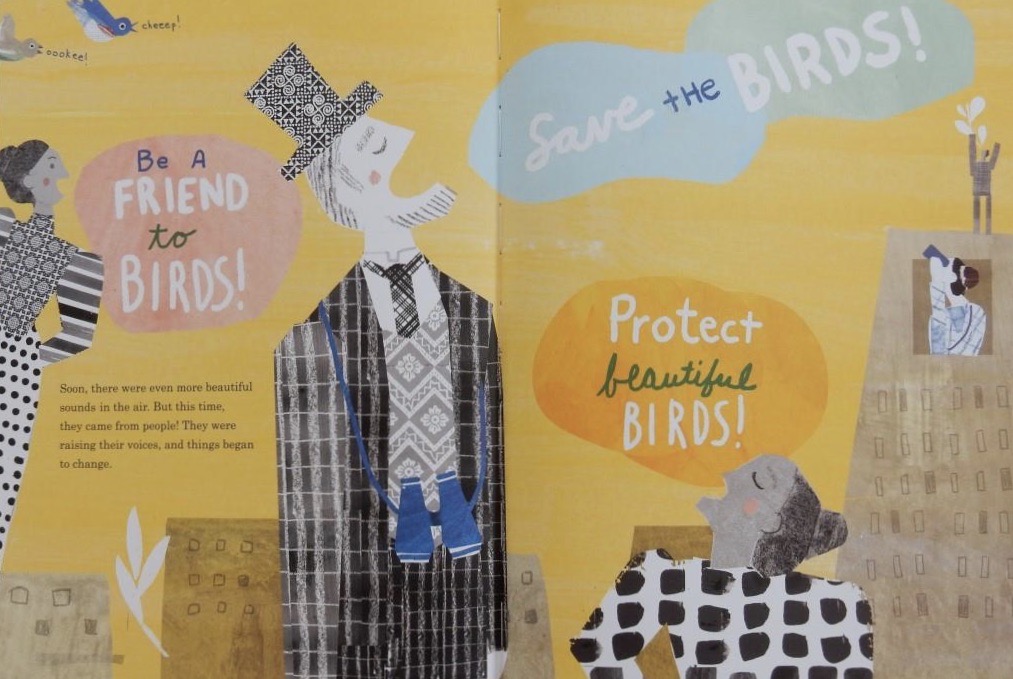
Thus guns could be replaced by binoculars and listeners to their songs taking heed of her ‘Shhhhhhh! Listen. What are they saying?’would be filled with delight and share her determination to push forward crucial changes.

Thus it was that one person’s mission gradually became that of many;

the end result being that ‘The world became safer for the birds, and more beautiful for us all.’ How this was actually achieved we aren’t told but it’s evident that the millinery trade and others got the message that began with a single woman nature lover.

In her hand-painted collage, oil pastel, and pencil illustrations, Andrea D’Aquino focuses the reader’s attention on her subject’s personal mission while using rich colours to emphasise the overwhelming importance of nature and its beauty, and giving the birds centre stage.

In addition to giving more detail about Bailey’s life, the final spread contains a reminder that the struggle to protect birds continues and there are some recommendations for readers who want to help.

How to Change the World / Climate Rebels

How to Change the World
Rashmi Sirdeshpande, illustrated by Annabel Tempest
Puffin Books

In her follow up to How to be Extraordinary, Rashmi Sirdeshpande presents a companion book in which she shows what a large impact can be made by people working together. There are fifteen stories of teamwork that start way back in sixth century BCE Athens with the origins of the very first democracy and is followed by a look at the incredible human engineering collaboration involved in the building of the Great Pyramid in the desert of ancient Egypt.

Then come the campaigns for change – well known and less so – in various parts of the world. Thus among environmental campaigners we have not only the universally known Greenpeace and the Montreal Protocol banning CFCs, but also the Treeplanters of Piplantri that I know of only because a friend took me to visit the village in Rajasthan a few years back. (Every time a girl is born 111 trees are planted in honour of the chief’s daughter who died during a drought around fifteen years ago).

Then, as well as the Montgomery Bus Boycott triggered by Rosa Parks’ action, there is the Singing Revolution in Estonia where people used song to tell the world that this small country had always been a free nation.

Following the spread about the abolition of slavery campaign in the British Empire is one about the 1965 Freedom Ride campaigning for justice for the indigenous people of Australia.

Alluringly illustrated by Annabel Tempest and attractively laid out, each spread with its well-written text offers an example of high quality narrative non-fiction for primary readers.

The same is true of

Climate Rebels
Ben Lerwill
Puffin Books

‘The greatest threat to our planet is the belief that someone else will save it’. Robert Swan’s quote at the beginning of this book is a powerful reminder that the terrible effects of climate change can only be arrested through our individual and collective actions.

Award winning writer Ben Lerwill presents twenty five inspiring and fascinating stories of individuals (and some groups) who have worked tirelessly and continue to do so for the causes in which they believe so passionately.

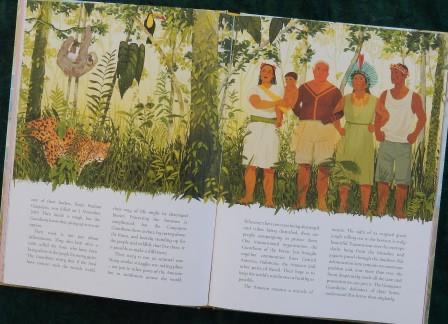
Among those featured are Dr Jane Goodall (who wrote the book’s introduction), Sir David Attenborough, the Greenpeace founders, Rachel Carson and Greta Thunberg. Alongside those are accounts of less famous names – The Guajajara Guardians –

who often risk their lives while working to protect the Amazon Rainforest; and William Kamkwamba who built a windmill in a small village in Malawi and went on to build more that pump water to the crops in the fields, thus improving the life of his entire community through renewable energy.

Not only is this book a powerful call to action; it’s also a reminder that we need to stand together – there might just be time to make those crucial changes to the climate change story.

Compellingly written in a lively style and illustrated by Masha Ukhova, Stephanie Son, Chellie Carroll, Hannah Peck and Iratxe Lopez de Munain, this book is strongly recommended for home and school reading.

One Little Bird

One Little Bird
Sheryl Webster and Helen Shoesmith
Oxford University Press

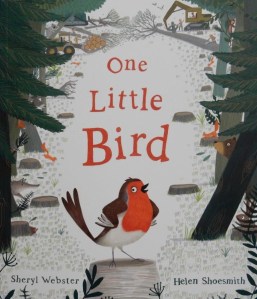
Rosa the robin isn’t one to stand by and do nothing when a man chops down the tree in which she’s nesting. Rather than finding another tree as the fellow says, she snatches up his hat, flies to his chimney and proceeds to nest therein.

She doesn’t leave things there either. Instead, she issues a rallying cry, “Animals, everywhere! We must stop people from taking our homes!”

Before long, Rosa is the talk of the forest, the tropical jungle, the grasslands, and the animal residents thereof, having lost their own homes, move into those of the destructive humans who have made them homeless.

Needless to say this infuriates the fellers, the jungle clearers and the road builders and eventually both animals and humans are incensed. The news gets back to Rosa and she realises that things have to change: surely a harmonious co-existence is possible.

Again Rosa sends her words over land and sea, summoning both animals and humans to a meeting and having heard both sides say exactly the same thing, she delivers a stark reminder to the destroyers of the animals’ homes.
From that day on, things begin to change for the better …

Sheryl Webster’s Rosa certainly had the courage of her convictions in this fun cautionary tale that might well serve as a call to young humans to become environmental activists too. Helen Shoesmith’s cover illustrations definitely depicts her as a bird with attitude, while her scenes of Rosa’s actions and their results are amusingly portrayed with a wealth of diverting detail on every spread.

Little People, Big Dreams: Pelé / If You’re Going to a March!

Little People, Big Dreams: Pelé
Maria Isabel Sánchez Vegara, illustrated by Camila Rosa
Frances Lincoln Children’s Books

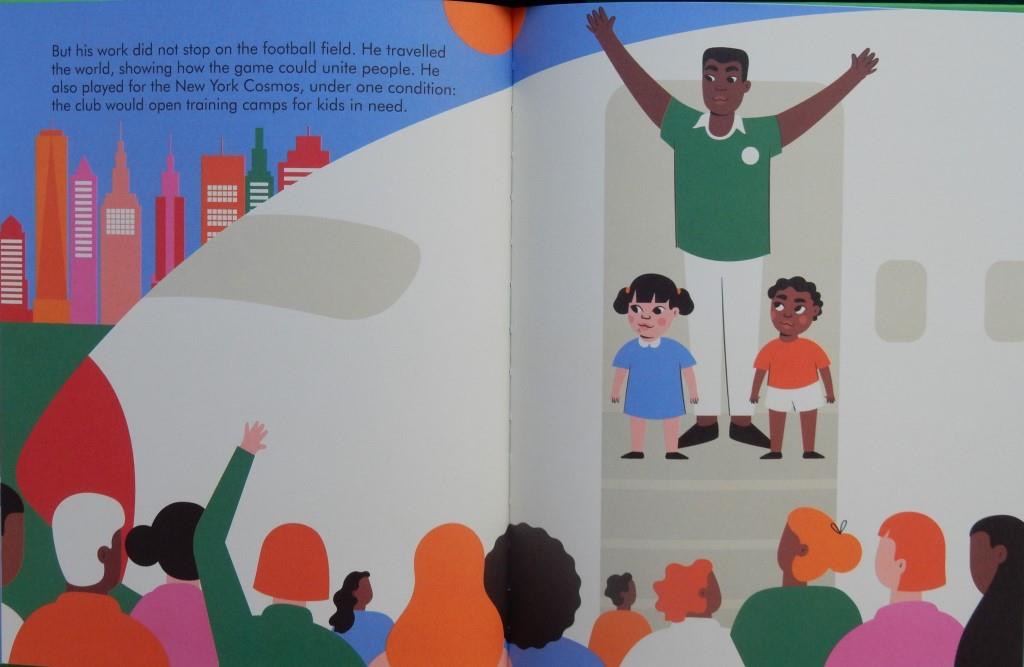
This new addition to the best-selling series stars one of the world’s greatest ever soccer players, telling of both his awesome skills on the field and his sterling work off the pitch in helping children in need, not only in his home country Brazil, but the world over.

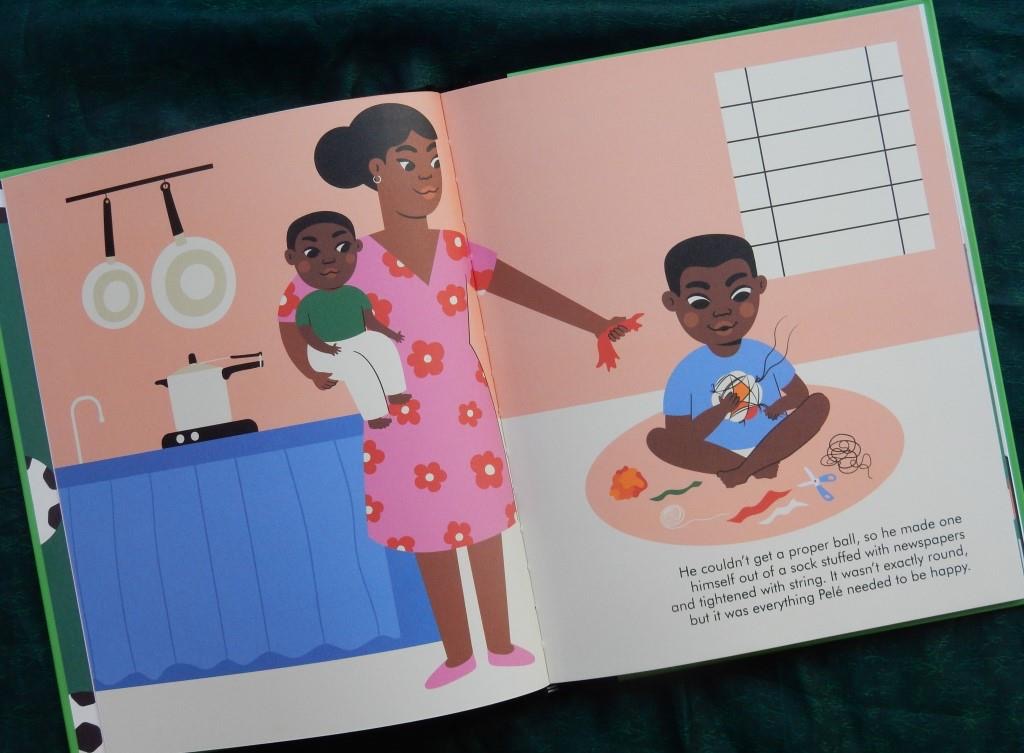
From modest beginnings in a poor neighbourhood in Brazil, young Edson aka, Pelé fashioned a ball from a sock stuffed with paper and tied with string and used it to work on his footie skills.

Fuelled with a determination to lead his country to a World Cup victory, he was selected at age sixteen to play for the national team in Sweden where he became known as the player of ‘Jogo Bonito’ (‘beautiful game’)

Pele went on to take his country to another two World Cup victories. He’s now recognised as the top footballer who ever lived as well as a voice for unity and for the most needy.

With additional facts at the back of the book, set out along a timeline, and Camila Rosa’s striking illustrations, this is a book to inform and inspire young sports enthusiasts especially.

If You’re Going to a March
Martha Freeman and Violet Kim
Sterling Children’s Books

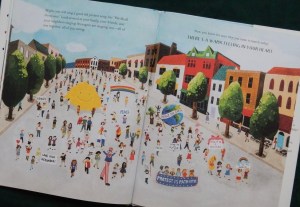
Although this book originated in the USA, there are plenty of young activists and would-be activists in the UK and in many other countries too; this book with its reader-friendly advice and instructions, will speak to them all, whether their cause is civil rights, the environment, women’s rights, gay rights, peace or whatever. And, children start very young: during my participation in pro EU marches I encountered babes in slings accompanied by parents and young siblings.

There’s advice on such practicalities as making your own sign,

appropriate clothing (check the weather forecast), transport to starting point; plus warnings about such possibilities as getting a bit bored if lots of people want to make speeches; feeling free to let go and dance should the opportunity arise; how to interact with the media; even visiting the loo is covered; (perhaps the spread with the smiling police officers ‘their job is to keep people safe’ is probably more apt for the UK than that of the book’s origins).

The author and illustrator also present the ‘why’ behind marches, rallies and protesting – ‘they are showing they care about their country and want to make things better’, as well as pointing out the possibility of seeing people who disagree with your cause – ‘sometimes democracy looks like disagreement’ and advising politeness. With its focus on the practical and positive elements of activism, this book is a good starting point for adults wanting to introduce the possibilities of political involvement, peaceful protest and community action to youngsters.

I love the way Violet Kim conveys a community feel to her scenes throughout.

I Am One / Our Little Kitchen

I Am One
Susan Verde and Peter H. Reynolds
Abrams Books for Young Readers

It’s never too soon to introduce a young child to the idea that s/he can make a change in the world and this gorgeous book by a team whose books I greatly admire, shows the way.

Subtitled ‘A book of Action’ this one is clearly much more focused on being active than several of the others in the series and it’s a pitch perfect demonstration, given by a child of how seemingly simple actions can make all the difference.

Here we witness the planting of a single seed, a brushstroke, a note ‘to start a melody’, a step to set off on a journey, and I particularly love the “One brick to start breaking down walls’ sequence of actions

so pertinent in our increasingly troubled times.

The harmony between Susan Verde’s words and Peter H. Reynolds’ signature style illustrations is what truly makes this such a special introduction to social activism; it’s tender, inspiring and uplifting.

Furthermore, Peter has dedicated the book to Greta Thunberg and in the final author’s note, (that also contains a beautiful meditation) Susan writes that her inspiration came from a quote from the Dalai Lama: what more can one ask?

A conversation opener, but equally or more importantly, an impetus to seize that inner power and take action.

Also about taking action – singly and as a community is:

Our Little Kitchen
Jillian Tamaki
Abrams Books for Young Readers

Inspired by her own experience of volunteering in a community kitchen, here’s a really tasty, deliciously diverse, offering from Jillian Tamaki. Now, with hands washed and aprons on, we’re ready to go in the community kitchen. We’ll create a meal – something that happens every Wednesday and it’s a bit of a squash to accommodate all the enthusiastic volunteers.

Luckily, they have their own little garden so there’s no need to look too far afield for ingredients; and there appears to be a fair bit stored away that needs using up and there are donations from the food bank. (Beans again – can they be creative?) It’s definitely a case of waste not, want not (although the odd item is clearly no longer fit for human consumption.

This team clearly makes its own music as they work: ‘glug, glug, chop chop, sizzzzzzzzle, pick! Peel, trim, splash! Toss, squish, mmmm!’ Then comes the shout, “Fifteen minutes!’

The countdown is on as the hungry start coming in; they clearly know one another – there’s plenty to chat about while they wait.
Eventually the leader gives the order “Let’s go!” and in comes the food – yummy and very ‘SSSSSSLLLLLUUUURRRRRPPPP!’- worthy.

Speech bubbles abound, providing a running commentary by the workers and the recipients of the bounty produced by the team; indeed, the entire atmosphere is cheery and relaxed,

made so evident by Jillian Tamaki’s vivid colour palette and the fluidity of her lines. In fact the entire book is a veritable feast for all the senses. There are even recipes on the front and back endpapers.