Everybunny Count! / abc

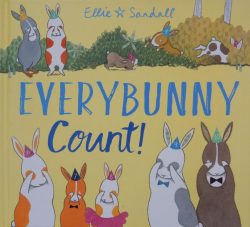
Everybunny Count!
Ellie Sandall
Hodder Children’s Books

Since making friends in Everybunny Dance, ’Fox and bunnies like to play, / all together, every day.’ And their chosen game for this particular day is hide-and-seek.

The bunnies do their countdown and the hunt for fox commences. The first finding is a single badger soon followed by two bunnies spotting two birds: ‘Everybunny count to TWO!’

The search continues. Three bunnies spy three frisky squirrels; four find four ladybirds.

The pond is a fruitful place for fresh discoveries: five diving bunnies see five ducks while among the sticks, six bunnies find six frogs. ‘Everybunny count to SIX!’
Next stop is the carrot patch – just the place for a crunchy carrot nibble. It’s getting late and eight bunnies are anything but observant in their haste …
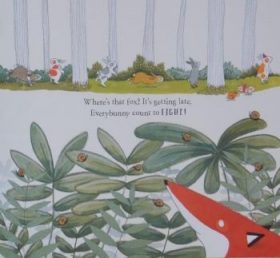
By now those bunnies are feeling sleepy as they form a line and count to NINE! (sheep) and then hurrah! There among the trees, close to his den is Fox.

There’s another surprise however for at the count of ten what should appear but ten little fox cubs and a proud mother.

It’s time to dance …

Ellie Sandall’s rhyming text with its infectious repetition ‘Everybunny count to …’ bounces along as beautifully as the bunnies. Add to that her deliciously playful pencil and watercolour illustrations (children will delight in occasional glimpses of Fox along the way) that lead to this …

and we have a counting book story that’s full of fun and sure to result in echoes of the animals’ “Let’s play hide-and-seek again.”

abc
Aino-Maija Metsola
Wide Eyed Editions

Learning the alphabet is just a part of this new addition to the Learning Garden series. Young children can have fun not only naming the objects for each letter of the alphabet but also enjoying the various patterns, shapes and bright colours that are part and parcel of every page.

There are numerous opportunities for language learning, depending on the child’s interest and the skill of the adult sharer. You might for example, chose two or three of the letters and illustrated objects, and use them to make up a story together. The sturdy pages mean that this little board book should stand up well to the enthusiastic use it’s likely to get in a nursery or family.
Quality From The Start

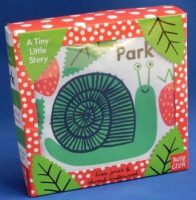
Park
Lisa Jones and Edward Underwood
Nosy Crow
It’s never too soon to introduce babies to books: this ‘Tiny Little Story’ is a delight. We accompany Mum and Baby Boo on a walk in the park where they see a dog, a squirrel – squeeze the page and the leaves rustle – and a snail.

It rains, they feed the ducks and then the infant bids farewell to a bird and the park. That’s it; but with its squidgy fabric pages, simple, bright, attractive illustrations and brief text, it’s perfect for a first book. The whole thing comes in a presentation box and there’s a velcro strap to attach the book to a buggy.
With its soft pages, this would make a super present for a mum and new baby.

So Many Feet
Nichole Mara and Alexander Vidal
Abrams Appleseed
HIGH FEET, SLOW FEET; FAST FEET: SNOW FEET; DANCING FEET, HANGING FEET – these are just some of the many different kinds to be found in this largish board book that introduces toddlers to the diverse forms and functions of animal feet be they toed, clawed, webbed, sticky, hoofed, padded or other. Each animal’s feet are adapted for its life style whether it’s  mountain climbing, slow plodding, jumping, swimming, digging,

or perhaps, wall scaling.
Interesting, informative and alluringly illustrated, and with its final spread, which concludes with a parting question, ‘What can YOUR FEET do?’ an open invitation for youngsters to try some experimental movements with their own feet. In fact, nursery practitioners might make it the starting point for some playful group movement activities.

123
ABC

Nosy Crow
Nosy Crow has embarked on a new collaboration with The British Museum and these two board books are some of the first of a new joint non-fiction list.
Each one contains photographic images of objects found in the museum and thus give very young learners an opportunity to see and celebrate some of the wonderfully rich cultural collections while at the same time re-enforcing alphabetic and numerical concepts.
I randomly opened 123 at the first spread and was surprised to see a pair of what look like almost identical Indian shoes to a pair I have that I bought in Rajasthan, India a few years back, and where there are a fair number of makers/sellers of these jooties or mojaris as they are called. Those illustrated here are given in the index as ‘shoes: date unknown’ so I have no idea how old they might be, but it just shows how certain things remain almost unchanged over time.
In fact the whole book starting with 1 llama (a gold figure from Peru); and ending with 20 coins, is full of fascinating objects to look at and talk about.

There is a mix of photos of illustrations (paintings, etching, drawing) and 3D objects including drums, bowls, kites, beads, bags and spoons from the collection.
A similar mix of illustration and 3D items graces the pages of ABC. This spread shows a Japanese woodblock print of a snail, a porcelain teapot from the UK and an ivory figure from Sri Lanka.

Think of the rich vocabulary you might help your child develop by focussing on any of the objects shown: there’s certainly no talking down to toddlers here.
In addition to the index each book has, there is a QR code that if scanned on a smart phone supplies further information about the objects depicted. So, share these exciting little books and then if possible pay a visit to the British Museum and try to find the objects on display there.

I’ve signed the charter