These are all new titles from Oxford Children’s Books: thanks to the publisher for sending them for review.
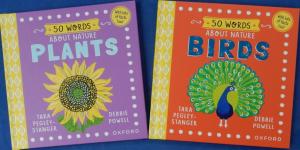
50 Words About Nature: Plants
50 Words About Nature: Birds
Tara Pegley-Stanger and Debbie Powell
These are additions to the series wherein author, Tara Pegley-Stanger doesn’t believe in talking down to young children, instead she uses the correct scientific terms for processes such as photosynthesis, pollination and germinates as well as, in the first book, other plant-related words as she provides a look at the diversity of Earth’s plant life. I totally endorse this approach: children do assimilate ‘big’ words in context and love to impress grown-ups with their ever-growing vocabulary.
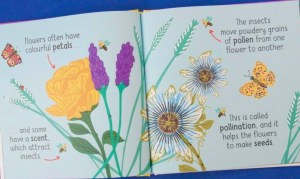
Young children sharing Plants with an adult will learn basic facts relating to flowers, seeds, fruits and growth as well as visiting various habitats including a tropical rainforest, a desert, an aquatic location, meeting a botanist at work and more.
Birds takes a similar approach introducing basic bird features, some specialisations such as those of waterfowl, the bee humming bird, the Asian peacock and raptors. There are examples of a migratory bird, flightless birds and there’s a spread about an ornithologist.
Both books are illustrated in a realistic style by Debbie Powell, whose images are carefully integrated with the text.
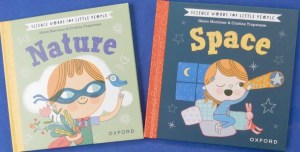
Science Words For Little People: Nature
Science Words For Little People: Space
Helen Mortimer and Cristina Trapanese
Engagingly written and visually attractive, both of these titles in a new series are worth adding to home bookshelves and early years collections.
Nature presents life cycles of an apple tree and a frog, as well as spreads on growing, senses, habitats, behaviour, rocks and soil and care of the natural world.
Space is introduced by the child characters who have become astronomers having a sleepover in their observatory. Subsequent spreads see them using a telescope, pretending to be astronauts, using fruits to make a solar system, discussing Earth’s rotation, introducing the phases of the moon, a space mission, star gazing, space probes and imagine alien possibilities.
Aimed at adult sharers, the final spread of each provides ten ideas for getting the most from the book.
 Red Reading Hub - Jillrbennett's Reviews of Children's Books