Shapes, Reshape! Shapes at Play

DSCN7713

Shapes Reshape!
Shapes at Play
Silvia Borando
Walker Books
If you’ve watched young children get creative when given lots of 2D shapes, then you’ll be aware of some of the possibilities and hours of fun messing around with shapes offers. Here Silvia Borando has taken that idea a stage further in two wonderfully imaginative new Minibombos.
In Shapes Reshape they do just that: the shapes being rectangles and squares (mostly the former) with just the odd few very small circles used as dots for eyes.
It begins with 60 rectangles arranged thus …

%0A

which rearrange, no, ‘reshape’ themselves into ten BUZZY things …

DSCN7702

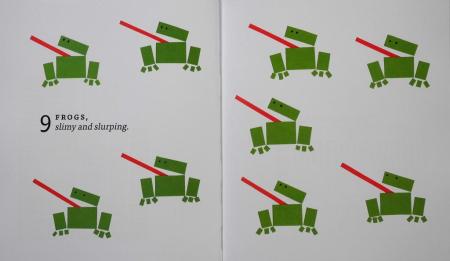
So brilliantly playful; but there’s a whole lot more to come – 99 shapes become 9 Jumpy, slurpers … so cool aren’t they?
DSCN7703

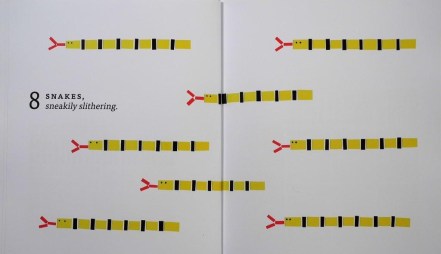
Introduce another colour and the possibilities increase: look at these sneaky slitherers
%0A

fashioned from …

%0A

I could easily go on showing each and every wonderful ‘reshaping’ but suffice it to say there are eight further rearrangements from serried rows to creatures large and small from sniggly snuffling hedgehogs and nip-your-nose crabs to ferocious hungry lions, snappy alligators and the final piece-de-resistance –

%0A

which flees, having been frightened by something reshaped from these …

DSCN7706 (1)

Now what could that be, I wonder. Hint: count the number of small rectangles …
Shapes at Play begins with a ‘Let’s play!’ invitation from a red equilateral triangle, a yellow square and a blue circle. Then the participants and others like them do so, starting with the triangles, followed by the squares and then the circles, each of which is given a double spread to do their stuff. Then follows a bit of bouncing, bumping and toppling … but undaunted, that’s followed by hasty re-creation …

%0A

after re-creation, (oh! and there’s a spot of multiplication along the way too) first of the architectural kind …

%0A

and then, of the vehicular variety …

DSCN7711

and culminating in a terrific BLAST OFF, flight and a landing where our three friends are greeted by some new shapes …

%0A

Once many, many years back as a fledgling teacher, I read a book by Glenda Bissex called GNYS at WRK. Here’s genius at play, courtesy of Silvia Borando.
This, or a slightly less sophisticated form of same, is what children in their early years at school would and perhaps should be doing, were they not being required all too often, to jump through various mathematical hoops to satisfy the tick-box mentality requirements of the curriculum that prevails.

Use your local bookshop   localbookshops_NameImage-2

WNDB_Button

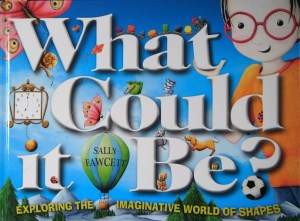
What Could It Be?

DSCF3012

What Could It Be?
Sally Fawcett
EK Books
I love books that invite children to be creative and this one certainly does just that and more. Subtitled Exploring the Imaginative World of Shapes we do so courtesy of a boy (observant readers will discover his name further into the book) and his rhyming narrative which, on the opening spread says, ‘This is a CIRCLE./What else could it be?’ and goes on to demonstrate over the page …

DSCF3013

Thus, readers are immediately drawn into a playful exploration of basic 2D shapes and how they can be transformed into all manner of exciting objects.
Next comes the square followed by the triangle …

DSCF3015

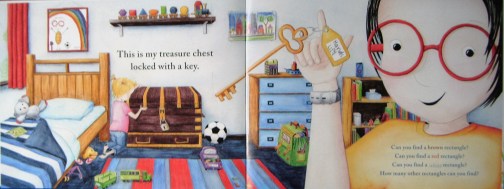
(there’s artistic license here but the ‘can you find?’ questions all relate to 2D shapes). Next comes the rectangle and a bedroom scene wherein we see all seven of the shapes included in the game.

DSCF3016

Another basic shape known to most pre-schoolers, the hexagon calls for the donning of a superhero cape by our narrator as he climbs to rescue his football, while his younger sister plays in her sandpit (a hexagonal enclosure, of course) close by.
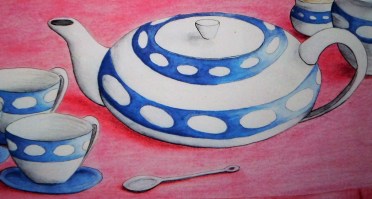
Ovals come next and I particularly like the way these are transformed into a teapot ready for afternoon tea…

DSCF3017

and the final encounter is with the octagon and we have a seaside scene. Having explored the basics so to speak, the narrator then suggests readers start creating by making their own templates and letting their ideas flow …
There’s even a suggestion to upload personal artwork onto the publisher’s website if further incentive is needed.
Now that your thinking is out of the square,/pull out a pencil and pull up a chair.’ And that’s where children’s thinking needs to go … away from things that can be tested, measured and compared: if only all teachers might find the courage to keep offering the spaces for this to happen. Just do it!

Use your local bookshop   localbookshops_NameImage-2

WNDB_Button

A Bounty of Board Books

DSCN5313 (800x600)

Walter’s Wonderful Web
Tim Hopgood
Macmillan Children’s Books
Walter is a spider with a mission: he wants to spin a perfect web, not a wibbly- wobbly one that is whisked away whenever the wind blows.
His first effort – a triangular one is destroyed by the first puff of wind so he tries another – a rectangle, but with no more success.

DSCN5314 (800x600)

The diamond meets a similar fate but what about his circular-looking one, could that be the answer?
But three wooshes and Walter plus web hit the ground. Nearing despair, Walter stops to think before making one last attempt and by nightfall it looks as if he’s got it the design just right –

DSCN5315 (800x600)

WOW! Walter, you certainly deserved to succeed – top marks for perseverance and a wonderfully intricate web.
This delightful story for the very youngest provides a great opportunity to introduce ideas about not giving up when things get tough and of course, built into the narrative are those six basic 2D shapes.

DSCN5316 (800x600)

The Butterfly Garden
Laura Weston
Big Picture Press
Twenty words and a sequence of half a dozen super-stylish, beautifully patterned black and white illustrations: nothing much to get excited about – right? Wrong: look closely at the first of those black and white spreads.

DSCN5317 (800x600)

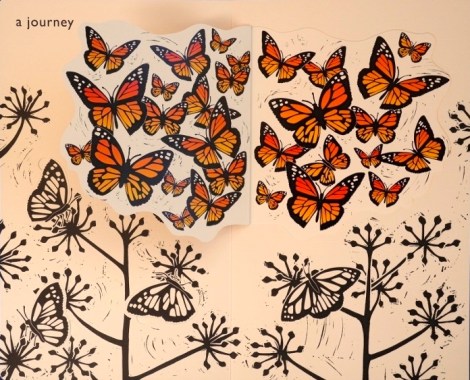
How many caterpillars can you spot? Look again at the silhouetted leaves and blooms and you notice there are flaps to lift. Open the top left-hand flap to reveal …

DSCN5318 (800x600)

And then the other four flaps and you’ll see a whole lot going on in vibrant colours …


DSCN5319 (800x600)

The subsequent spreads show the life cycle and life journey of the Monarch butterfly. (In North America, the Monarch migrates en masse to Mexico during the course of its life.)


DSCN5320 (800x600)

Essentially that’s it and every spread is beautifully designed and arresting first in black and white and then with its flashes of flamboyant colour.
Although the Monarch isn’t a breeding British butterfly, this book is a striking visual account of a butterfly’s life cycle.

DSCN5321 (800x600)

The Tiger Prowls
Seb Braun
Simon & Schuster
It’s hard to choose a favourite from the five animals that pop out from the pages of this seemingly simple yet impressive book. I love the shape and feel of the whole thing – its arresting cover, the way it whizzes through the various habitats the colour palette used and the clever paper engineering. Then there’s the elegant prose of the sentences used to describe each of the iconic creatures that grace the spreads.
First off is that tiger from the cover described thus:
‘The tiger prowls, stalking the jungle. Paw after heavy paw crunches on the forest floor. And so he does emerging from a gentle hint of vegetation straddling that first spread across which slides a muted snake.
Turn over and meet a graceful whale with its cleverly upturned tail and snout;

DSCN5322 (800x600)

the brown bear padding slow through the forest, the mighty elephant taking a shower in the hot sun (If I’m fussy I’d like to have seen an upturned trunk and slightly sharper tusks here ) and finally …

DSCN5325 (800x600)

Gentle, elegant, treetop nibbling, cloud-high grazer giraffe ‘pitching his way across the savannah, like a ship adrift on the open plain.’ (love those bird silhouettes)
Aimed at the very young but I can also envisage older children who get hold of this being inspired to try their hand at making their own pop-up animals.

DSCN5307 (800x600)

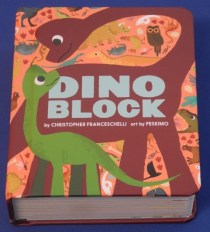
Dinoblock
Christopher Franceschelli and Peskimo
Abrams & Chronicle
MEET THE DINOSAURS says the sign across the museum doors and on opening them readers (and the two child investigators) find two key questions ‘Who are the dinosaurs?’ and ‘Where are the dinosaurs?’
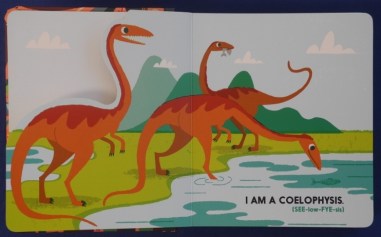
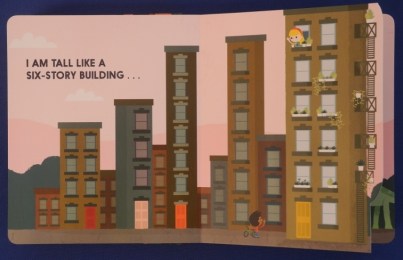
From then on the book’s clever design really comes into play with a formula that is used to great effect for the next ninety or so pages using a mix of cleverly crafted cutaway pages and a series of similes likening each of the twenty three dinosaurs introduced to something a young child is likely to be familiar with, followed by another spread showing the particular dinosaur in its natural habitat and a sentence giving the dinosaur’s name with its phonetic pronunciation. Thus we have for instance, ‘I have a neck like a goose …

DSCN5308 (800x600)DSCN5309 (800x600)

turn over to ‘I am a Coelophysis (SEE-low-FYE-sis)’…
Or this one:

DSCN5310 (800x600)

DSCN5311 (800x600)

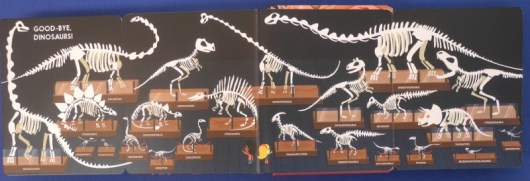
The grand finale comprises a spread of drawn-to-scale dinosaurs on a gate-fold that opens out into a farewell display of skeletons of all the dinosaurs featured.

DSCN5312 (800x600)

Of those a fair number are relatively uncommon in books for young children and indeed a few such as Micropachycephalosaurus and Edmontosaurus) were new names to me.
Assuredly a block-buster for the very young but also a book that offers a great opportunity for them to see and think about a favourite topic in an exciting and imaginative new way. And, a jumping off point for further investigation and children’s own creativity.

Use your local bookshop      localbookshops_NameImage-2