They All Saw a Cat / Picture This

%0AThey All Saw a Cat
Brendan Wenzel
Chronicle Books
A cat is a cat, is a cat, no matter what. Right? Perhaps not. The world looks different depending on the lenses through which we view it, surely? I certainly think so. It’s a wonderfully philosophical consideration brilliantly demonstrated by author/illustrator Brendan Wenzel in this creative, thought-provoking mixed media exploration of observation, imagination and perspectives, which begins thus:
‘The cat walked through the world, with its whiskers, ears and paws …’. The child sees the cat, the dog sees the cat – sleek and slinky, the fox sees the cat – chunky and stubby, the fish sees the cat thus …

%0A

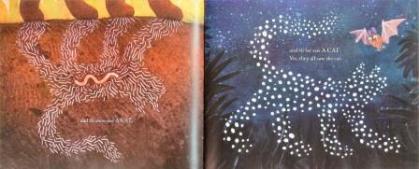
and the mouse – well the mouse sees an alarmingly jaggedy, predatory monster, and the bee sees a pointillist image. On walks the cat and is seen by the bird, the flea, the snake, the worm and the bat …
DSCN8621

A dozen sightings, every one through different lenses, lenses which create shifts between texture, colour and tone, underlined after all twelve sightings by ‘YES, THEY ALL SAW A CAT!’

DSCN8622

We’re then told ‘The cat knew them all, and they knew the cat.’ –a lengthy discussion might ensue from this statement alone. But wait, we’re not quite done yet; the cat walks on and comes to the water: imagine what it saw …
Wenzel uses a range of painterly styles borrowed from impressionism, pointillism and others to make readers think about how perception, art and emotion are intricately linked. But that’s not all: the use of italics and capitals and the patterned structure of the narrative all contribute to the impact of the whole.
This is a book that can be used right across the age range from early years to adult students of art and philosophy: what a wonderful way to help the young to begin to understand and give credence to other people’s viewpoints.

The manner in which emotions are engaged and affected by the visual composition of images is explored in the revised and extended edition of a fascinating and insightful book first published 25 years ago:

%0A

Picture This
Molly Bang
Chronicle Books
In the first hundred or so pages, Molly Bang takes the story of Little Red Riding Hood and shows how different placement of cut paper shapes and colours on the page work together to help create and build up emotionally charged scenes, our perceptions of which are bound by the context of our own experience. Why does a triangle placed on a flat base give us a feeling of stability whereas diagonal shapes make us feel tense?

DSCN8650

How come we feel more scared looking at pointed shapes, and more secure or comforted looking at rounded shapes or curves? These questions are explored as are others of colour choice and combination.
In the second, much shorter (new to the revised edition) section of the book, the author takes her story When Sophie Gets Angry – Really, Really Angry, and using four pictures from it, looks at how she created four distinct feelings – one per illustration – of Fury, Sadness, Expectancy and Contentment/contemplation and uses them to explore the principles she’s looked at in the first part. And the final pages invite readers to create and analyse a picture of their own. Perhaps but first I’m off to take another look at some picture books starting with Bethan Woollvin’s Little Red.


WNDB_Buttonlocalbookshops_NameImage-2

Secret, Secret & Mouse’s Best Day Ever

%0A

Secret, Secret
Daisy Law
Jessica Kingsley Publishers
In this rhyming contemplation of secrets of all kinds, the child narrator takes readers and listeners through many different kinds of situations and secrets that children may experience. Having worked in various roles in education for over thirty years (and had children disclose to me) I know and appreciate just how difficult it may be for some children, in certain situations to have the confidence to open up and talk about certain things that are troubling them.
Subtle in its approach, this little book explores – with child and floppy bunny creature friends –

%0A

a variety of secrets be they sad, happy, crazy, new, old …

%0A

quiet, loud, the really scary, make your insides stone-cold kind, or these …

%0A

To keep or tell, that is the question when it comes to secrets.
All children need to develop emotional intelligence: this book is a very helpful tool to use to this end; it deserves a place in primary classrooms, children’s centres, in fact anywhere that children are cared for and their well-being of vital importance.
One splendid way to help a stressed child is through reflexology and here is a picture book that embodies some basic techniques in the pursuit of well-being:

DSCN8051

Mouse’s Best Day Ever
Susan Quayle and Melissa Muldoon
Singing Dragon
The book features half a dozen characters: main protagonist Mouse (representing the solar plexus reflex point),

DSCN8052

together with Hare, (representing lungs and chest reflexes), Otter (representing the lymphatic system), Squirrel (head, sinus, teeth, eyes and ear reflexes), Mole (reflexes of the digestive system) and Snake who represents the nervous system, back and spine reflexes. Told through a gentle rhyming text, and pen and ink illustrations,

%0A

the story is designed to accompany a sequence of reflexology moves aimed at calming a child’s peevish mind and thus helping to improve general health. At the same time it facilitates the cementing of a bond between child and adult, soothing a youngster at bedtime, when stressed or unwell. Additionally it might be used to re-inforce names of parts of the feet and legs; and to help children begin to understand the interconnectedness of various parts of their bodies. (The latter is something mentioned in the foreword by Spiros Dimitrakoulas, Chair of Reflexology in Europe Network.)
Instructions are given on how to use the book at the beginning, and instructions for each reflexology move is given at the top of each verso page throughout the story.

WNDB_Button localbookshops_NameImage-2


Not Today, Celeste!

DSCN8029

Not Today, Celeste!
Liza Stevens
Jessica Kingsley Publishers
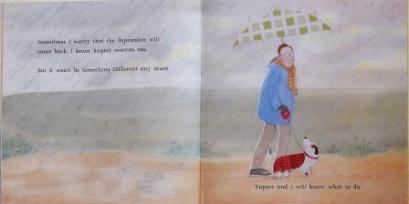
This story, told through a dog narrator, Celeste, explores in a very accessible manner, the subject of depression and its effects on the depressed person and others. Herein it’s Celeste’s owner Rupert who is suddenly overcome by depression. Here’s how Rupert and Celeste used to be …

DSCN8030

One day however, when out walking together, Celeste notices a change in her owner: is it Celeste’s imagination or has Rupert really undergone a change? It looks like the latter …

DSCN8031

Despite the fact that Rupert tries to convince himself, and Celeste, that everything is fine, they both know it isn’t. A worried Celeste does her level best to cheer up Rupert but to no avail and soon, she becomes very sad and scared. Fortunately, neighbours Lily and Henry notice the change in Celeste and the narrator tries to tell all. After that Lily helps both Celeste and Rupert to come to terms with ‘His poorly feelings’: Celeste spends some time playing next door while Lily talks to Rupert and then Lily gives some helpful coping advice to Celeste.
Eventually, Rupert does start to feel better; and safe in the knowledge that it’s not her fault, Celeste is prepared for moving on with his funny and ‘very, very brave’ human.

DSCN8032

In itself this is a moving story; but it also presents the tricky topic of depression and how it affects others in a way (with dog as storyteller) that allows children to think about the subject matter through a narrative distancing device. The final spread is ‘A Guide for Parents, Carers and Professionals’ written by a specialist in child and adolescent mental health and emotional wellbeing outlining the important issues when talking to children who may be dealing with depression in someone they know: essentially these are that talking about it is fine; that the child or children are still loved unconditionally and not to blame; that it is OK to seek help; that there is nothing to be afraid of; that it can and will get better with treatment. All in all, a thoroughly useful book, delightfully illustrated and subtly conveyed in both words and pictures. (Don’t suffer in silence: ask for help…)

Order from JKP
WNDB_Button localbookshops_NameImage-2

Connor the Conker & Little Meerkat

DSCN7924

Connor the Conker and the Breezy Day
Rachel Lloyd
Singing Dragon
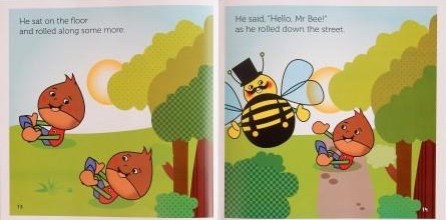
Connor is a conker residing with his family – mum, dad and two siblings – in Horse Chestnut Town. It’s a particularly breezy day when we meet him and he’s eager to demonstrate his balancing on one leg, (without any wibble wobbles, is the aim). The wind is very playful though and that makes Connor get the sneezes unbalancing him; but that’s no problem because Connor knows how to roll and land safely without spilling himself: in fact it’s rather fun so he does a whole lot more rolling …

%0A

right into a friend and on through the town and oops! Straight in the river so it’s fortunate that he also knows how to swim, though he’s always up for a bit more learning, so he tries backstroke too as the fish suggests.
While on his back, Connor decides it’s time he went home so off he goes; but first he has a last lovely stretch – in all directions …

DSCN7927

I’m a yoga teacher rather than a teacher of pilates about which I know comparatively little. I do know however, that story is a fantastic medium for working with young children and that the author Rachel Lloyd has a dance background and is a Pilates Master Trainer who is clearly passionate about its practice. Her positivity and what she says in the helpful notes at the back resonate with me completely. There are also photographic sequences and instructions for teaching each of Connor’s Pilates activities – equally helpful and empowering: and unsurprisingly, very similar to yoga asanas and sequences.

In similar format, and also recommended for early years and KS1 classes, as well as home use, is:

DSCN7928

Little Meerkat’s Big Panic
Jane Evans and Izzy Bean
Jessica Kingsley Publishers
This one’s subtitled ‘A Story About Learning New Ways to Feel Calm’ and don’t we all need those right now.
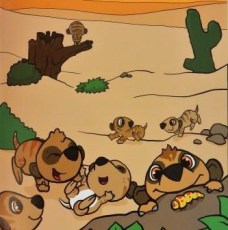
When we meet Little Meerkat he’s faced with the prospect of ‘a very important job’ and today’s the day: his vital role is to act as ‘Lookout Meerkat’ and keep watch over the whole Meerkat gang. Simple eh?

DSCN7929

Well, not really because it means he has to stay wide awake and alert so that in the event of unwelcome potential harm in the form of snakes, large birds and other predators, he can sound the “Danger, danger, danger!’ alert. So how do you think he feels about that? It’s a question asked of listeners to the story.
Now most of us are familiar with that wobbly legs, heart thumping, hyper breathing that kicks in all too easily on such occasions, making it hard to focus on the task in hand and that is exactly how Little Meerkat feels on this important, right of passage day.
Off go his fellow Meerkats for some fun and games safe in the knowledge that there’s a watchful Meerkat at the ready just in case …

%0A

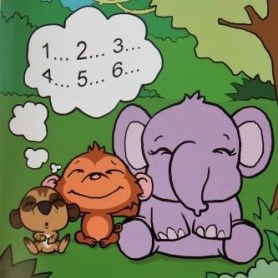
Soon though our little watcher begins to feel drowsy on account of the heat and he dozes off – just for a very short while – but he awakes to discover all the other Meerkats have vanished. Little Meerkat’s in such a panic he can’t get his words out properly and Small Elephant gets a very convoluted message when the two come face to face. Fortunately the elephant has a good imagination and is able to understand and empathise with how his friend might feel right then; and soon both are frantically searching high and low – to no avail.
Along swings Mini Monkey and providentially he has some breathing techniques to pass on: Just what the others need to make them feel nice and calm.

%0A

(And yes, they definitely work – I know from experience.)
And do the friends manage to discover the whereabouts of the missing Meerkats? Certainly they do; but first Little Meerkat has to tell the story from his viewpoint: then a plan is suggested, put into action and …

%0A

There are his fellow Meerkats safe and sound in the ‘safe place’ just where they should be, if only the one on lookout had been able to stay calm and remember …
The final pages of this enjoyable, but very vital book explain simply some ways of keeping calm, as well as discussing the triune brain (not using this word however, other than in the adults’ information section.) And, I’m pleased to say, the author points out that everyone is different: what one brain likes may not suit another person (or meerkat) when it comes to relaxation techniques.

Order from JKP

Use your local bookshop     localbookshops_NameImage-2

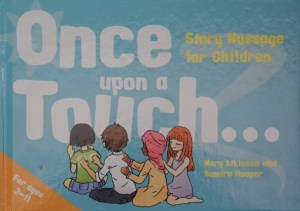
Once Upon a Touch …

DSCN6524 (800x600)

Once Upon a Touch …
Mary Atkinson and Sandra Hooper
Singing Dragon
A number of years ago while working as an early years teacher in  outer London, I participated in an excellent massage course given by Mia Elmsater (and several follow up courses). From this first, I think, UK course of its kind, developed the Massage in Schools Programme (MISP). I then introduced peer massage into my school and one I moved on to. So, my own experience tells me that the narrative method documented herein – ‘Story Massage for Children’ yields enormous benefits and is a tool well worth every primary teacher acquiring. To this end, two experienced MISP trainers have put together this book.
It comprises a short introduction followed by three brief sections that outline the benefits of story massage for children and offer guidelines on how to use same. Here the importance of respect is stressed as well as taking into account the needs of individuals.
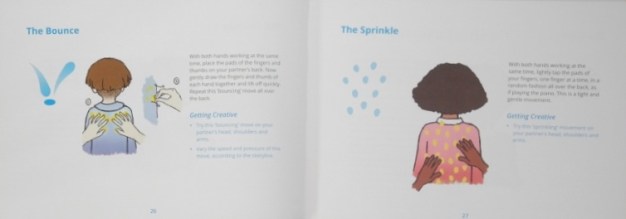
We are then introduced to the ten massage strokes that are the bedrock of the whole programme; and clear, illustrated details of how to do each stroke (and some variations) is given.

DSCN6525 (800x600)

The main part of the book ‘Story Massage in Action’ contains over 30 story/rhyme massages that draw on these basic strokes, and this is divided into six sections. The first contains well know tales and nursery rhymes with the visual symbols for each massage stroke to be used.

DSCN6527 (800x600)

The second section has six seasonal offerings; the third ‘In Your Imagination’ has a musical interlude, a pirate encounter, a visit to the fair, a balloon ride, an aeroplane flight and a circus trip. The remaining two are topic related and wide ranging.
Having read and absorbed this excellent little book, adults should be in a strong position to try the approach perhaps with their own children in the first instance knowing they have the tools to be confident and sensitive in providing, calming relaxing massage sessions for the young.
Once they become confident in using ideas from the book, readers can begin to choose stories and rhymes for themselves to add to their repertoire of story massages; many well-known picture books, traditional tales and nursery rhymes work well.

Order from JKP

Use your local bookshop      localbookshops_NameImage-2