One Wise Sheep

Originally published in German, this is a hilarious retelling of the nativity story unlike any other. It’s a chapter book with occasional illustrations that are perfectly appropriate for Ulrich Hub’s wryly humorous text.

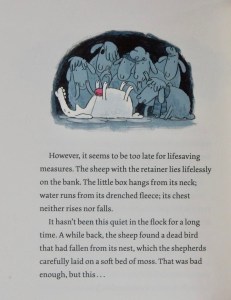
Meet seven sheep, a small flock if ever there was one; it includes one that has a plaster cast on its leg, another that wears a bobble hat, one has its wool parted on the side, there’s one that wore braces but now has a retainer (in a case), one with a snuffly nose that means it needs to sleep away from the rest, one with an eye-patch, plus one more.

One night the sheep, unable to sleep see a bright star and the one with a bobble hat tells the others how it was woken up by a voice singing “ ‘I bring you good tidings’ … ‘And suddenly a host of angels appeared in our field singing praises. I think I even heard trumpets.” Where though are the shepherds? Certainly not kidnapped by UFOs, a goat (with attitude) assures snuffly nosed sheep, going on to say, “For unto us a child is born and you shall find it wrapped in swaddling clothes – “ This sheep reports back to the others, they all assume that the newborn is a girl and set off to find the town where this special baby is said to be.

All kinds of misadventures ensue

and eventually they arrive at their destination only to be told that the baby – a boy – and its parents have departed. The sheep are of course disappointed, especially after creating their own present: a song that begins, “Si-i-lent niiiight”—a song that they speculate is sure to be a hit. `’People will still be singing it in a thousand years.” However, they return to their fields (stopping on the way to pick up litter) and there a special treat awaits.

With a plethora of anachronisms (the shepherds have backpacks containing such items as spare socks and toothbrushes, UFOs, gift cards, wolves wearing mirrored sunglasses to name a few), this is a terrific read aloud (so long as audiences know the traditional Nativity story) to share in the classroom or with a family.
Type to enter text

Zac and Jac

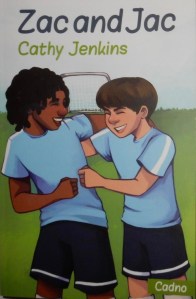
Early in the school year, nine year old Jac’s teacher asked the class to write about their real-life heroes and Jac had chosen his dad, a lorry driver. That though is before Jac is asked to join the soccer team his good friend Zac belongs to. Thereafter things at home start getting uncomfortable.
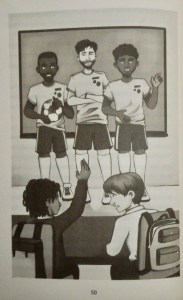
Then comes the news from class teacher, Miss Parker: three professional footballers are coming to talk to the class the following day. They are members of an organisation and what they talk about is racism. As he listens, Jac feels extremely uncomfortable as he starts to realise that the dad he previously thought a hero is in fact, a racist, and that his best friend Zac and his father David, have been the subjects of some of Dad’s racist remarks.

Now with a heightened awareness of racism and how such prejudice is usually passed down from one generation to the next, Jac (from whose viewpoint the story s told) becomes determined to help make change happen in society, starting with his own family. His mum admits she’d been aware of his dad’s attitudes but hadn’t challenged them. Can he with the help and support of his friends and Mum show his Dad that people should not be judged simply by what he thinks they are?

Using football (a children’s local team) as a backdrop, Cathy Jenkins has created a powerful story, sensitively showing what an evil racism is and encouraging youngsters to challenge it whenever it raises its ugly head. That way lines a better future for everyone.
Time Travellers: Secret and Spies / The Arctic Fox

These are both Little Tiger books: thanks to the publishers for sending them for review.
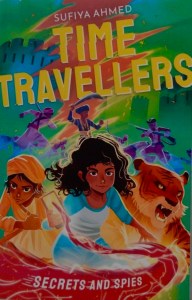
This story begins during the Easter holidays when friends Suhana, Mia and Ayaan are spending time together in Edinburgh. It’s not long before down comes the rain and the three head into the Museum of Scotland. Very soon though they are spinning back in time and their trip to Scotland becomes a trip to 1799 India: their mission being to ‘save the young princess’.

As they are wondering what exactly that entails they encounter young Imran wanting to know why they’re talking about The East Indian Company.. Dressed as a soldier, Imran tells the three that he’s preparing to join Tipu Sultan (the Sultan of Mysore) in battle. He then helps them explore the fort and palaces. They’d seen the date of the Sultan’s death in the Edinburgh museum so things are urgent; they split into two groups and Suhana and Mia head to the harem in search of the little princess. There they see a little girl, Casimebi, causing a todo about her doll and decide she must be the princess they seek. However the female guard is suspicious of their presence and the girls have to make a run for it and hide. This results in them discovering a secret passage in the harem grounds.

Slightly later they overhear a conversation between an army general and Tipu Sultan’s dewan who is planning to betray the Sultan. Perhaps it’s too late to save the Sultan from his fate but what about his family, especially the little princess?

Based on historical events, this dramatic story is an excellent way for readers to learn something about British Colonial history, a subject that should be more widely known. Make sure you read the author’s note after the conclusion of the story.

There’s time travelling of a sort in

Ellie is thrilled to be spending five days in Lapland during the Christmas holidays but before she goes, is horrified to learn on a school trip, that Arctic foxes were trapped for their fur in the early part of the 20th century. Her mum reassures her that this no longer happens and that it’s not likely they will see an Arctic fox during their holiday as these extremely rare creatures are very shy.

However soon after their arrival, Ellie looks out the cabin window and sees what she thinks is a fox. She worries about this fox when the family go to see the Northern Lights. In bed that night she’s woken by a sudden light and when she creeps outside to see the foxfire, she hears an eerie wail and tries to find its source.

The narrative then alternates between Essi (a dream character perhaps) and Ellie. A snow fox, Āppās, is freed from a trap but Ellie is a long way from her family and the cabin. The fox leads her through the snow but a lynx appears which Ellie manages to ward off with a pine branch and return safely to her cabin.

An exciting adventure with occasional illustrations by David Dean that younger animal lovers especially will love: it made me want to go and see the Northern Lights.

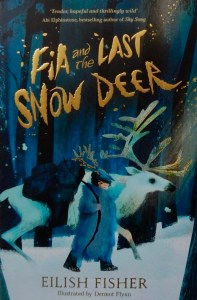
Fia and the Last Snow Deer

I deferred reading this, put off by the hype it’s had, but once I started, I was immediately drawn in by the author’s lyrical writing and magical storytelling, reading her verse novel in a single sitting.
The setting is Ireland in ancient times and it’s narrated by Fia whose village is trapped under a blanket of snow where after several unending winters the starving villagers are eagerly awaiting the return of the hunters, due to arrive before the next solstice.

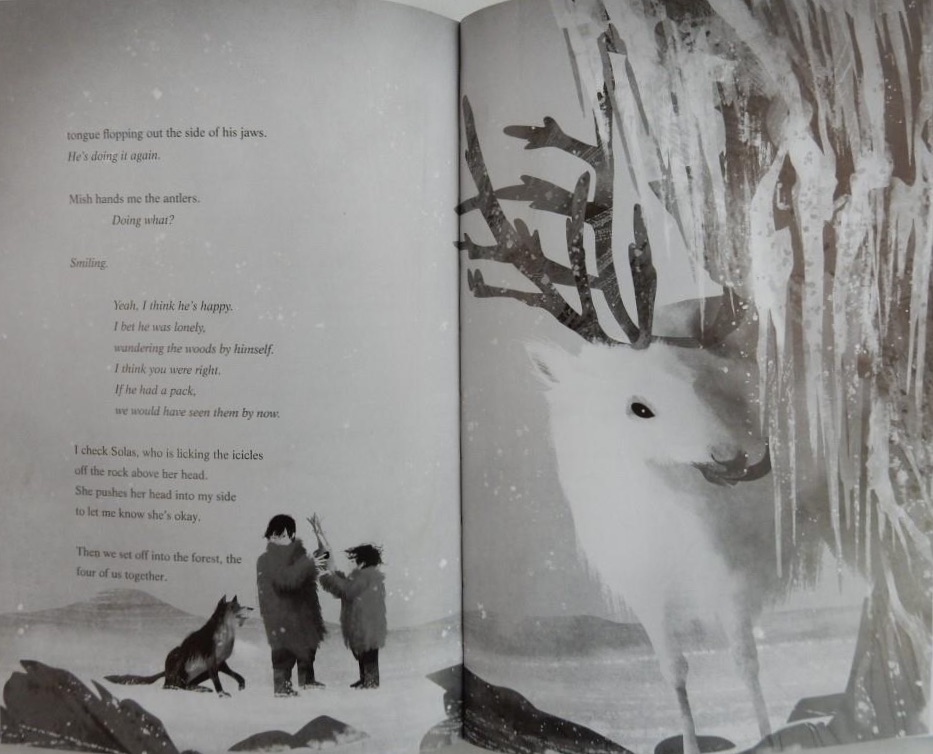
However they come with barely enough for a couple of days and so the villagers gather to determine the fate of Fia’s snow deer, Solas (born under the same solstice as the girl thirteen years ago) not only for his meat but also for an ancient prophecy promise that an ultimate sacrifice will return sunlight and life to the world. However, Fia plots with her great grandmother to seek out the Deer Mother who wakes the world at the winter solstice thus saving the village and Solas. Then Fia and her cousin Mish run from the village with Solas, travelling through the harsh landscape, facing such perils as lurking shadows and hardship. They also meet a wolf.

During the journey Fia learns a lot about loyalty, love, family, friendship, jealousy and kindness, and readers find out more about both Fia and Mish, their relationship and standing within the village, as well as the expectations and pressures of birthright and of prophecies. Will they make it to the Deer Mother and ultimately, will Fia find the courage to make the sacrifice required to end winter and bring the sun back – a sacrifice she didn’t fully understand at the outset?

An integral part of the story are Dermot Flynn’s stunning illustrations which echo the transition from darkness to light, while highlighting the love, hardship and hope of the narrative.

A spellbinding read for chilly winter days, best enjoyed snuggled up while consuming a hot chocolate.

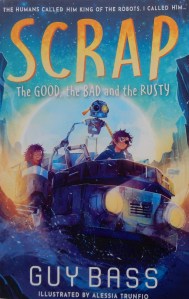
Scrap: The Good, the Bad and the Rusty

In this second story in the trilogy readers join Scrap, Paige and Gnat as they journey across Somewhere 513. The book opens with the three going on a quest to find the Pink-Footed Goose, supposedly it’s landed somewhere in the no-go Badlands of Elsewhere and it’s their only chance – so the children’s mother said – of getting off-world. There are perils aplenty but then they encounter Wired Bill who takes them to the wandering robot town of Mooch where the robots have rejected Mayor Highshine’s views, welcome the three visitors and make them feel at home.

Wired Bill is even more welcoming when he learns that Scrap and KI-NG are likely one and the same. Scrap then begins to think perhaps the three of them should abandon their plans to escape the planet and instead make their home with the folks of Mooch. Enter Newman desperate to know where the King’s core is and promising to help and keep the children safe in return.

Then Paige starts seeing visions of ghostly humans: now she can hardly wait to get away from the strange town. And when their gofer is fixed that’s what she’s determined to do but then agrees to stay another night, the result being an attack from glowsharks, one of which bites Paige. When they eventually depart for Tumbledown Canyon things get more perilous and suddenly Scrap learns something that rocks him to the very core. Events get progressively weirder, Gnat gets angry, but who can be trusted?

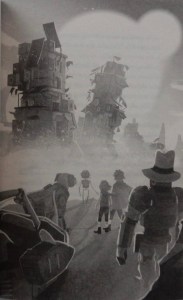
The book ends on a cliff-hanger with Scrap, Paige and Gnat taking the only chance they have and heading off in search of Newman’s ship which may or may not have been destroyed already. Brilliantly done with a scattering of splendid illustrations by Alessia Trunfio. Book three can’t come quickly enough for me and I’m sure Scrap’s countless followers.

Relic Hamilton Genie Hunter

Twelve year old Relic lives in London’s Soho with his grandfather who runs an antiques business under their home. From things we learn early on it’s evident that the boy is being bullied.

One day as he’s sorting through items in the basement, Relic comes upon a box containing brass oil lamps, six small ones in the middle of which is a larger one. As he starts to polish the large one Relic unleashes a genie – a powerful one of the evil kind that feeds on people’s hopes. “What do you wish for Relic Hamilton?” he asks Relic starts to feel strange and the next thing he knows his grandfather is lying on the floor beside him, unconscious. After that he loses consciousness again and wakes to discover that he is being whisked away in a jet called Aladdin with his grandfather who is lying in a bed. Also on board are two people, The Professor and Raphaela who tell him that they are members of the Hermitic Sodality of Genie Hunters and so is his grandfather.

Meanwhile, Ravenna, the genie Relic has unleashed is taking over Taya Porter, a girl with lots of wishes. Every time Taya makes a wish her power over herself diminishes. Seemingly such genies will stop at nothing to get what they want and to thwart the evil Ravenna, Relic is plunged into a thrilling but dangerous adventure that takes him back in time. He meets pirates and giant squid as he gradually discovers more about himself and the world, in his endeavours to save his beloved grandfather.

With creepy illustrations by Hyun Song We, this fabulously exciting story ends on a cliff hanger that will leave you eagerly awaiting Grandfather’s revelations and what they lead to in the next book. You’ll certainly never think of genies in the same way again

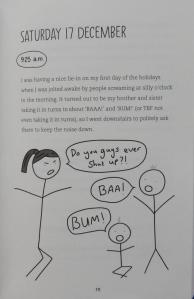
How to be Silly Every Day of the Year

Once upon a time Harry Hill was a doctor but he gave up practising medicine and became a comedian instead. If you are looking for reasons for being silly then you can blame this guy for compiling a book that encourages readers to be silly for a whole 365 days. Alternatively if you fancy a short spell of silliness you can dip in and see what takes your fancy just for a few days at a time. Assuredly you will find some hilarious suggestions among the activities.

Want to impress your parents? How about turning yourself into a human hoover. to do so you will need several rolls of double-sided sticky tape to wrap around yourself. Then all you have to do is lie down on the carpet or a rug and roll around picking up whatever fluff and rubbishy bits are there.

Maybe you’d like to adopt a conker. If so, ask an adult to make a hole through it so you can thread it onto a string and then off you go for walks together. (One of my young relations adopted a pine cone of the longer kind. She named it Violet and wrote stories about it. I don’t think her intention was to be silly however.) And in case you find you’re forgetting to be silly then try creating a SILLY acrostic that you can stick in a strategic spot as a reminder.

With facts of the silly sort and lots of doodle drawings to jazz up its appearance, this is a book to brighten up those days of doom and gloom especially. “Being silly is a serious art,” I heard someone say on the radio recently: what do you think?

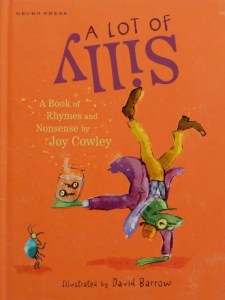
A Lot Of Silly

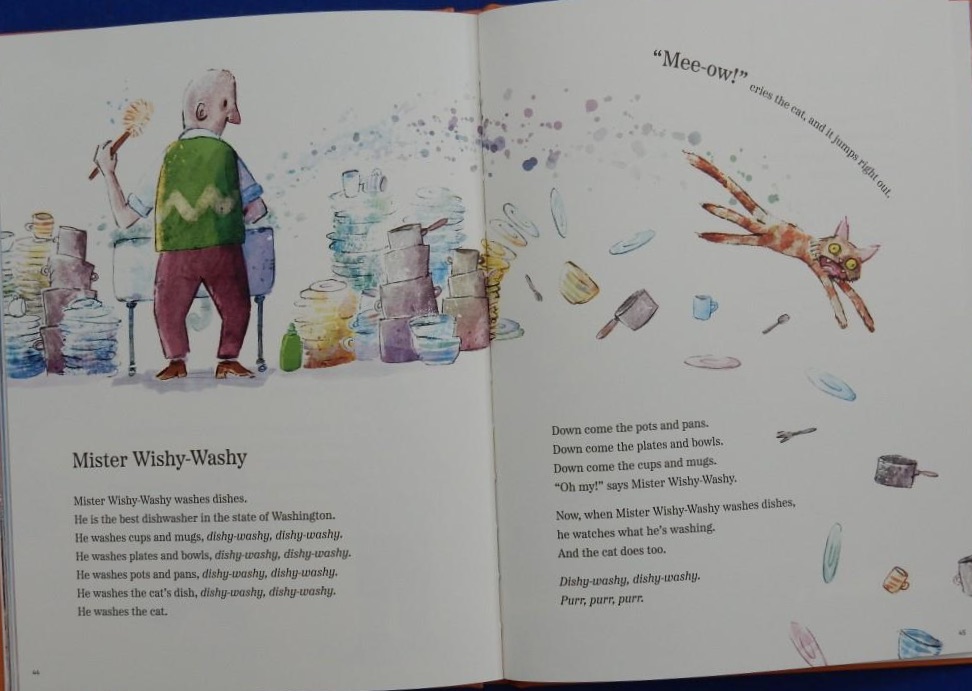
Herein we have almost forty pieces of silliness by Joy Cowley, all of which I think have come from her previous works and it’s terrific to have them brought together just waiting to make both children and adults giggle.

Doubtless everyone will have different favourites but some that especially appealed to me are My Tiger that tells what happens when a child takes his tiger that is suffering from toothache to the dentist. Following the fixing of the problem the dentist instructs, “Tell him he’s not to have cake again. … It’s bad for him.” The dentist goes on to say that the tiger should in future restrict his diet to “The same as other tigers,” You can guess what happens.

Also tickling my fancy was The Big Red Rose. This features Bubba, a little elephant that sniffs said rose; it goes right up her trunk and becomes stuck. A visit to the vet with Mother Elephant proves unsuccessful despite the fact that, ‘The vet got out his telescope, / a light, some pliers, a bit of rope’. Mother Elephant then resorts to an application from a sneeze-inducing condiment. Will that remove the blockage? Ah / Ah – ah / Ah- ah- ah … “ Hurrah!

There are a number of other poems and tales about elephants and you will also find such subjects as frogs, cats,

witches, a grizzly bear that gets stung by a bee and The Horrible Thing with Hairy Feet, intent on making a meal of a bunny rabbit.

Equally full of fun are David Barrow’s illustrations, which combined with the text make this a thoroughly enjoyable book to give or to share in a primary classroom.

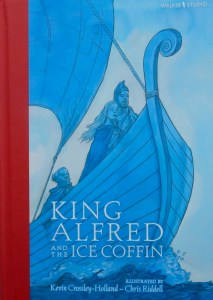
King Alfred and the Ice Coffin

Prize-winning author Kevin Crossley-Holland and artist Chris Riddell join forces again, this time in a mythic re-imagining of a story set in Anglo Saxon times. We hear at the start of this rhythmic, dramatically told prose poem, how King Alfred of Wessex met a trading traveller with ‘a tale to tell’. The trader is Wulfstan of Ravenscar and he spins a story to the King, his wife and the royal household telling of adventure, shipwreck and love.

It tells how at an early age, Wulfstan became skipper of a small trading boat. A boat that after a violent storm eventually reached a jetty where he expected a hostile reception. However the people that helped them ashore were welcoming and assisted the traders in mending their boat.
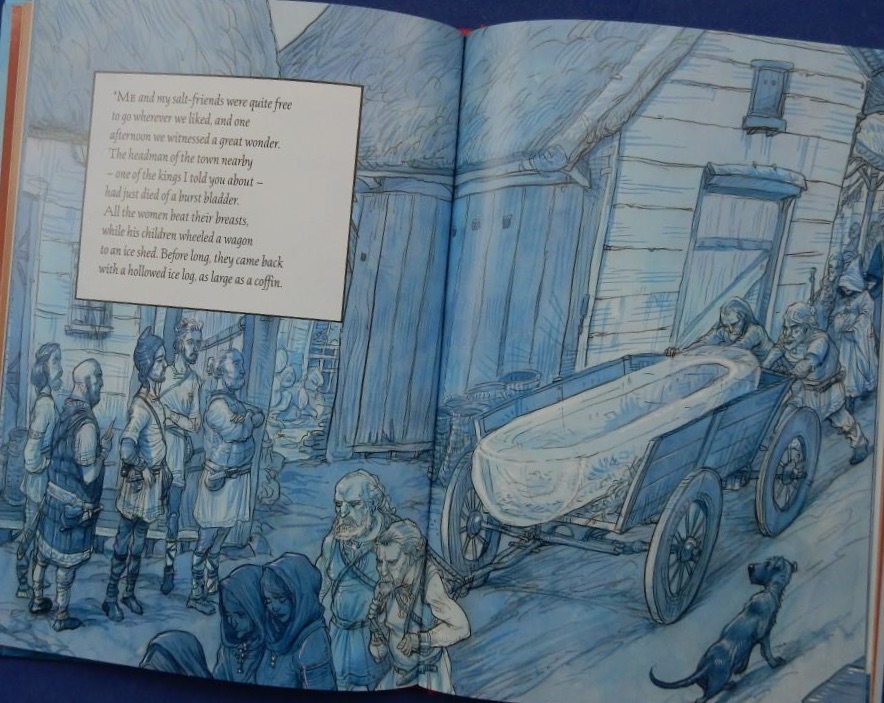
One day after the death of the nearby town’s headman, the visitors learn of some of the people’s customs including their use of a hollowed out ice log as a coffin to preserve the man’s body

and the events that happened including a horse chase hunt for the headman’s wealth, leading up to placing of the body onto the funeral pyre. As for the treasure hunt, Wulfstan himself became the winner of a real treasure, the beautiful golden haired Eliza whose heart he had won.

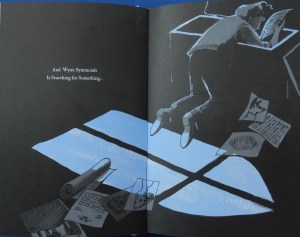
Riddell’s rich illustrations are at first rendered in sepia tones but once the story of the sea voyage begins, change to blue tones, returning to sepia after Wulstan concludes his account.

This would make a good read-aloud for Primary School classes looking at Anglo Saxon history as well as a solo read those interested in that period.

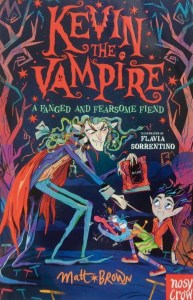
Kevin the Vampire: A Fanged and Fearsome Fiend

As the story opens Kevin receives a notice concerning his Gloaming,. This is an ancient test that eleven year olds have to pass to demonstrate they have the skills required to be a vampire. There are three skills, the first being Transformation when Kevin must turn into a bat. The second is Mind-Speaking which requires speaking in someone else’s mind and third is a Melt. (into the darkness). The first two shouldn’t prove any trouble for Kevin, however the third is something he isn’t able to do. But if he doesn’t pass all three he will be cast out forever. Kevin needs help and support but the one who could provide these cannot attend the event as it’s only for vampires, no matter she is regarded as part of Kevin’s family; to do so would be a violation of vampire rule number ninety three. What about a werewolf vampire though?

Before the tests begin Kevin’s Dad presents him with a special good luck surprise – the Aurelius Hat of Good Fortune and it certainly works for the Transformation though not all participants are quite so successful.

After this part Kevin and his vampire werewolf buddy take a walk and there follows an unexpected encounter first with dragons and then the Creature Keeper who is impressed with Kevin’s skills.

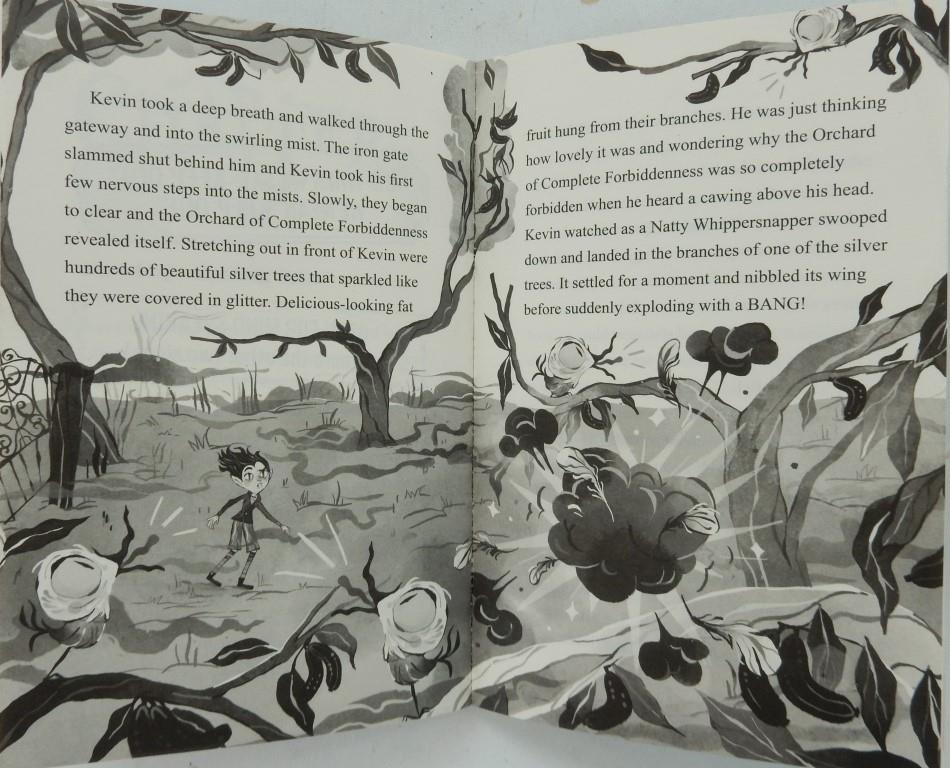
The MInd-Speaking set in the Orchard of Complete Forbiddenness

proves problematic for Kevin and he almost fails but due to unforeseen circumstances, eventually manages to succeed. That only leaves the next day’s Melt: can Kevin complete it in the allocated time? If not then what …

A terrific adventure with a satisfying finale, a cast of characters that includes some pretty nasty beings and Flavia Sorrentino’s weird and wacky illustrations: younger readers will be eager to get their fangs into this one for sure.

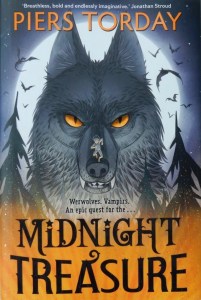
Midnight Treasure

Tibor, a werewolf and Roza, a vampir who was transformed into an Alsatian, are best friends and have been since they were put in an orphanage from where Baron Ambrus adopted them. (The Baron intends that Roza should keep an eye on Tibor and guide him.)
Living in the Baron’s luxurious House of Gold, Tibor is eager to find out who his real parents were and where he was from. In the hope of discovering a clue he attempts to break into the safe when the Baron’s out hunting. While so doing they hear a sound and thinking their guardian is returning, run outside so they won’t be caught. They then discover the rider is a woman and they hear these words, ‘There’s a little spell I need to prepare before we arrive.’

Worried that the stranger could be conspiring against the Baron, they hurry back to warn him only to learn that he was expecting the woman. He later introduces her as Professor Kira Halim, a celebrated scientist; moreover she appears to know all about Tibor. The Professor asks Tibor if he knows of the Dark Lantern Society. She goes on to present him with a gift on the society’s behalf – it’s a small carving of a knight and the Professor is able to make it spin in the air. The Professor then explains that she’s a member of the Society and they are searching for a lost artefact. She informs Tibor that he possesses an exceptional gift that will help them retrieve the Midnight Treasure but only on Spectre Night. The Baron explains that if not found the Treasure will disappear for a whole year. As more is disclosed, Tibor becomes increasingly concerned about what is being asked of him.

Overcoming his initial reluctance, Timor agrees to help and a few days later, accompanied by the Professor and Roza, he sets forth. What a perilous quest it turns out to be. It’s difficult for Tibor to know who can be trusted as he and Rosa encounter bears with which they battle, vampirs and more as the clock keeps ticking. However this proves to be an amazing adventure that will change his life and Roza’s forever.

An absolutely fantastic, superbly structured read with awesome world-building and characters. I can hardly wait for the second Midnight Treasure book.

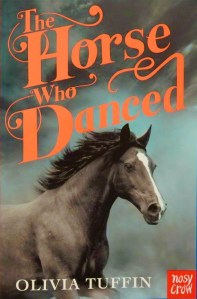
The Horse Who Danced

Iona lives with her mum and stepdad on the Kestrel estate. Iona helps her mum run the pony trekking centre and despite money being tight their life is a happy one. However, when the owner of the estate dies, Iona’s family are pressurised to sell their cottage and stables to the new owners – stables that have long been in her family’s care and which Iona’s mum has no wish to sell.

Horse loving Iona has a connection with her dressage horse, Jinks, and longs for stardom but money has always prevented her from participating in the big competitions. But then local dressage star, Jessica Jefferies, asks that her own injured horse be kept at her mum’s livery while he recovers and goes on to offer to train Iona. What more could she want? However, as she becomes part of a new, much more exciting world, Iona starts feeling resentful of her family’s struggles but not everything is as it appears in this new friendship. We also meet Oscar, a good friend to Iona and another rider, April, from a well-to-do family, Iona’s rival at events whom it’s clear Iona doesn’t get along with.

All the while pressure is being increased on Iona’s mum to sell the stables and as Iona’s successes mount some unexpected and upsetting incidents take place.:Are these all connected? Iona and Oscar are determined to discover who is behind the troubles that upset the girl’s very security.
The story draws to a life-threatening climax, followed by a confession and we leave Iona feeling differently about her own family set-up and about April. Finally both Iona and Jess are full of hope about the future.

With themes of friendship, family loyalty, fame and betrayal, a fascinating cast of characters and a powerful narrative, Olivia Tuffin’s latest book will be enjoyed by older KS2 readers, horse mad or not.

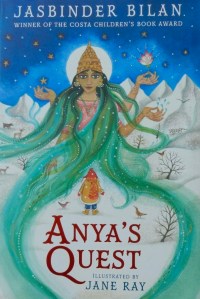
Anya’s Quest

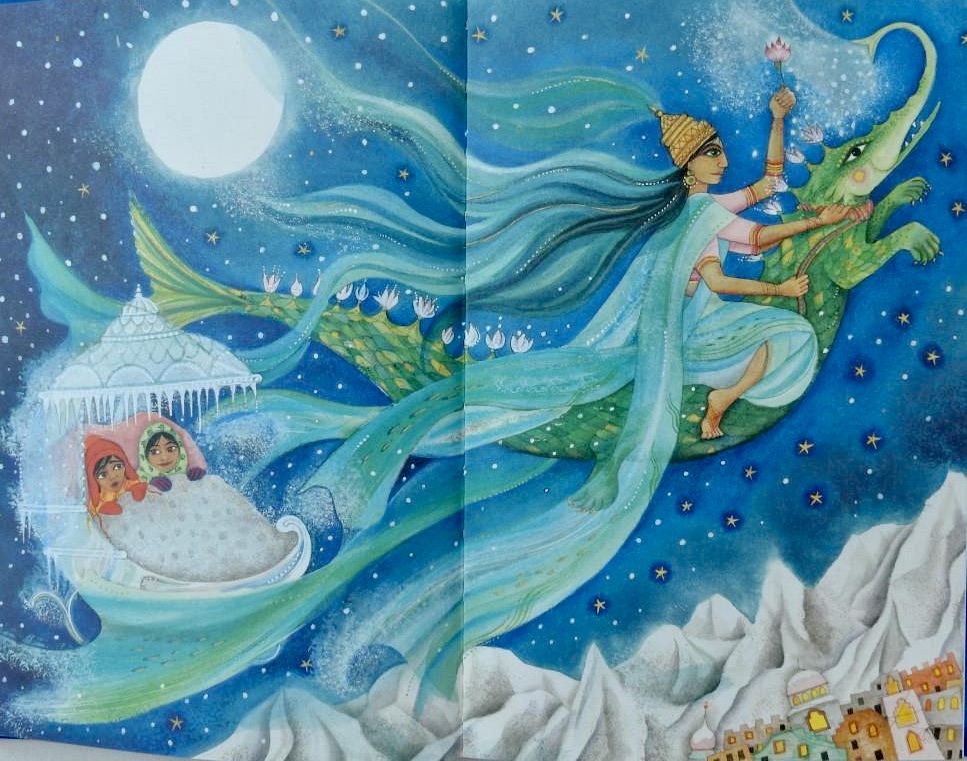
Little does Anya know when she complains to her papa of boredom that she is soon to embark on a vital quest. With her goes Mahi, the cook’s daughter with whom Anya reluctantly accepts as someone to play with in the snow. Anya is called by the goddess, Ganga and the two girls step into a chariot drawn by Ganga’s river dragon spirit companion and they undertake an epic journey through time and right across India.

As they fly Ganga explains that she urgently needs their help to heal the terrible damage that greedy, thoughtless humans have done to the fragile planet over time. They search for elusive spirit animals, lullabies long forgotten and while so doing Anya realises that she’s treated Mahi badly and apologises asking that the two become friends. Friends who can communicate effectively with the children of the world about the horrendous, pollution and its effects and save everything before it’s too late. The girls have to be brave, confront their fears and Anya has to dig deep within herself and connect with her ancestors as her friend has always done. She also needs to find a sacred star-shaped flower from her dreams, said to have healing powers, and use it to help a wounded bear cub.: could the bear be Anya’s spirit animal?

Once Ganga knows both girls are ready, she tells them that they ‘need to join the songs of all the children and sing the earth lullaby’, and thereby gradually heal the planet just like Anya helped the bear cub to heal. She also enlists the help of the other gods to support the earth healing cause and so more and more appear to join in ‘the celebration of sharing the lullabies and the message of hope.’ Finally with a promise to Ganga to do their utmost, the girls return home to the palace where anxious parents await and Anya and Mahi regale them with an account of their adventure and how they intend to make changes in their own lives.

Jasbinder Bilan’s thoroughly enchanting tale inspired by Hindu mythology, and equally enchantingly illustrated by Jane Ray, combine to make a truly gorgeous book. It’s one that will make a superb gift for a special occasion be that Diwali, a birthday, Raksha Bandhan or even Christmas.

Revenge of the Killer Worm / Terror Tower

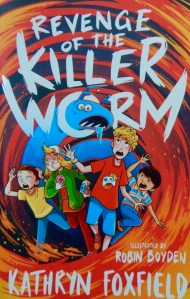
Eleven year old Milo is looking forward to the summer holidays: it’s to be our summer of adventure, so he tells his three friends who are also going camping at Stourmouth. His interest isn’t in the upcoming StourFest: the intention is to spend time playing video games in the dilapidated arcade, eat lots of doughnuts on the wasteland of a beach and generally getting up to mischief with Danny, Nora and Grace. It’s especially important as Milo and his mum are moving very soon and life will be very different then.
Currently Milo (a brilliant story teller who has dyslexia) is obsessed with a game called Worm Attack invented in the 1990s and despite being ace at video games he’s never made it past the giant killer worm and always gets eaten up.
From the start of the holiday the children notice weird things: the town’s mayor seems to be stealing huge trays of raw chicken; then Beth the arcade owner falls off the helter skelter roof shouting ‘He’ll come for you too’ and is taken away in an ambulance. Moreover Milo insists something was chasing them in the underground tunnel they’re investigating under the adventure golf course. Surely this story about the killer worm can’t be real – or can it? Convinced that the answer is to be found in the game, Milo persuades his friends to join him on a nightmarish investigation.

This is where I’ll leave them and merely say a life-threatening situation occurs, Milo comes to accept that change is inevitable and that this holiday is one he and his friends will not easily forget. Kathryn Foxfield’s blend of monsters and mayhem, scariness and humour, with occasional pictorial frights from Robin Boyden, will keep readers around Milo’s age on the edge of their seats till the final page.

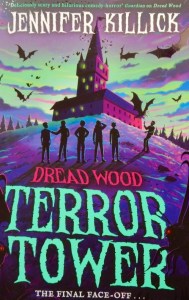
This is the sixth and final story in the Dread Wood creepy horror series and creepy it most definitely is. We start with Angelo and Gus wandering in the woods reminiscing about how they and three others formed Club Loser, when they come upon Kaya. Following an exchange of the meaty kind, she’s suddenly bitten by hundreds of little caterpillars and ends up in hospital. It turns out these are no ordinary caterpillars; they’re a sub-species of oak processionary caterpillars, so the announcement in assembly informs everyone, going on to remind them all about the meat-free month project the school has taken on.
There’s a strong possibility that the dastardly Latchitts have something to do with this alarming infestation. Then there’s the issue that caterpillars transform into something else which could be even more deadly. It’s time for Club Loser to investigate in the woods even if it means first having a Saturday detention with Mr C. who immediately has suspicions about why they are there.
Once in the woods the friends are suspicious of a masked stranger who watches them from behind a tree. Things go completely downhill when Collette disappears, the other club members are attacked by some sort of poison and end up flat on their backs in hospital; then Mr C is taken away by the police.

At this stage we’re only half way through the book but to learn how this super-scary tale ends, you’ll need to get your hands on a copy and read on, preferably while sipping a cup of Mr C’s favourite ‘hot choccie’.

Lockett & Wilde’s Dreadfully Haunting Mysteries: The Ghosts of the Manor

Matilda Lockett acts as assistant to spirit medium Signora Valentina (in reality her Aunt Evelyn) and Uncle Barnabus (close friend of her aunt).Really no ghosts appear at her aunt’s seances but she manages to convince those who attend that ghosts are actually reaching out from beyond the grave.
When Matilda isn’t pretending to be Edna at the seances she enjoys trying to solve mysteries.
Then one night Matilda thinks perhaps she did actually see something (or someone) during the act: a ghost perhaps? After the show, a woman bursts into their dressing room, introduces herself as Baroness Rosa Beachamp, announces that her home Beauchamp Manor is haunted and that she needs ‘Signora Valentina’s help urgently. Can her aunt pull off a real exorcism, Matilda wonders: apparently the baroness has offered a tidy sum in payment.

When the three arrive, the baroness introduces them to Mr Symmonds who is there to catalogue a collection of paintings in the folly (supposedly the National Gallery are interested in them) asking that they don’t disturb his work. He plays a violin (terribly) to keep ghosts at bay.
There follows a lot of snooping on Matilda’s part, assisted by a ghost boy, Edgar with whom she forms a bond. But what is Mr Symmonds really up to? A mystery needs solving.

There’s a treasure supposedly hidden somewhere. During their stay Matilda sees and hears things that make her worry about her future. How will this all end?

This suspenseful, often humorous tale, with Pam Smy’s atmospheric illustrations, has eeriness aplenty but it’s also about working together, trust, love and the importance of friendship. Just right to curl up with as the nights draw in.

Dexter Procter the 10-year old doctor

Pretty much the moment he was born it was evident that Dexter Proctor was no ordinary infant. He spoke his first words when just four seconds old and by the age of three when most little ones are entering nursery, Dexter had passed eighty six A-levels. By age ten he was working as a paediatrician at Lilydale General Hospital having gained A* in all his exams at medical school bar communication skills where he only managed a B minus.

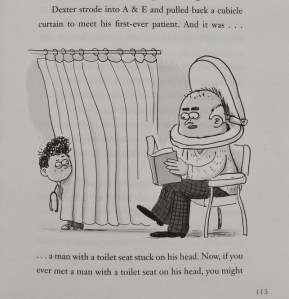
On his very first day he’s assigned to A & E where during the afternoon he’s called a genius by one of his first patients – a man who had a toilet seat stuck on his head,

or rather he did until Dexter successfully extricated him from his ‘bathroom-themed necklace’. It will come as no surprise however to learn that many others Dexter encountered are much more ageist towards him.

Pretty soon Dexter is moved to the paediatrics department where he has a few run ins with Dr Drake who quickly becomes his arch enemy. Add to this that the boy is constantly having to navigate the challenges posed by his irritating, albeit loving family and his loyal friends, not to mention a bullying classmate nemesis Toby Tanner who turns up with a troublesome foot. No prizes for guessing who he’s related to.
Then comes a major issue at Dexter’s old school where all the teachers are inexplicably struck down with severe diarrhoea; what on earth or in the school staffroom is the cause. Can Dexter possibly solve the mystery, save his medical career and find his place in the world?

Brimming over with humour, some of it of the gross kind, Adam Kay’s first novel for KS2 readers, liberally dosed with Henry Paker’s hilarious illustrations to complement the text, will have readers giggling all the way to the final letter.

Hercules: A Hero’s Journey( On a School Trip)

Hercules Braver (aka Herc) has a secret; he’s actually a demigod. Zeus’s other offspring all have a super-skill – bravery for instance, music or healing powers. Why then does he seem just ordinary?
Now the boy is absolutely determined to prove to his actual father, whom he calls Zooey, that he too is awesome. With the first term at big school having gone badly, he hopes the second one will be an improvement. It certainly seems a possibility when he discovers a large fang near one of the school wheelie bins and with the help of Ken (his ungodly dad) discovers it belonged to a boar. With bravery high on Herc’s list of super-skills, he decides to try and catch said boar. This is something a couple of his friends, for reasons of their own, then decide to get involved with.

Operation boar is disastrous but it does result in one of them winning a competition , the prize being a school trip to Greece. Just the place for Herc to discover his super-skill especially with a visit to the Acropolis being first on their itinerary; a chance to see if he is a healer. This does not go well, so that’s one to cross off his list. Having promised his mum before leaving home that he wouldn’t consult any Greek gods, Herc is stumped. Until that is his pal Pav mentions an oracle. He has his own reasons for wanting to consult said Oracle. However, Herc lands himself in more trouble, resulting in being confronted with the well nigh impossible task of horse poo shifting and spreading; either that or he’ll be sent home. Dare he break his promise to his mum?

Further disasters unfold as the week progresses: there’s a mountain emergency, a dad disappearance and a fierce raven attack, not to mention the shenanigans between Athena, Apollo and Ares. But what of Herc’s quest to find his super-power? Let’s just say after all his trials and tribulations, there’s a bolt from the blue …

Very loosely based on the 4th, 5th and 6th Labours of Hercules, friendship and kindness are key in this often hilarious saga, presented in diary form and liberally scattered with David O’Connell’s zany drawings. Whether or not readers are Greek mythology enthusiasts, they’ll find themselves frequently laughing out loud. Highly recommended for KS2 readers.

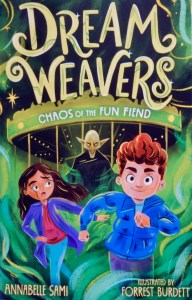
Ivy Newt and the Vampixies / Dream Weavers: Chaos of the Fun Fiend

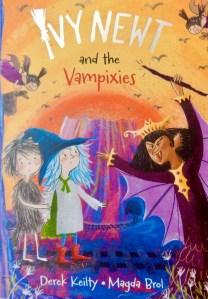
At the start of the story Ivy and Tom, (Ivy’s best friend and familiar) set out with Griselda the Sand Witch on an expedition to find the spell ingredients from her very long list. Their first stop is the Isle of Hob with its extinct volcano Mount Krakatoenail; there they hope to find sneezewort. This they do, but they almost lose Tom when he falls into a quarry-like area in the side of the volcano. Close by, they discover cart tracks running into tunnels that they deduce are part of a dust mine from where Dust Pixies mine the ore which is crushed to make a dust that is on Griselda’s list of required spell ingredients. However as they collect the dust they overhear something alarming that causes them to hide and from their hiding place they hear an announcement from Queen Drusilla, the leader of the Dust Pixies. Said Queen then proceeds to turn the Dust Pixies into Vampixies that will then go and sprinkle this dust everywhere in Miracula thus robbing the witches and wizards of their magical powers.

Griselda and Ivy realise that something needs to be done urgently to prevent this disaster; but what can they do to stop the malevolent plot and thereby save both Miracula and magic itself? The next thing they know, they’re hurtling into the sea not far from the Fishy Wizards’ ship. Perhaps the captain of this ship can help them …

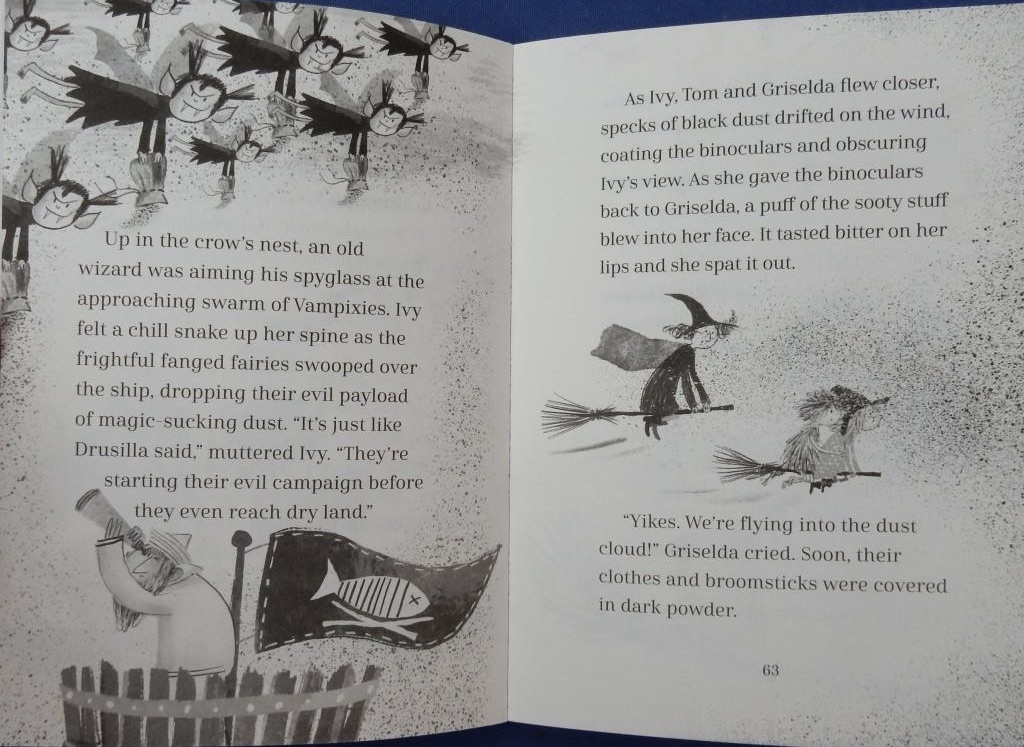
With a plot that moves fast, gentle humour, a satisfying finale and lively black and white illustrations, this fourth adventure for Ivy and Tom will captivate newly confident readers and also works well as a KS1 read aloud.

Tito is eagerly anticipating the holiday with his grandparents especially as his best friend Neena is joining him, his parents and little brother for the week.at the seaside. However even before they arrive at his grandparents’ home Tito feels that something isn’t right. Then the reception they all receive from Nan and Grandad is decidedly unwelcoming. All Grandad is interested in is listening to the clock ticking. It’s very strange indeed that his grandparents’ behaviour is uncharacteristic of their usual fun-loving selves. Tito decides that to get to the root of the trouble he and Neena should dreamweave into Grandad’s dream that night.

Despite feeling somewhat guilty that it’s an invasion of his privacy, he and Neena create a portal through which they enter and it soon becomes evident that they’ve found Grandad as a boy. Then suddenly there appears a tall pale figure that immediately begins to sap child Grandad’s energy. It’s a vampire.; not one that sucks blood, rather this one sucks fun.

In the morning Grandad and Tito talk and iGrandad realises his grandson is a Dreamweaver. He, Tito and Neena set out walking and Grandad tells them that he is a Spiritlink and they in turn tell him about the vampire. As they walk Neena suggests the Bhoot (her uncle) has done something to speed up his plan of merging the human world and the spirit world. Things get progressively weirder but it’s evident that it’s up to the children to find out exactly what is going on. There’s a confrontation with the Bhoot: he’s obviously up to evil tricks and more are to follow.

The story ends on a cliff hanger with Neena and Tito agreeing that they must travel to the spirit world.
A thoroughly gripping tale, the third in the sequence: you really need to read the first two before this one though.

Loki: A Bad God’s Guide to Making Enemies

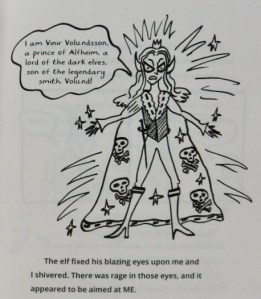
As readers of this hilarious series presented in diary form have come to expect, Loki has once again upset somebody or in fact more than one somebody. This time there’s his school friend, Georgina whom he’s got into trouble and then there’s Vinir Volundsson, an elf prince from Alfheim. Said elf for some reason unknown to Loki, beams him aboard his chariot and challenges him to a duel of the magical kind.

Initially Loki manages to extricate himself from this by sweet talking but the elf doesn’t give up that easily. Vinir even allows Loki to practise his skills but rather than returning to elf land, he turns himself into a a human child who shows up at school. calling himself Alfie. An opportunity for his opponent to study the elf for any weaknesses he might have thanks Loki.

Meanwhile Valerie continues to be obsessed with aliens, Thor remains obsessed with Frost Giants, and Heimdall and Hyrrokkin are pressurised into helping out with the school’s winter fair. There’s so much for our narrator to contend with not least the way a certain elf endlessly witters on about his dad and a seemingly endless string of detentions, not to mention that irritating brother Thor. So many lessons to learn about being good and surprisingly our young hero comes a considerable way in just one month.

Like this reviewer, many primary readers will eagerly anticipate Loki’s fifth adventure.

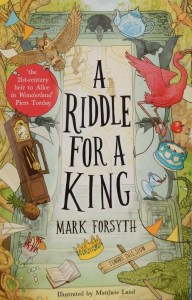
A Riddle For A King

Philo lives a very mundane life with his Uncle Harry and Aunt Harriet in a house full of clocks. He is required to follow a strict time schedule- something he can never quite remember – and as a consequence longs for freedom and adventure. Suddenly though, as the three are about to depart for a day at the seaside, something very unexpected happens to Philo who happens to be standing beside the only clock in the house that doesn’t keep perfect time. He hears this clock strike thirteen and sees the door at its front open. From the door steps a strange little creature enquiring if Philo is the king. Then having been told that he isn’t the creature vanishes back inside the clock only to re-emerge and ask about a crown as well as saying that his name is Mr Spronkel before disappearing once more through the clock door.

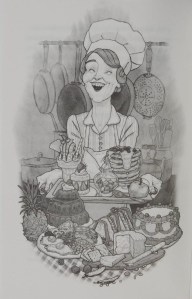
This time however, Philo decides to follow the creature and thus begins a sequence of weird and wonderful happenings including encounters with giants, flying castles, a witch that turns children into teapots and a strange cook who won’t feed herself, to name just a few.

There’s also a more normal character, a girl named Verity who, after being lost in the woods, knocks on Mrs Cook’s door asking to be fed. Her clever thinking solves Mrs Cook’s non-eating issue and she also offers to help Philo get back home. Verity, who becomes a good friend to the boy has a strong sense of what’s right and adheres to it come what may – until she doesn’t – with catastrophic consequences.

With cleverly conceived conundrums, mind-bending riddles, paradoxes aplenty and puzzles of the most peculiar kind, this splendidly silly, surreal story will leave your brain somewhat bemused quite often. but it’s well worth the befuddlement as it’s enormously enjoyable, made even more so by Matthew Land’s terrific illustrations. I love too the afterword, which may (or may not) enable you to see from where some of the characters originated. By the way, in case you are wondering whether Philo ever finds his way back home, you’ll need to get your own copy of the book to find out.

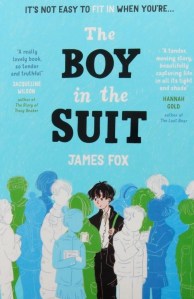
The Boy in the Suit

Ten year old Solo and his mum, Morag, frequently gate crash the get togethers held after funerals, the reason being, after losing her job, Solo’s mum doesn’t have sufficient money to buy food for them both and otherwise they’d be hungry all the time. Solo hates having to do this, detests wearing the over-sized suit from a charity shop, and going to school without the correct uniform resulting in him getting into trouble. He also hates the way his mum begs for food from the local shop and lies to get free bus rides. Worst of all though is when his mum spends several days in bed on account of the Big Bad Reds, (BBRs) and spends any money she has on what she calls ‘grown-up’ drinks. As a result, the poor boy stands out for all the wrong reasons. Despite everything though he really loves his mum.

Then one day the two of them go to a funeral of somebody famous, suspicions are aroused and they end up being featured in a newspaper and on the internet. Solo then gets called FB at school, his Mum gets him to make a dash from a school uniform shop, stealing a new uniform and is caught on CCTV.

Eventually everything gets just too much for Morag and she disappears. After several days there’s still no sign of her so Solo and his new friend Chetna sneak off during a school trip to search for her, looking in all the places the boy knows Morag likes, but with no luck. They end up missing the coach home and Chetna feels she must tell the teachers what’s happened. Despite all the awful things that he’s gone through, might this now be where Solo’s life finally starts to improve?

This is a hugely moving, compelling and empathetic story for older readers (and adults) that portrays with stark clarity the cost of living crisis, what it’s like living with a parent who has mental health problems.and having to be a young carer. Full of poignant and compassionate moments, there’s also humour and messages about the importance of friendship, resilience and finding the courage to accept help.

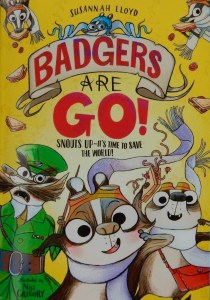
Badgers Are Go!

Lulu Whifferton-Rear likes nothing better than minding her own badgery business; but then she receives a letter concerning herself and a top secret mission. It tells her to report to The Rumptington Academy of Badgering the following morning and is signed by Major Musty Rumptington, She knows there’s no getting out of it and so early one Monday morning off she heads to begin her training.

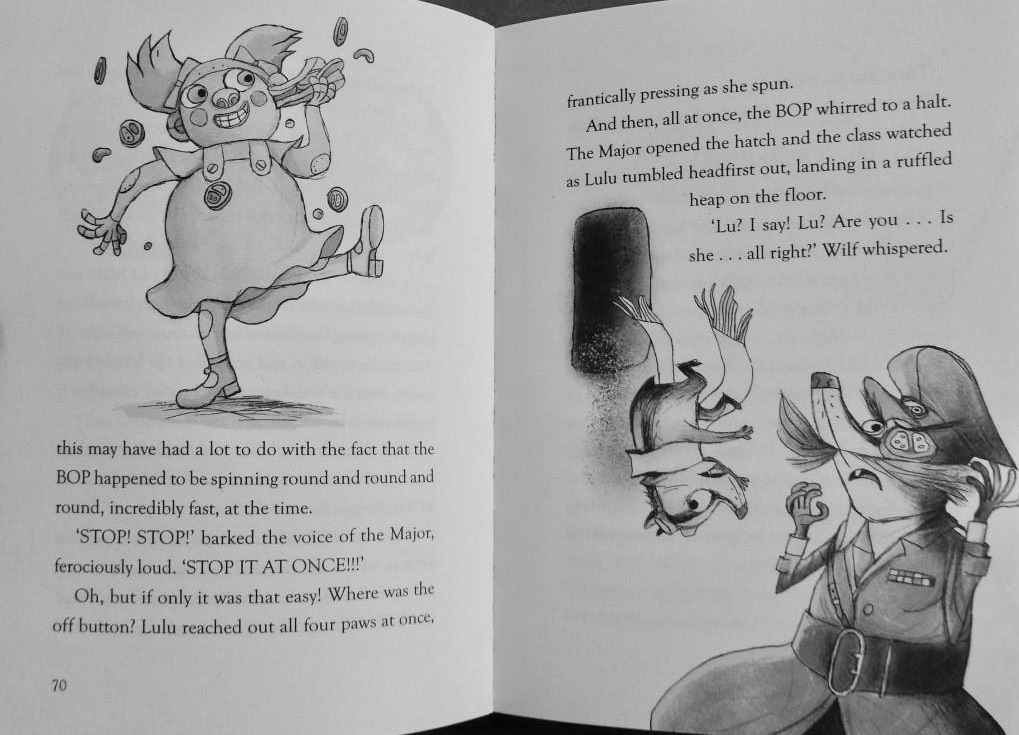
In the dormitory she meets another badger, one Wilfred C. Crumblepaw (Wilf) and the two quickly become good friends. To her surprise, in her first lesson Lulu learns that important humans are not the normal kind, rather they’re Badger Operated Persons or BOPs for short.
As for her training, well from the outset it certainly doesn’t go very well; indeed we could call it utterly catastrophic. For starters there’s the cheese and tomato sandwich procedure where said sandwich ends up in the wrong orifice; this provides one of the many laugh-out-loud moments in the book

and causes Lulu to have serious self-doubts about her suitability for the training. Thank goodness for her pal Wilf who tells her she’s just got a different way of going about things, thus calming her anxiety just a tad, briefly at least. However there also comes a second cheese and tomato sandwich incident at a much more crucial stage in the story; but about this I’ll say no more other than it involves the Prime Minister and the King of Switzerland during a crucial World Peace Conference. Can this perhaps be a case when too much welly turns out to be just what’s needed to save the day and indeed the world? And will Lulu gain her first level Badgering certificate? Errr …

A hilarious romp with some important messages concerning perseverance and self-acceptance (imperfections and all) that will cause readers to cheer for Lulu throughout her trials and tribulations. It’s made all the more fun thanks to Nici Gregory’s lively drawings liberally scattered throughout the book; they really bring the whole badger world to life.

I look forward to reading more about Lulu when she returns next year.

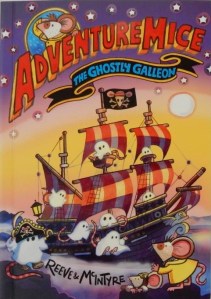
Adventuremice: The Ghostly Galleon

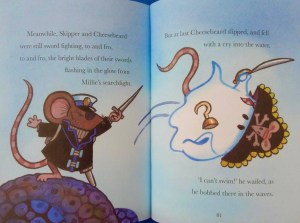
In this the fifth Adventuremice story, the team are sitting telling ghost stories as they drink their bedtime hot chocolate. When there’s mention of the Ghostly Galleon, a ship named the Piranha owned by dastardly Captain Cheeseboard that sank one stormy night and still reputed to sail around Bramble Island when the moon is full, young Pedro expresses the hope that he’ll never be so unlucky as to see this ship. However, come the following morning he accompanies Fledermaus to the sparsely populated Bramble Island to try and find out what’s behind the story..

On the island they meet Farmer Wheatley and his daughter mouse, Rye; the former somewhat reluctantly accepts the visitors’ offers of help with harvesting various fruits. He warns them to steer clear of the bay on the far side of the island and always return by nightfall. However after chasing a large blackberry, Pedro and Fledermaus find themselves right where they’d been told to avoid. Suddenly, what should appear but a ghostly galleon crewed by ghosts – or are they?

Back at Mousebase once more, the two recount their ‘ghost’ sightings to the other Adventuremice and Skipper decides there’s something fishy happening on Bramble Isle.

Can they find out exactly what?
Another delightful addition to the series with just the ingredients to keep young readers turning the pages: amusing, striking visuals, a dramatic plot with a wonderfully inventive and positive resolution and an interesting cast of characters.


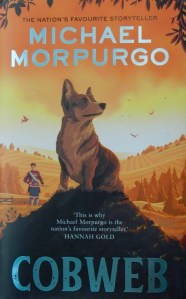
Cobweb

This wonderful story narrated by Cobweb, a Welsh Corgi, was inspired by real life tales of drovers whose job it was to take farmers’ livestock to market to be sold in cities, staying there until all the livestock were sold. One such route was from west Wales to London and Welsh corgis like Cobweb were frequently used.

He was born on a farm and much loved by Bethan, who lived alone with Tad, her father; after her mother and elder brother were both drowned when they went out in their boat to collect the lobster pots against Tad’s advice. We hear how Cobweb became a drover dog when Tad’s second wife gave the dog to her cousin Drover Morgan. The little dog is well cared for and comes to realise that he must remain with the drover and his own much older collie, Goodlad. The latter becomes a good friend and protector, teaching Cobweb the required skills to be a drover’s dog.

Their first trip to London is long and arduous but Drover Morgan is made welcome wherever they stop and ensures both dog’s are fed. Cobweb is kept going by thoughts of Bethan and the drover’s promise that he can return to her once his droving work is done. Then comes news that Napoleon has been taken prisoner and peace is on its way. After delivering all the animals to market in London and resting for a few nights, Cobweb learns the dogs must make their way home sans Drover Morgan.

During the return journey people are celebrating the British victory at the Battle of Waterloo and the two dogs encounter returning soldiers, in particular brothers Robbie and Jonno, the latter having lost his sight in the fighting. They talk of a very brave young French drummer boy they’d brought to England who then disappeared. Later the dogs come upon the very same drummer boy

who accompanies them on the long trek, eventually finding a home with Bethan.

A truly moving portrayal of the powerful bonds that can be formed between animals and humans, and of courage, the ghastliness of war and resulting loss of human life. Michael’s Morpurgo’s words and Michael Foreman’s illustrations together take readers back to an aspect of history that is relatively unexplored in children’s fiction. This would make a great read aloud to KS2 classes.

The Fairy Tale Fan Club

This is essentially a satirical collection of letters supposedly written to or from well-known fairy tale characters, each with an introduction by the supposed narrator—C.C. Cecily, the Senior Secretary of the Fairy Tale Fan Club. Said secretary also wrote a rather long introduction to the whole book where he explains how he came to compile and edit the work. Some readers may well want to miss out this and head straight to letter number one, hand-written by eight year old Ira to Little Red Riding Hood. Preceding this is a brief introduction from C.C using the first of a plethora of puns in the book, this one concerning the child being ‘literally wolfed down’ . This child is bemused by a couple of things in the story: how could Little Red have mistaken a wolf for her grandmother and how could she possibly be swallowed by a wolf and survive the experience. She goes on to enquire about the health of the recipient and ends with a PS asking ‘How “little” are you?’ Back comes an explanatory response covering the salient points.

Later there’s another correspondence – a fan letter of sorts – relating to this story but written by Sebastian (almost seven) to the wolf. The wolf then answers at considerable length.

For those who enjoy toilet humour, there’s a hilarious exchange involving a certain Prince Farty Pants (calling himself a duke in the first instance) and Prince Charming; and the latter proves less than helpful in his concluding sentence.

Another laugh-out-loud letter is penned by Humpty Dumpty in reply to that he received from Tyler (just eight). The egg talks about being anthropomorphised unfairly.

For the thoroughly modern reader there’s Zora’s message to Cinderella sans a single apostrophe and complaining about being unable to borrow her siblings’ iPads. This confuses the recipient who assumes an iPad is a cloth or similar used for cleaning.

In addition to the text there are a number of textured, sometimes finely detailed sketches as well as vignettes preceding each epistolary exchange; a perfect complement provided by David Roberts.
Altogether a very clever, tongue-in-cheek compilation that will appeal to book lovers especially those like me with a penchant for traditional tales.

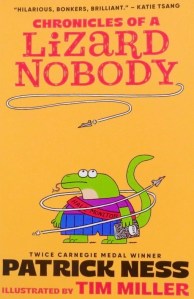
Chronicles Of A Lizard Nobody

“ I’m making you both Hall Monitors,” Principal Wombat said, though she quickly added, “This isn’t because you’re monitor lizards.” So begins this laugh-out-loud school story with a difference , seemingly the first of a series, aimed at primary readers, from Carnegie medal winning Patrick Ness.
It’s not long before Zeke, one of the chosen two and rather large, demonstrates how incompetent he is at the role. He has an unpleasant encounter with the school bully Pelicarnassus (son of an international supervillain), punches him in the beak and loses his position as hall monitor.

Another problem for Zeke soon raises its head at school; it’s that due to an ancient family curse the entire country of France appeared on Zeke’s knee after the death of his father. Now his class is to study France and teacher Mr MacPherson has the lizard sitting on the edge of the teacher’s desk and is using the shape on Zeke’s knee as a visual aid. Add to that the fact that since his father’s death, Zeke’s mother has been suffering from depression and the young lizard has an awful lot to cope with. On the positive side, however, Zeke has some loyal, brave friends who are often on hand to offer wise words and to assist in his efforts to save their school.

Ness uses an anthropomorphic cast to present the sort of issues human children might face at school every day – bullying, intimidation, violence, fat-shaming and insensitivity to disabilities. His combination of splendid silliness, tenderness and poignancy works effectively, so much so that readers will find themselves laughing frequently. Making the whole thing even funnier are Tim Miller’s zany ink drawings. Underestimating a monitor lizard is not to be advised.

The O.D.D. Squad: Attack of Aunty Enchanty

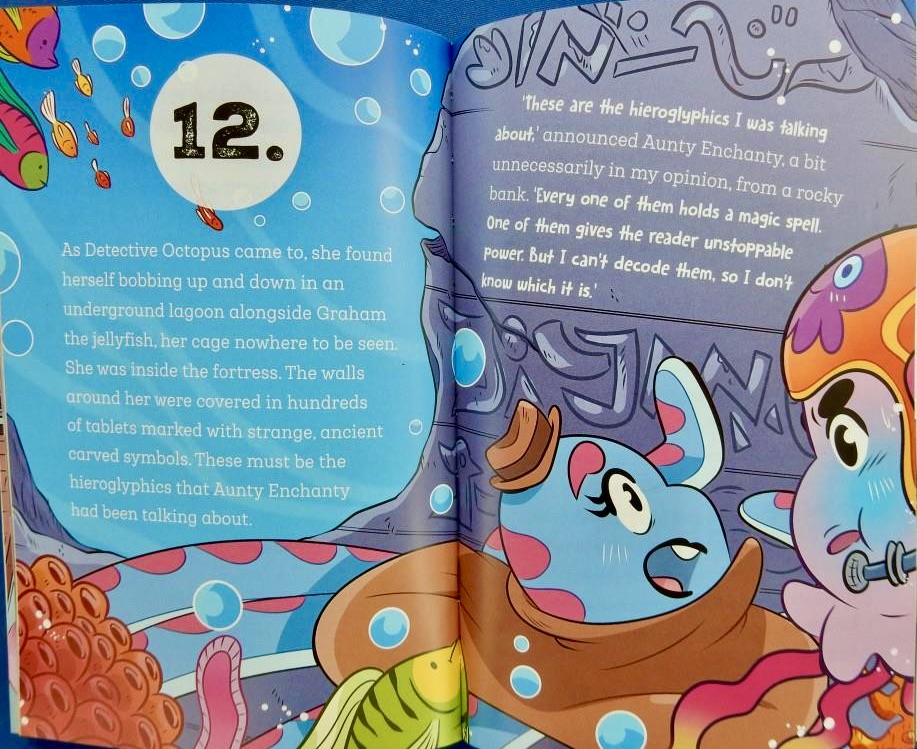
Like the first title in the series, this sequel is fast, funny – often ridiculous and highly illustrated.. In case you’ve not read Rise of Invisidog, the setting is Justice City and the O.D.D squad comprises a team of more than a tad inept crime-fighters – superhero duckling Quack Attack, Detective Octopus and Invisidog (the team’s newest member). A weird threesome indeed and when it comes to apprehending criminals, they do a pretty decent job, as they did at the start of this book when they succeeded in getting The Incredible Slowman safely in handcuffs.

However on returning to headquarters they discover that the place had been broken into and a note left by one Aunty Enchanty claiming to have kidnapped their pal Graham the jellyfish. Now this particular villain, unlike the Incredible Slowman, far from being a bungling idiot; is reputedly an all-powerful sorceress who is intent on carrying out an evil plan to destroy Justice City.
The next thing the team know, one of their number – Detective Octopus – is missing; she’s currently in the clutches of Aunty Enchanty who has designs on the captive’s brain. Unbeknown to the captor however, octopuses actually have nine brains. In order to translate the hieroglyphics which would give her unlimited powers the one needed is that which the octopus least wants her to have. The situation gets progressively worse with Detective Octopus having to join the missing jellyfish in an underwater lagoon

closely guarded by the arch evil one, and Quack Attack now having an alter ego, Quacksquatch, a giant were-duck. How on earth or underwater, will this sorry saga end? Can the three detectives get back together and even bring Aunty Enchanty to justice?

Another zany, metafictive romp wherein chapters end on cliffhangers, frequently with a comment from author, Stuart. Coffee anyone?

Raz Beri

Billy has cerebral palsy and is a wheelchair user. His time at primary school was reasonably okay but now he’s in secondary school, his fellow pupils are much more unkind, including his erstwhile friend Rio and buddies. I felt my blood boiling as I read some of the things he was called. However on line, Billy is able to escape from the bullying and inhumane name calling and feels part of a community.

Then a new girl, Mia, also a wheelchair user, joins the class and everyone is excited to discover that her uncle is a famous soccer player. They’re even more excited when she announces that said uncle – Danny Cash – and some fellow soccer stars are coming to visit the class. Billy, a soccer lover, can’t wait to meet them but he almost misses the opportunity. However an enormous effort on his part means he arrives in class just in time; but it turns out that Billy’s hero isn’t quite what he’d hoped; indeed his behaviour is similar to that of his prejudiced classmates.

Nevertheless during the visit, Billy pulls off something amazing and surprises everyone but infuriates many of his classmates. Things get worse for a while but eventually, with the help and support of online friends, he makes a terrific stand while at a soccer match. This gives lots of people, (including Danny Cash,) cause to rethink their attitudes to Billy and to disabilities. By this time though Billy has come to realise that a sense of self-worth comes from within. 


Matt Stephens’ hard hitting and empowering story needs to be read widely by those of eleven onwards, including adults; it will one hopes make them examine their own attitudes towards, and treatment of , anyone who has a disability. As a class reader, it could provoke extremely valuable discussions.

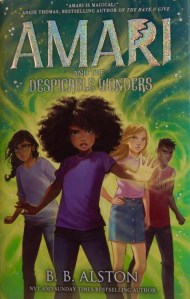
Amari and the Despicable Wonders

In the previous story, Amari and the Great Game, Amari had to concede defeat in a contest with Dylan Van Helsing and was left without her magical powers. Now with the League of Magicians and the rival organisation, the Bureau of Supernatural Affairs heading for a decisive showdown, the powerless Amari faces her greatest ever challenge.

As the war intensifies, Quinton, Amari’s elder brother and superstar agent now back on the scene and others from the Bureau are intent on keeping her out of harms way, leaving him to undertake missions. Meanwhile her erstwhile friend and former partner, now her nemesis, Dylan Van Helsing has become head of the League and seems able to outsmart her no matter what she tries. However, Amari is one determined girl and even with the odds against her, she and her loyal group of friends set out to locate their only hope of preventing Dylan from unleashing a new destructive power that would render him invincible. What they need to find is the only source of anti-majik, ancient inventions called Wonders.

The tale twists and turns this way and that to its denouement, which is both poignant and uplifting. And for Amari, it affirms her place in the community she loves. For me as a reader, one of her thoughts near the end particularly resonated: ‘And it makes me hopeful that people might start giving others a chance before judging who they are.’

If you’ve not met Amari et al before, then start with Amari and the Night Brothers and move on to Amari and the Great Game before reading this one.

Star of the Show

I have a guest reviewer today: my relation Emmanuelle, an 11 year old, avid reader. Here’s what she had to say:

Jaqueline Wilson’s latest book is an amazing tale of family and hardship. Tess, from whose viewpoint the story is told, and her family live in Victorian England. Sadly their Ma has just died and their Pa has walked out on the children. The five siblings, Maggie, Connor, Tess, Tommy and baby Ada do their best to support one another, the older brother and sister doing all they can to earn some money. Tess though dreams of being a dancer. but she has to attend The Ragged School where she looks after little Ada.
One day she learns of a pantomime that is to be performed at The Grand Theatre and she determines to audition for a role dancing in Cinderella … Can she possibly fulfil her wish?

I really loved reading this story, especially the way in which you are introduced to the characters and gradually learn more about them all as the narrative unfolds. It’s great to see how, from such a bad situation at the start, things get progressively better for every one of them.
One thing I found surprising was that readers only truly understand the title in the second part of the book.

A wonderful story and one I would definitely recommend to anyone who enjoys stories set in bygone days or wants to pursue a dream.

The Boy Who Cried Ghost

This story of Richard Barnes is a very personal one for author Ian Eagleton: Richard has OCD, with which Ian was diagnosed in his late teens.

Richard and his mother move into what was Grandma’s house just before the beginning of Year 6 and the likelihood that this is permanent, taking him away from his friends, troubles the boy greatly. Everything about his new room troubles him too: he lies awake on his first night thinking about starting at a new school and listening out for the strange sounds that seem to be coming from the old wardrobe in the corner. He resolves to keep it locked to prevent anything hiding inside from escaping. He checks it many more times before leaving for school, which makes him late but Richard believes it’s the only way to keep him and his mother safe.

One day his mum’s friend, Tony, who has been doing some painting in their house, collects Richard from school, accompanies him home and reveals that the boy’s mum has already told him about there being something in the wardrobe. Moreover, he’s also found its key and insists on unlocking the door. Richard is horrified at his thoughtless attempt to show the boy that his anxieties are unjustified: he fears that the ghost has now been released into the room with the result that he experiences a massive panic attack.
However when he tries explaining, both Tony and then his mother tell him that his anxieties about the released ghost are down to his over-active mind.

Scared and very angry he decides to enlist the support of his new school friends. They are willing and together settle on calling it ‘The Whisperer’. Meanwhile Mum reveals something about his Grandma and Richard wonders, could she be the Whisperer?

Richard’s friends come to a sleepover with the aim of banishing the spirit once and for all. They reveal lots about themselves during the night but they don’t see the ghost. Then things go disastrously wrong, Mei is hurt and Richard ends up falling out with them, albeit temporarily. Now he feels totally isolated and desperately in need of help. Can Richard finally admit he needs to find somebody to talk to about what is going on and the debilitating voices in his head? Only then might he be able to live comfortably with himself.

Written from the heart, with themes of acceptance, confronting fear, family, friendship and mental health, this powerful story needs to be read widely by older KS2 and KS3 readers as well as adults, many of whom have little or no understanding of OCD. It made me feel I should have been far more empathetic towards a teacher I once worked with who has OCD and frequently turned up late for school. There’s humour and laughter in this book too and in the author’s notes at the end of the book, he pays tribute to his dad who loved jokes, using humour to help him and others deal with their worries.

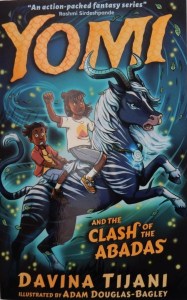
Yomi and the Curse of Grootslang / Let Sleeping Gods Lie

In this third fantasy adventure in Davina Tijani’s Nkara Chronicles series with Adam Douglas-Bagley’s dramatic illustrations, Yomi and her younger brother, Kayode, accompany their Uncle Lou ( a researcher for the Sacred Beast League) to South Africa. Shortly after they arrive the siblings meet the Vilha Treasure Hunters, a group of children who have heard about their bravery when they rescued a Senegalese dragon king and saved a city. The Treasure Hunters believe the qualities the siblings exhibited are exactly what will be required if they agree to join them in their quest to find the Tusk Diamond and bring it back to the rightful owners as well as hopefully, to break a curse issued by the elephantine serpent, Grootslang in whose cave the jewel is hidden. Yomi and Kay agree and so begins their adventure.

On finding the cave the adventurers try bargaining with Grootslang using the pyronite Kayode had brought in exchange for their freedom and the diamond.

When this fails can they come up with something else to persuade her and ultimately help bring peace and harmony to Vilha?

The author weaves mythology, culture and details of South African landscapes into her fast-paced story which also demonstrates the importance of camaraderie and working together, leaving it neatly set up for the next adventure in the series, set in the Congo. Bring it on.
There’s mythology too in

Following her adventure with trickster gods in Old Gods New Tricks, Trixie dos Santos is settling back into her usual way of life, this includes school. She manages to tolerate the boredom of lessons but hates the taunting from some of the pupils, so on some days she spends her time elsewhere, wandering in the woods for instance. It’s on one of these occasions that she loses track of time and reaching home late, is greeted with the news that her grandmother has died and they have to go to Norway for the funeral.

Shortly after arriving there’s some talk of Grandma’s magical cauldron but it isn’t where it’s supposed to be. Trixie notices some strange marks on the kitchen floor. She decides to take a look outside and with Bragi the dog, she sallies forth into the freezing cold. In a clearing in the wood she encounters Baba Yaga.

It turns out that the witch knew Trixie’s grandmother and knows about her magic cauldron. Thus begins Trixie’s next mission: to travel to the Land of the Dead and search for the cauldron.

While in the underworld, having met her dead grandma, Trixie comes upon Hel (goddess of death) and her father Loki, the latter she already knows. Can she trust the trickster when he offers to help. her? Not only he but all the other tricksters that offer assistance as her quest continues taking her through many underworlds. There’s really no choice if Trixie is to prevent the evil army from taking over the world.

A breath-taking tale with plenty of humour, that introduces mythology from various cultures. It will have readers on the edge of their seats as they root for Trixie at every twist and turn. The author’s black and white illustrations are superb – striking, often intricate and very powerful. I can’t wait for Trixie’s next foray into the world of mythology; her emergence from this quest has left her mentally stronger.

The Secret of Golden Island

Yakov has had to leave his war ravaged home country and now is staying with relations. He struggles to fit in at school and cope with being away from his loved ones. Skylar’s struggles are with how she feels after her grandfather’s stroke (he’s always been her rock) and a bullying incident at school for which she is suspended.

Skylar: ‘I’m not crying.’ Yakov: ‘I know.’ These are the very first words the two children exchange and somehow this brief interaction is the beginning of a friendship, one they both desperately need. Both of them too have a strong desire to change things for the better and not just for themselves but for those they love. It’s this that brings them even closer to one another as they enter a competition, the prize for which is the ownership of the nearby Golden Island. How though can two children compete successfully against adults with schemes and plans of their own?

Certainly, the call of the island is very strong but the quest they embark upon must be kept secret from family members and they only have one another to rely upon for their safety. As the adventure progresses Skylar and Yakov’s friendship deepens, they reveal more about themselves allowing things they’ve kept deep inside to be exposed.

Trying to solve the clues they’ve been given, the pair come up against some competitors who will go to any length to achieve what they want. Can they overcome all the obstacles that arise during their quest, including a desperate race against time with way more at stake than the competition?

Totally gripping, compassionate and exquisitely told, this book swept me away and as I reached the final paragraphs I felt tears welling up, such is its power.

A wonderful read for older KS2 readers and beyond.

The Great Crisp Robbery / The Majorly Awkward BFF Dramas of Lottie Brooks

The latest story narrated by Izzy unfolds on a night train from Aberdeen to London. None of the young travellers has been on a sleeper train before and the realisation that it means bunk beds adds to the excitement. A BIG ADVENTURE indeed: Gary Petrie even has his silky dressing gown and judging from the enormity of her suitcase it would appear that Maisie thinks she’s going to be away for ages. Why though has Miss Yu and not Miss Jones been designated ‘teacher in charge’ when the children have only known her for a few days? Surprising to Izzy is that Jodi suddenly appears on the train having escaped early from the wedding she’s been at and she’s still wearing a floaty pink bridesmaid dress.

As the journey is about to get under way Izzy looks out the window and gasps in horror: on the platform stands a hooded figure watching them: surely it has to be a train robber. Those familiar with Pamela Butchart’s child characters know that it doesn’t take much for imaginations to run wild and their misunderstandings to become suspicions that lead to them being way off beam as they become certainties. Here we have a group of hysterical youngsters on account of Gary’s sixteen missing packets of crisps, albeit Tesco Finest varieties, not to mention all the spending money.

How on earth – make that on railway lines – is this all going to end? Actually it doesn’t exactly do so for puffing and panting and puzzling over what Miss Yu will say in her ‘quick chat’ readers leave the train about an hour from its destination.

Primary readers will devour this faster than Gary’s crisps and the sandwiches from the refreshments trolley and then want more. With its multitude of twists and turns, this adult reviewer was left decidedly dizzy especially at the impending BIG TROUBLE facing Izzy and her pals.

Presented in diary form as usual, with plenty of Lottie’s amusing doodles, this one relates the events from New Year’s Day to the day after Valentine’s day.

January 1st sees Lottie in high spirits about her new boyfriend, Daniel, but as readers might expect, Amber is jealous and makes plenty of mean remarks about the relationship. She even starts giving out application forms at school for the role of Amber’s boyfriend, and then holds auditions.

With regard to Lottie however, she has an abundance of hugely embarrassing moments due to eyebrow alterations and style icon attempts with over-size earmuffs, just to name a couple. Then comes brother Toby’s announcement of his new year’s resolution: to get a dog and for once in her life, Lottie is in agreement with him, even going so far as to aid and abet his plan for mum persuasion. Eventually there comes a new member of the household: enter five-month old golden cockapoo, named Snookers, though that soon gets changed to Pot Noodle, thanks to a remark by Mum. Said pooch is adorable but there’s a major snag, he’s full of mischief, destructive and definitely, despite what Dad was led to believe, NOT toilet trained. How on earth is Lottie meant to cope with a new boyfriend and a new dog that insists on leaving deposits of poo all over the carpet and in other extremely annoying places.

Assuredly she has a whole lot less time to spend on other people – her gang especially, one of whom, Jess, shares the news that she might be gay.

My goodness all that and more in just a few weeks. It’s easy to see why the Lottie Brooks books have become so popular with’tweenage’ girls. I have no doubt fans of the series will eagerly devour this and readers new to Lottie will be equally enthusiastic after reading this one.

Rosie Raja: Undercover Codebreaker

Rosie Rajah’s third adventure is possibly even more exciting than her previous two. As the story starts, Rosie and her papa are parachuting over the Belgian countryside. On landing they are met by Brigitte, an American. The Americans have recently joined the war but it soon appears that Brigitte has her own agenda when it comes to the Nazis. Both of them though are involved in rescue missions; and there’s also a meeting up between Rosie’s papa and an old school friend.

Pretty soon, Papa announces that they need to head back to England, but first Rosie must change her appearance as the Nazis have issued an alert regarding her .
Once safely on English soil, Papa’s mission is to find the Nazi spy operating undercover at Station X aka Bletchley Park. His first stop though is at RAF Abingdon where he’s been asked to check out something and while so doing, Rosie meets Noor Inayat Khan. She’s working there as a radio operator deciphering messages and is a descendant of Tipu Sultan.

One of the amazing codebreakers Rosie encounters is Alan Turing who despite his genius, is a shy retiring character. But, there are also resistance fighters and double-crossers so Rosie has much to contend with and decide whom to trust especially when her father is in very serious danger. Can she keep her head and do something to save him?

Meanwhile back in pre-partition India, Rosie’s aunt, Rani-K is very involved in Gandhi’s Quit India Movement that is working to gain independence from British rule – another important piece of political history children will be made aware of.

Another truly gripping episode in the life of a girl who occasionally lets her emotions rather than her mind guide her actions. I was enthralled throughout.

A History of My Weird

For Mo, the narrator of this story, things are changing way too fast. She’s just started secondary school where one of the teachers in particular doesn’t understand how to work with what they call her disruptive behaviour, sending her out of the classroom frequently. Mo is neurodivergent and has trouble making real friends; they tend to be bemused by her stimming and annoyed by her tendency to correct factual things when others, teachers included, get them wrong. Add to this, the fact that her body is developing she hates the ‘rubbery blobs that have appeared seemingly overnight’, on her chest.

Then Mo meets Carys, preferred name Onyx; who appears to like her; could this be the true friend she’s been hoping for. She certainly encourages Mo to go to drama club.

During history the class hear of a disused Victorian asylum in the locality. This sparks Mo’s interest but Dad tells her Denham is private property and exceedingly dangerous. However after school one day she and Onyx manage to get in, albeit only for a short while. So, despite Onyx’s father having told his daughter that Mo’s a bad influence they resolve to make another visit, at night this time, fuelled by the possibility that her great uncle had been kept there. Meanwhile rehearsals for the drama club’s forthcoming production take up some of Mo’s time and energy.

When Halloween night comes the friends keep their promise to each other and return to the asylum. There Onyx opens up to Mo about the issues she’s dealing with, but as they proceed disaster strikes: the floor and Onyx vanish down into blackness. What will be the outcome of the accident?

Mo is a very endearing character and her friendship with Onyx/Carys is really well portrayed, which is no surprise as the author, Chloë Heuch is herself neurodivergent, a part-time teacher and a parent. Highly recommended for older readers.

Pirate Academy: New Kid On Deck / Missing At Sea

ARRR! me ’earties! It’s time to fast forward to the year 2507 and step aboard for a cracking pirate adventure.

Classmates Jasmine and Jacoby are privileged to be studying at the Pirate Academy under the tutelage of legendary pirates. Like their fellow students – fifteen are chosen each year – Jasmine and Jacoby are from famous pirate families and are in Barracuda class. All is not well though: unexpectedly Jacoby receives an unfavourable assessment; this the lad graciously accepts promising to do better in future. Then Jasmine is summoned to Captain Salt’s office where she’s hoping to hear about what has caused the non-return of her parents and their ship. Tensions rise even further when Captain Raven Moon dramatically removes her son, Wing, from the Academy, ominously telling Jacoby, “These are dangerous times to be a pirate … be careful my precious boy.”.

Shortly after, another boy, Neo Splice, mysteriously arrives at the school. He tends to keep himself to himself, which arouses the suspicions of others and Jasmine has a feeling she’s seen the lad before somewhere. Is he trustworthy or an enemy? There are certainly enemies at work outside the Academy but could there be a traitor within threatening their safe world too? There’s definitely a surprise in store for Jacoby. It’s crucial that Jasmine and Jacoby set aside any differences and work together using all the skills they’ve learned.
This action-filled page-turner ends on a cliffhanger leaving readers eager for the second adventure;

Book 2 starts four weeks later with Barracuda class about to face the first challenging test of their abilities, the Oceans Bound.weekend. The pirate apprentices are divided into five teams, each with a leader, one of whom Jacoby hopes will be himself and when this isn’t so he’s devastated. Jasmine though is selected and this makes their relationship somewhat tricky but eventually she, Neo and Jacoby form a team.

A much greater difficulty emerges when she learns that her Uncle Noah – a ringleader of the League of True Pirates – has somehow managed to escape from Pirate Federation’s maximum security prison. Nonetheless she refuses to let this put her off participating in the event and her crew sets sail along with the other four. Before so doing each leader is given a coloured glass bottle continuing a note on which is written the first of a series of tasks.

Soon members of one team (you can probably work out which) find themselves facing unexpected dangers in the form of highly venomous vipers and spiders with a poisonous bite,

as well as a skull. Eventually another crew’s members become concerned that a rescue might be required; they just need to persuade the remaining Barracudas to join them in operation rescue mission.
Even so, it will take all they’ve got for the tenacious young pirates to complete the course and triumph against their heinous enemy.

With some shocking plot twists, the story like the first one, ends on a cliff hanger that will ensure readers are left thirsting for book three.

Dirty Bertie: Pets and Pests / The Determined Kitten

This is a bind up of three previously published Dirty Bertie books: Fleas!, Rats! and Bees! each of which contains three episodes in the life of the lad with a magnetic attraction to mischief-making possibilities. He’s involved in such escapades as flea catching (thanks to Whiffer, the house is infested with the things); Bertie and Gran take the pooch to the vets where as you’d expect, chaos soon ensues. In another episode, having locked the supply teacher in a cupboard, Bertie learns what it’s like to be a teacher, under the watchful eye of a slightly bemused school inspector.

He also participates in a cross country run with his classmates that results in a too close for comfort encounter with cows, sets a mouse loose in the classroom (accidentally of course) and decides to try his hand at being a bee-keeper courtesy of Mr Monk’s bees. All this and more besides.

Adult readers aloud, youngsters just starting to fly solo, and listeners at home or in the classroom will find it impossible not to come under the Bertie charm especially with the wealth of comical black and white illustrations.

While out walking the dog in the park with her Dad, Rosie comes upon a box containing five ginger kittens, evidently they’ve been abandoned by someone. There appears to be something wrong with one of the kittens but nevertheless Rosie manages to persuade her Dad to take them home. Once Mum sees them, she insists they must be taken to the local animal shelter. To Rosie’s surprise, Sam the cat fosterer lives in an ordinary house and is willing to take them on and help them find new homes. She tells Rosie that she’s welcome to come and visit the kittens at the weekend but also mentions the possibility that little Bill has something called cerebellar hypoplasia, also called wobbly cat syndrome. Rosie continues visiting and helping Sam but it’s not long before all the kittens except Bill have gone to new homes.
Rosie is determined to persuade her parents to let her adopt Bill but Mum is quick to remind her of what her teacher has said about her struggling to concentrate in lessons. The reason for this however, is because she’s being bullied but Rosie doesn’t say so at that point.
How will the bullying problem be resolved and where will kitten Bill eventually find a home?

Just right for animal loving readers around Rosie’s age, especially those who have a penchant for cats.

Where the Water Takes Us

When eleven year old Ava learns she’s to spend the summer at her grandparents’ remote island cabin with her Nonno and Nonna, because her mother’s twin pregnancy has become complicated, she can’t let go of the fact that she’s been labelled a ‘burden’. In addition she feels terrified that something awful could happen to her mother.

Soon after her arrival when out paddling the canoe, Ava notices a boy standing with a fishing rod on the dock. He endeavours to make conversation but she turns down his offer of showing her pike and continues paddling before ending up in the water. Ava is so tired that once she’s pulled herself out she falls asleep. She’s awoken by a powerful storm and a woodpecker falling at her feet, which she is unable to revive. This leads to second encounter with the boy, Cody MacDonald, who is with his father and he insists on seeing that she gets safely back to her grandparents’ island.

That evening when Ava and Nonna are talking about birds, Nonna says that a dead bird falling at your feet or on your doorstep can be a sign that a death will come to the family. Ava then hears her mother is back in hospital and decides that nothing else matters except that her mother must be saved. She returns to Deer Island to make a deal with the dead woodpecker. Back at the cabin, Ava is told that rather than trying to call her Mum she should write her a letter and as a further distraction, she should walk to the spring with Nonno to collect some jugs of water.

At the spring there’s another chance meeting with Cody and despite Ava denying she’s friends with him Nonno leaves her with the boy to fill their jugs. While there Ava discovers two eggs – robin’s eggs so Cody says. During the ensuing conversation despite herself, Ava finds she’s getting closer to the boy, and she then takes the two eggs back to her grandparents home for protection. Caring for two baby robins with her Nonna’s help might just be what she needs.

Then a situation unfolds which puts Cody’s life in danger and Ava must summon both her swimming skills and courage to save the day.

With themes of protection, friendship and identity, this is a truly compelling, sensitively written story full of lyrical descriptions about the natural world. The author’s occasional delicate watercolour illustrations have a quiet power of their own: be sure to follow the development of the two eggs along the bottom and up the edge of the recto pages.

Ettie and the Midnight Pool

Eleven year old Ettie is living a peaceful life with only her grandma for company. They grow their own food, sell anything they don’t need and the girl spends much of her time listening to stories, reading, sketching, and roaming the beautiful countryside surrounding High Fell House, their home. Ettie’s mother, a doctor, left to go travelling but war, sickness and grounded planes have prevented her from returning or even sending letters. This leaves a deep sadness residing within the girl.

One afternoon while exploring the woods, Ettie spies a girl who seems to be walking with a fox. Enter the mysterious Cora: Ettie finds herself drawn to the stranger and follows her. Grandma is horrified when that evening, Ettie tells her she’s come across the disused quarry, a place that lingers in her mind long into the night, leaving her determined to return the following morning.

When she does so, Ettie discovers Cora is lying hurt in one of the old slate mine tunnels. She just has to help her but without letting Grandma know. A friendship begins to develop: Cora teaches Ettie how to dive into freezing water. Another late return upsets her grandma but Ettie is resolved to keep her adventuring a secret. Grandma however is becoming more and more worried about her grandaughter’s protracted absences and her change of attitude towards their restrained life together, asking lots of questions and even giving her an old watch. Ettie in turn is convinced something secret is being kept from her too.

While Ettie is strongly attracted to Cora’s wild existence, readers have a mounting sense of unease. Maybe Cora can lead Ettie to discover the truth about the secret; on the other hand she could be leading her towards tragedy. Tension mounts to a dramatic climax – a life or death situation – after which Ettie has to face a difficult decision: who is she and what does she want? Cora’s identity remains a mystery though the author’s interweaving of myths provides clues and Grandma eventually shares her tragic tale about the pool and goes on to agree that Ettie should live her own best life, darkness and all.

Enhanced by Pam Smy’s powerfully evocative illustrations, Julia Green’s wonderful descriptions of the countryside, in combination with intrigue and nail-biting moments, make this a mesmerising story that lingers in your mind long after you’ve set the book aside.

Here’s what Emmanuelle (11) an avid reader, had to say about the book:
Julia Green’s new book is thrilling and full of secrecy. Ettie lives in the countryside with her grandma. One day, whilst out in the forest, she sees another girl and follows her to a hidden quarry pool. She soon makes friends with the girl, whose name is Cora. But Ettie notices that she never gives answers to any of her questions about where she came from. Ettie is in awe of the stunning pool but soon discovers that it holds deep and dangerous secrets; so too does Cora.
This book is perfect for readers who enjoy adventure, family stories and mystery. It has you hooked right from the beginning and keeps you turning the pages right through to the end. The story builds to the biggest scenes where Ettie finally swims in the quarry pool and learns a massive secret. This reader was left wanting to know more.


Destiny Ink: Sleepover Surprise

Destiny is one of life’s enthusiasts who finds every day an adventure. As the book opens she is excited to be going to the park to meet her best friend, Olivia. On the swings Olivia reminds her of tomorrow night’s sleepover when the two will be spending the night in a tent under the stars in Olivia’s back garden. Destiny’s tummy starts to feel a bit funny though she assures readers that it’s not because of the sleepover or the possibility of scary monsters. Her mum’s reassuring words “It’s going to be INKTASTIC” followed soon after by “It’s OK if you feel a bit nervous,” don’t completely allay her fears.

Back at home Destiny creates her own tent in her bedroom for a practice sleepover to prepare both herself and Fuzzy, her hamster. She plays in the tent but come bedtime, despite Dad’s brainwave of lending her his torch, she’s still wide awake at 01:28. Suddenly she becomes aware of something strange and the torch reveals an actual monster. A monster – Trog by name – that is clearly scared too and is accompanied by a pet named Furbs. Trog, she learns, is scared of being away from home so Destiny sets about showing her new friend that there’s nothing to be frightened of.

Come the morning with her own fears dissipated, she feels somewhat different. Is she now ready to enjoy her own sleepover at Olivia’s?

It’s great to see how Destiny uses her creativity in overcoming her apprehension and fearfulness.
Adele Sokunbi’s description of how, helped at one point by her Dad, Destiny uses a silk scarf to protect her hair in bed is a detail that will be new to many young readers/listeners, but equally important for those familiar with the practice to see themselves reflected in the story.

Look out for Talent Show Magic, the next sensitively written episode in the life of the delightful Destiny Ink coming this autumn.

The Secret Hen House Theatre

The author has drawn on her own childhood memories of life on a farm to create this exciting family story.

Since her mum died some ten years ago, eleven year old Hannah’s life has been pretty chaotic. Her dad is working as hard as he can to keep the family farm going but things get worse day by day and she and her siblings are called upon to do all they can to help. Hannah isn’t worried about having to search jumble sales for clothing or cook the family meals, finding refuge in her love of theatre and passion for acting although she has little time for so doing, especially as her Dad thinks it’s a waste of time. But then the landlord doubles the rent charged for the farm putting it in jeopardy and Dad’s money raising plans (he’s only a tenant farmer) are never going to raise enough, even those that work.

So, Hannah decides to enter a play competition with a first prize of £500 which she will give to her dad, should her play win. Her best friend Lottie and other family members (unbeknown to Dad) all help and together they set about turning an old disused hen house into a theatre and Hannah gets to work writing the play. Thus the secret theatre begins to flourish but things don’t go quite to plan. Friendships are tested to their limits; Hannah however is a determined character and she’s not prepared to give up without a fight. Raise money she must; but what will Dad say when he finds out what has been going on?

With a powerful plot, a splendid cast of characters and a setting that feels timeless, this story (first published over a decade ago) is totally absorbing and you won’t want to put it down till you reach the final page.

The same farm is under threat again in The Great Farm Rescue, to be published in August.

Freya’s Gold

This cracking adventure is set in Edge, the same sleepy seaside town as the author’s debut novel Looking for Emily.

Twelve year old Freya lives with her Granny Kate and together they run the popular B&B on the old boardwalk. This B&B is also their home and during the summer when the town is alive with activity, their home is full of happy holidaymakers. Now though it’s February and things feel totally different with sleety rain and sea mist replacing the crowds of people and Freya has much more time to spend with her best friend, Lin. The B&B is empty until a strange woman with a false smile and heavy suitcase arrives at reception and asks for a room. Something about her makes Freya feel ill at ease although her gran is only too happy to have Ms Oleander as a guest in the off-season.

One morning Freya and Lin are on the otherwise deserted beach using their jointly owned metal detector and hoping to find some treasure to help Granny Kate and they come upon a gold coin. Later that day Freya sees Ms Oleander talking to the mayor outside the town hall and almost immediately Freya senses someone else close at hand: it’s a boy but he disappears in a flash. It transpires that on account of Ms Oleander, the town is under serious threat; but why is the boy seemingly following this woman?

A few days later, determined not to let this unpleasant woman ruin their town, Freya and Lin head for the beach again with the metal detector and make for the caves, Freya’s courage rapidly evaporating as they enter the dark However, things don’t go to plan; the two girls have a row and part company. Meanwhile the clock is ticking. It’s time for Freya to face her fears, summon her inner strength and search the tunnels properly for the legendary pirates’ treasure. Can she do it? Perhaps, with the assistance of her bestie and Teddy, the boy she has now befriended, since that first fleeting sighting.

With its twisting, turning plot this fast-paced tale is full of suspense and mystery and will engulf readers like the sticky salt off the sea that coats the town in winter.

Alice Éclair Spy Extraordinaire: A Dash of Daring / The Summer Dolphin

This is the fourth and sadly, final story in the delicious series starring creative, kind, resourceful Alice Eclair.
Alice and her mum are anticipating a relaxing week in the mountains when they arrive at Hotel Anise. It’s not long though before Alice starts feeling disappointed: the atmosphere is far from exciting and she isn’t getting the opportunity to enjoy the hotel’s facilities. However Claude’s appearance on the scene, talking of a complex, ingenious cipher machine that can convert messages into unreadable code in seconds soon dispels her frustration. The problem is the machine has gone missing, along with its maker, Claude’s inventor friend, Jan.

Before long Alice is drawn into a mystery. Then her dastardly Uncle Robert appears on the scene: what is he doing in the hotel? Meanwhile, iJan’s daughter who is staying at the Olympic training camp on the outskirts of the city with her brother, has been receiving unpleasant messages as she prepares to compete in the cycling events to be held in Berlin.

Having persuaded her mother to let her go to the training camp, Alice begins working undercover while at the same time tackling the tricky issue of creating healthy but tasty desserts in the Olympic kitchens. Then to her surprise and delight, her friend Sophie, France’s most talented engineer appears and she offers to introduce Alice to the cyclist Adele and her brother, Hugo. Hugo in turn introduces her to his carrier pigeon. Determined to solve this case, Alice faces many challenges as she follows the numerous clues, some of which as you might expect, are red herrings, sets about working out who she can trust and cracking lots of codes along the way.

A tasty conclusion to the tale and the series: Alice emerges with some new friends including Hugo who happens to use a wheelchair. The author took advice from a fellow author and friend in her sensitive portrayal of this character.

Lillie and her family are having a fortnight’s holiday in the Gower, Wales, staying in Gran and Grandpa’s new home. Things get off to a disappointing start for Lillie who discovers that she’ll have to sleep on the attic floor between the beds of her older sister, Frankie and their cousin Lara.
Almost immediately the older girls gang up and Lillie is made to feel a baby, excluded from their activities but no one else appears to notice she’s lonely and upset.

Then during a boat trip around the harbour, the crew mate Alice, mentions a tidal island that’s a wild bird reserve during the summer months where they might see dolphins as well as seals and birds. Suddenly there in the water they spy a flicking tail, then more; it’s dolphins swimming alongside the boat. One of them in particular, it seems to Lillie, is happy and this makes her feel happy too. Surely that dolphin smiled at me, she thinks to herself.

Later, Frankie and Lara flatly refuse to let Lillie accompany them on a rock-pooling expedition. Instead she decides to go off by herself in the hopes of seeing the dolphins, especially the calf, again, something that when her parents discover where she is, troubles them considerably. However it doesn’t stop Lillie going off exploring alone again after Lara is particularly horrible to her. There’s a problem though, for Lillie doesn’t understand the tide at all and she’s lost track of time. Worse, is that with water up to her chest, she can’t remember any of the special ways to keep safe she’d been told of in school. Then she catches sight of a dolphin; could it be trying to help her?

Whether read by newly confident solo readers or aloud to a class, this mix of sister dynamics and adventure is a story that will be enjoyed by animal lovers especially. David Dean’s black and white illustrations underscore the characters’ feelings throughout the book.

Dungeon Runners: Hero Trial

Set in the land of Zerb, as the story begins, Kit a gnorf – part gnome, part dwarf- is sitting in the local inn glued to a screen showing the finals of the Dungeon Runners, the favourites being Ultima Squad, winners for the four previous years. Commentator, Jenna the Giant, thinks it will be a close thing between them and the Night Beasts; all the latter need to do is defeat tonight’s monster or find the hidden treasure, either of which would mean extra points. Suddenly the other commentator, Dirk the Orc makes an unexpected announcement: one of the teams has had an accident with a frost dragon and that means there’s space for a brand-new Dungeon Runner team. The trials will be held in just two weeks.

Kit is excited but knows he stands little chance; but when Breg, the bullying troggle, kicks him out of the inn and then challenges him to enter the trials, he finds himself accepting. This he quickly regrets for he has no team, no skills and no weapon. Pretty much no chance at all of succeeding or worse still, getting through the trial alive. What does Grandfather Klot, an erstwhile Dungeon Rum champion, have to say other than he was much older than Kit when he won.

Feeling pretty down, Kit then meets another gnorf – Sandy Sanders – a mage in training.

Now with Kit as the ‘fighter’ and Sandy the ‘mage’, all that’s needed is a ‘healer’. Fortunately Sandy knows Thorn Darkblood, a vegan vampire, can you believe? These three form team Triple Trouble. By working together can they possibly overcome all the odds. Assuredly they face trials that test their problem-solving skills, resilience and nerves

but their positivity and teamwork might just be the key to success.

Team Kieran Larwood and Joe Todd-Stanton have co-created an exciting fantasy that is just right for newly independent readers who will delight in the weird and wonderful characters, be rooting for the underdogs throughout their adventure and be thrilled to learn that this is the first of a new series.

One Extra Sparkle: Ellie and the Marriage List


Ten-year-old Ellie Anderson (who has Down’s syndrome) anticipates having the best summer ever. She loves hanging with her big brother, 15-year-old Ben though of late he’s been paying her less attention on account of soccer and his stock-taking job. Now he’s become even more preoccupied with new neighbour, Sara, even inviting her on outings Ellie thought were special for her brother and herself – their nature hike and the Ability Centre (AC) dance, for instance. She feels like she’s losing Ben.

Things get even worse when her best friend, Ling, claims that according to her list Ben and Sara are getting married, That means they will move away forever. Ling’s list has six steps including hand-holding and kissing; Ben and Sara are working their way through these steps and when they reached step three, it’s panic stations. The two friends start operation stop Sara and Ben’s wedding at all costs, either that or Ben could end up as a Hawaii husband. It’s impossible not to be amused at what Ellie and Ling get up to as, list in hand, they track him.

They begin training to enable them to use the treehouse in Ellie’s garden to scare Sara so much she never comes near again. However Ellie finds herself carrying out the plan by herself, things go wrong, people’s feelings are hurt and Ellie herself feels terrible. Moreover she doesn’t even get to help Ben when he DJs at her AC dance, though she does help her magician Dad at the event.

But nothing else seems to work out right and Ellie ends up endangering the weeping willow tree in her garden she loves so much. With so much at stake, can she possibly find a way to rekindle her brother’s affection toward her as well as save her favourite tree from being cut down?

There is so much to love about this book: Ellie is such an endearing character with her extra sparkle: she is artistic and full of life despite having to cope with speech difficulties and ‘wobbly spaghetti’ muscles. Her family members, particularly Ben, are very supportive and her friendship with Ling is really heartwarming. Indeed the whole story, with Lucy Rogers’ superbly expressive illustrations, is one that deserves to be read widely.
At the back of the book author Tricia Seabolt gives information about Down’s syndrome and various therapies that enable people who are neurodivergent to flourish.

The Super Sunny Murder Club

This follow up to The Very Merry Murder Club has thirteen tales written by almost the same authors as the previous book: Abiola Bello, Maisie Chan, Benjamin Dean, Roopa Farooki, Sharna Jackson, Patrice Lawrence, Elle McNicoll, E.L. Norry, Serena Patel, Annabelle Sami, Dominique Valente and Nizrana Farook, with Robin Stevens contributing one of his own.

With suspense aplenty, not all the stories involve a murder but each tells of a mysterious, disturbing happening, the perpetrator of which, young investigators set out to discover.

Robin Stevens’ offering is a murder mystery that takes place in a second-hand book shop called Mystery and Mayhem that the mother of Gracie, the story’s narrator visits to do some research of her own. It’s there young Gracie meets the shop owner’s offspring, Why, and three days later the two of them have to turn detective, Why clad in a trench coat and sporting dark glasses. It’s crucial they discover the real murderer of customer Mr Rustin because Gracie’s mother has been arrested for the crime.

In Roopa Farooki’s A Midsummer Night’s Murder Mystery, an awful lot of yogurt is consumed in the run up to the school play but there’s something not right about Yoglicious: people start getting stomach problems after eating it. Teacher Mr Ofu is concerned there won’t be any children left to act as they’re all stuck in the loo. But who is responsible for the dodgy yogurt? Ali and Tulip’s Nan-Nan is on the case: can she get to the bottom of what Ali calls ‘a proper medical mystery. A poison plot and a bad guy in disguise!’ ?

There’s a story that stands out as being very different from the others: Mistlight takes the form of a diary written by Jormun Jaegerson who is to turn twelve in just two months time. On that fateful day, so his grandma, Ska, tells him, he must leave the island and make a new life, forgetting all about his previous one. Either that or be turned into a sea serpent on account of a curse-bargain struck between the world of monsters and that of humans. But then Jormun finds a scale has grown on the back of his neck and soon after his sister Elowen notices it too. She though suggests it might be a feather. Does that mean that perhaps her brother could be the one to break that curse and what then?

There’s no need to read the stories in order; readers can just dip in and out of the book and almost immediately their little grey cells will be working overtime along with the young detectives’ in the stories. And make sure to take time to appreciate Harry Woodgate’s black and white illustrations; there’s one for each mystery.

Terrible True Tales: Romans / Terrible True Tales: Egyptians

Having watched his parents slain by the Romans, the boy narrator of the first tale The Captive Celt, is taken from Britannia to Rome as a slave, not to a Roman but to Celtic hero Caratacus.

There he learns vital fighting skills and three years later, his master frees him to return to his homeland.
With maternal death, human sacrifice, brutal corporal punishment, genocide, and child slavery this is pretty terrifying stuff but Terry Deary’s dark, wicked sense of humour shines through it all and children love it.
They will also enjoy the three other stories – The Fatal Fire, The Grim Ghost and The Goose Guards. The Fatal Fire gives a short account of the burning of Rome and of the Emperor Nero.
The Grim Ghost refers to the subject of a tale told to a young boy, Pertinax as he keeps the great Pliny company in the garden. The Goose Guards tells of a boy priest who is determined to get his revenge on fellow pupil Flavia for making him look stupid during a lesson with the head priest.
Each story has an afterword giving a factual historical summary, as well as a ‘You Try’ activity or two.

Egyptians too has four stories loosely based on real events. The Gold in the Grave is told from the viewpoint of Paneb a tavern owner’s son, renowned for his thieving skills. In the robbery he’s aided and abetted by Dalifa,

Both are tasked with getting the treasure out of Tutankhamen’s tomb after the funeral ceremony. You could say of some concerned with this thievery, greed comes before a fall.
The Plot on the Pyramid centres on the pyramid builders, with farmers being required to work for the Pharaoh building a pyramid during Akhet, the time of year when the river rises, flooding the surrounding fields. We read of the trials and tribulations of one farmer, Yenini, member of a gang working under the direction of the bullying Ahmes. With lots of gory details, many young readers will relish this.
In The Magic and the Mummy a father tells his young daughter Neria she’s to assist him in the House of Death where mummies are made. To her surprise she is asked to mummify the pharaoh’s cat so it can accompany him to the Afterlife. There’s a big problem however: this cat looks very like her own cat, Katkins so there’s no way she wants to kill and gut the creature. Is there any way she can save the cat and not get caught and punished for so doing?
The Phantom of the Nile sees Menses, a bit of a chatterbox, training to be a scribe in the local temple. In order to earn extra money to buy his father a much-needed new boat for fishing, he takes on another job, to help Maiarch get rid of the phantom that haunts her new house. When Menses visits the woman a second time he is accompanied by his friend Ahmose who quickly surmises that it’s no ghostly being that is alarming Maiarch. So who is it and what is the intruder’s purpose? Can Menses come up with a plan to expose him and even earn the money his family so badly needs? Greed and doing the right thing are at the heart of this story.

Irreverent and huge fun – the fun being added to by Helen Flook’s illustrations. Put both books in a primary classroom and children will be clamouring to read them.

Tidemagic: The Many Faces of Ista Flit

Since arriving in the curious town of Shelwich searching for her father who has gone missing, and been hoodwinked by one Alexo Rokis, Ista Flint has become familiar with its winding cobbled streets. Whereas most of the town’s residents are born with a magic gift – a Tide-blessing – of some kind, Ista is a face-changer with the magical ability to take on the appearance of anyone she encounters, something she makes use of for all manner of purposes.

As we read, ‘Amongst the cobbled streets of Shelwich, magic rises and falls with the tide.’, but something weird is happening; many townsfolk are mysteriously disappearing and it seems to be happening more often.

Then Issa meets Nat and Ruby, both of whom are on searches of their own but to save the town they need to work together and find out what is really going on. A perilous enterprise it turns out to be and one readers are quickly caught up in, desperate to uncover the truth along with the three child protagonists. as their quest takes numerous twists and turns.

With its richly imagined, immersive world building, enriched by Karl James Montford’s wonderful illustrations, dark magic aplenty and much uncertainty as to who is and who isn’t, a villain, the book ends in such a way that some things are left open for further adventures of Ista, that readers, including this reviewer, eagerly anticipate.

Finding Alfie: A D-Day Story

Created by two masters of children’s literature and published in collaboration with the Royal British Legion, to mark the 80th anniversary of D-Day on 6th June 2024, this intensely moving story pays tribute to all those who served in the Second World War.

Author Michael Morpurgo’s journey is one he undertakes in search of the answer to what happened to the painter of a picture that he saw on the wall of Aunty Iris’s room in her nursing home every time he visited her and which now hangs on his own bedroom wall.

It was some years after her death that, having discovered a photo he’s sure is of Alfie, he set out to discover why the young soldier never returned despite promising to do so.. Telling his mother he’s going off sketching, he heads first to Bradwell in Essex and there comes upon an old man who gives him one piece of Alfie’s story. As a result of what he learns our narrator then crosses the Channel to Normandy.

There he finds Alfie’s grave and further pieces of the story and in so doing learns a powerful lesson about service to others be they from your own home country or another.

Both the written narrative and the illustrations are beautiful; together they make for a profound, powerful story, just one of so many that could be told of those who stood, determined and dedicated, against the threat of invasion in 1940, and played their part in the D-Day landings on the beaches of Normandy in 1944 and in the liberation of Europe from occupation and tyranny.

We owe it to them to keep their story alive and one way to do so is to share this book with children in school. Another is to buy a copy, a contribution of £1 from the sale will be given to the Royal British Legion Poppy Appeal. (The historical background to the story is chronicled by Philippa Rawlinson, Director of Remembrance, Royal British Legion and includes photographs of the landings.)