Wizarding for Beginners!

Wizarding for Beginners!
Elys Dolan
Oxford University Press

Dave the dragon spent his last tale honing his skills as a would-be knight and now returns, along with his best pal, Albrecht; he of story-telling prowess, the glossy-coated, somewhat noxiously smelling goat.
Now they’re going undercover as wizards in order to gain entrance to the decidedly shady Wizarding Guild with the aim of freeing their friends from the evils of dastardliest of all wizards, the hair-obsessive, tantrum throwing terrible Terence: he who has ambitions to take over the entire world.

But once inside this exceedingly strange rule-bound place,

No bums on the table especially on spaghetti night.

it isn’t many hours before Albrecht has managed to get himself kidnapped and shoved into a sack (on account of his glossy coat so we later learn) and it’s down to Dave to rescue him. In this enterprise he’s ably abetted by Brian who just happens to be a female wizard – something Dave discovers when he follows Brian into the loo, the ladies loo no less. But her gender isn’t Brian’s only secret; her magic so she admits is rather reliant upon porridge – yes porridge – but that does happen to be Dave’s favourite breakfast (mine too actually).

A deal is struck: the two team up and with additional assistance from an emotional wreck of a monster named Pansy who’s large, lonely, lacks self-confidence and is all ‘owie’ on account of having fought a tiger.

While all this is going on poor Albrecht is having a pretty terrible time. Terence is making him confront the magic mirror,  a thoroughly nasty piece of work that appears to have nothing good to say about anyone or anything.

Or does it?

If all these shenanigans haven’t whetted your appetite for this splendidly silly saga, then let me just throw into the mix a brand new dessert called Squirrel Parfait, some further great reveals in the gender department, rule rubbishing galore, a reunion and errr, that would be telling!

Hurray for porridge power, for the splendid plugs for books, reading and libraries, and the plethora of jokes herein.

Elys Dolan’s second Dave saga is as deliciously daft and enormously enjoyable as Knighthood for Beginners. This is a great read, especially for those who like their stories liberally sprinkled with crazy illustrations of the Dolan kind.

Need more help finding summer reading for your child? Try the Toppsta Summer Reading Guide

Bee Boy: Attack of the Zombees

Bee Boy: Attack of the Zombees
Tony De Saulles
Oxford University Press

We’ve heard about the parasite infected ‘Zombie’ bees in the USA and now here they are in this, new Bee Boy book.

For those who have yet to meet Melvin Medley, he lives with his mum and keeps a hive of bees on the roof of his tower block. His secret power is that he can, when his beloved bees need him, become a bee himself.

This is his second story and at the start he walks to school with best pal Priti to discover at the gates a boy dressed in a hoodie with golden cuffs, golden trainers and boy band styled hair stepping from a Rolls Royce. It’s newcomer to St John’s Primary, Berty Crump, nephew of millionaire business tycoon Sir Crispin Crump. And, Melvin is charged with looking after him on his first day.

Eager to do anything for his favourite teacher, Melvin introduces himself to Berty who immediately announces that he hates bees. “Gross” he calls them. Things are not looking good.

Then when a peculiar sickness bug that turns people yellow suddenly hits the school, starting with his arch-enemy Norman Crudwell and Berty, both of whom have honey sponge at lunch time, Melvin knows he has to start investigating.

His first question is to Daisy who gave Melvin his bees. She talks of bees getting sick on account of feeding on plants treated with noxious chemicals, suggesting sick bees might make sick honey.

Further questions crop up when Mel and his own bees discover a factory on the edge of the woods, a field full of gigantic flowers, drones spraying nasty chemicals, metal-suited beekeepers and oh, my goodness, Zombees!

Could all this have anything to do with that dastardly-looking uncle of Berty’s?

Passionate bee advocate, Tony De Saulles has penned another funny, exciting, pacy story, with a vitally important conservation message. Liberally scattered throughout are his comical cartoon style illustrations.

Need more summer holiday recommendations for your children? Try Toppsta’s Summer Reading Guide

Going Solo: The Princess in Black Takes a Holiday / Hubert and the Magic Glasses

The Princess in Black Takes a Holiday
Shannon & Dean Hale and LeUyen Pham
Walker Books

Princess Black has a double identity moving between Princess Magnolia and her black clad alter ego and it’s a pretty full-on, hard going existence and one that causes her to pay the penalty of a lack of a decent night’s sleep.
Now her slumbers are disturbed once again and having donned her transforming dark disguise, despite near exhaustion, she’s ready to leap into action once more.

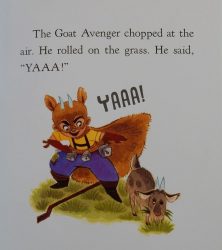
Consequently when the Goat Avenger (who bears a close resemblance to her pal Duff the goat boy), offers to take over goat-guarding

and keep watch against marauding monsters, thus allowing the black sporting princess to take a much needed holiday, she cannot resist the opportunity.

Bags packed, Princess Magnolia is off on her bike to the seaside.

However her much-needed rest and relaxation are short lived for even on the beach, a monster shows up, emerging from the waves to cause havoc and scare the sunbathers out of their wits.

Time, (while Goat Avenger is still bravely playing the hero back home), to grab that black garb, step up and do battle with the brute.

Of course, in the end, our resourceful princess does finally get that much-needed holiday sans monsters, sans screaming humans, just her and sand, sea, sunshine and the odd bit of shade courtesy of a few coconut palms.
Brimming over with action, humour –due occasionally to the princess not recognising her friends, as well as monsters of the not really scary variety, the Hale partnership has penned another great chapter-book adventure story for readers just flying solo that’s bursting with engaging, action-packed illustrations from LeUyen Pham to smile at. Equally though, plenty of in-built sound effects to let rip with, make it a super read aloud.

Also ideal for new solo readers is:

Hubert and the Magic Glasses
Candice Lemon-Scott and Joe Spellman
New Frontier Publishing

When it comes to soccer, young Hubert’s skills as goalie for the under 12s Goodview Primary Able Ants team leave a lot to be desired: at best he’s mediocre. But then his team itself isn’t likely to be under enormous pressure in their next match when they take on the Wandering Wombats, reputedly the worst team in the district.

We first meet Hubert as he sits in the changing room struggling to tie his own boot laces, so nervous is he feeling while the other players are already on the field warming up. However despite the lad letting several goals in, his team does manage to win that match.

Next, Hubert’s team have to play in the quarter finals – a real challenge against a decent team – but then at dinner Hubert is faced with yet another problem when his mum announces that she’s made an appointment for him to see an optometrist.

The verdict? Astigmatism and Hubert is prescribed glasses: he’s not happy.

Just over a week later though, as he’s attempting to eat his breakfast Hubert is finally persuaded to put on his glasses and from then on everything in his life takes on an altogether different view.

With a new version of their goalie, can the Able Ants eventually win through: after all those glasses of Hubert’s aren’t just ordinary ones.

Issues of confidence building, team relationships, taking charge of your life, peer pressure and more are embraced in this amusing pacy narrative that has cool colour illustrations by Joe Spellman sprinkled throughout.

Me and Mister P: Ruby’s Star

Me and Mister P: Ruby’s Star
Maria Farrer, illustrated by Daniel Rieley
Oxford University Press

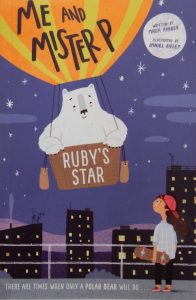
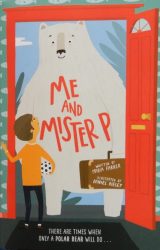
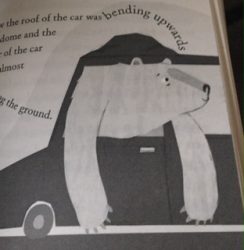
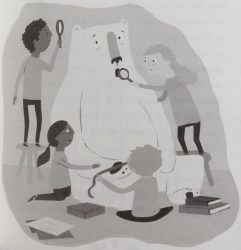
Mister P is back and now he’s dropped into young Ruby’s already packed life. With absent father, a mother and a little brother Leo to take care of, let alone attending school, her days and nights are pretty jam-packed and there certainly isn’t room in it, or their not very big flat, for a large white furry polar bear.

He’s certainly not what she had in mind when she made that wish for a birthday surprise. The trouble is, having drifted down in a hot-air balloon and landed in the nearby park, it doesn’t look as though he’s going anywhere in a hurry.
Thank goodness then for kindly neighbour, Mrs Moresby, who’s not averse to supplying the odd packet or so of fish fingers.

Activities as diverse as busking (to raise money to repay Mrs Moresby), and skateboarding (Ruby is a fan on account of her father and eager to improve her skills; Mr P. needs four skateboards and he’s pretty inept but determined) feature large and very large.

‘Perseverance, guts, determination, friends’ those are the requisites for Connor to be a skateboarder. They’re also what Ruby deems she needs to survive.

Survive she does and much more, emerging by the end, emotionally stronger, with a greater self understanding and generally an all round better person, thanks in no small part to Mister P. a character that utters not a word throughout the whole story, but also thanks to Mrs Moresby, an understanding headteacher and new friend Connor.

This fine book encompasses a number of themes including empathy, tolerance, acceptance and diversity, all of which are subtly woven into the story that also includes the needs of young carers. It’s beautifully illustrated by Daniel Rieley.

The Truth About My Unbelievable School…

The Truth About My Unbelievable School …
Davide Cali and Benjamin Chaud
Chronicle Books

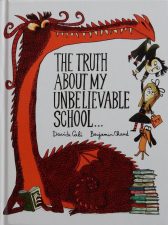
Henry returns in a new story, and on this occasion he’s charged with taking a new classmate on a tour around school. If you’ve met Henry previously, you’ll already know that he’s more than a little inclined to exaggerate. Here though he’s up to something different: “… there really isn’t much to see …” he tells the girl as he shows her the class pet – a gigantic jellyfish. She appears singularly unimpressed, as she does at the sight of the music teacher,

the art class in progress and the maths lesson.

Not even the long tentacles escaping from a part closed door, the short cut to the playground …

or the flying mashed potatoes in the cafeteria cause her to bat an eyelid.
After a few more stops including a Smaug-like den and the principal’s office (reached by rowing boat),

the two arrive back at their classroom just as their teacher is bidding the class farewell. Perfect timing. And then we get a wonderful surprise ending.

(Observant readers may well have noticed the odd clue as to what’s coming already, as well as enjoying the various literary allusions scattered throughout in Chaud’s wryly funny illustrations.)

Keep an eye on Henry’s dog: the animal seems to have muscled its way into the action and is sure to make readers smile.

Delicious fun and another likely winner for Cali and Chaud.

Little Guides to Great Lives: Nelson Mandela

Little Guides to Great Lives: Nelson Mandela
Isabel Thomas and Hannah Warren
Laurence King Publishing

Nelson Mandela is one of my all time heroes so I was particularly pleased to see this little biography aimed at children around the age of the class I was teaching (7/8) at the time he was released from prison in 1990. I remember we all got up and cheered and jumped around. Yes, we were quite political and had already done some work on apartheid and Mandela in class.

One of a new series, the book is written by Isabel Thomas in an accessible style for young readers.
It begins with a look at his village childhood when the young boy was named Rolihlahla (pulling the branch of a tree’ or perhaps ‘troublemaker’) and includes a local game.

After the death of his father, the teenage Nelson lived with the acting king of the Thembu people and became great friends with his son, Justice.

Brief details of his time as a university student lead on to running away to Johannesburg and, set against factual information of socio-political happenings, the events that took place up to and after he obtained his law degree; his work with the ANC against apartheid in particular, and his time (27 years) in prison, mostly on Robben Island.

The final pages tell of Mandela’s release from gaol, his leadership of the ANC, the scrapping of apartheid laws, his winning of the Nobel Peace Prize and his becoming the first president of South Africa to be elected by all the country’s people, ending with his death at 95 years of age in 2013.

There’s also a timeline and a glossary.

Hannah Warren’s retro style illustrations executed in a limited colour palette, using mainly the ANC colours, add to the book’s appeal.

Also in the series and equally worth seeking out is the story of aviation super star and women’s right pioneer:
Amelia Earhart

Isabel Thomas and Dàlia Adillon


The Misadventures of Winnie and Wilbur / Get Me Out of Witch School!

The Misadventures of Winnie and Wilbur
Laura Owen and Korky Paul
Oxford University Press

It’s good to have the ever-popular picture book duo, Winnie the Witch and her cat Wilbur, in another chapter book format edition.
This one has eight short stories, each one profusely illustrated by Korky Paul in his distinctive zany style.

In the first, Winnie gets her knickers in a bit of a twist when her new enterprise isn’t quite the resounding success she’d hoped, but then Winnie doesn’t exactly employ the kind of sales talk that will have her new products whizzing off the shelves.

No matter: the ingenious uses she finds for her unwanted wares are bound to give readers a good giggle.

The second story has Winnie cooking up a feast for her interfering sister Wilma. It’s not the special fresh batburgers she originally planned – she hasn’t the heart to serve up relations of her ’diddly bat’ friend – but, thanks to some timely assistance from Wilbur, Wilma leaves after supper thoroughly satisfied with her meal.
That should suffice to give you a flavour of the hilarious escapades within; the others being concerned with bothersome bubbles, a whopping great whale and other fishy findings, a car boot sale with a difference,

some high drama in a big top, extraordinary doings at a soccer game involving the odd bit of knicker elastic zapping and finally, a spot of excavating.
Sheer hilarity from beginning to end, and perfect read alone fare as well as a hoot to read aloud.

More witchy shenanigans in:

Get Me Out of Witch School!
Em Lynas, illustrated by Jamie Littler
Nosy Crow

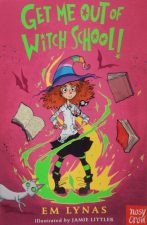
In the second book of Daisy Wart’s adventures at Toadspit Towers, Witch School of Conformity and Strickness, the reluctant young witch is now known as Twinkle Toadspit.
She’s yet to gain full control of her witchy powers and still holds ambitions to be an actress. But when she determines to rescue a ‘cute, cuddly kitten’ Twinkle inadvertently sets off a chain of chaotic happenings.
It’s down to Twinkle and her pals to save Toadspit Towers. Can they do so, and in time for the would-be star of stage to tour her “Bottom”?

Bursting with wonderful characters, this is total spellbinding fun to keep readers in suspense throughout. Equally it makes a thoroughly enjoyable read aloud for those not quite ready to fly solo. However it’s read, Jamie Littler’s illustrations add to the enjoyment.

Bad Nana Older Not Wiser

Bad Nana Older Not Wiser
Sophy Henn
Harper Collins Children’s Books

This is the first book in what is to become a series and it’s mega-talented Sophy Henn’s debut as a writer of profusely illustrated younger fiction. It certainly looks as though she had great fun creating the three wickedly funny episodes narrated by young Jeanie, age 7¾ about the outrageous exploits of the grandma known to the family as Bad Nana; she of the black dress, pointy black shoes and gigantic earrings, who carries a walking stick – not necessarily for that purpose – and a massive handbag crammed with everything from emergency knicker elastic to stinky fish paste. All this and more, including things about Nana’s friends and acquaintances

and some of her past escapades, we learn in the first part “Things You Should Know’.
One of Bad Nana’s favourite locations is the park and part two of the book tells of Bad Nana’s extremely mischievous way of dealing with the plethora of “DO NOT” signs put up all over the park by the new and inordinately officious park keeper; and then goes on to recount what took place when a sweet wrapper just happened to drift from her hand and land in front of said park keeper.

Bad Nana lends a hand in the final and longest part. She somehow manages to get herself engaged as a school-trip helper when Jeanie and her class visit the local history museum, probably THE most boring museum ever.
Not so however, when a certain trip-helper decides to well and truly bring local history to life by inserting herself into one of the displays.

The whole episode is utterly hilarious and had this reviewer spluttering with laughter all the way through.

Sophie’s distinctive narrative voice in tandem with her splendiferous artwork makes for a stonklingly good chapter book for primary readers whether or not they cut their teeth on Pom Pom and her other picture book characters.

Mabel and Sam at Home

Mabel and Sam at Home
Linda Urban and Hadley Hooper
Chronicle Books

It’s moving day for Mabel and Sam and things look pretty chaotic from the viewpoint of the siblings.

To keep out of the way of the grown-ups they embark on a series of adventures related in three chapters. The first is ‘On the High Seas’ and here Captain Mabel and First Mate Sam set out in the good ship Handle With Care. Bossy sis. gives the orders as they go sailing on the high seas, a dangerous voyage full of pirates, whales and sea serpents

until they spy some friendly landlubbers, after which it’s “All ashore” for some tasty pizza.
‘At the Museum’ has curator Mabel showing Sam new ways of looking at old familiar things: the dialogue here is especially wonderful with Mabel “Behold“ing at every opportunity as she introduces the various artefacts to her brother.

Finally, after supper the two become astronauts blasting through space heading for Planet Perfecto and for this they need to be especially bold, “Space Bold” Astronaut Mabel declares, “Space Bold is bigger, because space is bigger.

Linda Urban’s entire text is a delight – funny, full of charm, reassuring and cleverly structured so as to embrace the kind of things that cause young children moving day anxieties; and before the end, the children are feeling upbeat about the move with Mabel concluding that their ‘new planet was surprisingly homey’.
Hadley Hooper’s illustrations (created with printmaking techniques and Photoshop) are, like the siblings’ adventures, wonderfully imagined, both in their rendering of the children’s adventures and the portrayal of the somewhat frazzled parents at the end of the book.
Just right for sharing with a child or children moving home.

Arlo, Mrs Ogg and the Dinosaur Zoo / Why is the Cow on the Roof? & Smart Girls Forever

Arlo, Mrs Ogg and the Dinosaur Zoo
Alice Hemming, illustrated by Kathryn Durst
Maverick Arts Publishing

At Purple Hill primary School there’s yet another supply teacher in 4X; they’ve gone through quite a few already so the question is, how long will the strange-looking Mrs Ogg survive, particularly when she decides to take the class on an outing – their first ever – to the zoo? Can she possibly keep seventeen unruly children under control for a whole day? It’s particularly important, for their attendance at the end-of-year party depends upon the trip being 100% trouble free.
Arlo decides it’s unlikely, so he assigns himself the role of chief back-up.

Mrs Ogg however is no ordinary supply teacher and the zoo she’s taking them to is no ordinary zoo, which probably accounts for the inclusion on the ‘don’t forget’ letter sent to parents just prior to the trip, of a T-bone steak.

Is the outing a success and do they arrive back at school with all seventeen children plus teacher safe and sound? And, are they allowed to go to that eagerly anticipated end-of-year party? You’ll have to get hold of a copy of this action packed story and find out.

With its twisting-turning plot, it’s certainly lots of fun. Packed with zany illustrations by Kathyrn Durst

and promises of further adventures to come, let me just say, there’s a whole lot more to class 4X than previous teachers had thought: Mrs Ogg manages to unearth a whole lot of hidden talents therein.

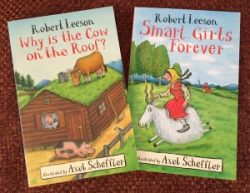
Why is the Cow on the Roof?
Smart Girls Forever

Robert Leeson illustrated by Axel Scheffler
Walker Books

These two books of short stories were first published 20 years ago and they’re as amusing now as ever – great for reading aloud or for solo reading.

Why is the Cow on the Roof? is one of the five folk tale based renditions in the first book, the story being based on the Norwegian, ‘The Husband who was to Mind the House’ and is a hilarious account of what happens when a husband and wife swap their round of daily tasks to see who works hardest.

The other four stories also pose questions including ‘Why are you such a Noddy, Big Ears?’ and “Who’s Next for the Chop?’, the former, a pourquoi tale being based on a Native American ‘Rabbit’ character and the latter from a story in the Arabian Nights..

In each case, Leeson’s renditions are full of humour with plenty of dialogue used to great effect; if you’re reading them aloud to a group, don’t forget to share Axel Scheffler’s funny line drawings that introduce each story.

Smart Girls Forever contains six tales from various parts of the world, all of which have resourceful female lead characters; they are, Leeson tells us ‘Russian, Indian, Irish, Scottish, Persian and English’ but ‘could be from anywhere’.

Look out for Natasha who outwits the devil and Oonagh who gets the better of the terrible giant Cucullin, an act for which her husband Fin M’Coul will be forever grateful.

Timeless Tales: I Really Want to See You, Grandma / I Wish I Was Sick, Too!

I Really Want to See You, Grandma
Taro Gomi
Chronicle Books

First published in Japan (the home of the book’s creator), in 1979, this story about a small girl and her grandmother and their efforts to see one another is now available in English for the first time.

Yumi and her Grandma live some distance apart, Yumi on a hill, her grandma on a mountain, and simultaneously each decides to visit the other – why they didn’t ring one another one can only assume is due to there being no mobile phones in those days.

They both leave home in upbeat mood, Yumi boarding a bus, her Gran taking a train.

Both arrive at the other’s home to discover the muddle and head back to their own homes …

missing each other again.

Will they ever get to meet or are they destined to spend the day passing each other on the way?

Gomi’s illustrations fill in much of the detail not mentioned in his simple text: ‘How come she was allowed to go on a bus without a grown-up?’ my listeners wanted to know after hearing this story of mix-ups and changing emotions.

Those in the early stages of becoming readers may well be able to try this one for themselves having heard the story read aloud first.

I Wish I Was Sick, Too!
Franz Brandenberg and Aliki
The New York Review Children’s Collection

I first came across this book as a young teacher in its Picture Puffin incarnation, I Don’t Feel Well.

It features sibling kittens, Elizabeth and Edward. Elizabeth is resentful of the attention her brother receives when he’s ill in bed. “It isn’t fair! … I wish I was sick, too!” she says.
When her wish comes true a few days later, she realises that, rather than all the attention received, it’s as her brother says, “The best part of being sick is getting well.

Aliki’s chalky illustrations capture the emotions of the infant cat characters superbly and the story’s as amusing now as it was over three decades ago.

Share and enjoy no matter the state of the listeners’ health; equally, with its clear print and inviting layout, it’s a good book for solo readers to try for themselves.

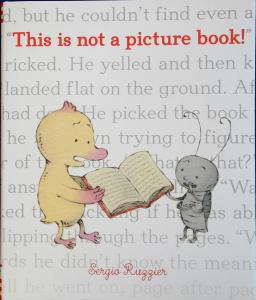
Testing Friendships – Fox & Chick: The Party and other stories / Rabbit and Hedgehog Treasury

Fox & Chick: The Party
Sergio Ruzzier
Chronicle Books

Let me introduce Chick and Fox. Fox is an equable character who enjoys reading, cooking and painting; Chick, in contrast, is totally irrepressible – a bit of a pain to say the least. Surprisingly these two are friends. They star in three comic style episodes aimed at those just taking off as readers.

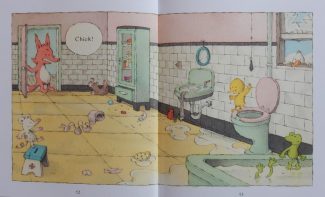
The first story (which gives the book its title) is I think the funniest. Chick calls on Fox, gains entry asking to use the bathroom and then proceeds to throw a party for his pals therein.

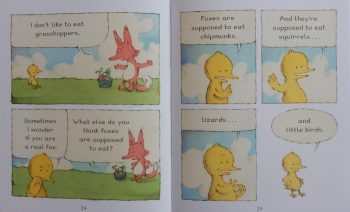
In the second story, Good Soup, Chick gives Fox a hard time about his vegetarian predilection wondering why he eschews frogs, small furry creatures, grasshoppers and er, little birds as ingredients for his soup.

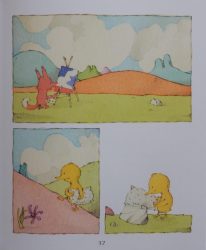
Finally, Sit Still focuses on Chick’s total inability to do just that , leaping up every few minutes for a cushion, food and a drink while Fox endeavours to paint his portrait.

How long-suffering Fox puts up with Chick is anybody’s guess: – shades of Lobel’s Frog and Toad here – but their interactions are highly amusing, the text very readable and the illustrations rendered in pen, ink and watercolour are wonderfully expressive and enormously engaging.

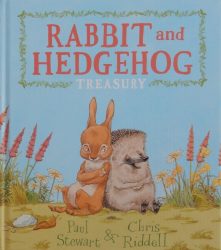
Rabbit and Hedgehog Treasury
Paul Stewart & Chris Riddell
Andersen Press

I’ve been a huge admirer of Stewart and Riddell’s Rabbit and Hedgehog since A Little Bit of Winter (one of the four tales included here) was published about twenty years ago. If you’ve not met these two enchanting characters then this book of four stories is a great opportunity to get to know these two and the challenging nature of their friendship: one is awake all day and the other all night.

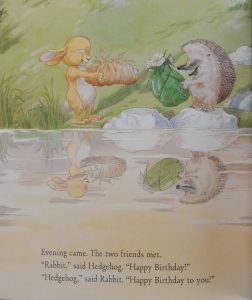
In the first neither of the best friends knows the date of his own birthday let alone each other’s. To be on the safe side they decide to celebrate the very next day and each goes about finding a very special gift to give the other.

Rabbit’s Wish is the second story but when he wishes that hedgehog will stay awake so they can spend a whole day together, the outcome is not quite what was anticipated.

In the third episode a remembering game tests the friendship between the two protagonists but an accident serves to remind them of the strength of their bond.

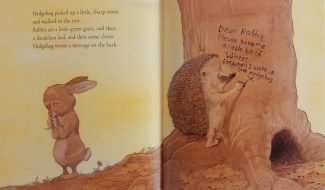
The final A Little Bit of Winter sees the friends facing another challenge. As Hedgehog prepares to hibernate he carves a message on the bark of an oak tree asking the somewhat forgetful Rabbit to save him a little bit of winter so he can find out what the season he’ll sleep through is really like.

Despite the chilly nature of the season, it’s a truly heart-warming story and like the others, beautifully and sensitively illustrated.

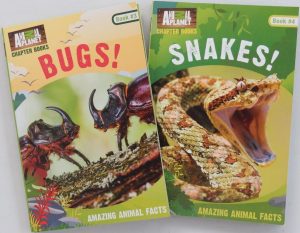
Animal Allsorts: Bugs!, Snakes and The Zoological Times

Bugs!
Snakes!

James Buckley, Jr.
Liberty Street

Animal Planet have added two new titles to their Chapter Book series of non-fiction titles for newly independent readers. With eleven chapters per book, they are absolutely packed with information, every spread has at least one coloured illustration; there is clear labelling and sidebars such as ‘In your newsfeed’
Bugs begins with insect anatomy and life cycles and then moves on to look at a variety of insects. There are chapters on dragonflies; mantids and phasmids (stick insects); beetles; mosquitos, flies and fleas; butterflies and moths and ants share a chapter with bees and wasps.
There are also chapters on life cycles, food and feeding, movement and insect senses and throughout the facts are presented in an interesting, fun way but there isn’t a hint of talking down to the reader.
The whole look is one that says, ‘read me’.
The same is true of Snakes! wherein readers encounter the fastest, longest, heaviest, largest

and most deadly snakes – beware of elapids such as cobras, mambas and death adders in particular.
Did you know that some snakes swim, a few are amphibian and others can climb trees? Fascinating and exciting.

The Zoological Times
Stella Gurney and Matthew Hodson
Lincoln Children’s Books

Following on from The Prehistoric Times comes a new edition of their exciting newspaper style books that offer a fun way of learning especially for those who are keen on the comic format. Now hot off the press is a look at the animal kingdom and it’s chock full of exciting information, black and white photos, wacky illustrations, puzzles, games and activities; there’s even a problem page.
Animal conservation is an issue for us all and this is addressed here too.
In brief, educative and enormous fun.

Distinctly Different Chapter Books – Fabio: The Case of the Missing Hippo & Akissi: Tales of Mischief

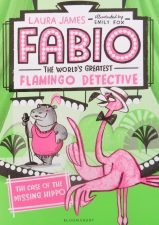
Fabio: The Case of the Missing Hippo
Laura James, illustrated by Emily Fox
Bloomsbury Children’s Books

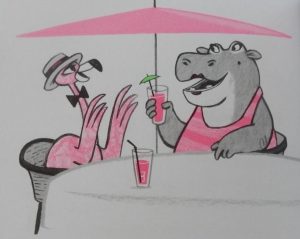
Resident of a small town on the banks of Lake Laloozee lives Fabio the world’s greatest flamingo detective: slender, pink and extremely clever.

When Fabio and his associate Gilbert the giraffe stop at the Hotel Royale for a cool glass of pink lemonade,

he allows himself to be persuaded to head judge the hotel’s talent competition, a competition intended to boost its business.

Disaster strikes however when Julia, the jazz-singing hippo and most promising of the contestants, takes to the stage and as she does so, the lights go out and Julia goes missing.

The police are called but it’s time for Fabio to put that thinking cap of his back on, hone his questioning skills and set about solving the mystery and one or two more that crop up along the way.

Delicious comic humour that will delight young readers and listeners, day-glo greens and pinks to dazzle in Emily Fox’s delicious illustrations and a layout that’s just right for newly confident readers, this comedy cum mystery looks – just like Julia – set fair to captivate its audience.

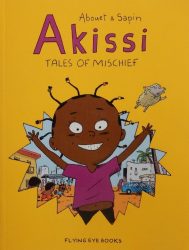
Akissi: Tales of Mischief
Marguerite Abouet and Mathieu Sapin
Flying Eye Books

This bumper graphic novel style edition contains 21 episodes featuring Akissi, a little girl who lives in a town on the Ivory Coast. This spirited miss is supremely self- confident and frequently finds herself getting into trouble for misdemeanours often involving her brother Fofana or her friends.

Her far from exemplary behaviour finds her engaging in such activities as ‘borrowing’ a neighbour’s baby for a game of “mums”; adopting as a pet a mouse that causes all manner of problems; barging her way into the boys’ football games and generally getting into fights and scraps.

During the course of all these mischievous scenarios and more, readers learn not only about the main protagonist, but also about her family and her life – in one story she gets tapeworm; another describes her being responsible for her nan getting knocked out by a falling coconut; there’s also a ‘head-lice’ episode and toilet humour too.

And if your stomach is feeling up to it, there are a couple of bonus recipes courtesy of Akissi, as well as instructions for hair braiding African style.

A comic book hero who could surely give Dennis the Menace a run for his money – memorable and for many I suspect, irresistible.

I’ve signed the charter  

A Different Dog

A Different Dog
Paul Jennings
Old Barn Books

When I taught children in KS2, Paul Jennings was one of our favourite authors. His short stories from Unreal, Uncanny, Unbelievable etc. and with younger audiences,The Cabbage Patch Fib, were always much requested both as class read alouds and for individual consumption.. I’ve not kept up with his output of late but was instantly drawn into this one and read it in a single sitting.
It’s a novella, quite unlike any Jennings’ I’ve read before and for such a short book, it spans a great many themes including poverty, loss, cruelty, bullying, trauma and its effects, determination and resilience.

The boy narrator is something of a loner; he doesn’t speak and is tormented by other children. The story opens with him dressing himself in his mother’s pink parka, adding a black bin bag on top and setting out to take part in a charity fun run, determined to win for his mother’s sake especially.

En route to the venue in treacherous weather, the boy sees a road accident and although he is unable to save the driver of the van, he is determined to see the dog to safety.

His subsequent journey, both physical and mental is gruelling yet ultimately uplifting.

Compelling and tersely written – every word counts –this is a book to hold you in its thrall even after you’ve put it aside. Geoff Kelly’s black and white illustrations are atmospheric and powerful.

This is a book that deserves to be shared and discussed widely in school, at home, by teachers and other educators, those who work as speech-language pathologists, (I was interested to learn that the author has worked in this field) and in particular, it offers rich potential for a ‘Community of Enquiry’ type discussion.

I’ve signed the charter  

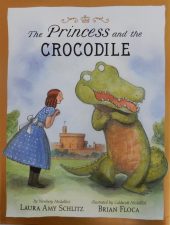
The Princess and the Crocodile

The Princess and the Crocodile
Laura Amy Schlitz and Brian Floca
Walker Books

Cossetted from the start, the ‘perfect’ being that is Princess Cora is then – once the realisation dawns on her doting parents that she’ll one day be the ruler of the land – scheduled for every single minute of her time for fear she won’t measure up to the task.

A nanny is hired to ensure she’s always neat and clean – a three baths a day regime is introduced; and when she’s not in the tub, her mother is making her life a misery with deadly dull tomes or her father subjecting her to a gruelling fitness regime.

One night though the girl decides a dog might just make her life bearable but neither her parents nor the nanny are willing to entertain such an idea. In desperation the Princess writes to her fairy godmother and then rips the letter to pieces and tosses them out of the window. Here Schlitz injects a lovely magical touch “because it was a letter to her fairy godmother, every scrap turned into a white butterfly and flew away’.

Perhaps though she isn’t sufficiently specific in her request for the following morning what should be at the foot of her bed but a gift-wrapped crocodile.

The two strike a deal. For a day, in exchange for cream puffs the crocodile will take Cora’s place giving her a day of sheer unadulterated freedom.
First though there’s the issue of a suitable disguise: that comes in the form of a frilly frock and mop wig together with a promise not to eat anyone.

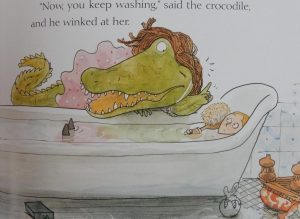
The creature keeps his promise while managing to create utter havoc around the palace with an appropriate degree of ferociousness: dunking in the tub and nips for the nanny,

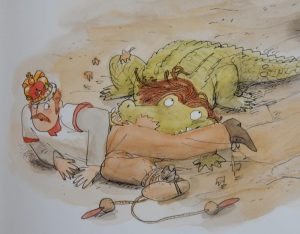
insults and nips for the Queen and lashings, clawings, bitings …

and incarceration for the King, allowing Cora a wonderful day outdoors being thoroughly wild,

getting messy, wet, and even managing to step in a cowpat.

Witty writing and delicate yet energetic, and often very funny illustrations, make for a wonderful read aloud or read alone chapter book. Either way, I imagine a good many listeners or readers wanting to devour this whole riotous neo fairytale in a single sitting.

Enchanting from begin to end. A book that will appeal to those who love princesses, justice, a good giggle and even perhaps, crocodiles. The latter will certainly love the one herein.

The Princess and the Suffragette / The Song From Somewhere Else

The Princess and the Suffragette
Holly Webb
Scholastic Children’s Books

This is a sequel of sorts to one of my childhood favourite reads, Frances Hodgson Burnett’s A Little Princess.
It centres on one of the characters from the original story, Lottie, now ten, who has lived at Miss Minchin’s school since she was four.

Now, a few years on, it’s 1911, when the suffragette movement is on the rise, Lottie finds herself becoming friends with one of the maids at the school, a girl named Sally who is interested in the rights of women.
During the next couple of years she also finds herself getting more rebellious and more involved in suffragette activities.

In tandem with her burgeoning rebellion, Lottie discovers that there’s a mystery surrounding her mother, and that what she’d been led to believe about her isn’t the truth.

There’s frankness about Holly Webb’s writing that makes the whole story feel genuine and well researched. She doesn’t avoid mentioning the suffering and brutality that some members of the suffragette movement underwent; and one hopes, her deft manner of talking about it will inspire young readers to understand the importance of standing up for what they believe to be right.


The Song From Somewhere Else
A.F.Harrold, illustrated by Levi Pinfold
Bloomsbury Children’s Books

Here’s a book that is both beautiful and alarming, terrifying even at times.

Frank (Francesca Patel) is stalked and bullied by the local nasty, Neil Noble, and a couple of his pals; but then a rather odd boy, Nick Underbridge comes to her rescue. You might expect that the girl would be greatful, indeed she knows she ought to be, but at school Nick is said to be smelly and so not exactly the kind of person she’d want any involvement with.
However, for safety she goes back to his house with him intending merely to thank him and leave. It’s a rather strange house – not what she’d expected – filled with abstract painting done by Nick’s dad; there’s a rather strange earthy aroma pervading the place and suddenly she hears music. It’s the most haunting and beautiful music she’s ever heard; and she wants more of it and more, and more. And so, she returns.

What happens thereafter is the development of an unlikely but challenging friendship, and the discovery that within Nick’s home are secrets.

There’s a talking cat involved too.

Part reality, part fantasy, this story is absolutely wonderfully and lyrically told, and entirely convincing – the stuff of dreams, the stuff of nightmares both.
And Levi Pinfold whose images – dark, mysterious and haunting – are a fine complement to Harrold’s telling, equally beautifully illustrates it.

Totally captivating: a magical book to return to over and over.

Secret of the Ron Mor Skerry / The Night of Wishes

It’s great to see The New York Review of Books bringing forgotten children’s books back for a new audience; they have some wonderful titles on their list. Here are two recent ones:

Secret of the Ron Mor Skerry
Rosalie K. Fry
New York Review Children’s Collection

As a child I was an avid collector of Puffin Books and had one with a Welsh setting called Snowed Up by Rosalie Fry, so her name rang a bell when I received this review copy.
It’s a tale of erstwhile city dweller, ten year old Fiona McConville who goes back to live with her grandparents in a village on the Scottish coast.
With her she takes memories of her lost little brother Jamie whose cradle had been swept from the shore of Ron Mor several years before, and disappeared at sea.
From her Grandfather she learns that fishermen tell tales of a child of the seals; could this possibly be her lost brother? Fiona determines to find out.
Poetically told and imbued with folklore of the Western Isles, and illustrated with line drawings by the author, this magical tale was the basis for the classic film, The Secret of Roan Inish.
It’s a small treasure.

The Night of Wishes
Michael Ende illustrated by Regina Kehn
New York Review Children’s Collection

It’s New Year’s Eve; Shadow Sorcery Minister Beelzebub Preposteror is in his laboratory when he discovers he has a visitor. It’s one Maledictus Maggot, come to remind him that he has only until midnight to fulfil his contractual obligations re pollution, extinction of species, tree destruction, plague and devastation, or have his powers rescinded – a ‘personal foreclosure ex-officio’ is how Maggot puts it.
There is seemingly, only one way to avert this terrible fate; Beelzebub must collaborate with his aunt Tyrannia Vampirella (who has also received a similar ultimatum) in the brewing of the ‘Satanarchaeolodealcohellish Notion Potion’. This dastardly and powerful spell will, on New Year’s Eve alone, grant its imbiber a wish for every glass downed in a single gulp.
Can the two possibly accomplish the task in the face of an attempt to counter the plan from animal spies, Beelbezbub’s cat Mauricio and Tyrannia’s raven Jacob, and hence save the world from destruction?
Written by the author of The Neverending Story and translated by Heike Schwarzbauer and Rick Takvorian, this twisting, turning comic fantasy of good versus evil should enthral older readers, who will appreciate the word play and injections of verse. Regina Kehn’s wonderful illustrations, and the ticking clocks throughout, add to the atmosphere.

Seasonally Flavoured Fiction

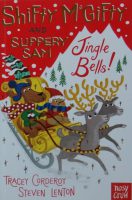
Shifty McGifty and Slippery Sam: Jingle Bells!
Tracey Corderoy and Steven Lenton
Nosy Crow

If you’ve yet to meet comedic twosome, the wonderful baker dogs Shifty McGifty and Slippery Sam I urge you to do so with this book of three stories. Shifty’s the more industrious, of the pair; Sam means well but tends to lack his pal’s organisational skills.
In the first story, the dogs have been commissioned to create Santa’s Christmas cake and deliver it to him the same afternoon. No easy task especially with next-door neighbour Red Rocket determined to create mischief at every opportunity.

The other two tales, Sea-Monster Ahoy! and The Lucky Cat aren’t Christmassy but they are equally good fun and all are perfect for those just taking off as independent readers, who will particularly relish Steve Lenton’s lively scenes of the canine mystery solvers at work.

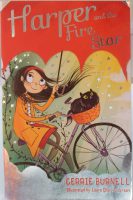
Harper and the Fire Star
Cerrie Burnell illustrated by Laura Ellen Anderson
Scholastic

Harper, the girl endowed with a rare musical gift, who resides in the City of Clouds and is able to play any instrument she picks up without learning a single note, returns in her 4th adventure and once again it’s full of music, magic, friendship and gentle humour.
In this story, the Circus of Dreams (Harper’s birthplace) is back in town and as well as seeing her parents, Harper has something important she wants to do and that is to help the Wild Conductor win back his place in the magical show. Why he wants to do so is a mystery to Harper and her friends, nevertheless they put on an amazing show but things don’t quite go according to plan.
Then they learn exactly why getting back into the circus is so important to the Wild Conductor: it’s on account of his love for a girl named Fire Star, so called because ‘whenever she heard music she began to shine like a star.’
Adding to the fun of the tale are Laura Ellen Andersen’s sparkly illustrations.
Always ready to help others, Harper is a delight.

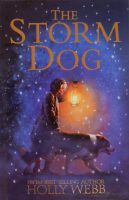
The Storm Dog
Holly Webb
Stripes Publishing

Young Tilly and her mum are going to stay with her Grandma and Great-Gran over Christmas but when work delays her mum, Tilly travels ahead alone on the train.
Great-Gran (almost ninety) has sent Tilly a parcel to open on the train and inside she discovers a Christmas tree decoration and a photo.
Soon, lulled by the motion of the train, Tilly starts to doze and finds herself back in the time when it was her Great-Gran taking the journey as an evacuee more than seventy years back. (Tilly is learning about World War Two for a school project.) She then re-lives some of Great-Gran’s evacuation experiences along with her two younger brothers who also stayed at Mr Thomas’ farm on the Welsh borders, attended the village school, tended the farm animals, had their first experience of snow and sledging, and prepared for the Christmas season..
Tilly forms a special friendship with Tarran, Mr Thomas’ sheepdog and it’s he that plays an important role on more than one occasion.
Gently told, the twisting, turning adventure draws you in right away and keeps you entranced right through to the end. It’s great for giving young readers an insight into life in WW2, especially those who, like Tilly, are learning about the period at school. Line drawings by Artful Doodlers, several per chapter, are scattered throughout the story, further adding to the reader’s enjoyment.

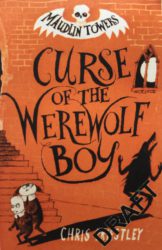
Curse of the Werewolf Boy
Chris Priestley
Bloomsbury Children’s Books

This had me gripped from the start. Essentially it’s a boarding school parody of the Gothic kind and its stars, or rather heroes – neither seems to quite fit the bill – Arthur Mildew and Algernon Spongely-Partwork aka Mildew and Sponge are pupils at Maudlin Towers School, by all accounts a pretty awful establishment for the ‘Not Particularly Bright Sons of the Not Especially Wealthy’.
Returning after a half-term holiday, the pupils are informed that a terrible crime has occurred: the School Spoon (once owned by the school’s founder) has been stolen and the headmaster threatens terrible consequences for the culprit(s).
Who better for a spot of detectivating than Mildew and Sponge who are about to learn that crime solving isn’t as easy as they might have thought. Particularly when there’s a ghost in the attic, not to mention a Viking wandering around, a history teacher, one Mr Luckless who has a ‘temporo-trans-navigational-vehicular-engine’ (a time machine to you and me); even a werewolf boy (but you’d expect that from the title), and more.
It’s not only the lead crime solvers who are splendid; every single character is wonderful be they pupil or teacher – you can meet the whole cast at once via the role of honour board at the start of the story. With staff names such as Mr Particle actually newly deceased when the story opens; you can guess what subject he taught, Mr Stupendo and the Latin speaking Miss Livia; and Enderpenny and Furthermore numbering among the pupils.
Then there’s the narrative itself which is peppered with such deliciousness as:
I know what a ha-ha is, you nose hair,” said Kenningworth … ; and
… Mildew’s upper lip began to lose some of its structural integrity…”;
a brilliantly controlled plot that twists and turns while keeping readers totally engrossed throughout its mock scary entirety; and if that’s not enough, the book is chortle-makingly illustrated by none other than Chris Priestly himself.
Why am I including this story in a Christmas review, you might be wondering: that’s for me to know and for you to discover when you get hold of a copy of this cracker of a book.

With Giving in Mind

Little Hazelnut
Anne-Florence Lemasson and Dominique Ehrhard
Old Barn Books

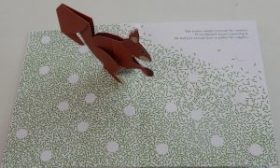
What a simply gorgeous presentation is this tale of a hazelnut dropped by squirrel …

and buried by a heavy snowfall.
Other woodland animals, furred and feathered, come and go but the nut remains undiscovered.
In the spring, a little tree shoot emerges – literally – and a sapling begins to develop: a little nut tree, no less.

Readers are taken on a journey through the changing seasons in this wonderfully crafted pop-up story. The limited colour palette and occasional patterned backgrounds are most effective and the paper-engineering superb.
A book to share, to treasure and to give.

Greatest Magical Stories
Chosen by Michael Morpurgo
Oxford University Press

Michael Morpurgo has selected a dozen magical tales from different parts of the world for this collection, the final one of which, Jack and the Beanstalk is his own retelling. This first person telling from Jack Spriggins aka ‘Poor Boy Jack’ is especially engaging for young listeners. Morpurgo also provides an introduction as well as an introductory paragraph to each story.
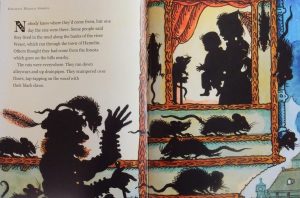
Ten illustrators have been used with Victoria Assanelli and Bee Willey having two tales each. Most arresting as far as I’m concerned are Ian Beck’s wonderful silhouettes for Adèle Geras’ rendition of The Pied Piper.

From Japan comes Yoshi the Stonecutter, retold by Becca Heddle and beautifully illustrated by Meg Hunt, the only non-European offering.
Cinderella, Sleeping Beauty and Jack and the Beanstalk are ‘almost part of our DNA’ says Morpurgo in his introduction: they are universal.
Perhaps not a first collection but this read aloud volume is certainly one worth adding to a family bookshelf or primary classroom collection.
Not included in the above but certainly magical is:

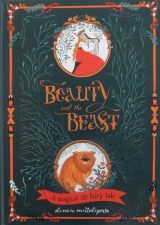
Beauty and the Beast
illustrated by Dinara Mirtalipova
Templar Publishing

To satisfy his youngest daughter’s wish, a merchant steals a rose from the garden of a hideous-looking beast and Beauty, to save her father’s life, goes in his place to the Beast’s palace, falls in love with him and well, you know the rest.
The classic fairy tale is retold in a truly beautiful rendition – a feat of paper-engineering and lavish, cut out illustrations by self-taught illustrator Dinara Mirtalipova.

She has created six multi-layered scenes by using three layers of paper cut to look 3D, so that each spread simply springs into life when the page is turned.
Magical!
I really had to exercise my powers of persuasion to get one listener to part with my copy after we’d shared it.

A Child’s Garden of Verses
Robert Louis Stevenson, illustrated by Michael Foreman
Otter-Barry Books

I clearly remember my father reading Robert Louis Stevenson poems from A Child’s Garden of Verses on many occasions; most notably Rain. The Swing, From a Railway Carriage, Autumn Fires, Where Go the Boats? and my very favourite, Windy Nights (which I still know by heart).
Here’s a beautiful book of those same poems that were first published in 1885, and a century later illustrated by Michael Foreman, beautifully packaged with a foreword by Alexander McCall Smith for a new generation of listeners and readers.
For me Foreman is the perfect illustrator for the poems, his watercolours imbuing them with a sense of timelessness and innocence. One for the family bookshelf.

Space Adventure Activity Book
illustrated by Jen Alliston
Button Books

There’s plenty to engage young children during the long winter evenings in this space-themed activity book. There are things to count, to colour and to make; plenty of puzzles, wordsearches and more, plus 4 pages of stickers. All you need are pens, pencils, scissors, a paper plate or so, a couple of sponges and 2 rubber bands (to convert your shoes to moon boots) and some basic ingredients for the Stellar Cakes (plus the help of an adult).
With 60 pages of spacey fun, this should help fill a fair few hours of darkness.

Halloween Briefing: Monsters Galore and a Witch or two

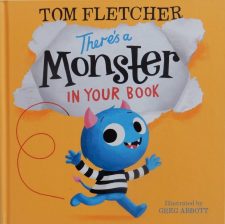
There’s a Monster in Your Book
Tom Fletcher and Greg Abbott
Puffin Books
Here we have one of those interactive picture books that are in vogue at the moment and it comes from the co-writer of The Dinosaur That Pooped series.
The book is invaded by a rather cute-looking little monster that seems intent on wrecking the whole thing. ‘Let’s try to get him out,’ suggests the narrator which is clearly a good idea.
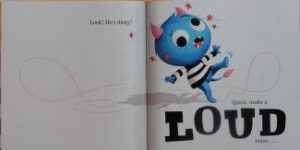
Readers are then asked to shake, tickle, blow, tilt left, then right, wiggle and spin the book, turning the page after each instruction. All the while the monster lurches this way and that around a plain background looking far from delighted at the treatment being meted out to him.
None of this succeeds in dislodging the creature but he’s definitely feeling dizzy so loud noises come next; then even louder ones.

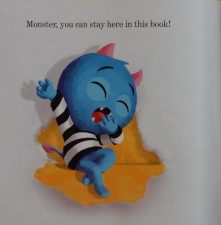
This works but ‘Now he’s in your room!’ That’s even worse than being contained within the pages, at least from the reader’s viewpoint, so now the idea is to gently coax him back into the book. There he can stay while receiving some tender head stroking and a soft ‘goodnight’ until he falls fast asleep. Ahh!
With Greg Abbott’s cute, rather than scary monster, this is a fun book to share with pre-schoolers particularly just before their own shut-eye time; all that shaking and shouting will likely tire them out making them feel just like this.

SHHHH!

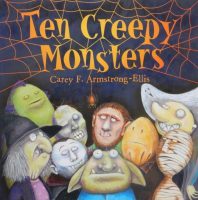
Ten Creepy Monsters
Carey F. Armstrong-Ellis
Abrams Books for Young Readers
Here’s a gigglesome twist on the nursery countdown featuring a mummy, a witch, a ghost, a werewolf, a vampire and others who, having gathered ‘neath a gnarled pine’ begin to disappear until only one remains. But what sort of creepy monster is that? Be prepared for a surprise.
Trick or treaters, if mock scary ghastly ghouls are your Halloween thing then look no further than this gently humorous, little paperback offering.

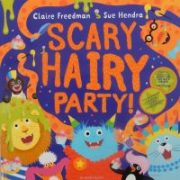
Scary Hairy Party!
Claire Freedman and Sue Hendra
Bloomsbury Children’s Books
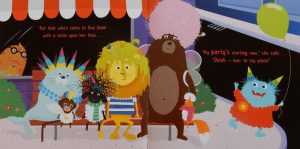
Monster’s having a party; it’s at 3 o’clock and all her friends are invited. Fortunately they’ve just got time to nip into Raymond’s salon for a hairdo first.
Seemingly Raymond’s not on top form however, as one after another receives a style disaster.

What on earth is Monster going to say when she sets eyes on her pals with their new make-overs?
Light-hearted rhyming fun illustrated with crazy, brighter than bright scenes of barnet mayhem: just right for those youngsters who like their Halloween stories to be on the silly, rather than the spooky side.

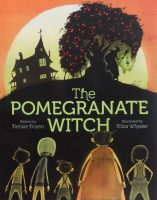
The Pomegranate Witch
Denise Doyen and Eliza Wheeler
Chronicle Books
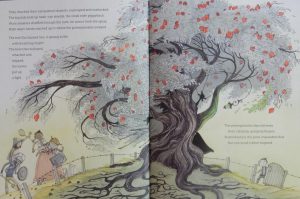
A deft rhyming text, imbued with spookiness and replete with rich language, tells a tale of how five children desperate for a pomegranate from the witch’s tree, and armed with all manner of unlikely implements, do battle with its owner to get their hands on a tasty treat from its branches. A veritable Pomegranate War is waged …

until finally, one of children succeeds in bagging the object of their desires and they each have a share of the spoils.
The following day, Halloween, a Kindly Lady (the witch’s sister) appears to offer cider and a celebratory surprise fruit to all the town’s children: ‘And not one child wondered who was who, or which was which. / The shy old Kindly Lady or the Pomegranate Witch.’
Surely they couldn’t be one and the same – or could they?
Not for the very youngest listeners but a fun read aloud for KS1 audiences. As your listeners savour Denise Doyen’s story, make sure you allow plenty of time to enjoy Eiiza Wheeler’s delightfully quirky ink and watercolour illustrations.

For older solo readers:

Witch Snitch
Sibéal Pounder, illustrated by Laura Ellen Andersen
Bloomsbury Children’s Books
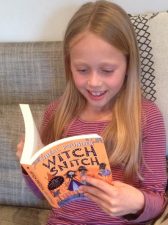
The (Witch Wars) Sinkville witches are preparing for Witchoween and it’s the first Tiga will experience. This is especially exciting as Peggy has asked her and Fran to make a documentary about the town’s most famous witches. With Fluffanora acting as fashion adviser, what more could she ask?
This book with its numerous activities, facts and character information as part and parcel of the narrative, is sure to make you giggle. So too will Laura Ellen Andersen’s line drawings.

Barkus / Lulu Gets a Cat

Barkus
Patricia Maclachlan and Marc Boutavant
Chronicle Books
Meet large brown dog, Barkus, “Smartest dog in the whole world.” So says globetrotting Uncle Everton when he arrives on the doorstep one day with what he calls “a present” for the young narrator, his niece Nicky. Nicky is reassured to learn that Barkus doesn’t bite and thus begins a beautiful friendship.
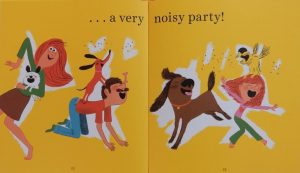
Over the next four short chapters we learn how Barkus follows Nicky to school and is adopted as the class dog; celebrates his birthday in a very noisy manner;

discovers a kitten and is allowed to keep it, naming it Baby; and finally, camps out for the night and enjoys an autobiographical story by torchlight.

The five amusing episodes are linked but the separate events provide suitable stopping points for readers just embarking on early chapter books.
Marc Boutavant provides appropriately cheery, retro style illustrations that range from full page to vignette.
All in all an upbeat, engaging read about family, friendship and the benefits of having a winningly positive attitude to life and its possibilities.

Lulu Gets a Cat
Anna McQuinn and Rosalind Beardshaw
Alanna Books
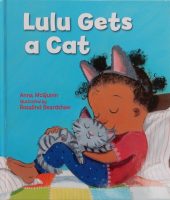
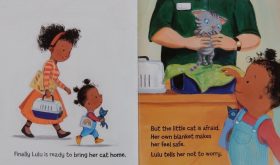
In her latest story Lulu wants a cat and sets about showing her mum that she’s ready to have one by doing some research on their care and putting in some practice on her cat toy. Eventually Mum is persuaded and off they go together to the cat shelter.

There, Lulu doesn’t so much choose a cat, but is chosen by one of those she’s shown.
Cat shelter worker, Jeremy provides some helpful advice; they go home and make preparations; and return next day to collect the new pet. Lulu gives her cat the beautiful name, of Makeda, which means African Queen and after a period of adjustment, it’s not long before Makeda is well and truly settled into her new home.

Lulu never fails to delight: this new story, endorsed by the National Cats Adoption Centre, ticks all the boxes for showing the very young that becoming a pet owner involves considerable responsibility, as well as introducing the basics of adopting a cat.

I’ve signed the charter  

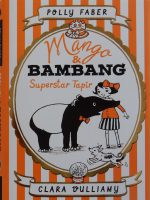
Mango & Bambang Superstar Tapir

Mango & Bambang Superstar Tapir
Polly Faber and Clara Vulliamy
Walker Books
I have to admit that I’m a great fan of the Mango & Bambang series, this being the fourth book; and they seem to go on getting better and better.
What is the snowiest meal you can think of: whatever it is I’ll bet it’s not half as delicious as that consumed by the little girl and her best friend and tapir, Bambang in the first of these four linked, although separate, stories. It happens because, Mango is trying to provide the best possible experience of snow for her pal without there actually being any likelihood of the chilly precipitation in their neck of the woods, especially as it’s summer. Instead she decides to ‘bring snow to the tapir’; and they end up breakfasting on lemon sorbet, cream soda, crushed ice topped with whipped cream plus meringue chunks and marshmallows – white ones naturally. That of course is only part of their snowy Saturday outing, which does get more than a little hairy at times …

The whole episode is sheer delight though, especially the finale that you’ll have to discover for yourself by getting your hands on a copy of this enchanting book.
In the other three stories, they spend a night at the fair and poor Bambang ends up with Bambang sustaining a rather nasty injury, inflicted by one of the duo’s arch enemies when Bambang puts his own safety second in order to protect Mango.
Being quick to recover though, its only a few days before the two are ready for their next two adventures, the final one of which sees them reunited with Bambang’s somewhat sassy, diminutive young cousin Gunter at the international premiere of his new film.

I absolutely love Bambang’s assessment of the canapés offered as ‘just normal food, made too small.
Charm simply oozes from these wonderfully uplifting, fun-filled tales; but what over-arches everything is the bond of affection between the two main protagonists, one of which has an unfailing capacity for innocent havoc wreaking.
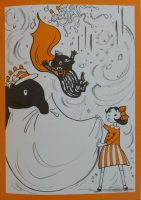
As always, Clara’s delectable, retro-style illustrations – this time with touches of orange – add visual charm to Polly’s stories; the combination once again creating the perfect book for newly independent readers, or for sharing with those not yet ready to fly solo.
If you’ve yet to be delighted by this team, get a copy of this book right away; I suspect you’ll then want to read their previous stories too.

I’ve signed the charter  

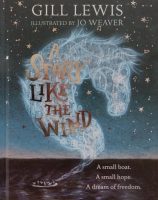
A Story Like the Wind

A Story Like the Wind
Gill Lewis and Jo Weaver
Oxford University Press
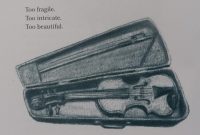
Gill Lewis has woven a wonderful novella with an up-to-the-minute feel to it. Stories of the refugee crisis continue to feature in the news with desperate people continuing to attempt seemingly impossible journeys in inflatable boats: this fable is such a one and this particular boat is filled with hopeful passengers young and old, ‘clutching the remains of their lives in small bags of belongings.’ The boat’s engine has failed and the boat is adrift on the Mediterranean; but the passengers, their resources dwindling minute by minute, are alive. Even so, they are willing to share what they have. Among them is fourteen year old Rami: he has no food to share so he refuses what the others offer him. What he does have though, is his precious violin: fragile; intricate; beautiful.

I took the only thing I could not leave behind,” he tells the others when asked why he refuses their offers.
Tell us a story to see us through the night,” requests mother of two young children, Nor.
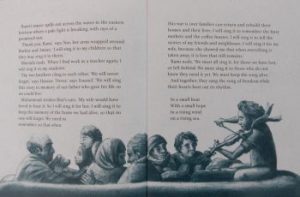
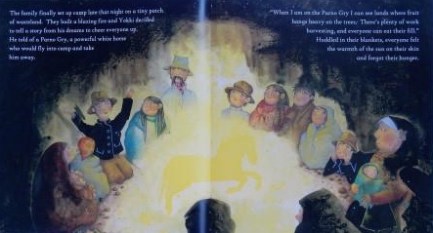
What Rami performs for those beleaguered passengers is, so he tells them a story of Freedom, a story like the wind, a story that begins on the highest plains of the Mongolian desert, known as the ‘land of a million horses’. His story – essentially a Mongolian folktale about a young shepherd and a white stallion that he rescues as a foal, – is powerful, drawing in each and every listener (and readers) and as it progresses part by part, the passengers make connections with their own lives. Carpet seller, Mohammad tells of trying to sell a flying carpet to the woman who is now his wife. Others too have stories to tell but eventually, Rafi’s magical telling is done. It’s brought his audience together in a shared bond of happy memories, of sadness for those they’ve loved and lost, but most of all, of freedom and hope.

With what I fear is an increase in overt racism, in hate crimes and fascism, not only here in the UK, but also in many other parts of the world, this affecting book deserves, (I’d like to say needs), to be shared widely and discussed anywhere people come together in groups.
Music has the power to transform – that is clear from the story;

and it’s something many of us know from experience: so too do words. Let’s hope Gill Lewis’s poignant words here can work the same magic as those of Rami. They certainly moved me to tears several times as I read. But let’s not forget the power of pictures: they too can bring us together, sometimes in shared understanding, sometimes, shared appreciation or awe. Seamlessly integrated into the story, and adding to the sense of connectedness, Jo Weaver’s illustrations rendered in blue-grey shades are at once atmospheric, evocative and intensely moving, as befits the telling.

I’ve signed the charter  

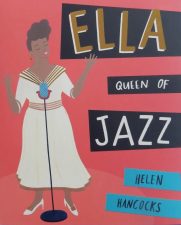
Ella Queen of Jazz / The School of Music

Ella Queen of Jazz
Helen Hancocks
Frances Lincoln Children’s Books
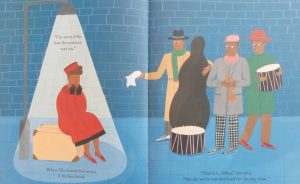
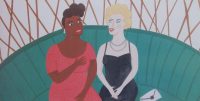
A super-stylish biographical story of the friendship between two iconic women: Ella Fitzgerald and Marilyn Monroe. It tells how rising star, Ella and her ‘Fellas’ experienced racial prejudice on the part of some club owners.

This treatment dented her confidence, but only temporarily, thanks to the magic of her music and the intervention of one very special woman who secretly used her powers of persuasion to get Ella an invitation to perform at the ‘biggest joint in town’, (The Mocambo,) the very same nightclub that had turned her away before.
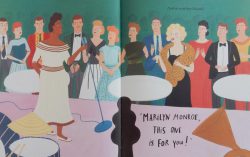
And so it was that, just as her secret friend had predicted, Ella Fitzgerald became a huge hit with the audience

and subsequent shows drew in enormous, enthusiastic crowds for every performance, in part thanks to Marilyn Monroe’s presence. Like all good things though, this show had to come to an end; but Ella’s sadness was more than compensated for by the lasting friendship between herself and Marilyn .

Thanks to Marilyn too, Ella became a great film singer and even sang for the US president, eventually earning the name of ‘First Lady of Song – the Queen of Jazz’ and winning thirteen Grammys and many other awards.
Enormously empowering and pitch perfect for KS1 readers is this slice of 1950’s Hollywood razzle-dazzle.

Jazz is just one of the many music genres featured in another stylish presentation:

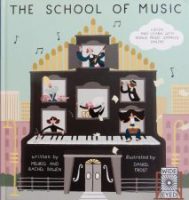
The School of Music
Meurig & Rachel Bowen and Daniel Frost
Wide Eyed Editions
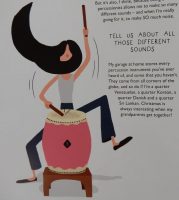
Readers are invited to enrol in the School of Music for a course of 40 lessons, presented over three terms. First we meet ‘The Boss’ aka Sergio Trunk aka, The Maestro, convincingly putting the case for having music in your life and explaining his role as Head of School. Next we meet other faculty members, six talented professors including the percussionist, Roxy Moto …

Now let lessons commence:
During the first term, there’s an introduction to a variety of musical instruments and a wide range of music.
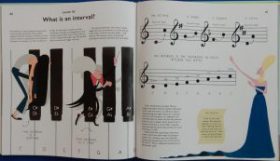
Term two comprises a look at the essentials of melody, harmony, pitch and rhythm; and musical notation is explained in terms understandable to anyone, even those without any musical knowledge.

Students who make it through to Term 3 – and one hopes that’s everyone (no exams here), the final nine lessons encompass ways to enjoy the practical aspects of music. There’s a lesson on making music at home, another on singing and its benefits, and a brief consideration of which instrument to learn. Then comes the nitty gritty ‘Why do we have to practise?, followed by helpful ideas for combatting nerves and more. Many of the lessons have a practical activity for additional enrichment and enjoyment. There is even a QR code at the back of the book with which to stream  samples  of music to your phone or tablet.
I learned more from reading this, than I did during all my music lessons at grammar school (albeit only taken for the first four years and during which I spent a lot of time mucking around as the teacher was so boring). Meuirig and Rachel Bowen are infinitely better teachers and their lessons are made more accessible and further enlivened through Daniel Frost’s witty, contemporary illustrations.
Thoroughly recommended for KS2 readers at home or school.

I’ve signed the charter 

For Your Information Shelf: Books Books Books / Taking Flight

Books Books Books
Mick Manning and Brita Granström
Otter-Barry Books
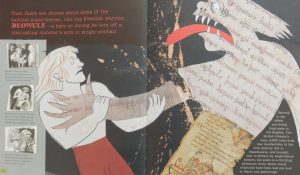
Award-winning team, Mick Manning and Brita Grandström takes readers on an exploratory journey around London’s British Library, a library that holds over 150 million items in all, going right back to the earliest printed books and coming bang up to date with some printed this year.
First stop is the St Cuthbert Gospel, an ancient hand-made volume that was found in the saint’s coffin at Lindisfarne Priory some time after he died in the 7th century and which was sold to the British Library in 2011 for £9,000,000.
We’re also shown the Lindisfarne Gospels; a copy of Beowulf written in Old English …

and eighteen other landmark publications from the Hound of the Baskervilles to Alice in Wonderland, including the gigantic Klencke Atlas, dating back to the time of Charles 11, that needs six people to lift it …

handwritten sheet music and newspapers.
Mick makes the whole place sound absolutely fascinating and Brita’s visuals really bring each and every entry to life. I haven’t visited this enormous library for many years but reading their book sent me first to its website, http://www.bl.uk and from there to planning my next visit in the near future.

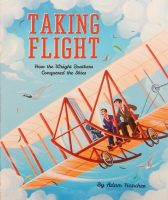
Taking Flight
Adam Hancher
Frances Lincoln Children’s Books
Adam Hancher tells in words and pictures , the amazing story of the Wright Brothers and how through determination and fearlessness, they brought their childhood dream to fruition.
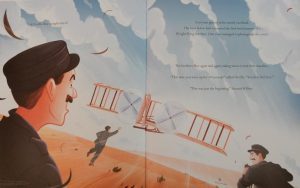
From humble beginnings in Ohio, the boys, inspired by the gift of a toy helicopter from their father, worked tirelessly on project glider. Starting with observations of birds in flight, then working on designing and making, they built their first glider, which they then tested in one of the wildest parts of the US. The machine was a failure, so it was back to the drawing board to work on Mark 2.
Finally a powered machine was ready for testing and … yes, the first journey of a Wright flying machine took place.

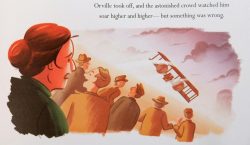
It still needed perfecting however and patience was needed until in 1908, everything was ready but …

‘ … something was wrong.’

Fortunately the brothers had kept the promise they’d made to their sister never to fly together, so although Orville was badly injured, he recovered and meanwhile Wilbur had been hard at work flying and breaking records. Fame at last for the Wright Brothers and thoroughly deserved it was.
A mix of superb double page spreads of key scenes, single pages and small scenarios, Hancher’s illustrations really do evoke a sense of their late 19th century settings.
An inspiring, beautiful book for KS1/2 readers at school or at home.

I’ve signed the charter  

Trees / We’re Going on a Bear Hunt My First Adventure Field Guide
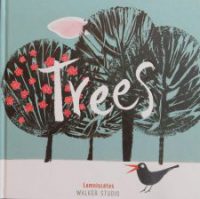
Trees
Lemniscates
Walker Books
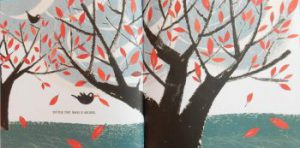
Published under the Walker Studio imprint, this is a gorgeously textured, digitally worked, tribute to trees. Through elegant illustrations and a succinctly worded text, homage is paid to trees. We see them in all their changing seasonal glory;

trees with ‘their heads in the clouds and their feet on the ground.

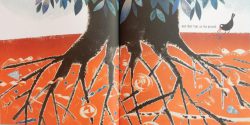
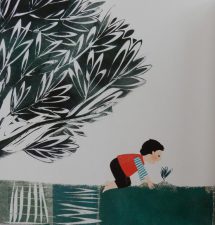
And we learn something of the functions of their roots; their various locations and something of the important environmental roles they play: homes for a plethora of birds and other creatures, providing shade for humans and other animals, cleansers of the air we breathe; and providers of a bounty of fruits. In the last few spreads we are in the company of a child in various tree interactions both rural and urban.

Share this lovely book with young children and then go outside and start to observe, enjoy and appreciate the wonderful trees around.

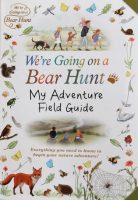
We’re Going on a Bear Hunt My Adventure Field Guide
text by Hannah Peng/Walker Books
Walker Entertainment
Somebody somewhere has had the clever idea of capitalising on the popularity of the original Rosen/Oxenbury We’re Going on a Bear Hunt picture book and the more recent success of the animation of the same and come up with this natural history adventure guide using some stills of scenes from the latter.
Like all good adventures, it takes a bit of planning and making sure one takes the appropriate things along in the way of clothing and protection, together with a handy notebook. Then it’s off into the big wide world of explorations, be they at home, school, countryside or seaside, by day or perhaps, night, always accompanied of course, by a responsible adult.
High in the Sky’, ‘Down in the Ground’ in that ‘thick oozy mud’; Further Afield to caves, through woodlands and forest (stumble trip) and onto the shore are other possible places for spotting a plethora of flora and fauna, large and small. Doing weather observations, making mud bricks, collecting fruits for scrumptious baked apples, creating a special plant habitat at home and measuring the heights of trees are just some of the numerous possibilities included; and I’m sure children will relish the idea of a poo hunt.
With its wipe-clean cover, this backpack-sized beauty concludes with some important words about the impact of certain kinds of human activity on the natural world, ways to help combat these and a final glossary.
For any child with a taste for adventure, either at home or in school.

I’ve signed the charter 

The Story of Space / 100 Steps for Science

The Story of Space
Catherine Barr, Steve Williams and Amy Husband
Frances Lincoln Children’s Books
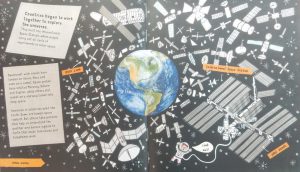
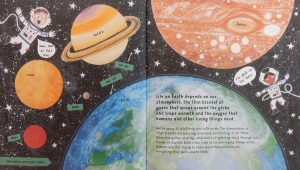
Subtitled ‘A first book about our universe’ this follow-up to The Story of Life is an equally fascinating exploration of another ‘big’ topic: what is thought to have happened 13.8 billion yeas ago when the Big Bang created our universe; and what followed in space thereafter going right up to the present time …

even projecting future possibilities. We’re told how the sun came into being; how, over billions of years, stars ‘are born, grow old and die’; how the planets – and hence our solar system – were formed. As well as that, there is a spread on comets and asteroids; another on how/why the seasons vary in different parts of the Earth; and one looking at oxygen and how it supports life.

This awesome journey is taken in the company of two young space investigators who comment and ask questions alongside the authors’ main narrative. Both Barr and Williams have a science background and manage perfectly, to avoid talking down to primary school aged readers. Amy Husband’s vibrant illustrations have an exuberance about them, making the whole book all the more inviting for the target audience.
I’d most certainly add this to a home collection or primary class library.
The same is true of:

100 Steps for Science
Lisa Jane Gillespie and Yukai Du
Wide Eyed Editions
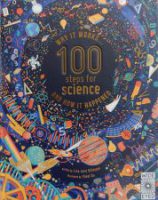
Ten STEM topics are explored in this fascinating book (written by a doctor of chemistry), that offers thoroughly digestible, bite-sized introductions to Space, Wheels, Numbers, Light, Sound, Particles, Medicine, Materials, Energy, and Life.
Each one is allocated several spreads wherein its evolutionary story is explored and the key scientists are introduced. In this way, what might for some, seem formidable topics, are given a human element making them more easily engaged with and intriguing. Add to that Yukai Du’s detailed visuals, which include some amazing perspectives …

and science becomes exciting for everyone.

I’ve signed the charter 

The Egg

%0a

The Egg
Britta Teckentrup
Prestel
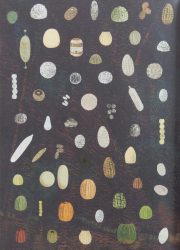
Many aspects of oviparity are explored in this fascinating book along with spreads on the egg in art, religion and mythology;

%0a

a look at traditions involving eggs, the famous Fabergé egg and the symbolic golden egg of wealth and fairy tales; and there’s a look at decorating eggs.
Caliology is an engaging aspect and obviously interested Britta Teckenetrup who devotes a dozen double spreads to various kinds of bird’s nests from the colonial nest building weaver birds, whose amazing nests are often built suspended (as a safety precaution) from trees over water,

%0a

to the ground nesting Snowy Owls that make shallow nest bowls where the snow has gone, during the Arctic summer.
Other egg layers include insects, there being a multitude of marvellous shapes, colours and textures;

%0a

spawning amphibians, reptiles – these mostly lay soft-shelled eggs incubated by natural heat rather than by the adult; turtles, fish and the mammalian sub-group which includes the platypus and echidna, the latter two being termed monotremes; and are indigenous to Australia and New Guinea.
The book’s blurb says of the egg, ‘Its beauty has inspired artists since ancient times’:

%0a

it has clearly inspired Britta Teckentrup, the creator of this handsomely produced, (it has a wonderful feel as well as look) enormously engaging and informative ‘eggthology’. As with many good information books it leaves you wanting to know more.
One for the primary school bookshelf, as well as for interested individuals.

Charter logo FINAL.indd

For Your Fiction Shelf

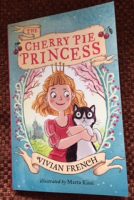
The Cherry Pie Princess
Vivian French (illustrated by Marta Kissi)
Walker Books
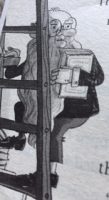
Vivian French is a cracking storyteller. Oliver’s Fruit Salad and Oliver’s Vegetables have been perennial favourites with many, many infant classes I’ve taught; ditto Yucky Worms. Here though she is writing for a slightly older audience and immediately I was drawn into her story – partly because when it begins, the setting is a library. Grating Public Library to be more precise, and the staff (Miss Denzil at least) are eagerly anticipating a visit from seven princesses. Much more circumspect though is the chief librarian, a rather crusty old dwarf by the name of Lionel Longbeard.

When the party duly arrives, it turns out that only one princess has any interest in books and she is Princess Peony. The book she takes, or rather later, sends a pageboy for, is A Thousand Simple Recipes for Pies, Puddings and Pastries and, she holds on to it for a very long time. The king though, has the librarian arrested for breaking the rules, on account of his kindness in speaking to the princess, and locked up in his dungeons. The princess meanwhile, takes to baking until her overbearing father puts a stop to it.
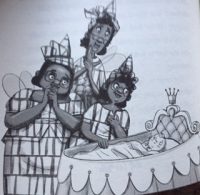
Years pass, a new royal baby is born …

and a christening party duly announced and invitations sent out – with one notable omission.
Now that sounds like there could be trouble on the horizon. What happens thereafter involves a whole lot of rule breaking, a rescue and a host of exciting twists and turns, The story moves along at a fast pace and is made all the more enjoyable by Marta Kissi’s pen and ink illustrations, which are liberally scattered throughout the book adding to the slightly zany tone of the whole thing.

Spy Toys
Mark Powers (illustrated by Tim Wesson)
Bloomsbury Children’s Books
Imagine a totally weird bunch of superheroes and you’d probably never quite come up with such an unlikely crew as those in Mark Powers’ book. So let’s meet Snugaliffic Cuddlestar teddy bear, Dan, made by accident 1000 times stronger than was intended;

rag doll, Arabella, a far-from friendly character; a soldier with an eyesight issue (which can sometimes be a hinderance) … and a foot where his head ought to be; and Flax the rabbit, a policebot on the run and more.
All have computerised brains and are recruited by the Department of Secret Affairs for a mission to protect the prime minister’s son from one Rusty Flumptrunk – a half-human, half-elephant breakfast cereal promotion gone wrong. What follows is a cracking, crazy, fast-moving, action-packed yarn full of slapstick and witticisms: lots of fun and made all the more so by Tim Wesson’s zany illustrations.

Louie in a Spin
Rachel Hamilton (illustrated by Oscar Armelles)
Oxford University Press
Louie is enjoying life in New York at the School for Performing Arts and is determined to remain upbeat despite the efforts of Arnie and grumpy dance teacher, Madame Swirler. Here though, it looks as if he might be losing the battle: in error, he’s been signed up to represent his dance school in the ballet category at a national dance competition. With the school’s reputation at stake, can Louie, with an enormous amount of self-belief to make up for what he lacks in skill, save the day?
It’s all beautifully funny and one cannot but admire Louie’s inexhaustible supply of inner strength and positivism. Long live Louie who is made all the more adorable through Oscar Armelles funky line drawings

Nelly and the Flight of the Sky Lantern
Roland Chambers (illustrated by Ella Okstad)
Oxford University Press
If you’ve enjoyed Pippi Longstocking – or even if you haven’t, you really should meet Nelly Peabody in her second splendid story. Here, on returning from her first adventure, Nelly and the Quest for Captain Peabody, the fearless explorer discovers that her mother has mysteriously vanished and nothing will stop the young redhead from tracking her down. This entails a flight in a laundry basket, high above the clouds, not to mention a deep-sea dive courtesy of a tin can contraption. As ever, of course she’s accompanied by her best friend, Columbus the turtle.
It’s quirky, full of deliciously off-beat characters and most important, superbly written, with wonderful illustrations by Ella Okstad in black and white with touches of red.

I’ve signed 

Mostly Mary & All Mary

dscn0112

Mostly Mary / All Mary
Gwynedd Rae and Clara Vulliamy
Egmont Publishing
Oh joy; two books I loved as a child, borrowing them frequently from the library, now reissued; and re-imagined by the wonderful Clara Vulliamy: I can think of no better person to bring fresh zest to these timeless beauties than Clara with her gently humorous touch.

%0a

For those who have yet to make the acquaintance of Mary, ( or Mary Plain, which she discovers is her full name early in the book), she’s an orphan bear cub, resident of Nursery Pit, Berne Zoo, who, in the first story is attempting to find her place in the pecking order of her extended family. She finds school lessons a bothersome experience and is much happier sallying forth with her friend, Sir Robin who provides some shrinking powder so that Mary can adjust her size and take a moonlit ride on his back and have a wonderful, rather crazy adventure.

%0a

Then there are the St Bruin’s Day celebrations when best behaviour is the order of the day, and Mary is in trouble, over a suitable gift before she’s even set out for the festivities.
Having re-read the ten episodes in the first volume they’ve lost none of their appeal: a spirited bundle of mischief, at once ursine-like and child-like, Mary is still a charmer.
Equally funny and fresh-seeming is Mary’s second set of adventures. It begins with Mary receiving an invitation to pay a visit to ‘the Lady in the Fancy Coat’ and having to consult – or more accurately ‘ask a private ask’ of her friend and designated chauffeur, Owl Man, on the meaning of luggage before they set off to the residence of Fancy-Coat-Lady.

%0a

What happens thereafter I won’t reveal; but rest assured it’s more than worth getting hold of a copy of the book and discovering for yourself. There’ll certainly be plenty of laughs provided by the trouble-prone young bear.
I do hope other titles from the series are to follow.

Rabbit & Bear The Pest in the Nest

%0a

Rabbit & Bear The Pest in the Nest
Julian Gough and Jim Field
Hodder Children’s Books
After the first wonderful Rabbit & Bear book, Bear’s Bad Habits, from this duo I did wonder whether the second could possibly be as good. The answer is definitely yes, every bit as brilliant and every bit as uproarious. Here’s a sample of the delights of the dialogue:
‘ “What?” asked Bear. “I’m angry! And I want to be calm! So I’m angry that I’m angry!” …
Why did you kick yourself?
Because I’m annoyed with myself!” said Rabbit. “Because I can’t change myself
But you can change your thoughts,” said Bear.
Change my thoughts? What’s wrong with them? My thoughts are PERFECT,” said Rabbit.
But your thoughts are making you unhappy,” said Bear.
No!” said Rabbit. “The world is making me unhappy! I must change the world … Stupid world! Change!” …
Maybe you could just think about the world differently,” said Bear. “Maybe you could … accept it
Accept! Accept!” said Rabbit … “What’s accept mean?
Saying, well, that’s just the way it is,” said Bear. “Not try to change it.
No!” said Rabbit. (a creature after my own heart; don’t an awful lot of us feel like that right now with everything that’s happening around us?) Bear though, is entirely right when she tells her pal, “Your brain is getting into a fight with the World.
As you’ll have realised – if you weren’t already aware from book 1 – these two characters are pretty much polar opposites with cantankerous Rabbit and reasonable, reasoning Bear.
What in particular though, in this tale, has made Rabbit so tetchy? Only that he’s been woken from his slumbers by a TERRIBLE noise and his place of repose (Bear’s cave) is full of light. No, it’s not thunder and lightning as he fears however, but Bear snoring and Spring sunlight illuminating the cave.

%0a

That’s just the start of things though: worse is to follow. There’s an intruder in his burrow – not the snake he feared but still not wanted …

%0a

and newcomer to the valley, Woodpecker’s ‘BANG! BANG! BANG!’ is utterly infuriating.
Thank goodness then for Bear and her words of wisdom. She has a wonderfully tempering effect on Rabbit and although he won’t, despite what he says, remain “Calm and Happy and Wise forever!” he does now at least have some coping mechanisms: for Bear’s snoring anyway “Mmm, maybe I should think about it in a Different Way. … Yes! I shall stop thinking of it as a Nasty Noise. I shall think of it instead as a nice, friendly reminder that my friend Bear is nearby.” And suddenly the sound, without changing at all, made Rabbit feel all happy and warm. (Must try that one.)
As well as so much to giggle over, Gough give his readers (as well as Rabbit) plenty to ponder upon in Bear’s philosophical musings about the manner in which they react to things: perspective is what it’s about essentially. Field’s visuals are equally sublime in the way they present both the humour and pathos in the relationship between the two main characters, and the situations they are involved in.

%0a

A brilliant read for newly independent readers, but also a great read aloud: adults will enjoy it as much as listeners I suspect.

WNDB_Button localbookshops_nameimage-2

Me and Mister P

%0a

Me and Mister P
Maria Farrer illustrated by Daniel Rieley
Oxford UniversityPress
Arthur is less than happy with his lot: he longs for a normal family wherein he can have his fair share of parental attention. Instead he has to contend with a brother on the autism spectrum towards whom much of his parents’ attention is directed.
Now, sent to his room instead of being able to watch the much anticipated football match on TV, Arthur – with lucky crystal in one pocket and survival tin in t’other – decides to leave home,, for good! But what, or whom should he encounter on the doorstep but an enormous polar bear, Mister P. The bear doesn’t speak but Arthur gleans this from the name on his old brown suitcase, which has a distinct fishy aroma about it and has a label with Arthur’s family address on. Could it be that the creature intends to stay?
He does; and Arthur’s life starts to get a whole lot better– not to mention that of brother Liam and the rest of their family.
Full of warmth and humour, this story is a delight to read, either aloud to a class, or as an individual. Listeners will revel in such scenarios as that when Mister P. endeavours to fit his huge bulk into Mum’s car (hilariously illustrated by Daniel Rieley) …

fullsizerender-10

or that of Mr Craddock’s class endeavouring to discover interesting facts about polar bears while Mister P. reclines on beanbags in a corner of their classroom.

%0a

There’s another character who needs a mention too, and that’s Rosie. She doesn’t put in an appearance until about half way through the book but she’s certainly pretty persuasive: “Anyway, our scores are going to improve because now Mister P is going to be our lucky mascot, isn’t he? “ ‘She put her hands together in the praying position.’ “PLEASE.“; and contributes some extremely apposite insights and comments: “See … Mister P knows how to get things sorted.
And a sorter of things is most definitely what Mister P. is – in more ways than one – shades of Nurse Matilda aka Nanny McPhee here.
I’ll say no more other than to urge you to get hold of Maria Farrer’s superbly empathetic book, made all the more so by Daniel Rieley’s wonderfully droll illustrations.

bookgivingdayblogbadge-1 localbookshops_nameimage-2

Thank Goodness for Bob / The Healthy Coping Colouring Book & Journal

dscn9789

Thank Goodness for Bob
Matthew Morgan and Gabriel Alborozo
Egmont Publishing
‘A problem shared is a problem halved’ goes the well-known adage. The trouble is, Max an inveterate worrier doesn’t share any of his with family or friends for fear of troubling already busy people or looking foolish: he just stores them all up inside and it leaves him feeling overwhelmed …

dscn9790

Despite this, everyone knows about this and seemingly, his worries are infectious.

dscn9791

Thank goodness then for Bob. Bob the dog offers a listening ear and Max talks and talks; gradually his worries come bubbling out and drift around the room and then the two of them find the perfect way of dealing with them.

%0a

Gabriel Alborozo’s gently humorous illustrations are perfect for this sensitively told, empowering story that will help children deal with their anxieties.

Also aimed at helping children – albeit slightly older ones than the previous book – and subtitledCreative Activities to Help Manage Stress, Anxiety and Other Big Feelings’ is

dscn9803

The Healthy Coping Colouring Book and Journal
Pooky Knightsmith and Emily Hamilton
Jessica Kingsley Publishers
Mental health ambassador, Pooky Knightsmith, has joined forces with illustrator, Emily Hamilton, to produce a book full of activities to help develop and enhance the well-being of children between eight and fourteen. It might well be equally used by adults. The aim is not only to help in reduction of stress but is also a tool for managing feelings and could be used at any time, whether one is feeling bad or good.
There are plenty of pages to colour, spaces for reflection and writing as well as a plethora of wise words to guide, inspire and motivate.

%0a

There are lots of diary format pages for recording ones personal experiences, preoccupations and feelings.
Buy to use or buy to give.

bookgivingdayblogbadge-1 localbookshops_nameimage-2

Sproutzilla vs.Christmas / Santa Claude

dscn9403

Sproutzilla vs. Christmas
Tom Jamieson and Mike Byrne
Macmillan Children’s Books
Young Jack’s abhorrence of Brussels sprouts is about to result in the ruination of Christmas and not just for the lad himself when his parents come back from a shopping expedition with the most enormous one of the green veggies he’s ever set eyes on. He’s called Sproutzilla and he’s the meanest, greenest Christmas ruining vegetable ever. What’s more, he (and his army of Sproutlings) have their sights set on Santa; and Sproutzilla is exceedingly hungry.

dscn9404

Seemingly, if the mums and dads, the angry dinner ladies and the furious chefs can’t save Christmas, there’s only one person who can and there’s only one way he can do it. Jack will have to EAT SPROUTS!

dscn9405

This is a totally ridiculous story over which you cannot help but have a good giggle, as will young children, especially at the final PAAAAAAARRRRRRRRRRRP-powered delivery, not to mention the tasty final twist.
Sprout lover or not, I suspect you’ll never look at your Christmas veggies in quite the same way again.
More bonkers fun in:

%0a

Santa Claude

Alex T.Smith
Hodder Children’s Books
It’s Christmas Eve night and Mr and Mrs Shinyshoes have left Claude and best pal Sir Bobblysock alone in the house while they go out partying. A super-excited Claude has tucked himself up in bed and is just settling down to read his new Cops and Robbers book when he hears a loud THUD! followed by what sound like a series of heavy footsteps. Convinced whoever has whooshed down the chimney is a burglar, and already anticipating catching same red-handed, off he goes armed with his handcuffs to apprehend the intruder.
Having secured the ‘burglar’ to the arm of a chair in the pitch-dark living room, Claude switches on the light to find himself face to face with none other than Santa. Easy enough to release the handcuffs you might think but oh dear me, no! The key is nowhere to be found.
With Santa out of action there’s only one thing to be done; Claude and Sir Bobblysock will have to make the rest of the deliveries instead. But can they – even with Claude decked out in Santa’s seasonal costume –

%0a

make it round all those hundreds of homes, delivering an absolutely enormous sack of presents and be safely back by midnight when the Shinyshoes return?
Needless to say, things won’t be plain sailing no matter what: let the festivities begin …
With Claude and Sir Bobblysock you’re guaranteed a whole load of gigglesome delight and this fast-paced festive romp is no different. It’s perfect to tuck into a Christmas stocking, or for an excited youngster to hide away with for a pre-Christmas chortle.

Cracking Seasonal Reads

%0a

Stinkbomb & Ketchup-Face and the Great Kerfuffle Christmas Kidnap
John Dougherty and David Tazzyman
Oxford University Press
It’s Christmas Eve and all’s right with the world. Right? Well not quite.
When Stinkbomb and Ketchup-Face wake up it’s after midnight (so technically they can call it Christmas Day) with cries of “He’s been! He’s been!”, it takes but a few seconds for them to discover that this is not the case: Father Christmas has definitely not visited their abode, and that’s despite the pair having been extra good that year. All they see where those presents should have been is a great big pile of nothing, absolutely zilch.
Obviously Father Christmas must be in some kind of trouble – think dastardly badgers – and it’s up to Stinkbomb and Ketchup-Face to come to the rescue, find Santa and save Christmas for all the inhabitants on the little island of Great Kerfuffle.
As with previous books in the series, this one is full of wonderfully off-the-wall characters, bonkers jokes, evil-sounding laughter, magic and mayhem, crazy dialogue and perfect comic timing to boot. What’s more it’s illustrated by the brilliant David Tazzyman whose seemingly scribble illustrations are the perfect accompaniment to John Dougherty’s clever and deliciously silly writing style.
A seasonal cracker if ever there was one.

Altogether different but equally worth seeking out is:

fullsizerender-9

There May Be a Castle
Piers Torday
Quercus Children’s Books
It’s Christmas Eve: a family – mum, two sisters and a brother – are on the way to visit the grandparents. Violet the eldest is dressed as a pirate, toddler Esme has a passion for chocolate and Mouse, a smaller than average, highly imaginative eleven year old is still in his robot pyjamas; Mum is at the wheel. Snow is falling fast, the visibility is bad, but the journey across the moors should be fairly short.
As it often does on such occasions, bickering begins and Mum loses control of the car and it spins off the road. Mouse is thrown from the car by the crash but everyone else is trapped inside.
When he comes to, Mouse finds himself in a magical landscape with no snow and no car, just a peculiar sheep named Bar, a talking one-eyed horse called Nonky, a garrulous minstrel, a size-changing dinosaur; oh, and there may be a castle. Thus begins Mouse’s quest to find that castle despite not knowing quite why.
Back at the scene of the accident, Violet is on a mission to save her mother who is unconscious and bleeding, and little Esme, who keeps demanding chocolate. To do this she has to use her knowledge of a very fierce pirate woman, which, harnessed with her own imagination, gives her the strength she needs to cope.
Without giving away what happens let’s leave those two wonderful, very brave characters in their spellbinding wintry tale of hope, courage, the power of the imagination and the stories we tell ourselves.
Brilliantly imaginative and totally immersive it’s a beautifully written book; read it and you’ll be hooked, but be warned, you’re on something of an emotional rollercoaster.

Pinball Science & The Pen

%0a

Pinball Science
Illustrated by Owen Davey
Templar Publishing
The teacher part of me has always advocated putting scientific learning into a meaningful context: now here is an exciting project incorporating a whole lot of scientific principles that’s a tremendous learning opportunity. All you need to do is open up the box and follow the step-by-step instructions for assembling an 88 piece model complete with levers, plungers and flippers – awesome! In practice, I think it may prove a little more tricky.
Before plunging in though I suggest reading the pages describing the science behind the whole pinball wonder.

image1

Here’s Jack working on the model

It’s fascinating stuff: I learned it in deadly boring, text book only O-level physics with nay a practical in sight, but only understood what some of it really means, for instance Newton’s third law of motion ‘Every action results in an equal and opposite reaction’ when messing around with toy cars while teaching infants many years later. Now, it’s explained along with a simple investigation with a balloon.

%0a

And the difference between kinetic and potential energy? I remember learning that off by heart with little understanding but here, it’s neatly explained through an investigation with a tennis ball.

%0a

These practical activities and many others, all relevant to the enterprise about to be undertaken, provided by authors of the project, Nick Arnold (of Horrible Histories fame) and Ian Graham, are all stylishly illustrated by the wonderful Owen Davey.

dscn8435

The Pen
Raphaël Fejtö
Firefly Books
This near pocket-sized book is one of a series called Little Inventions. It’s a fascinating and delightfully quirky look at the history and development of a writing implement from the beginnings of writing when sharp reeds were used to engrave on soft clay tablets. It takes us up right through to the advent of Biros and then, the disposable BIC pens we’re so familiar with. In Japan, brushes were used for writing and these led to the invention of felt-tip pens so popular today for writing and colouring.
That’s it briefly; and the final page is a memory quiz. With amusing illustrations on every page,

%0a

this is just the kind of book to fascinate those youngsters less keen to embark on fictional stories: a whole lot of information, delivered narrative style, is packed into just 32 pages. Having read this one, I suspect children will want to seek out the other titles in the series: The Fork, French Fries, Glasses, Pizza and The Toilet (I bet that one proves popular!).
Just right for a school topic box, home library – anywhere there are readers (and writers) actually.

Yoga for You

dscn9175

Yoga for You
Rebecca Rissman
QED Publishing
Over the last decade children have become more and more pressurised with constant testing and increased curriculum demands in school, shorter breaks, hours of homework and more. It’s no surprise that many of them feel stressed, exhausted and completely unable to relax.
In my experience one of the very best ways to alleviate anxiety and stress is through yoga and happily, some schools are beginning to take this on board and offer yoga and, or, meditation as part of the curriculum. Not enough though; but here is a handy little book for children from around nine or ten, which can serve as an introduction to the practice.
In a straightforward manner, its author, herself a yoga teacher, explains all the basics that a beginner needs to know. There are sections outlining what yoga is and how it can benefit those who practise it as well as how to choose a class – this summarises some of the many different types of yoga.
There are two sequences: the first is a more active, energising one comprising 17 asanas; here are two of them …

dscn9177

the second is a calming sequence of 18 asanas or poses – two are shown below …

dscn9176

although as the author points out, the final savasana (or corpse pose) is used to end any yoga session and I would certainly endorse this.

%0a

Savasana

Every pose is illustrated, but it’s important to remember what the author says indeed what any yoga teacher should tell you, ‘Never do a pose that causes you pain.’ It’s also wise to remember that a beginner trying a pose will not necessarily look just like that in the illustration right away: flexibility takes time to develop. The Sanskrit names are given for each one of the poses and there are also brief sections on breath control or pranayama as well as mindfulness and meditation. The final pages comprise a list of useful links and a glossary.
Written in an extremely user-friendly manner, this is an excellent starting point for youngsters contemplating taking up yoga.

Maverick Junior Fiction

Maverick is already well established itself as a picture book publisher; now they make their first foray into junior fiction with a trio of exciting titles:

dscn8899

Grandma Bendy and the Great Snake Escape
Izy Penguin
Rickety Rocket
Alice Hemming and Emma Randall
Letter to Pluto
Lou Treleaven
Maverick Arts Publishing
Grandma Bendy boasts an interesting cast of characters including Grandma’s grandchildren Max and Lucy, Mike Grimace – he’s the school bully, Lady Lavender, Sergeant Nevil Rodent and Mr Brain Freeze, all residents of Pumperton (twinned with Bottumburper and Le Pongue) where the story unfolds. Already you’ll be guessing that this is a funny book and one likely to grab the interest of newly confident readers. The story starts on the first day of term with 4B embarking on a session of ‘Show and Tell’. Mike Grimace has brought his pet snake to school and he has a wicked grin on his face as he transfers it from his school bag to Lucy’s as she’s about to open the session and talk about her Gran.
Before long there’s a snake on the loose, the school is empty and the entire town of Pumperton is beside itself with ‘snakeitis’.

%0aThen it’s down to Lucy, brother Max and the indomitable Grandma Bendy to apprehend the snake and put things right.
Funky illustrations by the author adorn every page and add to the fun of the whole crazy experience.
Rickety Rocket contains three short stories starring adventure-loving Spacey Stacey, her friends Timble the robot, twins Zip and Zap and creative Moondoodle. Then there are their rivals, Astro Pete, Jack Boom and Jill Zoom. The first story tells what happens when they all take part in The Great Space Chase. Who will be first across the finish line: Spacey in her Rickety Rocket or Astro Pete in his shiny shuttle? It’s going to be a close thing for sure.
In the second adventure Stacey is overwhelmed with orders for her special jellies and resorts to using a jet-pack to speed deliveries up a bit. Things don’t quite go to plan of course but her aeronautics are certainly a crowd-pleaser.

%0a

Picnic Planet sees the friends heading off for a day out but there are warnings not to feed the space bunnies scattered around. Then when food begins to vanish, those innocent-looking creatures are under suspicion: they couldn’t be the thieves surely …
Letter to Pluto revolves around an interplanetary penpal programme initiated by Jon’s teacher, Mrs Hall. Jon happens to be paired with a Straxi and he’s not happy about it: firstly she’s a girl and secondly she lives on Pluto, which is the smallest and the most boring planet in the entire universe; and it’s smelly! Almost the whole book takes the form of illustrated letters between Jon and Straxi …

dscn8902

and through their correspondence we learn how the two eventually become firm friends and manage to save Planet Pluto from ecological catastrophe. Great fun!
All three are ideal for that taking off stage of reading but would also work well as read alouds for KS1 classes.

I Broke My Trunk / Let’s Go for a Drive

I Broke My Trunk!
Mo Willems
Walker Books
I love Mo Willems’ Elephant and Piggie stories; they’re ideal for beginning readers and totally crazy. In the first one poor Gerald has a damaged trunk and just when Piggie is wondering why his friend hasn’t put in an appearance, along comes Gerald looking just a tad sorry for himself. “What happened to your trunk?” asks Piggie and thus begins a protracted and rather convoluted tale of misadventure and madness. Imagine trying to balance a hippo on your trunk; that’s what Gerald did, and a rhino, followed by Hippo’s big sis who just happens to have a piano with her.


Well of course Gerald’s trunk would break under all that weight wouldn’t it? Actually no; there’s more to this bonkers story because Gerald’s trunk managed to stand up to all that mis-use; but then in classic Willems/ Gerald fashion comes the embarrassing part …

and a final whoops:

let’s leave Piggie to have the last word – or rather words.
Hilarious nonsense, but utterly irresistible and delivered all in dialogue and through Mo’s minimalist chucklesome pictures. Make sure you peruse the final endpapers – seemingly Piggie has found another old friend to share his tale with.
More delicious Gerald and Piggie nonsense in
Let’s Go For a Drive
Mo Willems
Walker Books
Let’s go for a drive!” suggests Gerald; “That sounds fun!” agrees Piggie. “Drive! Drive! Drivey-drive-drive!” they shout together gleefully. Gerald then announces the need for a map – he’s just a little bit of a fusspot (a pedant) and continues listing a whole lot more items crucial for the enterprise while poor Piggie dashes around collecting sunglasses, umbrellas, bags, …

We have so much to pack,” interjects Gerald; but that’s not all … “There will be a lot of driving on our drive,” he continues. Really? Haven’t they forgotten about one fundamental item for this drive.

What should they do now? Luckily for Gerald, PIggie has an answer and, a plan.
Another winner in this early reading series –young readers don’t need a plan either – all they need is right there in this satisfying little book.

Mango & Bambang Tiny Tapir Trouble / Pugly Solves a Crime

%0a

Mango & Bambang Tiny Tapir Trouble
Polly Faber and Clara Vulliamy
Walker Books
The tiny tapir referred to in the title of this, the third delicious Mango And Bambang collaboration between Polly Faber and Clara Vulliamy doesn’t crash onto the scene until the third story and when he does, my goodness he certainly makes his presence felt.
Before that though, Bambang and Mango visit the seaside to spend a special carefree, fun-filled day together before Mango’s new school term starts. At least that’s the plan, but it turns out to be a day packed with unexpected incidents culminating in the rescue of a toddler swept out to sea and an exciting parachute flight.
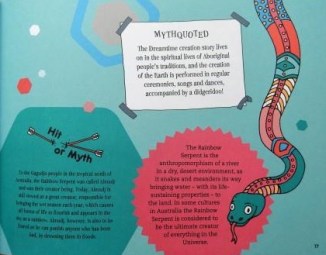
In the second story Bambang is feeling off-colour, his snout is blocked and he takes to his bed. Doctor Blossom the tapir specialist is at a loss to know how to make him better …

%0a

so it’s left to Mango, ably assisted by their pal George, to find a cure.
Even after his recovery, Bambang hasn’t regained his full bounce and so he and Mango do quiet things at home. But then a large parcel is delivered addressed to Bambang and any chance of peace and quiet immediately go out the window, for what should be inside but his small cousin Gunter – a cousin he didn’t even know existed. Small he might be, but he’s a force to be reckoned with and pretty soon, it becomes evident that two tapirs in one apartment is one too many. The trouble is Gunter has announced his intention to stay put and Mango appears to be enjoying his company rather too much. So much so that Bambang starts to think that perhaps he should be the one to go …
The final story sees Mango participating in the City Chess Tournament and one of the other competitors is the boy who’s been champ for the past three years. Seemingly though – at least to Bambang – something strange is afoot.

%0a

By the end of the book, Bambang has come to a very important understanding about family – it’s not about who you look like or where you started; true family are those you belong with – those who make you feel most completely yourself, no matter what.
Full of warmth and humour, these stories are perfect for those readers just starting to go solo.
Another favourite character returns in a brand new adventure:

%0a

Pugly Solves a Crime
Pamela Butchart and Gemma Correll
Nosy Crow
When Pugly learns that Big Sal the guinea pig has been ‘GUINEA PIG-NAPPED he dons his detective hat and turns PUG-DETECTIVE. But who’s responsible for this dastardly crime? Perhaps it’s Glitterball the Poodle who has come to live next door – Pugly doesn’t trust poodles. Or could it be someone else? Time to enlist the help of super smart cat, Clem. Off go the two of them in search of clues …
With plenty of wonderful illustrations from Gemma Correll …

%0a

this crazy tale is sure to bring plenty of smiles to the faces of young readers; in fact, there’s not a spread that didn’t make me giggle to myself.

Operation Bunny / Tally & Squill in a Sticky Situation

%0A

Operation Bunny
Sally Gardner illustrated by David Roberts
Orion Children’s Books
Meet young Emily Vole, nine years old and, having been left abandoned in a hatbox believed to be ‘an explosive device’ at Stansted Airport, adopted by the Dashwoods, who subsequently had their own triplets. Emily is then relegated to the status of a servant and made to sleep on an ironing board in the laundry room. Fortunately for Emily however, kindly neighbour Miss String (a sort of fairy godmother figure) and her huge talking cat, Fidget, step in:

%0A

(I was greatly amused to discover that Fidget liked nothing better than’ ironing while listening to cricket on the radio.’) and within a year, Emily has learned to read, write, do maths and speak both German and French, not to mention Old English. Not only that but her new friends introduce her to a whole new exciting life in a world of magic and danger, a world she’d never even dreamed about. But it’s Emily herself who inadvertently does something that results in her becoming the new Keeper of the Keys.
Subsequently Emily inherits a shop and, aided and abetted by Fidget and a pair of detectives, Buster – a grumpy individual, and James Cardwell – much more equable and sensible, turns detective herself and is determined to solve the mystery of Operation Bunny.
Sally Gardener’s writing style is delightfully quirky and contemporary: Mr Dashwood is a hedge fund manager and his wife has strawberry-blonde hair extensions and ‘trusted in her credit cards: silver, gold and platinum.’
This will make independent readers (not to mention adults) laugh out loud in places and David Roberts’ deliciously spiky illustrations are a real treat adding to the deliciousness of the whole experience. (That Harpella of his is enough to send shivers down your spine.)

%0A

And, with Emily and her friends now running a detective agency, those who enjoy the slightly dark-edged humour in this can look forward to further cases of the magical kind.
The story would also make a great read aloud to share with those not yet confident to read it solo.

A servant girl is also the heroine of another new series, the first of which is:

%0A

Tally & Squill In a Sticky Situation
Abie Longstaff illustrated by James Brown
Little Brown
This story features orphan and kitchen maid Tallulah (aka Tally) and her pet squirrel, Squill. Tally’s home is Mollett Manor, an old mansion; but she’s only to be found below stairs, so to speak in the scullery where she sleeps in a sink. However, Tally’s a very bright young thing and when she discovers first a plethora of spiders, some mysterious ancient carved cubes, an ancient tapestry and then a secret, magical library beneath the manor – a library wherein the books come to life, she’s in her element.
When Mollett Manor is burgled it offers a challenge to Tally who determines to catch the thieves; but can she do it? Well, she has Squill and those magic books …

%0A

plus Lord Mollett’s endorsement, “You’re the most sensible person we have around here.” And what of those flashes of seeming recognition she keeps having: where do they fit in to all this?
Using plenty of short sentences, Abie Longstaff weaves a good tale; and this one’s likely to draw newly independent readers into its web and hold them spellbound throughout. There are touches of humour and James Brown’s illustrations plus the various lists, pages of rules,

%0A

notes and other written items add to the fun of this magical book.

WNDB_Button localbookshops_NameImage-2

Dixie O’Day On His Bike!

%0A

Dixie O”Day On His Bike
Shirley Hughes & Clara Vulliamy
The Bodley Head
An ‘affable’ chat over coffee with a passing cyclist, Dean, met while Percy is busy polishing Dixie’s car,

%0A

and an increase in the size of Dixie’s waistline, result in the latter deciding he needs more exercise and he tells Percy of his intention to take up cycling. Not only that, he wants to buy a tandem. However on account of their differing leg lengths, Dixie needs to call upon the services of another pal of his, Don Barrakan who agrees to design a specially adapted model  just for Dixie and Percy …

%0A

When the machine is finally delivered, Percy is soon engulfed by Dixie’s enthusiasm and before long the two of them are heading off down the road, but very soon …

%0A

Never mind, Percy, Dixie’s there to pick you up and encourage you to practise, practise, practise … and soon the pals are planning a cycling trip. Routes are considered, maps pored over (with a bit of input from Dean), destinations discussed and an expedition is finally decided upon. The plan is that Dean will take the lead on his bike and the other two will follow, which when put into operation, isn’t quite such a clever idea … as the two bikes hurtle downhill at an alarming speed towards a haystack resulting in …

%0A

Extrication accomplished, the three part company and whom should they meet as they reach home but nosy neighbour Lou Ella. Inevitable comments are passed and smartly brushed aside with Dixie’s “Just a small mishap.”
Is that mishap the end of Dixie and Percy’s flirtation with cycling? Of course not – this is Dixie O’Day we’re talking about but if you want to discover how things develop and I’m certain you do, then grab yourself a copy of this latest delicious Dixie offering from the inimitable mother and daughter team Shirley and Clara.
Shirley’s faultless storytelling and Clara’s delectable illustrations together offer total delight for those ‘just independent’ readers and of course, it’s a cracker for reading aloud, one to one, or with a group.
I’ll just add that there are thrills aplenty and the odd spill (or ”error of judgement”) as Percy puts it,

%0A

not to mention a long-distance race, the Didsworth Cycle Rally and the unmasking of a cheat. Oops! I‘m in danger of telling all in my enthusiasm for this wonderful book … Don’t get left behind; get hold of it rightaway. As well as the story, there’s the usual mix of maps, a quiz, a chat with the book’s creators …

%0A

and more, to enjoy too.

WNDB_Button localbookshops_NameImage-2

Yokki and the Parno Gry / Cool Mythology

%0A

Yokki and the Parno Gry
Richard O’Neill, Katharine Quarmby and Marieke Nelissen
Child’s Play
Yokki’s family are Travellers who live under canvas and make their money by selling – it might be horses or things that they make when there’s no other work – things like carved wooden spoons or lovely paper flowers. At other times of the year, they might be found mending pots and pans, sharpening tools or picking fruit and vegetables.

%0A

Their evenings are spent around the camp fire when stories are told; and young Yokki is a particularly good story teller whose tales are a re-mix of those he’s already heard and things he adds of his own.
One year however, with work hard to come by the family is really down on their luck and Yokki’s father is worried about how they’ll cope with the coming winter. Phuri Dai (Grandma) suggests a place where they can set up camp and when they’ve done so, Yokki decides a story is just the thing to raise their spirits.

%0A

Look at the image in the centre …

It’s a mythical tale of a powerful white flying horse – a Parno Gry – that would take him to places where life would be everything they could wish.
Can that wonderful horse fly in and save Yoki’s family at their darkest time? That is the big question and one you will have to get yourself a copy of this wonderful book to answer.
Everything about this book is exciting: most importantly that the story is a real testament to the power of children’s imaginations and the valuing of same; Marieke Nelissen’s illustrations are delightfully dream-like in places, the different viewpoints and perspectives used …

%0A

add visual interest at every turn of the page and further enhance the telling.

DSCN8158

Cool Mythology
Malcolm Croft
Pavilion Books
Prolific author Croft turns his attention to a subject popular with primary age readers, as well as a topic much studied in schools. In fact I became very interested in the whole area when studying at London University in the 80s and have continued to find the whole vast topic endlessly fascinating ever since. This book is, as it says “Filled with fantastic facts’ and encompasses the main world mythologies, Sumerian and Inca and Nubian, all of which and more are mentioned on a spread entitled Map of World Mythology.
Thereafter, logically, is a look at creation myths, the commonest forms of myths and these are broken down into five general classifications as shown here …

%0A

Examples of these are then explored in four spreads with the Greek Gaia, various sun-related myths, some fascinating African ideas and the Rainbow Serpent from the Aboriginal Dreamtime.

%0A

‘Myths and legends are a vital part of … what it means to be human’ we’re told and the author then goes on to look at the seven basic plots used in myths. There’s also an exploration of places such as Atlantis, as well as the more recent Bermuda Triangle; and the afterlife with a look at ancient Egypt; animals, monsters and part human, part animal beings, also have a place herein.
Indeed it’s amazing just how much is packed into this little book on a topic that has much to say to us, and societies the world over today. If you know a child who wants a quick but absorbing introduction to a vast subject, this is a very good starting point. It’s fun, attractively laid out and very readable.

WNDB_Button localbookshops_NameImage-2

They Didn’t Teach THIS in Worm School!

%0A

They Didn’t Teach THIS in Worm School
Simone Lia
Walker Books
Observer and Guardian cartoonist Simone Lia has created a cracking story featuring Marcus – a splendidly resourceful worm, and Laurence, a bird who looks like a chicken but is convinced that he’s a flamingo. An unlikely pairing you might be thinking.
Their initial meeting is decidedly iffy but Marcus manages to convince Laurence that making a slurpy spaghetti-like breakfast of him isn’t the best plan. In response to the worm’s “Are you going to eat me for breakfast?” Laurence replies, “Probably not … It feels funny eating you … now that we’ve had a conversation.” (The bird, by the way, is determined to fly all the way to Lake Nakuru National Park in Kenya – his true home, so he thinks – but his map reading skills leave more than a little to be desired.)
After some more chat, a deal is struck. Marcus, with his “funny ideas and marvellous sense of direction” is to act as navigator for the journey and the two of them, having made some preparations, and Marcus has made plans to inform his relations …

%0A

the two appear to be ready – or maybe not quite yet. It looks as though Laurence has rather overdone his packing  …

%0A

Several hours later, with unpacking done and plumbing works re-connected, Marcus is safely (and comfortably) installed in a very soft spot in Laurence’s plumage, they’re on their way heading supposedly in the first instance for Paris.
After a while “lost” might be the best description of where they are but then, having glanced at the cover of his pal’s French guidebook, Marcus identifies The Eiffel Tower …

DSCN8294

Panic over – albeit temporarily.
I could continue telling you what happens but suffice it to say all manner of near tragedies and ‘stewish’ shenanigans occur until eventually it seems they’ve reached their ultimate destination; but have they?

%0A

There are certainly flamingos; but we’re still 50 odd pages short of the end of this hilarious saga so I’ll leave you to make up your own minds and just add that this is a laugh out-loud read, full of wonderfully funny illustrations … and a must read for anyone from around seven especially those with a sense of adventure.

WNDB_Button localbookshops_NameImage-2

Lemur Losing & A Ghost Called Dog

%0A

How to Lose a Lemur
Frann Preston-Gannon
Pavilion Books
“Everyone knows that once a lemur takes a fancy to you there is not much that can be done about it.” Thus begins a delightful child narrated take of what happens when one does just that – to the small boy himself. As our narrator takes a stroll in the park one sunny morning he notices, but does his level best to ignore, the lemur that’s in hot pursuit.

DSCN7999

The lad tries all kinds of escape ruses such as tree climbing and cycling … but nothing seems to work, not even giving them stern looks.
In desperation the boy buys a train ticket but guess what joins him. He takes to the air; but those pesky animals seem to have all eventualities covered, even camel riding …
and trekking through blizzards. Surely the latter will see them off but no.

%0A
Suddenly though, the creatures seem to have gone to ground; the boy is far from home though and has no idea how to get back. Perhaps … well, just perhaps: I’ll say no more and leave it to readers to imagine what happens thereafter
Sheer delight from cover to cover is this board book with its collage style illustrations from rising star, Frann Preston-Gannon whose amusing story is certain to please the very youngest listeners as well as those adults who share it with them.

For older readers:

%0A

A Ghost Called Dog
Gavin Neale
2QT
A family has just moved into a new house. Dad is a writer, working at home and under pressure with a deadline looming, so much of the task of settling in and organizing things is left to Mum, although she has to go to work as well. They have two children: Abby and her competitive, soccer-mad brother, Chris. When wildly imaginative Abby says she sees a rabbit in the shed this is rubbished by Chris; but then suddenly, he starts feeling ice-cold fur rubbing against his skin.
Moreover, there are two mysterious old women: stern, goat-keeping Nora and chatty Daphne, who live in a cottage close by and are showing a great deal of interest in the children. And what is all the talk of potential witches, spirit familiars and warlocks?
So begins a story full of intrigue and danger involving a disappearance (the children’s mother), challenges and dark forces.
Gavin Neale clearly knows something of the interests, or rather obsessions of primary school children, and his story may well hit the mark with readers who like stories with a mix of fantasy and reality, challenge and problem solving.

WNDB_Button localbookshops_NameImage-2

Mr Particular & Super-Powered Ollie

%0A

Mr Particular
Jason Kirschner
Sterling
Superhero he may be, but the particular superhero of Jason Kirschner’s debut picture book hasn’t been given his name without reason. Yes, he’s able to perform all manner of amazing feats such as car lifting (toy cars that is), and outrun trains – the kind you see at the zoo – and keeps strictly to his 7.30pm bedtime every single evening. (Parents, take note). He has however, a somewhat self-limiting issue: the little guy ‘liked things the way he liked them – and only the way he liked them.’ There’s an element of that in all of us but his weakness – so we’re told – is that of specifics: ketchup with all non-dessert foods, positively no humming, shirts must always be untucked, nothing with even a slight whiff of coconut about it, no squishy mud or oatmeal and anything green is a total no-no.
All these quirks do have a tendency to hinder him and his pals in their keeping the universe safe from Bad Guys mission …

DSCN7803 (1)

Eventually those long-suffering friends, Atomic Bear, Daring Duck and co. call an emergency meeting, the outcome of which is that Mr Particular is a group member no more; instead Dr Slimyhands -recently defected to the good guys side – takes his place.
Poor Mr Particular is devastated: surely his fate isn’t to be left at home playing with nappy-filling SUPERPOOPER.

%0A

Change is needed … and boy does our hero try, but to no avail – old habits definitely die hard. You’ve gotta hand it to the guy though, he keeps on trying over and over …

%0A

Then suddenly an opportunity presents itself: – those very Super-Duper Group members who have just ousted him – seem rooted to the spot …

DSCN7807 (1)

while Atomic Bear dangles by the seat of his pants from a tree branch. He is however, suspended right above an exceedingly muddy, mega- slimy patch and there just happens to be rather a lot of small insects creating something of a buzz right alongside. Can Mr P. finally overcome those pet aversions of his and save the day, whether or not Atomic Bear is faking the whole thing?

DSCN7809

Highly entertaining, this is told in action-packed comic-book format and is a wonderful take on sensory defensiveness and aversions. And with a few pooey touches thrown in to keep young listeners super-attentive, this one is bound to appeal especially to superhero addicts – and that’s an awful lot of youngsters – who will at the same time be absorbing messages about drawing on one’s inner strength, never saying never and only holding on to what, ultimately is of use to us. Let those super-powers shine through. And for those determined to do so and one hopes that’s everyone, then the inside covers have a show of everything for the job in hand …

%0A

Ollie and his Super Powers
Alison Knowles, illustrated by Sophie Wiltshire
Jessica Kingsley Publishers
Language has tremendous power in the way it affects those around us; that we all know from recent events in the UK.
In this slim, illustrated book we meet seven year old Ollie who no longer has his brand new trainers: he’s been bullied into giving them over to two much bigger boys. Ollie’s mum is furious and he’s only told her that he’s left them at school. “You did what? … They cost a fortune, Ollie. You know I can’t afford to get you another pair. Oh Ollie, how thoughtless.” is what she says and off they both go in the car to visit the old people’s home where she works.
It’s there that one of the inmates, Mr Wilcox listens to Ollie and the whole sorry tale of how not only his trainers but other things have been taken from the lad, and about the name calling too. Mr Wilcox then suggests Ollie uses his superpowers to sort out the bullies. And thus begins the unleashing of Ollie’s amazing superpowers: Courage, Bravery, Strength and Calm among others; and with Mr Wilcox as his friend and guide, it’s not too long before Ollie

%0A

(and his team of superpowers) is ready to begin Operation Positivity …
What a good example of the importance of using positive language to encourage, and/or reinforce, positive behaviours.
WNDB_Button localbookshops_NameImage-2

Noggin the Nog

DSCN7775

Noggin the King, Noggin and the Whale,
Nogbad Comes Back, Noggin and the Dragon
Oliver Postgate & Peter Firmin
Egmont Publishing
I’ve been a huge Noggin fan since I was a child and at one time was the proud owner of a much-cherished complete set of the original The Saga of Noggin the Nog books on which these new editions are based. Sadly, years ago my partner waxed lyrical about them to our plumber and without asking permission, loaned them to him, for his son. To this day I have never seen them again: all I have now are just these two duplicates …

DSCN7774 (1)

What we have here are I think, smaller versions of the Early Reader editions, also from the 1960s. In my experience, young children do love collecting little books and so I’m sure these mini Noggins will be a big hit. Noggin himself is goodness through and through. Here are the opening lines of Noggin the King: ‘Noggin was a good king./ He liked to look after his people./ He liked to give them warm socks to wear.

DSCN7778

 He liked to give them good food to eat./ He liked to make sure that they had good roofs on their houses.’ Oh Noggin, we need you now.
Noggin is married to Queen Nooka; he often consults her when he is puzzled over a question and herein it’s a particularly thorny one: “Tell me, Nooka, am I king of the birds as well as king of the people?” She doesn’t answer him directly but together, the two seek, and find, an answer …

%0A

Beautiful.
In Noggin and the Whale, Noggin is celebrating his birthday. Unusually however, he’s not the only recipient of presents: the ever benevolent monarch gives all the children of the town gifts too: things with which to create music …

DSCN7780

However, on this particular birthday, the musical celebrations are interrupted when a whale summarily seizes the boat in which Noggin and the children are playing and lifts it aloft. But that’s only the beginning of this delicious tale. Noggin’s young son Little Knut plays a significant part in saving the day (and shifting the whale) as does Olaf the Lofty (who as he tells us himself, is “very clever”), and the town’s bell-maker helps too.
Nogbad Comes Back sees the return of Noggin’s wicked uncle – banished from the Land of Nog by Noggin, to spend time in his castle to learn to be good. The crucial question however is, has Nogbad really seen the error of his ways? “Now I am Nogbad the Good!” he asserts but Queen Nooka has her doubts. Will he behave if Noggin allows him to take part in the annual animal and vegetable show;

%0A

or will he, once again, show his true colours?
In Noggin and the Dragon, we join Little Knut and his friends when they go on a dragon hunt.

%0A

But are there, or aren’t there – Noggin definitely says there aren’t – any dragons left in Dragon Valley? If not, then what is this …

DSCN7784

For me, Noggin has lost none of his charm: indeed he’s even more adorable and wise than ever. And from a mature adult perspective, bringing so much more to the stories, I can really appreciate the genius of  Noggin’s creators, Oliver Postgate and Peter Firmin.
It’s wonderful that Egmont have brought back these tiny treasures. I’m over the moon.

Use your local bookshop     localbookshops_NameImage-2

Solo Reading Delights

%0A

Lottie and Dottie Grow Pumpkins
Claire Burgess, illustrated by Marijke van Veldhoven
Orion Children’s Books
Green-fingered siblings, Lottie and little sis. Dottie, are once again inspired by their reading – it’s Cinderella this time – and off they go to the garden centre to buy pumpkin seeds. With just three in the packet that’s one for each of the sisters and one for their pal Basil (also a keen gardener). As the pumpkin seeds germinate and grow, Dottie muses over possibilities …

DSCN7530

and soon it’s time to replant the rapidly enlarging pumpkins outside where they continue growing and growing until …

DSCN7531

And with such a wonderful crop, come the autumn, there’s plenty for soup making, carving and more …

DSCN7532

and of course there are plenty of seeds for next year’s sowing.
A tasty treat for ‘just taking off’ readers and with those amusing illustrations, it also makes a great read aloud, especially for one to one sharing.

DSCN7533

Belinda and the Bears Go Shopping
Kaye Umansky, illustrated by Chris Jevons
Orion Children’s Books
Kaye Umansky puts a delicious new slant on the Three Bears story when young Belinda persuades Mummy and Daddy Bear to convert their attic into a bedroom for Baby Bear. It’s rather bare though

%0A

and the trouble is, the Bear family are used to the woods: going furniture shopping in the village will take a whole lot of organising and once they get to the junk shop, Baby Bear needs a bit of persuading to concentrate on the job in hand …

%0A

Luckily, Mr Musty has everything the Bears need and even offers to deliver their purchases free of charge; but when it comes to Baby Bear’s first bedtime in his new room, there’s a bit of a hiccup. Fortunately however, Belinda knows just what to do to make sure her small bear friend sleeps soundly.
With delightful illustrations by Chris Jevons on every page (and instructions to make a Robin Hood hat like Baby Bear’s at the end), what more can just independent readers ask. Some green paper and a feather perhaps …

Use your local bookshop  localbookshops_NameImage-2

This is not a picture book

DSCN7589

This Is Not a Picture Book
Sergio Ruzzier
Chronicle Books
Essentially this delicious work of metafiction is about learning to read, or rather, becoming a reader. It begins with a duckling coming upon a book. No actually it begins with the front endpapers which, for a competent reader, present no problem, but might well be how a not yet reader views a printed text – as an intimidating jumble of letters and seemingly senseless words. Here are the first few lines: ‘One day, a itellet ldgicukn was anigtk a wkla, nhwe he wsa itegmohsn erd nyigl on the gonrdu. “A book!” he etyclxied. He kiecpd the book pu, eladyra ikgnntih fo all the faileutbu eispcutr hatt, he was eicnrta, eerw snedii.
Back to our duckling and his book, a fat looking volume, which, he discovers on opening it, is completely lacking in pictures. This is what happens next …

%0A

Along comes a bug, eager to know what duckling has and whether he can read it. There follow an ingenious couple of spreads symbolising the beginning of duckling’s transition from someone that finds pictureless books a no go area, to a reader in the full sense of the word …

%0A

One who appreciates the worlds that open up through words be they funny, sad,

%0A

wild or peaceful, words that take you far away and also, bring you back home again, words that no matter where you are, will always be with you …

DSCN7593

What a wonderful testament to the power of reading and the way it can change individuals and, one hopes, the world.
Readers of this terrific book should turn now to the back endpapers to see the transformation to comprehendable text completed … job done for that particular duckish reader.

DSCN7594

Ruzzier’s gentle watercolour and ink illustrations speak volumes demonstrating the power of visuals too. Quite simply, brilliant.

Use your local bookshop   localbookshops_NameImage-2

WNDB_Button